

Have you ever received a text ending with “JSP” and wondered what those three letters actually mean? You’re not alone. Texting abbreviations can be surprisingly confusing because the same short form may have different meanings depending on the conversation, platform, or language.
When people search what does JSP mean in text, they’re often looking for a simple explanation of how the abbreviation works in casual conversations. In some English-language texting contexts, JSP can mean “Just Saying Please” or be used as a variation of “just saying.” However, it isn’t a universally standardized abbreviation. Other interpretations exist, including “just playing,” while French internet slang uses lowercase “jsp” for je sais pas, meaning “I don’t know.”
That’s why context matters. A message from a friend, a comment on social media, and a programming discussion could all give “JSP” a completely different meaning. Let’s break down the possibilities so you can understand it naturally instead of guessing.
What Does JSP Mean?
In casual English texting, JSP can be used to mean “Just Saying Please.” It can suggest that someone is making a request, comment, or suggestion while trying to keep the tone polite or light.
For example:
“Can you send me the notes, JSP?”
Here, the sender may be using JSP to make the request feel less demanding. However, this particular expansion is not a universal texting standard. Some online slang references instead describe JSP as “Just Playing” or “Just Saying,” so you should always consider the surrounding message before deciding what it means.
Real-Life Examples
Imagine your friend says:
“You should probably bring an umbrella tomorrow, JSP.”
The person may simply be sharing a helpful suggestion rather than telling you what to do.
Another example:
“Send me that picture when you get a chance, JSP 😅”
The abbreviation may be intended to soften the request and make it sound casual.
However, if someone writes:
“I have no idea what happened, jsp.”
and the conversation is in French, the meaning is likely different. In French texting, jsp is a common abbreviation for je sais pas, meaning “I don’t know.”
So, when figuring out what does JSP mean in text, don’t look only at the three letters. Look at the language, sentence, relationship, and overall tone.
Origin and Background of the Term
There isn’t one clearly documented origin for the English texting expansion “Just Saying Please.” Like many internet abbreviations, it appears to have developed from the broader habit of shortening everyday expressions for faster digital communication.
The phrase “just saying” itself is much older than texting. People commonly use it after giving an opinion, observation, or suggestion. In written digital communication, abbreviations became a convenient way to reproduce that casual conversational style.
There’s another important reason abbreviations like JSP can develop several meanings: texting removes many of the signals people normally use when speaking face to face. You can hear someone’s voice and see their expression in person. In a text, you usually can’t.
As a result, users add short expressions, emojis, punctuation, and abbreviations to indicate how a message should be interpreted.
It’s also important not to confuse slang JSP with the technical acronym JSP, which has historically referred to JavaServer Pages in web-development contexts. That technical meaning has nothing to do with casual texting.
Read More: CYA Meaning in Text: What Does CYA Mean in Chat & Texting?
How JSP Is Used in Daily Life
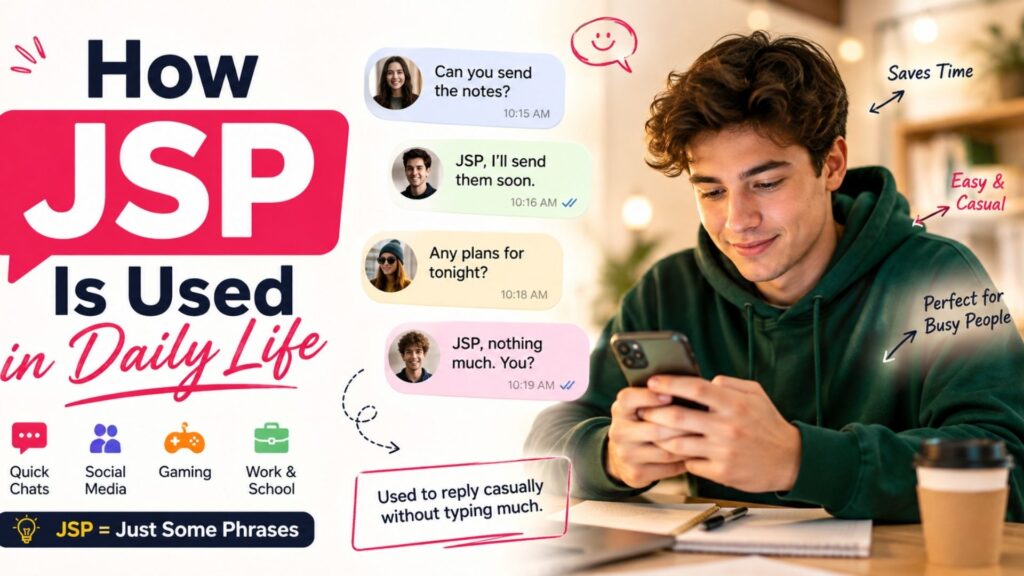
The way someone uses JSP depends heavily on the conversation.
In an everyday chat, it may be placed at the end of an opinion or request:
- “You should get some rest, JSP.”
- “Can you call me later, JSP?”
- “I think you’re overthinking it, JSP.”
- “That color looks better on you, JSP.”
- “You might want to check the time, JSP.”
In these examples, the writer may be trying to make their comment feel less forceful.
JSP can also appear in social-media conversations, direct messages, group chats, or informal comments. Because abbreviations are quick to type, they fit naturally into fast-moving conversations.
That said, JSP isn’t as universally recognized as abbreviations such as LOL, BTW, IDK, or JK. If you send it to someone who has never seen it before, they may not know what you mean.
That’s one reason context is so important.
Read More: What Does SU Mean in Text? Meaning, Uses & Examples
Emotional or Practical Meaning of JSP

Beyond the literal words behind an abbreviation, JSP can serve a practical purpose: it can influence tone.
Suppose someone says:
“You really need to stop staying up so late.”
That sounds fairly direct.
Now imagine:
“You really need to stop staying up so late, JSP.”
The second version may feel more casual, depending on the relationship between the people involved.
This is similar to adding phrases such as “just saying,” “no offense,” or “I mean.” The writer is giving the reader a clue about how they want the statement to be received.
Still, an abbreviation cannot magically make every statement polite. If the message itself is insulting or aggressive, adding JSP may not remove the negative tone.
For example:
“You’re impossible to talk to, JSP.”
That could easily sound sarcastic or passive-aggressive.
So, the emotional meaning comes from more than the abbreviation. Consider the words around it, punctuation, emojis, and the relationship between the people texting.
Similar or Related Terms
If you’re learning texting slang, several expressions can overlap with JSP depending on how the sender uses it.
| Term | Common meaning | Typical use |
|---|---|---|
| JS | Just saying | Adding an opinion or observation |
| JK | Just kidding | Showing that a statement was a joke |
| TBH | To be honest | Introducing an honest opinion |
| IMO | In my opinion | Sharing a personal viewpoint |
| FYI | For your information | Giving useful information |
| IDK | I don’t know | Showing uncertainty |
| LOL | Laughing out loud | Showing amusement |
The closest phrase to a “just saying” interpretation of JSP is JS. Meanwhile, JK has a different purpose because it specifically signals that the previous statement was a joke.
Another important related meaning appears in French texting. jsp is widely used as a shorthand for je sais pas, meaning “I don’t know.”
This is a good example of why you shouldn’t assume an abbreviation has one meaning everywhere.
Common Misunderstandings About JSP
Because JSP has multiple reported meanings, it’s easy to misread. Here are some of the most common misunderstandings.
1. It Always Means JavaServer Pages
Not necessarily.
If you see JSP in a programming tutorial or developer conversation, it may refer to the technical term JavaServer Pages. In an ordinary text message, however, a slang interpretation is much more likely.
The surrounding conversation tells you which meaning makes sense.
2. It’s Rude
JSP isn’t automatically rude.
When used to soften an opinion or request, the sender may actually be trying to sound more relaxed or polite. But tone depends on the complete message.
For example:
“Could you send that to me, JSP? 😊”
can feel friendly.
On the other hand:
“You never listen, JSP.”
could sound sarcastic.
So, don’t judge the abbreviation alone.
3. It’s Formal
No. When JSP is being used as texting slang, it belongs to casual digital communication.
You generally shouldn’t use an unexplained slang abbreviation like JSP in a formal email, academic assignment, job application, or professional report.
In those situations, simply write the full thought.
4. It Means “Just Say Please” Everywhere
No.
“Just Saying Please” is one reported interpretation, but it isn’t a universal definition. Other sources describe JSP as “Just Playing” or “Just Saying,” and French speakers may use jsp to mean je sais pas.
If someone sends you JSP and the meaning isn’t obvious, asking them what they mean is perfectly reasonable.
5. It’s Only Used by Teenagers
Not necessarily.
Internet abbreviations aren’t limited to one age group. Adults also use shortened expressions in texts, social media, gaming chats, and group conversations.
What matters more is whether the person and their audience are comfortable with informal online language.
6. It’s Passive-Aggressive
JSP can sound passive-aggressive in certain situations, but that’s not its automatic meaning.
For example:
“You could answer your messages once in a while, JSP.”
Depending on the relationship, that could be a playful reminder or a subtle complaint.
Compare that with:
“Could you send me the address, JSP?”
The second example is much more likely to be a casual request.
When interpreting JSP, always read the entire message instead of assigning an emotional meaning to the abbreviation by itself.
Examples of JSP in Sentences
Here are some natural examples showing how JSP might appear in casual communication:
- “Can you send me the address, JSP?”
- “You should probably charge your phone, JSP.”
- “I think you should give it another try, JSP.”
- “Maybe leave a little earlier tomorrow, JSP.”
- “You know you could have told me sooner, JSP.”
- “That outfit actually looks great on you, JSP.”
- “Can you save me a seat, JSP?”
- “You might want to check your email, JSP.”
- “I think you’re worrying too much, JSP.”
- “Call me when you’re free, JSP.”
Remember that these examples illustrate a possible English-language interpretation, not a fixed dictionary rule. If JSP appears in a French-language conversation, for instance, jsp may mean “I don’t know.”
How to Understand JSP From Context
When you see JSP, ask yourself three quick questions:
- What language is the conversation in?
- What does the sentence around JSP say?
- Does the tone sound like a request, joke, opinion, or uncertainty?
Those clues usually make the intended meaning much easier to identify.
Why Understanding JSP Meaning in Text Matters Today

Understanding abbreviations isn’t just about knowing internet slang. It can prevent unnecessary misunderstandings.
A three-letter abbreviation can change how you interpret an entire message. If you assume JSP means one thing when the sender intended another, you might respond in a completely different way.
For example, someone using French jsp may simply be saying “I don’t know.” If you interpret it as an English slang expression instead, the conversation can become confusing very quickly.
The same principle applies to many texting abbreviations. Digital communication removes facial expressions, gestures, and vocal tone, so context becomes especially important.
Knowing the possible meanings helps you read messages more accurately without immediately assuming that the sender is being rude, sarcastic, flirty, or serious.
And if the meaning still isn’t clear? Just ask.
A simple “What do you mean by JSP?” is often better than guessing.
FAQs:
What does jsp meaning in text mean in simple words?
In some casual English texting, JSP can mean “Just Saying Please” and may be used to soften a request or comment. However, JSP doesn’t have one universal meaning. It can also mean “Just Playing” or “Just Saying,” while French jsp commonly means “I don’t know.”
Is jsp positive or negative?
JSP can be neutral, friendly, playful, or even slightly sarcastic. Its emotional tone depends on the words surrounding it and the relationship between the people communicating.
Where is jsp commonly used?
JSP may appear in casual texts, DMs, social-media comments, group chats, and other informal online conversations. In French-language internet communication, lowercase jsp is also commonly used as an abbreviation for je sais pas.
Is jsp formal or informal?
When JSP is used as texting slang, it is informal. Avoid relying on it in professional emails, academic writing, or other formal communication.
Why do people search for jsp meaning in text?
People search for what does JSP mean in text because the abbreviation can have multiple meanings. The intended definition often depends on context, language, and the type of conversation.
Conclusion:
So, what does JSP mean in text? The answer isn’t completely universal.
In some casual English conversations, JSP can be interpreted as “Just Saying Please,” particularly when someone wants to soften a request or comment. Other English-language sources use JSP for “Just Playing” or “Just Saying.” In French texting, jsp has a well-established meaning: je sais pas, or “I don’t know.”
The safest approach is to look at the surrounding message before deciding what JSP means. Check the language, tone, and context. If you’re still unsure, simply ask the sender.
That small step can save you from turning three confusing letters into a much bigger misunderstanding.
