

Have you ever received a message containing “TMP” and paused because you weren’t sure what the sender meant? You’re not alone. Short texting abbreviations can save time, but they can also create confusion when the same three letters have different meanings.
When you search for TMP meaning in text, the tricky part is that TMP doesn’t have one universal definition in casual messaging. Its meaning depends on the conversation, the platform, and sometimes even the language being used. In some contexts, TMP may be shorthand for a phrase such as “tomorrow,” while in technical or professional settings, it can mean something completely different.
The best way to understand TMP is to look beyond the abbreviation itself. Let’s break down the possible meanings, common uses, examples, and misunderstandings so you can confidently figure out what someone means when they type “TMP.”
What Does TMP Mean?
TMP can have several meanings in text, so context is essential. Unlike common abbreviations such as LOL (“laughing out loud”) or IDK (“I don’t know”), TMP doesn’t have one widely accepted meaning across all texting communities.
In some informal conversations, people may use TMP as a shortened form of a word or phrase, particularly when they want to type quickly. In other cases, TMP may be an abbreviation specific to a particular group, workplace, game, app, or online community.
For example, if someone writes:
“I’ll send it TMP.”
you shouldn’t immediately assume what TMP means. The previous messages may reveal whether the sender is referring to tomorrow, a temporary arrangement, a technical term, or an inside abbreviation.
This is why searching TMP meaning in text without considering context can sometimes produce several competing answers.
Real-life examples:
Here are a few situations where TMP might appear:
“Can we finish this TMP?”
The meaning could depend entirely on what the conversation is about.
Another example:
“I’ll explain TMP when I get home.”
If TMP refers to a topic already discussed, it may simply be an abbreviation known to both people.
In a technical conversation, meanwhile, TMP could refer to a temporary file, temporary information, or another field-specific term.
The key lesson is simple: don’t interpret TMP in isolation. Read the complete message and the conversation around it.
Origin and Background of the Term
Unlike established texting abbreviations such as BRB or BTW, TMP doesn’t have one clearly established origin as a universal piece of internet slang.
Three-letter abbreviations naturally appear online because people constantly look for faster ways to communicate. A phrase that is repeatedly used inside a particular group can gradually become shortened. Once enough people understand the abbreviation, it becomes part of that community’s informal vocabulary.
TMP can also appear because people shorten words for convenience when texting. This is especially common in fast-moving chats, gaming communities, group messages, and social-media conversations.
However, there’s an important distinction between internet slang and technical abbreviations.
TMP has long been used in computing and other technical contexts to represent concepts involving “temporary” information. For example, you may encounter names such as .tmp files on a computer. That technical use doesn’t automatically apply when someone sends TMP in a casual text.
So, the origin and meaning depend heavily on where you encounter the abbreviation.
Read More: What Does JSP Mean in Text? Meaning, Uses & Examples
How TMP Is Used in Daily Life

In everyday texting, abbreviations usually appear when people want to communicate quickly without typing complete phrases.
You might see TMP in:
- Text messages
- Group chats
- Social-media comments
- Online forums
- Gaming chats
- Workplace messaging
- Technical conversations
- Private DMs
However, TMP isn’t nearly as standardized as many popular texting abbreviations. That means two people could use it differently.
For example, someone might use TMP as a personal shortcut that their friends understand. Another person might use the same letters because they belong to a particular online community.
This creates an important rule for texting slang:
Familiarity matters.
If everyone in a group understands TMP, the abbreviation works perfectly. If you send it to someone unfamiliar with it, they may have no idea what you’re talking about.
That’s why clear communication sometimes matters more than saving three keystrokes.
Emotional or Practical Meaning of TMP
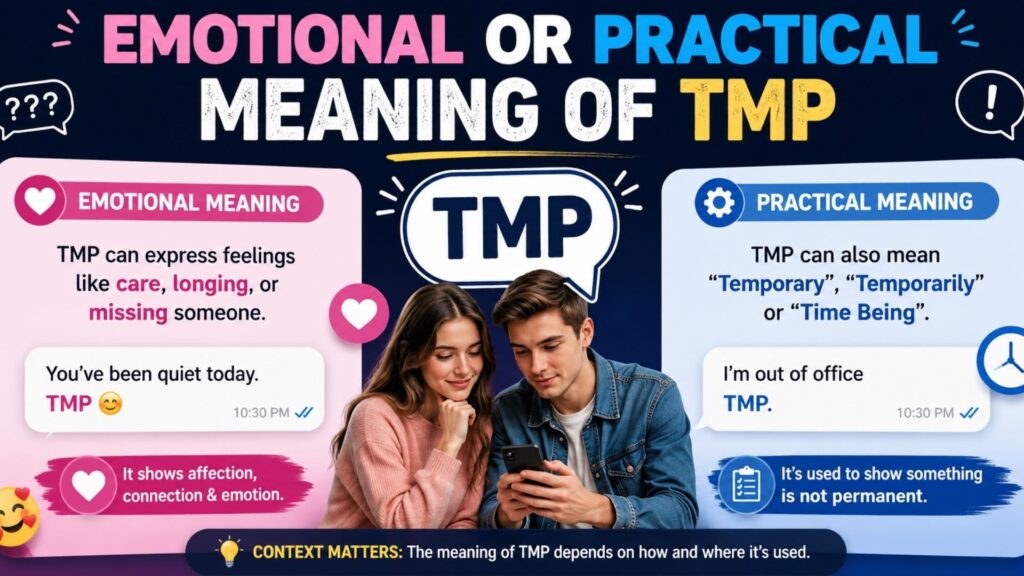
TMP usually doesn’t carry a specific emotional meaning by itself.
Unlike expressions such as “LOL,” which can signal amusement, or “OMG,” which can show surprise, TMP is generally dependent on the words around it.
Its practical purpose is usually more important than its emotional effect.
For instance, if TMP represents a particular topic or phrase within a conversation, it simply helps the sender type faster. The abbreviation itself doesn’t necessarily mean the sender is happy, annoyed, excited, sarcastic, or angry.
Still, context can change how a message feels.
Consider:
“Okay, TMP.”
and:
“Okay, TMP 😂”
The emoji can completely change the tone of the message even though the abbreviation stays the same.
This is a useful reminder when interpreting texting language: tone comes from the whole message, not just one abbreviation.
Similar or Related Terms
If you’re trying to understand TMP meaning in text, comparing it with more recognizable abbreviations can help.
| Abbreviation | Common meaning | Typical use |
|---|---|---|
| TMR | Tomorrow | Making plans |
| TM | Tomorrow or trademark, depending on context | Casual or general communication |
| BTW | By the way | Introducing another point |
| TBH | To be honest | Sharing an opinion |
| IDK | I don’t know | Showing uncertainty |
| IMO | In my opinion | Giving a viewpoint |
| FYI | For your information | Providing information |
| ASAP | As soon as possible | Showing urgency |
One especially useful comparison is TMR, which is commonly used as shorthand for “tomorrow” in informal messages.
For example:
“See you tmr.”
That meaning is usually much easier to identify than TMP.
If you see TMP in a similar sentence, don’t automatically replace it with “tomorrow.” Check the surrounding conversation first.
Common Misunderstandings About TMP
Because TMP can mean different things in different settings, several misunderstandings are common.
1. TMP Always Has One Meaning
It doesn’t.
This is probably the biggest mistake people make when searching for TMP meaning in text. Internet abbreviations aren’t always standardized. A person may use an abbreviation differently from the way another person uses it.
Context is your best clue.
2. TMP Is Always Texting Slang
Not necessarily.
TMP may appear in casual messaging, but it can also be a technical abbreviation. If you’re reading documentation, computer files, software instructions, or workplace material, the meaning may have nothing to do with texting slang.
3. TMP Is Automatically Related to Tomorrow
Some people may confuse TMP with abbreviations such as TMR or TM, which are commonly used for “tomorrow.”
But you shouldn’t assume TMP means tomorrow simply because the conversation involves future plans.
Look at the complete sentence first.
4. TMP Is a Formal Abbreviation
When used as casual internet slang, TMP is informal.
You shouldn’t use an unfamiliar texting abbreviation in a formal email, academic paper, official document, or professional application unless you know the intended audience understands it.
Writing the full phrase is usually clearer.
5. TMP Has a Universal Dictionary Definition
Texting slang doesn’t always work like standard vocabulary.
A dictionary may give established meanings for an acronym, but internet communities constantly create, adapt, and repurpose abbreviations. As a result, a slang definition can vary by region, platform, or social group.
6. You Should Guess Instead of Asking
There’s nothing wrong with asking.
If someone sends you:
“Let’s talk about TMP later.”
and you don’t know what TMP means, simply reply:
“What does TMP mean here?”
That’s often better than making an incorrect assumption.
Examples of TMP in Sentences
Because TMP can be context-dependent, examples should be treated as illustrations rather than proof of one universal definition.
Here are some natural situations where you might encounter the abbreviation:
- “What does TMP mean in this message?”
- “I saw TMP in the group chat and had no idea what it meant.”
- “Can you explain TMP to me?”
- “I keep seeing TMP online.”
- “Is TMP a texting abbreviation or something technical?”
- “She used TMP without explaining it.”
- “I had to ask what TMP meant.”
- “TMP seems to have a different meaning here.”
- “Check the earlier messages before interpreting TMP.”
- “I thought TMP meant one thing, but my friend meant something else.”
Notice how the surrounding sentence doesn’t automatically determine one fixed definition. That’s precisely why context matters when decoding unfamiliar texting abbreviations.
How to Figure Out TMP From Context
If someone sends you TMP and you’re confused, use this quick approach:
First, read the entire sentence. The words around the abbreviation may give you an immediate clue.
Next, check the previous messages. Sometimes the sender has already explained the subject.
Then, consider the platform. A gaming chat, work group, and personal text can use completely different shorthand.
Finally, ask if necessary. A quick clarification is better than a wrong interpretation.
Why Understanding TMP Matters Today

Digital communication moves quickly. People often type messages while working, commuting, gaming, studying, or talking with several people at once. Abbreviations make that easier, but they also create room for misunderstandings.
Understanding TMP meaning in text matters because the same letters can represent different things in different environments.
Imagine receiving a message from a coworker containing TMP. You might interpret it as slang when they’re actually referring to a technical term. Or you might see it in a casual conversation and assume it has a standard definition when the sender is using it as a personal abbreviation.
Knowing that abbreviations are context-dependent helps you avoid these mistakes.
It also makes online communication easier. Instead of treating every unfamiliar acronym as having one fixed answer, you learn to look for clues.
That’s a much more reliable way to understand texting language.
FAQs:
What does TMP mean in simple words?
TMP doesn’t have one universal meaning in texting. Its definition depends on the context, conversation, platform, and sometimes the community using it.
Is TMP positive or negative?
TMP is generally neutral by itself. Its emotional tone depends on the rest of the message and the situation in which it’s used.
Where is TMP commonly used?
TMP may appear in texts, DMs, group chats, online communities, gaming conversations, workplace messages, and technical contexts. Its meaning can vary between these settings.
Is TMP formal or informal?
When TMP is used as texting slang, it’s generally informal. For professional or formal communication, it’s better to use the complete phrase unless the abbreviation is already standard in that setting.
Why do people search for TMP?
People search for TMP meaning in text because the abbreviation can be ambiguous. Unlike very common texting terms such as LOL or BTW, TMP doesn’t have one universally recognized slang definition.
Conclusion:
So, what is the TMP meaning in text? The most important thing to remember is that TMP is context-dependent. It doesn’t have one universal texting definition that works in every conversation.
You may encounter TMP as informal shorthand in a chat, while a technical conversation could use the same letters for an entirely different concept. That’s why the surrounding words, platform, and subject matter are so important.
If you’re unsure what someone means, don’t overthink it. Read the conversation, look for clues, and ask the sender when necessary. In texting, a little context can turn a confusing three-letter abbreviation into a perfectly clear message.
