
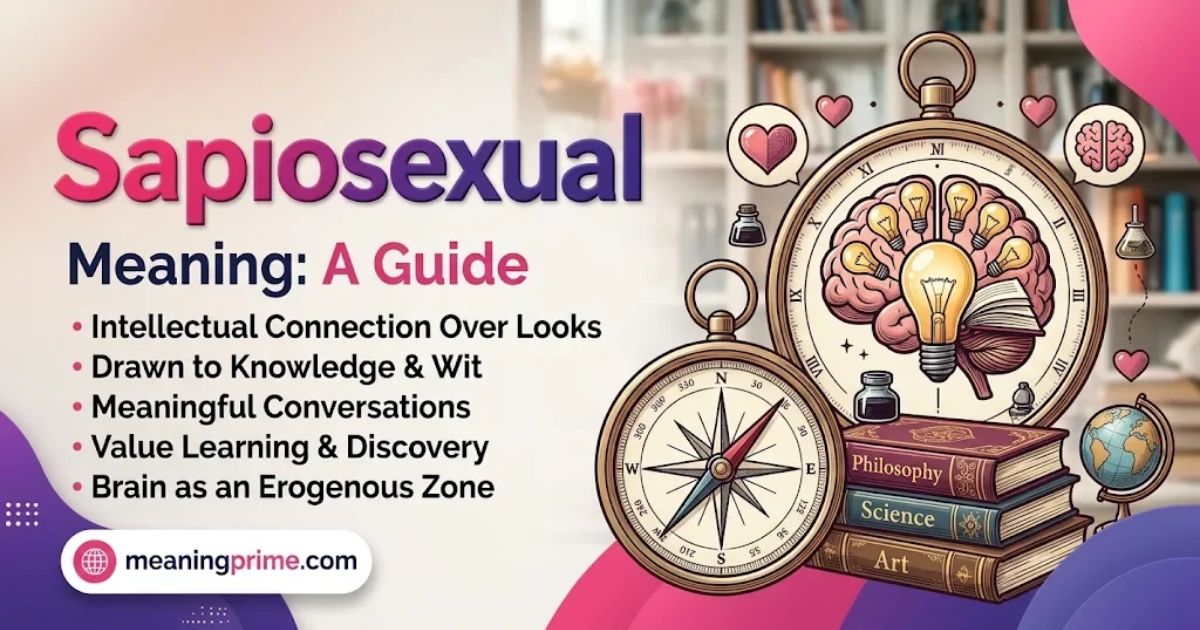
Have you ever found someone more attractive after having a deep, meaningful conversation with them? Maybe their intelligence, curiosity, or unique way of thinking caught your attention more than their physical appearance. If that sounds familiar, you might relate to the term sapiosexual.
Sapiosexual describes someone who experiences sexual or romantic attraction to intelligence. For these individuals, an interesting mind, thoughtful discussion, and intellectual connection can play an important role in attraction.
However, sapiosexuality isn’t simply about dating someone with excellent grades or a high IQ. It can involve curiosity, creativity, critical thinking, emotional insight, and the ability to discuss ideas openly.
The term has become more common in dating profiles, relationship discussions, and online conversations. Still, people often misunderstand what it actually means and how it differs from other forms of attraction.
In this guide, you’ll discover the sapiosexual meaning, common signs, real-life examples, differences from demisexuality, and what research says about attraction to intelligence.
What Does Sapiosexual Mean in Simple Words?
In simple words, a sapiosexual is someone who finds intelligence especially attractive. Their interest in another person may grow through meaningful conversations, thoughtful opinions, curiosity, and the way that person understands the world.
For example, imagine meeting two people. Both are physically attractive, but one starts an engaging conversation about science, art, history, or personal experiences. You become increasingly interested because of the way they think and communicate.
That experience may reflect sapiosexual attraction.
The important point is that intelligence itself can become a major source of attraction rather than just an additional attractive quality.
Is Sapiosexuality About Attraction to Intelligence?
Yes. Attraction to intelligence is the central idea behind sapiosexuality.
A sapiosexual person may feel drawn to someone who asks interesting questions, explains complicated ideas clearly, challenges assumptions, or shows genuine curiosity about the world.
However, intelligence doesn’t have to mean academic knowledge. Someone might find creativity, practical problem-solving, emotional understanding, or intellectual curiosity equally attractive.
For instance, a person who can discuss books, understand different perspectives, and approach problems thoughtfully may be more attractive to a sapiosexual than someone who simply memorizes facts.
It’s also important to remember that attraction is personal. Not every sapiosexual person values exactly the same intellectual qualities.
Does It Mean Intelligence Matters More Than Physical Appearance?
For many people who identify as sapiosexual, intelligence plays a more important role in attraction than physical appearance.
That doesn’t necessarily mean they ignore looks or never experience physical attraction. It simply means that someone’s mind may have a stronger influence on their romantic or sexual interest.
Consider this example:
You meet someone who looks attractive, but the conversation feels uncomfortable and uninteresting. Later, you meet another person whose appearance initially catches less of your attention, but their ideas, humor, and perspective make you want to spend more time with them.
A sapiosexual person may relate more strongly to the second experience.
In other words, intellectual connection can increase attraction in ways that appearance alone might not.
Does Sapiosexual Mean Being Attracted to High IQ?
No. Being sapiosexual doesn’t automatically mean you’re attracted to people with high IQ scores.
IQ tests measure certain cognitive abilities, such as reasoning and problem-solving. However, they don’t capture every quality that can make someone’s mind attractive.
For example, someone might be especially interested in a person who demonstrates:
- Creative thinking and imagination.
- Curiosity about unfamiliar subjects.
- Emotional intelligence and self-awareness.
- Strong communication skills.
- Open-mindedness and thoughtful reasoning.
- A genuine interest in learning new things.
- The ability to understand different perspectives.
A person doesn’t need an impressive academic background or an unusually high test score to be intellectually attractive.
In everyday relationships, the way someone thinks and interacts with others may matter much more than a number on a test.
Read More: Rabe Meaning: What Does Rabe Mean in Texting and Social Media?
What Is a Sapiosexual Person?
A sapiosexual person is someone who experiences attraction to intelligence as an important part of their romantic or sexual preferences.
They may enjoy conversations that explore complicated topics, exchange different opinions, or introduce them to new ideas.
For example, a sapiosexual might become interested in someone after discussing philosophy, technology, literature, psychology, or an interesting personal experience.
However, being sapiosexual doesn’t mean someone spends every conversation discussing serious subjects. Humor, playful arguments, curiosity, and everyday discussions can also create intellectual attraction.
It’s about finding another person’s way of thinking appealing, not constantly trying to have the deepest conversation in the room.
Where Does the Word Sapiosexual Come From?
The word sapiosexual combines two linguistic elements.
- Sapio: Comes from the Latin verb sapere, meaning to be wise or to have good sense.
- Sexual: Relates to sexual attraction.
Together, the word describes someone who experiences attraction connected to intelligence or wisdom.
The term became more visible through online dating culture, social media discussions, and conversations about different types of attraction.
People began using it to explain why intellectual connection could influence their interest in a potential romantic partner.
Although the word sounds scientific, identifying as sapiosexual isn’t a medical diagnosis or a formal psychological classification.
How Do You Pronounce Sapiosexual?
Sapiosexual is generally pronounced say-pee-oh-SEK-shoo-uhl.
It contains five syllables, with the strongest emphasis on the fourth syllable. The word may look complicated at first, but its pronunciation becomes easier when you break it into smaller parts.
You might hear it in conversations such as:
- “I think I’m sapiosexual.”
- “Intelligence is attractive to me.”
- “I’m more interested in someone’s mind than their appearance.”
Sapiosexual Meaning in Urdu, Arabic, and Spanish
The word sapiosexual doesn’t have one universally established translation in every language. It’s often explained through phrases that describe attraction to intelligence.
In Urdu:
Sapiosexual means:
- ذہانت سے کشش محسوس کرنے والا شخص
- ایسا شخص جو کسی کی ذہانت اور سوچ سے متاثر ہو
In simple Urdu, it describes someone who finds another person’s intelligence, understanding, and way of thinking attractive.
In Arabic:
Possible explanations include:
- الانجذاب إلى الذكاء (Attraction to intelligence).
- شخص ينجذب إلى ذكاء الآخرين (A person attracted to other people’s intelligence).
In simple terms, it describes someone whose attraction is strongly influenced by another person’s intelligence and intellectual qualities.
In Spanish:
The term is sapiosexual.
A simple explanation is:
- Atracción por la inteligencia.
- Persona que siente atracción por la inteligencia de los demás.
For example, “Me atrae la inteligencia” means “I’m attracted to intelligence.”
Across all three languages, the central idea remains the same: someone’s mind and intellectual qualities can be a major source of attraction.
What Does Sapiosexual Attraction Actually Feel Like?
Sapiosexual attraction can feel like becoming increasingly interested in someone because of their thoughts, ideas, and perspective.
Instead of being drawn to someone only because of their appearance, you might find yourself wanting to spend more time with them after an interesting conversation.
You may remember something they said, look forward to hearing their opinions, or feel excited when they introduce you to a new subject.
Why Can Deep Conversations Create Attraction?
Deep conversations can create attraction because they allow people to discover qualities that aren’t immediately visible.
A casual conversation might tell you someone’s favorite food or movie. A deeper discussion can reveal their values, curiosity, creativity, sense of humor, and approach to difficult situations.
For someone who values intellectual connection, these discoveries can make another person increasingly appealing.
Imagine discussing a topic you’re passionate about with someone who listens carefully, asks thoughtful questions, and introduces a perspective you hadn’t considered.
The conversation feels engaging because both people contribute something meaningful.
That experience can create a sense of connection that goes beyond ordinary small talk.
However, deep conversations aren’t automatically attractive to everyone. What matters is whether the discussion feels interesting, comfortable, and mutually engaging.
Why Can Someone Become More Attractive as You Discover Their Mind?
Attraction doesn’t always happen instantly. Sometimes, it develops as you learn more about someone’s personality.
A person might initially seem like an ordinary acquaintance. But after several conversations, you discover that they’re thoughtful, creative, knowledgeable, or surprisingly funny.
Your perception of them changes.
For example, someone might explain a complicated subject in a simple way, share an unusual idea, or demonstrate remarkable patience when discussing different opinions.
These qualities can make you appreciate them more deeply.
For sapiosexual individuals, intellectual qualities may play a particularly important role in this process. The more they discover about someone’s mind, the stronger their attraction may become.
Can Physical Attraction and Sapiosexual Attraction Happen Together?
Absolutely. Physical attraction and sapiosexual attraction aren’t mutually exclusive.
A person can appreciate someone’s appearance while also being attracted to their intelligence, personality, and communication style.
For example, you might initially notice someone’s smile or style. After talking with them, you discover that they have an interesting perspective, a curious mind, and a great sense of humor.
Both physical and intellectual attraction can contribute to your interest.
Some sapiosexual individuals may prioritize intelligence, while others experience a combination of different attractions.
There isn’t one universal pattern that everyone must follow.
What Are Some Sapiosexual Examples in Real Life?
Real-life examples make the concept easier to understand. Here are several situations that illustrate how sapiosexual attraction might appear.
Example 1: Attraction Through Conversation
You meet someone at a social event. Instead of discussing ordinary topics, they start an interesting conversation about psychology, human behavior, or personal development.
You become interested because you enjoy the way they think.
Example 2: Intelligence Creates Interest
You work with someone who explains complicated problems clearly. You admire their reasoning, patience, and ability to understand different perspectives.
Over time, you develop a personal attraction.
Example 3: Curiosity Becomes Attractive
Someone you’re getting to know constantly explores new subjects. They enjoy learning, ask thoughtful questions, and aren’t afraid to admit when they don’t know something.
Their curiosity makes them increasingly appealing.
Example 4: A Meaningful Debate
You disagree with someone about a particular topic. Instead of becoming defensive, they explain their perspective respectfully and listen to yours.
You find their open-mindedness and reasoning attractive.
Example 5: Intellectual Connection Over Appearance
You meet someone who isn’t initially your usual physical type. However, their humor, creativity, and thoughtful conversations make you look forward to seeing them again.
These examples show that sapiosexual attraction can develop through everyday interactions rather than only formal intellectual discussions.
Am I Sapiosexual? Signs That Intelligence Drives Your Attraction
Wondering whether you’re sapiosexual? The easiest way to explore this is to look at what consistently attracts you to other people.
You might notice that physical appearance catches your attention initially, but meaningful conversations make you genuinely interested. Perhaps you enjoy discussing complicated ideas, learning from others, or spending time with people who challenge your thinking.
These experiences don’t automatically mean you’re sapiosexual. However, if intellectual qualities repeatedly play a central role in your attraction, the label might describe your preferences.
You Become More Attracted After Discovering How Someone Thinks
One possible sign of sapiosexuality is that your attraction grows as you discover someone’s personality and thought process.
You might not feel an immediate romantic connection when meeting someone. However, after hearing their opinions, understanding their perspective, and seeing how they approach different situations, you begin to find them more attractive.
For example, imagine working with someone who initially seems like an ordinary colleague. During a project, you discover that they approach problems creatively, explain ideas clearly, and remain thoughtful under pressure.
Suddenly, you look forward to conversations with them.
For someone who identifies as sapiosexual, this kind of intellectual discovery can be an important part of attraction.
Intellectual Curiosity Makes Someone More Attractive to You
Curiosity can be an attractive quality because it shows that someone enjoys exploring ideas rather than simply accepting everything they hear.
You might feel drawn to people who ask thoughtful questions, read about unfamiliar subjects, explore different cultures, or enjoy learning new skills.
For example, someone who says, “I’ve never thought about it that way. Can you explain more?” might be more appealing to you than someone who acts like they already know everything.
Intellectual curiosity also creates opportunities for interesting conversations. You can exchange ideas, learn from each other, and discover new interests together.
For many sapiosexual individuals, that shared desire to understand the world can make a connection particularly exciting.
Shallow or Unengaging Conversation Can Reduce Your Interest
Another possible sign is that your attraction decreases when conversations consistently feel shallow or repetitive.
You might enjoy casual chatting occasionally, but you also want discussions that go beyond basic introductions and everyday updates.
For example, you may lose interest when someone constantly talks about themselves without showing curiosity about your thoughts.
However, this doesn’t mean every conversation needs to be serious. Talking about food, music, movies, or funny experiences can still be enjoyable.
The difference is that you appreciate conversations where both people contribute, exchange ideas, and show genuine interest.
It’s also worth remembering that someone being quiet, nervous, or less talkative doesn’t mean they’re unintelligent. People communicate differently, and a person’s intellectual qualities aren’t always immediately obvious.
You Care About How Someone Thinks, Not Just What They Know
Sapiosexual attraction isn’t necessarily about finding someone who knows hundreds of facts.
You may care more about how someone uses their knowledge, processes information, and approaches unfamiliar situations.
For example, two people might know the same amount about a particular subject. However, one explains ideas clearly, considers alternative viewpoints, and admits when they’re uncertain.
You might find that person’s approach more attractive.
Qualities you may appreciate include:
- Critical thinking and logical reasoning.
- Creativity and original ideas.
- Open-mindedness and curiosity.
- Emotional awareness and self-reflection.
- A willingness to learn from mistakes.
- The ability to communicate complex thoughts clearly.
In other words, intellectual attraction often involves the process of thinking, not simply the amount of information someone possesses.
Intellectual Connection Feels Necessary, Not Just Enjoyable
Many people enjoy intelligent conversations, but someone who identifies as sapiosexual may consider intellectual connection an important part of romantic or sexual attraction.
You might struggle to develop a deeper interest in someone if you don’t feel mentally stimulated by your interactions.
For example, you may find someone attractive initially but realize that your conversations never develop beyond surface-level topics. Even if other qualities are appealing, you might not feel the connection you’re looking for.
On the other hand, meeting someone who shares your curiosity and enjoys thoughtful discussions can make you feel much more connected.
The distinction is consistency. Enjoying an occasional interesting conversation doesn’t necessarily make you sapiosexual. It’s more about whether intelligence repeatedly influences your attraction.
Sapiosexual Meaning vs. Demisexual and Sapiophile: What’s the Difference?
Sapiosexual, demisexual, and sapiophile are sometimes used interchangeably in online conversations. However, they describe different ideas.
Understanding the differences can help you choose the term that best reflects your experience.
Sapiosexual and Demisexual Meaning: Key Differences
The main difference between sapiosexuality and demisexuality is what influences attraction.
A sapiosexual person experiences attraction strongly connected to intelligence. A demisexual person typically experiences sexual attraction only after developing a strong emotional connection with someone.
These experiences can overlap, but they aren’t the same.
For example, imagine someone who becomes attracted to a person after having several intellectually stimulating conversations. Their interest develops because they find the person’s mind attractive.
That may reflect sapiosexual attraction.
Now imagine someone who doesn’t experience sexual attraction until they develop emotional trust and a meaningful personal bond. That describes the central idea of demisexuality.
Here’s a simple comparison:
| Feature | Sapiosexual | Demisexual |
|---|---|---|
| Main connection | Intelligence | Emotional bond |
| Attraction develops through | Intellectual qualities | Strong emotional connection |
| Important factor | Thinking and curiosity | Trust and emotional closeness |
| Deep conversations | Can create attraction | May help build emotional closeness |
| Physical attraction | Can occur alongside intellectual attraction | Sexual attraction generally follows emotional connection |
| Main focus | What attracts someone | When sexual attraction develops |
Someone can identify as both sapiosexual and demisexual if both descriptions reflect their experience.
For example, they might need an emotional connection before experiencing sexual attraction while also finding intelligence especially attractive.
Sapiosexual vs. “I Just Like Smart People”
This is an important distinction because liking intelligent people doesn’t automatically make someone sapiosexual.
Most people appreciate qualities such as curiosity, knowledge, good communication, and problem-solving abilities in a potential partner.
However, sapiosexuality describes a more specific pattern in which intelligence is a particularly important source of sexual or romantic attraction.
Consider these two situations:
Person A: Likes dating intelligent people because they believe intelligence is a valuable relationship quality. However, they feel attraction for many other reasons.
Person B: Finds intellectual qualities central to their attraction. Meaningful discussions and the way someone thinks can strongly influence whether romantic or sexual interest develops.
Person A simply has a preference for intelligence. Person B might identify as sapiosexual.
There’s no need to force a label onto ordinary preferences. What matters is whether the term genuinely describes your experience.
How Does Sapiosexuality Affect Dating and Relationships?
Sapiosexuality can influence what someone looks for when dating and how they develop romantic connections.
For people who strongly value intellectual attraction, meaningful conversations may be just as important as shared interests, physical chemistry, and emotional connection.
This doesn’t mean every sapiosexual relationship follows the same pattern. People have different personalities, communication styles, and relationship expectations.
Sapiosexual Meaning in Love: Do Sapiosexuals Fall in Love?
Yes. Sapiosexual people can fall in love just like anyone else.
Their attraction may begin with someone’s intelligence, but lasting love usually involves more than intellectual compatibility.
For example, you might initially become interested in someone because of their thoughtful opinions and interesting conversations. As the relationship develops, you discover their kindness, emotional availability, humor, and reliability.
These qualities can turn an intellectual connection into a deeper romantic relationship.
Sapiosexual attraction describes one part of what makes someone appealing. It doesn’t determine how they experience commitment, affection, trust, or love.
How Do Sapiosexuals Flirt?
Sapiosexual flirting often involves conversation, curiosity, humor, and the exchange of ideas.
Instead of relying entirely on appearance-based compliments, someone might show interest by asking thoughtful questions or discussing subjects the other person enjoys.
For example:
- “I really like the way you think about things.”
- “That’s an interesting perspective. How did you come to that conclusion?”
- “I could talk about this with you for hours.”
- “You always make me think about things differently.”
- “I love how curious you are about everything.”
These expressions show appreciation for someone’s mind and personality.
However, sapiosexual flirting isn’t limited to serious discussions. Playful debates, clever jokes, funny observations, and intellectual humor can also create attraction.
The goal isn’t to prove who’s smarter. It’s to enjoy connecting with another person.
Can a Sapiosexual Date Someone Who Is Not Sapiosexual?
Absolutely. Two people don’t need to share the same attraction labels to build a successful relationship.
A sapiosexual person can date someone who doesn’t identify with the term but still enjoys meaningful conversations and values intellectual compatibility.
For example, one partner might consider intelligence a major source of attraction, while the other values kindness, emotional security, and shared experiences more strongly.
These differences don’t automatically create problems.
What matters is whether both people understand each other’s preferences and make an effort to connect.
A healthy relationship doesn’t require identical personalities. It requires mutual respect, communication, and compatible expectations.
What Happens When Intellectual Compatibility Is Missing?
If intellectual connection is particularly important to you, its absence might make a relationship feel less satisfying.
You may feel that conversations lack depth or that you can’t comfortably share your interests and ideas.
For example, you might enjoy discussing books, science, technology, or personal growth, while your partner rarely shows interest in those subjects.
Over time, you could begin feeling disconnected.
However, intellectual compatibility doesn’t mean having identical interests. Two people can enjoy completely different subjects while still respecting each other’s curiosity and learning from one another.
The real issue is usually a lack of mutual engagement rather than a difference in knowledge.
Why Intelligence Alone Does Not Guarantee Relationship Compatibility
Being attracted to someone’s intelligence doesn’t automatically mean you’re compatible as partners.
A person might be extremely knowledgeable but struggle with honesty, empathy, communication, or emotional responsibility.
Similarly, two people can enjoy fascinating conversations but disagree about important relationship expectations.
Long-term compatibility also involves:
- Shared or compatible values.
- Emotional maturity.
- Trust and honesty.
- Respect for personal boundaries.
- Similar expectations about commitment.
- Conflict-resolution skills.
- Mutual support and reliability.
For example, you might admire someone’s intelligence but discover that they dismiss your opinions or refuse to take responsibility for their mistakes.
Their knowledge doesn’t cancel out those problems.
A satisfying relationship needs more than intellectual chemistry.
How Emotional Compatibility, Values, and Respect Still Matter
Intellectual attraction can help bring people together, but emotional compatibility helps create a stable relationship.
You need to feel comfortable expressing your feelings, discussing difficult experiences, and being yourself without constantly worrying about judgment.
Shared values also matter. Two people don’t have to agree on every subject, but they should respect important differences and understand what matters to each other.
Respect is equally important.
A genuinely intelligent partner should be willing to listen, recognize mistakes, and appreciate that other people have valuable perspectives.
The strongest connections often combine intellectual curiosity with emotional understanding, kindness, and mutual respect.
How Can You Talk About It With a Partner?
If sapiosexuality describes an important part of your attraction, explaining it to your partner can help them understand what makes you feel connected.
You don’t need to introduce the term formally or turn it into a complicated conversation.
Instead, explain your preferences using everyday language.
For example:
- “I really enjoy meaningful conversations.”
- “I feel closer to someone when we can exchange ideas openly.”
- “Your curiosity is one of the things I find attractive.”
- “I love learning new things from you.”
- “Intellectual connection is important to me in a relationship.”
You can also ask your partner what makes them feel appreciated and connected.
The goal isn’t to make them prove their intelligence. It’s to understand how both of you experience attraction and connection.
Is Sapiosexuality an Orientation, a Preference, or Something Else?
One of the most common questions about sapiosexuality is whether it should be considered a sexual orientation or simply a personal preference.
There isn’t universal agreement on this. Some people use sapiosexual as an identity label because intelligence plays a central role in their attraction. Others consider it a description of what they find appealing in potential partners.
Understanding this distinction helps explain why people discuss the term differently.
Sapiosexual Meaning in the LGBTQ+ Context
Sapiosexuality sometimes appears in LGBTQ+ discussions because it describes a particular aspect of attraction.
Some people include it in their personal identity descriptions or use it alongside other labels. For example, someone might identify as bisexual and sapiosexual, explaining both the genders they’re attracted to and the importance of intelligence in their attraction.
However, sapiosexuality isn’t universally recognized as a standalone sexual orientation within LGBTQ+ communities.
A useful distinction is that traditional sexual orientation labels generally describe patterns of attraction in relation to gender, while sapiosexuality describes a quality that someone finds attractive.
These labels can serve different purposes, and people don’t have to use every available term to explain their identities.
Sapiosexual Woman and Sapiosexual Man Meaning: Does Gender Matter?
No. Sapiosexuality isn’t limited to a particular gender.
A sapiosexual woman is a woman who finds intelligence especially attractive. A sapiosexual man is a man who experiences a similar pattern of attraction.
The meaning doesn’t change based on gender.
For example:
- A woman might become attracted to someone because of their creativity and thoughtful conversations.
- A man might find someone’s curiosity and ability to discuss different ideas particularly appealing.
- A nonbinary person might describe intellectual connection as an important part of their attraction.
Anyone can identify as sapiosexual if the term accurately reflects their experience.
The important factor is what someone finds attractive, not their gender.
What Are the Common Criticisms and Misconceptions About Sapiosexuality?
Although many people use sapiosexual as a helpful description of their attraction, the term has also attracted criticism.
Some people question whether intelligence should be treated as a separate attraction label. Others worry that the word can unintentionally suggest that people with certain educational backgrounds, communication styles, or cognitive abilities are more valuable than others.
These discussions are worth understanding because attraction is personal, but language can also carry social assumptions.
Does Being Sapiosexual Mean You Think You Are Better Than Others?
No. Identifying as sapiosexual doesn’t automatically mean someone considers themselves more intelligent or superior to other people.
It simply describes a particular attraction preference.
However, the term can sometimes sound like a way of presenting oneself as unusually intellectual, especially when it’s used to suggest that ordinary conversations or people with different interests are somehow less valuable.
For example, saying “I only date intelligent people because everyone else is boring” can come across as dismissive.
A more respectful way to express the same preference would be:
“I value intellectual connection and enjoy being with people who are curious and thoughtful.”
This communicates what attracts you without insulting people who have different strengths or interests.
Why Can the Label Be Criticized as Elitist or Ableist?
One criticism of sapiosexuality is that it can unintentionally create a hierarchy in which certain forms of intelligence are treated as more desirable or valuable than others.
For example, someone might associate intelligence exclusively with university degrees, advanced vocabulary, academic achievements, or high IQ scores.
That narrow definition ignores many other ways people think, communicate, create, and understand the world.
The term can also raise ableism concerns if someone assumes that neurodivergent people or people with intellectual disabilities cannot be intelligent, interesting, or attractive.
These assumptions are inaccurate and unfair.
Intelligence is complex, and people demonstrate their abilities in different ways. Someone may have exceptional creative, practical, emotional, or problem-solving skills without fitting traditional academic expectations.
Identifying as sapiosexual doesn’t require judging another person’s worth or using one narrow standard of intelligence.
The most respectful approach is to recognize intellectual attraction as a personal preference while respecting human differences.
Why IQ, Education, and Intelligence Are Not the Same Thing
These three concepts are related, but they shouldn’t be treated as interchangeable.
IQ: An intelligence quotient score comes from standardized assessments designed to measure particular cognitive abilities.
Education: Education refers to formal or informal learning through schools, universities, training, and personal study.
Intelligence: Intelligence is a broader concept involving different abilities, including reasoning, learning, problem-solving, and understanding information.
For example, someone without a university degree may be an excellent critical thinker. Another person with advanced academic qualifications might struggle with practical problem-solving or understanding other people’s perspectives.
Neither situation tells you everything about someone’s overall intelligence.
This distinction matters when discussing sapiosexuality because attraction to intelligence isn’t necessarily attraction to academic qualifications or test results.
You can appreciate someone’s thoughtful personality without knowing their educational background or IQ.
What Does Research Actually Say About Sapiosexuality?
Sapiosexuality is more than a popular dating term, but the scientific evidence is still limited.
Researchers have explored whether intelligence influences sexual attraction and whether sapiosexuality can be measured as an individual psychological trait.
One particularly relevant study appeared in the academic journal Intelligence in 2018.
Its findings offer useful insights, although they shouldn’t be treated as a complete explanation of human attraction.
What Research Has Found About Attraction to Intelligence
A 2018 study by Gilles E. Gignac, Joey Darbyshire, and Michelle Ooi examined sexual attraction to intelligence and developed a measure called the Sapiosexuality Questionnaire (SapioQ).
The research involved 383 participants and explored how different levels of intelligence influenced attraction and interest in a potential long-term partner.
Some notable findings included:
- Participants, on average, rated intelligence around the 90th percentile (approximately IQ 120) as especially desirable.
- The researchers found that a small proportion of participants showed particularly strong sapiosexuality scores.
- Approximately 8.1% scored above 4.0 on the five-point SapioQ scale.
- The study suggested that attraction to intelligence may be a measurable individual difference.
- Participants’ own objective intelligence scores did not show a meaningful positive relationship with their sapiosexuality scores.
The researchers concluded that sapiosexuality may represent a genuine psychological construct, although other factors besides intellectual ability appear to influence it.
It’s important to understand that this was one study with a specific sample, not proof that every person experiences attraction in the same way.ScienceDirect+1
Does Sapiosexuality Mean Having a High IQ?
No. Research doesn’t establish that sapiosexual people have higher IQ scores than everyone else.
In fact, the 2018 Gignac study found virtually no correlation between participants’ measured intelligence and their SapioQ scores.
This means that being attracted to intelligence doesn’t automatically tell you how intelligent someone is.
Think about it this way: someone can appreciate beautiful music without being a professional musician. Similarly, someone can find intelligence attractive without having an unusually high IQ.
Your attraction preferences and your own cognitive abilities are two different things.
It’s also worth remembering that IQ tests don’t measure every quality people might find intellectually attractive.
What Current Research Cannot Tell Us
Although the 2018 study provides a useful starting point, there are still important limitations.
Research on sapiosexuality remains relatively limited compared with research on broader relationship and attraction patterns.
Current evidence doesn’t establish:
- How common sapiosexuality is across all populations.
- Whether sapiosexuality is a distinct sexual orientation.
- Whether everyone experiences intellectual attraction in the same way.
- Whether attraction to intelligence remains consistent throughout life.
- Whether specific types of intelligence create stronger attraction than others in everyday relationships.
- Whether the SapioQ captures every possible form of intellectual attraction.
The study also relied on a particular research sample and questionnaire, so its findings shouldn’t be generalized to every culture or relationship.
The safest conclusion is that attraction to intelligence is a real experience for some people, but the terminology and psychological classification are still open to discussion.
Does the Sapiosexual Label Fit You?
You don’t need to take a test or meet a particular set of requirements to decide whether sapiosexual describes your experience.
The label is simply a way to communicate what influences your attraction. If intellectual qualities consistently play an important role in your romantic or sexual interest, it might be useful.
Here are a few ways to think about it.
Ask What Actually Drives Your Attraction
Start by considering what makes you interested in someone beyond their appearance.
Do you enjoy someone’s personality because they’re funny, thoughtful, curious, or knowledgeable? Does a meaningful conversation make you feel more attracted to them?
Ask yourself:
- Do I find intellectual curiosity especially attractive?
- Do thoughtful conversations increase my romantic interest?
- Do I enjoy exchanging ideas with potential partners?
- Does someone’s way of thinking influence my attraction?
- Do I struggle to develop interest without intellectual connection?
Your answers can help you understand your preferences.
There are no correct or incorrect answers. Attraction is personal, and different qualities matter to different people.
Look for a Consistent Pattern, Not One Experience
One interesting conversation doesn’t automatically make you sapiosexual.
You might meet someone intelligent and find them attractive without consistently prioritizing intelligence in your relationships.
Instead, look at your experiences over time.
For example, if you repeatedly become more interested in people because of their curiosity, communication, creativity, and intellectual depth, that may suggest a consistent pattern.
Consider your dating experiences, past relationships, and the qualities that have made people especially attractive to you.
A recurring preference is more meaningful than a single interaction.
Decide Whether the Label Helps You Describe Your Experience
Labels can make it easier to explain personal preferences, but you don’t have to use one.
If sapiosexual helps you communicate why intellectual connection matters in your relationships, feel free to use it.
If you prefer saying, “I love intelligent and curious people,” that’s equally valid.
You also don’t need to announce the label publicly or include it in your dating profile.
The purpose of understanding sapiosexuality is to recognize what makes you feel attracted and connected, not to fit yourself into a category.
Frequently Asked Questions
Can Sapiosexuality Change Over Time?
Yes. Attraction preferences can change as people gain new experiences, develop different priorities, and understand themselves better. Someone who strongly values intellectual attraction at one stage of life might later place greater emphasis on emotional compatibility or other qualities. However, some people experience a consistent preference for intelligence throughout their lives.
Is Sapiosexuality a Real Thing?
Yes, attraction to intelligence is a genuine experience reported by some people. Research published in 2018 also explored sapiosexuality as a measurable psychological construct. However, its classification as a distinct sexual orientation remains debated.
Is Sapiosexuality a Medical or Psychological Diagnosis?
No. Sapiosexuality isn’t a recognized medical or mental health diagnosis. It’s an informal identity or preference label used to describe attraction to intelligence. You don’t need a professional assessment to use the term.
Is Sapiosexual the Same as Sapiophile?
The terms are closely related. Both describe someone who is attracted to intelligence or intelligent people. Sapiosexual is commonly used to describe sexual or romantic attraction, while sapiophile is another term for someone who loves or is attracted to intelligence. Dictionaries sometimes list them as related terms or alternatives.
Can Someone Identify as Sapiosexual Without Using the Label Publicly?
Absolutely. You can experience sapiosexual attraction without identifying publicly as sapiosexual. Some people prefer to describe their preferences privately or simply say that intelligence and meaningful conversations are important to them. Using a label is a personal choice, not a requirement.
Conclusion
Understanding the sapiosexual meaning helps explain why intelligence can play such an important role in attraction. For some people, an interesting mind, intellectual curiosity, and meaningful conversations create a connection that goes beyond physical appearance.
Being sapiosexual doesn’t necessarily mean having a high IQ, collecting academic qualifications, or avoiding physical attraction. It simply describes a preference in which intelligence is an especially appealing quality.
If you regularly find yourself attracted to someone’s thoughts, curiosity, creativity, and way of understanding the world, the term might describe your experience.
Ultimately, intelligence can create attraction, but lasting relationships also need kindness, trust, emotional compatibility, and mutual respect. A genuinely meaningful connection makes room for all these qualities.
