
Have you ever received a text that simply says “SU” and wondered what the person was trying to say? Short abbreviations can be surprisingly confusing because the same two letters can mean different things depending on the conversation.
When people ask what does SU mean in text, there isn’t one universal answer. In casual texting, SU can mean “Shut Up,” “See You,” or, in some contexts, “Swipe Up.” The intended meaning usually becomes clear from the surrounding words and the relationship between the people chatting.
For example, if a friend says, “SU 😂, you did not just say that,” they probably mean “Shut Up” in a playful way. On the other hand, “SU tomorrow” could mean “See you tomorrow.”
That’s why context matters. Let’s look at the most common meanings of SU, how people use it, and how to tell which meaning fits a particular conversation.
What Does SU Meaning in Text?
The most common meaning of SU in text is “Shut Up.” However, it can also stand for other phrases, especially “See You.”
The meaning depends on how SU appears in the message.
| SU meaning | Example | Likely meaning |
|---|---|---|
| Shut Up | “SU 😂, no way!” | Playful disbelief or surprise |
| See You | “Okay, SU tomorrow.” | See you later |
| Swipe Up | “SU for the link.” | Swipe up to access something |
| Other/context-specific meaning | Depends on conversation | Ask if unclear |
When SU means “Shut Up,” it doesn’t always carry an angry tone. Friends often use it jokingly to express surprise, disbelief, embarrassment, or excitement.
For example:
“SU 😂 You actually met him?”
Here, the person probably isn’t telling their friend to stop talking. They’re reacting with playful disbelief.
By contrast:
“I have to go now. SU later.”
could be intended as “See you later,” although “CU” or simply “see you” is more common and clearer.
Because abbreviations can be ambiguous, you should always consider the sentence before deciding what SU means.
Real-Life Examples:
Imagine your friend sends:
“SU 😂 You actually bought that?”
In this context, SU most likely means “Shut Up.” The laughing emoji suggests that the message is playful rather than aggressive.
Another example:
“I’m heading home. SU tomorrow!”
Here, the context suggests “See you tomorrow.”
Now consider:
“SU for the discount code.”
If the conversation is about social media or an online post, SU may refer to “Swipe Up.”
These examples show why looking at the entire message is more useful than memorizing one definition.
Origin and Background of the Term
SU developed as part of the broader culture of internet slang and text-message abbreviations. As people began communicating through SMS, instant messaging, social media, and online communities, shorter expressions became popular.
“Shut up” is a particularly common phrase in casual conversation, so shortening it to SU can save typing time. However, the abbreviation can also represent phrases such as “See you,” depending on the context.
The rise of social media added another possible use: “Swipe Up.” This expression became associated with social media features that allowed users to access a linked webpage by swiping upward.
Because abbreviations evolve naturally within different online communities, there isn’t always one fixed definition. A person’s age, platform, friend group, and conversation topic can influence which meaning they intend.
That’s why SU doesn’t have one universal meaning in texting.
How SU Is Used in Daily Life
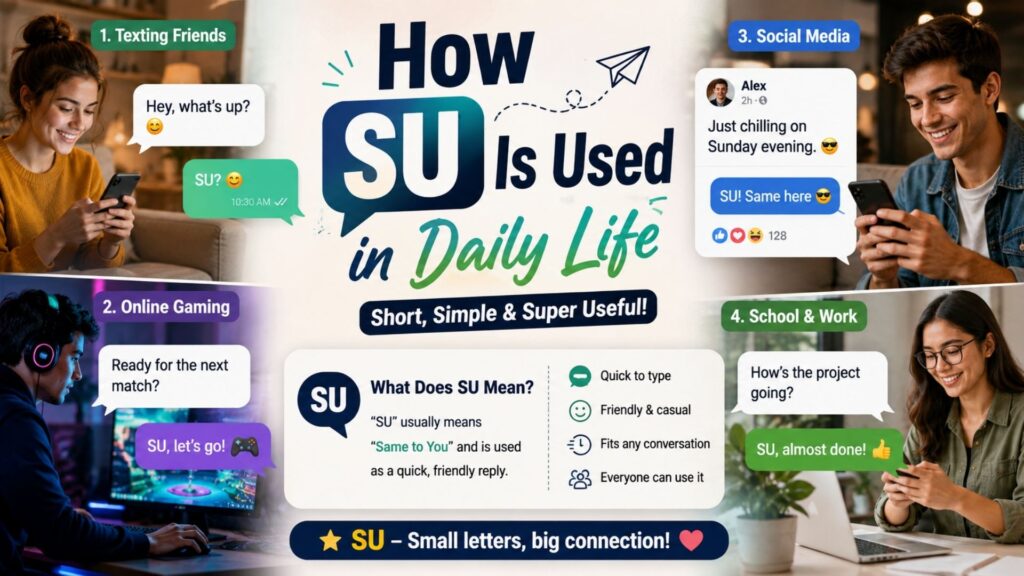
People use SU in different ways depending on what they’re talking about. In casual conversations, “Shut Up” is often the meaning when SU appears as an emotional reaction.
For example:
“SU 😂 That’s hilarious!”
Here, the speaker is probably expressing amusement rather than giving a serious command.
SU can also appear when someone wants to express disbelief:
“SU! You actually won the competition?”
In this case, the phrase communicates something closer to “No way!” than an actual demand for silence.
When SU means “See You,” it usually appears around words involving time or leaving:
“SU tomorrow.”
“SU later.”
However, many people prefer writing “see you” or “CU” because those forms are less ambiguous.
On social media, particularly in older or platform-specific contexts, SU can also refer to “Swipe Up.”
“SU to shop.”
This means the viewer should swipe up to visit a linked page.
Read More: What Does BTA Mean in Text? Meaning, Uses & Examples
Emotional or Practical Meaning of SU
The emotional meaning of SU depends heavily on context.
When SU means “Shut Up,” it can range from playful to genuinely rude.
For example:
“SU 😂 I can’t believe you did that!”
sounds playful.
But:
“SU. I’m done talking to you.”
sounds much more hostile.
The difference comes from the surrounding language, punctuation, relationship, and situation.
When SU means “See You,” there’s usually little emotional weight. It’s simply a quick way to say goodbye.
If SU means “Swipe Up,” it’s generally practical and action-oriented.
So, before reacting to an SU message, ask yourself:
- What were we talking about?
- Is the person joking?
- Are there emojis?
- Does the message involve leaving or meeting?
- Is the conversation about social media?
- How does this person normally communicate?
These clues can help you determine the intended meaning.
Similar or Related Terms
Several abbreviations can overlap with the meanings of SU.
| Term | Meaning | Typical use |
| SU | Shut Up / See You / Swipe Up | Context-dependent |
| STFU | Shut the f*** up | Stronger and more offensive |
| CU | See You | Casual goodbye |
| CYA | See Ya / See You | Casual goodbye |
| TTYL | Talk to You Later | Ending a conversation |
| GTG | Got to Go | Leaving a conversation |
| BRB | Be Right Back | Temporarily leaving |
| LOL | Laughing Out Loud | Showing amusement |
The biggest difference is that many of these abbreviations have a more predictable meaning. SU is more ambiguous because several phrases can be represented by the same two letters.
Key Differences:
If someone writes:
“SU 😂”
they may be saying “Shut Up” playfully.
If someone writes:
“CU later”
the meaning is clearly “See You Later.”
If someone writes:
“TTYL”
they’re saying “Talk to You Later.”
So, if you’re unsure what SU means, don’t interpret it in isolation. Compare it with the rest of the message.
Common Misunderstandings About SU
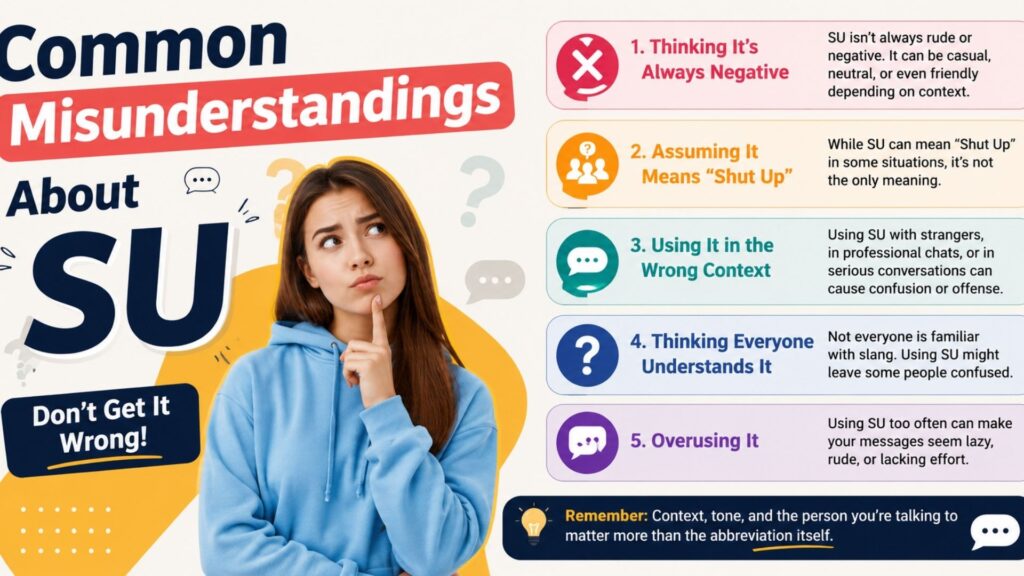
SU can easily be misunderstood because it has multiple possible meanings. Here are some common assumptions to avoid.
1. SU always means “Shut Up.”
Not necessarily.
“Shut Up” is a common interpretation, but SU can also mean “See You” or “Swipe Up” in certain contexts.
For example:
“SU tomorrow!”
could reasonably be intended as “See you tomorrow.”
The conversation usually provides the clue.
2. SU is rude.
SU can be rude, but it isn’t always rude.
Among close friends, “SU 😂” may be a playful reaction to surprising or funny information.
However, if someone uses “SU” aggressively during an argument, it can definitely sound disrespectful.
Tone matters.
3. SU is formal language.
SU is informal texting shorthand.
You generally wouldn’t use it in:
- Formal emails
- Academic assignments
- Job applications
- Official letters
- Professional reports
In formal communication, it’s better to write the complete phrase.
4. SU is outdated.
The popularity of individual abbreviations changes over time, and some meanings may be more common on certain platforms than others.
However, people still use short forms in texting and online conversations. The important thing is that not every abbreviation has the same popularity among every group.
If someone uses SU, understanding the context is more useful than assuming it is either universally popular or completely outdated.
5. SU has one universal meaning.
This is one of the biggest misunderstandings.
SU can have different meanings depending on the conversation. “Shut Up” may be the intended meaning in one message, while “See You” may make more sense in another.
Context is the key.
Examples of SU in Sentences
Here are some examples showing how SU can work in different conversations.
Example 1:
“SU 😂 You really said that to your boss?”
Meaning: “Shut up!” used playfully to show surprise.
Example 2:
“SU! That’s amazing!”
Meaning: A playful expression of excitement or disbelief.
Example 3:
“Okay, I have to go. SU tomorrow.”
Meaning: “See you tomorrow.”
Example 4:
“SU later!”
Meaning: “See you later,” depending on the speaker’s texting habits.
Example 5:
“SU for the full video.”
Meaning: “Swipe up” in a social-media context.
Example 6:
“SU 😂 I can’t believe you won.”
Meaning: “Shut up!” as a playful reaction to surprising news.
Example 7:
“I’ll text you when I get there. SU!”
Meaning: Potentially “See you,” depending on the person’s usual abbreviation style.
Notice how the same two letters can produce different interpretations. That’s why the surrounding words are so important.
Why Understanding SU Meaning in Text Matters Today

Texting has removed many of the signals we normally rely on during face-to-face conversations. When someone speaks, you can hear their tone and see their expression. A short text doesn’t give you those clues automatically.
That can make abbreviations like SU surprisingly easy to misinterpret.
For example, if a friend texts “SU 😂,” you might initially think they’re angry. But the laughing emoji and the previous conversation may show that they’re joking.
Likewise, if someone writes “SU tomorrow,” interpreting SU as “Shut Up” would make little sense. The mention of tomorrow strongly suggests a goodbye-related meaning.
Understanding what does SU mean in text helps you avoid these mistakes. Instead of reacting immediately, look at the context first.
It also helps you communicate more clearly. If you’re talking to someone who may not understand your abbreviations, writing “see you” or “shut up 😂” can be much clearer than simply writing “SU.”
In short, good digital communication isn’t just about knowing slang. It’s about knowing when an abbreviation is clear enough to use.
FAQs:
What does su meaning in text in simple words?
SU can have several meanings in text. The most common include “Shut Up” and, in some contexts, “See You.” It can also mean “Swipe Up” in certain social-media contexts.
Is su positive or negative?
It depends on the meaning and context. “SU” meaning “Shut Up” can be playful or negative, while “See You” is generally neutral or friendly.
Where is su commonly used?
SU may appear in text messages, group chats, direct messages, social media conversations, comments, and other casual online communication.
Is su formal or informal?
SU is informal texting shorthand. It’s best suited to casual conversations rather than professional or academic writing.
Why do people search for su meaning in text?
People search for SU meaning in text because the abbreviation can have multiple interpretations. They want to know whether the sender means “Shut Up,” “See You,” “Swipe Up,” or something else based on the context.
Conclusion:
So, what does SU mean in text? There isn’t just one answer.
In many casual conversations, SU means “Shut Up,” especially when someone uses it to express surprise, disbelief, or playful teasing. However, SU can also mean “See You” in goodbye-related messages and “Swipe Up” in certain social-media contexts.
The best way to understand SU is to look at the complete message. Emojis, punctuation, conversation topic, and your relationship with the sender can all help reveal the intended meaning.
If you’re still unsure, don’t guess. A quick “What do you mean by SU?” can prevent an unnecessary misunderstanding.
The main takeaway is simple: SU is context-dependent texting slang, and “Shut Up” is only one of its possible meanings.
