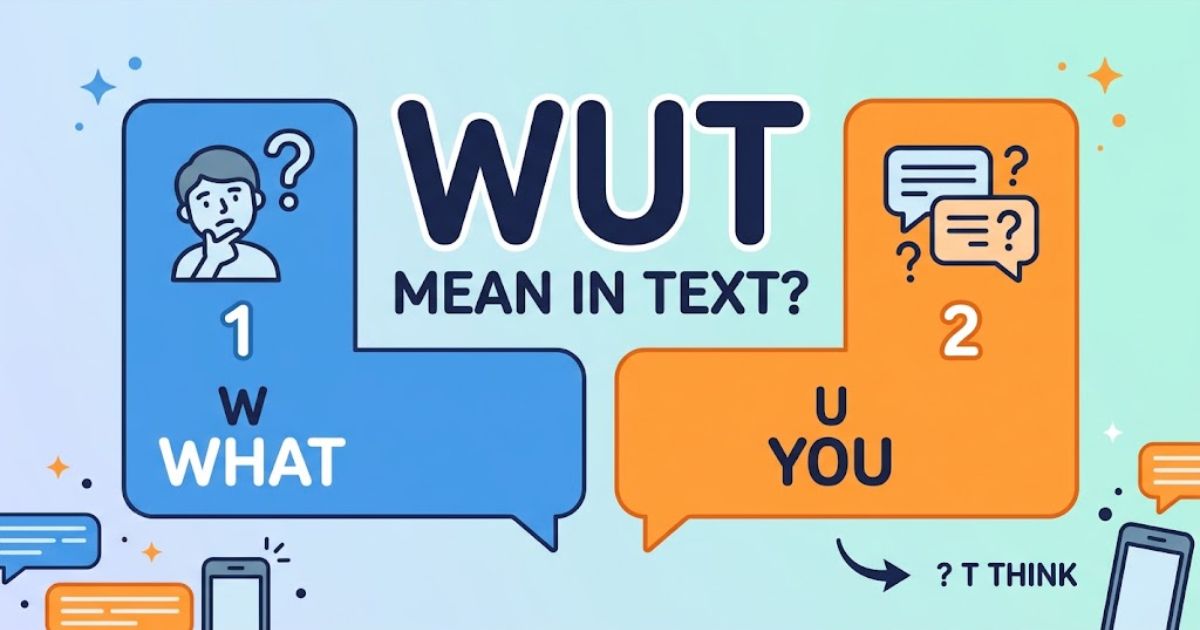
Have you ever received a message saying “WUT?” and wondered what the person meant? The answer is simple: WUT usually means “what” in text messages and online chats. People use it to express confusion, surprise, disbelief, or a playful reaction. You might see it in WhatsApp messages, Instagram comments, TikTok videos, Snapchat chats, and gaming conversations.
Although WUT looks like an abbreviation, it usually isn’t an acronym with a hidden full form. It’s an informal spelling of “what” that adds personality and emotion to a message. The exact tone depends on the conversation, punctuation, and emojis.
What Does WUT Mean in Text & Chat?
WUT means “what” in text messages and online chats. It’s a playful, informal spelling that replaces the standard word with a version that reflects how people sometimes pronounce it. It’s commonly used when someone wants an explanation, doesn’t understand something, or reacts to surprising information.
For example, if your friend texts, “I just won a free trip,” you might respond, “WUT?! That’s crazy!” Here, WUT expresses surprise rather than simply asking a question.
The spelling can also make a message feel more relaxed or dramatic. Unlike the standard word “what,” which works in both casual and formal writing, WUT belongs mainly in informal conversations. It’s not usually a separate acronym with a fixed full form.
Example
Imagine this conversation between two friends:
Alex: “I finished the entire assignment in 20 minutes.”
Sam: “WUT 😂 How did you do that?”
In this example, Sam uses WUT to show surprise and ask for more information.
Here are a few more examples:
- “WUT are you talking about? 😭” — Shows confusion.
- “WUT?! You actually met him?” — Expresses surprise.
- “Wut happened last night?” — Asks what happened in a casual way.
- “WUT 💀 That was so unexpected.” — Reacts to something shocking or funny.
The main idea is simple: WUT usually means “what,” but its emotional meaning depends on the situation.
Full Form, Stands For & Short Meaning of WUT
When people search for the WUT full form, they often assume it’s an abbreviation made from several words. In everyday texting, however, WUT is generally just an alternative spelling of “what.”
| Term | Meaning |
|---|---|
| WUT | Informal spelling of “what” |
| Full form in texting | No standard full form |
| Main purpose | Asking a question or reacting |
| Common emotions | Confusion, surprise, disbelief, amusement |
| Typical setting | Casual texts, social media, gaming chats |
| Formal usage | Generally avoided |
Unlike abbreviations such as LOL (“laughing out loud”) or BRB (“be right back”), WUT doesn’t usually stand for a phrase. It’s closer to informal spellings such as “wat” and “wot.”
For example, someone might write “WUT is going on?” instead of “What is going on?” The meaning stays the same, but the spelling gives the message a more casual or playful tone.
Remember that WUT can have different meanings in specialized settings, including as part of an institution’s name. If you encounter it in a technical document or official announcement, check the surrounding context before assuming it means “what.”
Read More: IMK Mean in Text? The Real Meaning, Uses & Examples 2026
Origin, History & First Known Use of WUT

WUT developed as part of the broader habit of writing words the way they sound. Informal spellings have existed for a long time, but internet messaging, chat rooms, online forums, and text messages made them especially visible.
As digital conversations became more common, people began shortening words, dropping letters, and using playful spellings to communicate quickly. WUT fits this pattern because it captures a casual pronunciation of “what” without changing the underlying meaning.
It’s difficult to identify one definitive first use of WUT in online communication. Informal spellings often develop across different communities rather than being invented by a single person. Without reliable historical evidence, it’s better not to assign an exact origin date.
The spelling also fits the expressive style of internet culture. Capital letters can make a reaction appear louder, while repeated punctuation can add emphasis. Compare these messages:
- “wut” — A casual question or mild confusion.
- “WUT?” — A more noticeable request for clarification.
- “WUT?!?!” — Strong surprise or disbelief.
- “wut 😂” — Confusion mixed with amusement.
Over time, WUT became recognizable as an informal alternative to “what,” particularly in casual digital conversations.
How People Use WUT in Daily Conversations
People use WUT for several reasons, and the intended meaning often becomes clear when you read the entire message. The same spelling can communicate curiosity, surprise, humor, or disbelief.
To Show Confusion
WUT is useful when you don’t understand what someone means. Instead of typing a complete question, you can use it as a quick reaction.
For example:
Friend: “I think we should cancel tomorrow’s plan and meet yesterday instead.”
You: “WUT? 😂”
Here, the response signals that something doesn’t make sense. It may also suggest that you’re asking the other person to explain themselves.
However, a one-word message can sometimes seem abrupt. If you want to sound more polite, try “Wut do you mean?” or, preferably, “What do you mean?”
To Show Surprise
WUT is often used when someone shares unexpected news. It can communicate excitement, disbelief, or shock without requiring a long response.
For example:
Friend: “She bought a new car without telling anyone.”
You: “WUT?! No way!”
The word works as an immediate reaction, especially when combined with punctuation or emojis. “WUT 😳” may suggest astonishment, while “WUT 😂” often makes the reaction feel lighter.
The emotion isn’t built into the spelling itself. The news and the surrounding conversation determine whether the reaction is positive, negative, or simply curious.
To Joke Around
Friends sometimes use WUT to make ordinary conversations more entertaining. The unusual spelling adds a playful tone, particularly when someone is deliberately acting confused.
For example:
Friend: “I ate the pizza you saved for tomorrow.”
You: “WUT. This is a national emergency 😭”
The exaggerated reaction makes the exchange humorous rather than serious.
In memes, WUT can also appear beside strange images, unexpected punchlines, or absurd statements. In those situations, it may mean something closer to “What am I even looking at?” than a straightforward request for information.
In Gaming Chats
Gamers use WUT in fast-moving conversations when they need clarification or want to react to an unexpected event. It’s convenient because it communicates a reaction quickly.
For example:
- “WUT just happened?”
- “WUT was that move 💀”
- “WUT weapon is he using?”
- “WUT?! How did I lose that round?”
In multiplayer games, a short message can be easier to type than a full sentence, particularly when players are communicating between rounds. WUT may also appear in gaming streams, comment sections, and community chats.
Still, the term isn’t exclusive to gaming. It’s a general internet expression that works across many informal digital settings.
WUT Meaning Across WhatsApp, Instagram, TikTok & Snapchat
The basic meaning of WUT stays the same across social platforms: it’s an informal version of “what.” What changes is how people use it within each platform’s style of communication.
On WhatsApp, WUT usually appears in private messages or group chats. People may use it to ask questions, respond to surprising news, or request clarification.
For example:
You: “I’m going to change my phone tomorrow.”
Friend: “WUT? Why?”
The friend is asking for more information, probably because the decision was unexpected.
On WhatsApp, context is especially important because short text messages don’t always communicate tone clearly. If you receive “WUT?” after sharing news, it doesn’t automatically mean the other person is angry or criticizing you.
On Instagram, WUT can appear in direct messages, Reel comments, Stories replies, and conversations with friends.
For example, if you share an unexpected photo or story, someone might comment, “WUT 😭” to express disbelief or amusement.
It can also be used as a question when someone sees something they don’t understand. In a funny Reel’s comments, WUT may act as a quick reaction to an unusual scene or unexpected ending.
Because Instagram includes both private and public conversations, the tone can vary. A close friend might use WUT playfully, while a stranger’s comment may simply express confusion.
TikTok
On TikTok, WUT commonly fits the quick, expressive style of video comments and direct messages. People may use it when reacting to surprising videos, unusual trends, unexpected plot twists, or funny clips.
For example:
“WUT DID I JUST WATCH 💀”
This comment suggests that the video was so strange, funny, or unexpected that the viewer doesn’t know how to react.
WUT can also appear in conversations about viral challenges or confusing content. Emojis such as 😭, 💀, and 😳 can provide clues about the intended emotion.
However, WUT doesn’t have a special official TikTok meaning. Its interpretation still depends on the words and content surrounding it.
Snapchat
On Snapchat, WUT usually means “what” in a Snap reply or private chat. Someone might send it when they’re confused by a message, surprised by a photo, or curious about something you said.
For example:
You: “Guess who I saw at the mall today.”
Friend: “WUT?? WHO?”
Here, the response shows curiosity and excitement.
If someone sends only “WUT?” after your message, they’re probably asking for clarification or reacting to unexpected information. If they add laughing emojis, the message may be playful. If they use several question marks, they may be especially surprised.
Don’t assume that WUT has a hidden Snapchat-specific meaning. It’s ordinary internet slang used in a platform where quick reactions are common.
Different Meanings of WUT in Other Fields
Although WUT usually means “what” in texting, the same letters can represent other things in specialized contexts. The correct interpretation depends on where you see them.
For example, an organization might use WUT as an abbreviation in its official name, while a casual conversation may use it as an informal spelling. These uses aren’t interchangeable.
When you encounter WUT outside social media, look at the surrounding words, the document’s subject, and whether the abbreviation is defined nearby.
Abbreviation for Universities
WUT can stand for the name of a university or another educational institution. One example is Warsaw University of Technology, which uses WUT as its English abbreviation.
In a university brochure, research paper, or academic announcement, WUT may refer to the institution rather than the slang word “what.”
For example:
“The research team at WUT published a new study.”
In this sentence, the abbreviation refers to Warsaw University of Technology if that institution is the subject of the discussion.
This distinction matters when interpreting search results. A page about WUT admissions may have nothing to do with texting slang. Always use context to identify the intended meaning.
Common Confusions, Mistakes & Wrong Interpretations
Because WUT is short and informal, people sometimes misunderstand its meaning or assume it carries an emotion that the sender didn’t intend.
Understanding a few common mistakes can help you interpret messages more accurately.
Mistake 1: Thinking It’s an Acronym
One common mistake is assuming WUT must stand for a longer phrase. In everyday texting, it’s generally an alternative spelling of “what,” not an acronym.
For example, “WUT happened?” simply means “What happened?” You don’t need to expand the letters into separate words.
The distinction is useful when comparing WUT with abbreviations such as IDK, which stands for “I don’t know.” WUT changes the spelling of a regular word rather than shortening a phrase.
Mistake 2: Thinking It’s Rude
WUT isn’t inherently rude. Friends often use it casually, and many people use it to express surprise or confusion without intending any offense.
However, the wording and situation can make it sound impatient. Compare these two messages:
- “WUT 😂 Tell me everything!” — Playful and curious.
- “WUT do you want now?” — Potentially irritated or dismissive.
The second message sounds less friendly because of the rest of the sentence, not simply because it contains WUT.
If you want to avoid misunderstandings, consider writing a complete question and using a friendly tone.
Mistake 3: Confusing It With Typing Errors
WUT can look like a spelling mistake if you’re unfamiliar with texting slang. In many conversations, though, the sender chooses the spelling deliberately.
It’s similar to “wat” or “wot,” which also appear as informal versions of “what.” The exact spelling varies from person to person.
If someone writes WUT repeatedly in casual messages, it’s probably part of their texting style. In a formal document, however, it may be an error that needs correction.
Mistake 4: Assuming Anger
A message such as “WUT??” may look intense because of the capital letters and punctuation. That doesn’t necessarily mean the sender is angry.
They might be shocked, amused, confused, or genuinely asking a question. A friend who writes “WUT 😭” may simply be laughing at something unexpected.
Look at the previous messages and the relationship you have with the sender. If you’re still unsure, ask a neutral question such as, “Did that surprise you, or do you want me to explain?”
Similar Terms, Alternatives & Related Slang
Several informal expressions have meanings similar to WUT, but they aren’t always interchangeable.
| Term | Meaning | Typical use |
|---|---|---|
| What | Standard question word | Everyday and formal communication |
| Wat | Informal spelling of “what” | Casual chats and memes |
| Wot | Informal or pronunciation-based spelling of “what” | Casual messages, especially in some English varieties |
| Huh? | Requests clarification or expresses confusion | Informal conversation |
| WTF | “What the f***” | Strong shock, disbelief, or frustration; vulgar |
| WTH | “What the heck” or “what the hell” | Surprise, confusion, or frustration |
| WYD | “What are you doing?” | Texting and social media |
| WTW | Often “What’s the word?” or “What’s the move?” | Casual conversation; context matters |
| IDK | “I don’t know” | Expressing uncertainty |
| FR? | “For real?” | Surprise or a request for confirmation |
The most suitable alternative depends on the message you’re trying to send. Use “What?” when you want a standard question, “Huh?” when you need clarification, and “WUT?!” when you want a more playful or exaggerated reaction.
Remember that WTF and WTH are different expressions from WUT. They can communicate stronger emotions and may be inappropriate in professional or sensitive conversations.
Examples of WUT in Real Chat Situations
Seeing WUT in realistic conversations makes its meaning easier to understand. Here are examples of how it can appear in different situations.
1. When someone shares surprising news
Mia: “I’m moving to another country next month.”
Lily: “WUT?! When did you decide that?”
Meaning: Lily is surprised and wants more information.
2. When you don’t understand a message
Jake: “The whole thing disappeared.”
Noah: “Wut disappeared? Explain 😂”
Meaning: Noah needs clarification.
3. When reacting to a funny video
Friend 1: “Watch this clip.”
Friend 2: “WUT IS THAT 💀”
Meaning: The clip is strange, funny, or unexpected.
4. When someone makes an unbelievable claim
Alex: “I finished a 500-page book in one night.”
Sam: “WUT 😭 Did you even sleep?”
Meaning: Sam finds the claim surprising and possibly amusing.
5. When chatting during a game
Player 1: “I got eliminated through the wall.”
Player 2: “WUT? How did that happen?”
Meaning: Player 2 is confused by an unexpected game event.
6. When a friend changes plans
Friend 1: “Actually, we’re meeting at 6 instead of 8.”
Friend 2: “WUT? I thought we agreed on 8.”
Meaning: The response expresses surprise and asks for clarification.
7. When someone shares a personal achievement
Friend 1: “I got the job!”
Friend 2: “WUT!! LET’S GOOO 🎉”
Meaning: WUT expresses excited disbelief.
8. When someone makes a joke
Friend 1: “My alarm clock and I are no longer on speaking terms.”
Friend 2: “Wut 😂”
Meaning: The response playfully reacts to the joke.
These examples show that WUT doesn’t have one fixed emotional tone. It can express anything from mild curiosity to genuine excitement, depending on the conversation.
How to Reply When Someone Says WUT
The best response depends on why the person sent WUT. They might be asking you to explain something, reacting to unexpected news, or simply joking around.
If you understand the situation, reply naturally rather than overthinking the slang.
Casual Replies
Use these when a friend asks a simple question or wants clarification.
- “What part confused you?”
- “Haha, let me explain.”
- “Yeah, seriously!”
- “I’ll tell you what happened.”
- “Long story 😂”
These replies keep the conversation relaxed without making the other person feel awkward for asking.
Funny Replies
If the person is joking or exaggerating their reaction, you can respond with humor.
- “WUT you heard is true 😭”
- “Even I don’t understand it 💀”
- “Welcome to the confusion club 😂”
- “I wish I were making this up.”
- “Don’t ask questions I can’t answer 😂”
Use playful replies when you know the other person will understand your humor. A joke may not work as well if they’re genuinely confused or upset.
Friendly Replies
If you want to sound warm and helpful, explain what you meant or invite the person to ask more questions.
- “Haha, I know that sounds crazy!”
- “Let me explain it properly.”
- “Wait, I’ll give you the full story.”
- “I can see why you’re surprised.”
- “Want to know what happened next?”
Friendly replies are especially useful when you’re discussing personal news, making plans, or sharing something unexpected.
Formal Replies
WUT is informal, but you may receive it from a colleague or someone you’re not very close to. In that situation, respond to the actual question rather than copying the slang.
For example:
- “Let me clarify what I meant.”
- “I was referring to the updated schedule.”
- “Sorry for the confusion. Here’s the explanation.”
- “Would you like me to provide more details?”
- “To clarify, the meeting starts at 10 a.m.”
You don’t need to criticize the person’s wording. Simply answer clearly and professionally.
Is WUT Still Popular? Trends & Online Usage
WUT remains recognizable as an informal spelling of “what,” particularly in casual conversations, memes, and expressive online reactions. However, its popularity varies between communities, age groups, and individual texting habits.
Some people prefer WUT because it looks playful or dramatic. Others use the standard spelling because they want their messages to be clearer. Modern messaging also makes it easy to express the same reaction with phrases such as “What?!,” “No way,” “Huh?,” or an emoji.
It’s important to distinguish continued use from a verified trend. Without reliable, current usage data, it’s not possible to say exactly how popular WUT is in 2026 or claim that its use is increasing or declining.
You may still encounter it in several settings:
- Text messages: Quick questions and reactions between friends.
- Memes: Exaggerated confusion or disbelief.
- Social media comments: Responses to surprising or unusual content.
- Gaming chats: Questions about unexpected events.
- Group conversations: Playful reactions to news or jokes.
If you see WUT online, you generally don’t need to look for a hidden meaning. Start with the ordinary meaning of “what,” then use the surrounding conversation to determine the intended emotion.
Quick Facts
Here are the main things to remember about WUT meaning in text:
- Basic meaning: WUT is an informal spelling of “what.”
- Full form: It doesn’t have a standard full form in everyday texting.
- Main purpose: Asking a question, expressing confusion, or reacting to something unexpected.
- Common platforms: WhatsApp, Instagram, TikTok, Snapchat, and other messaging services.
- Emotional tone: It can sound curious, surprised, amused, or frustrated.
- WUT vs. WHAT: Both communicate the same basic word, but WUT is more informal.
- WUT vs. WTF: WUT is not inherently vulgar; WTF includes profanity.
- WUT from a girl or guy: The basic meaning is the same regardless of gender.
- Professional use: Avoid WUT in formal emails, reports, and workplace documents.
- Context matters: Punctuation, emojis, and the surrounding message help explain the sender’s tone.
FAQs
What does WUT mean on Snapchat?
WUT means “what” on Snapchat. People use it in chats and Snap replies to show confusion, ask for clarification, or react to surprising information. For example, “WUT?! 😳” often communicates surprise.
What does WUT mean on Instagram?
On Instagram, WUT is an informal spelling of “what.” You might see it in direct messages, Story replies, or Reel comments when someone is confused, surprised, or amused by something.
What does WUT mean on TikTok?
WUT means “what” on TikTok, especially in comments and casual conversations. A comment such as “WUT did I just watch 💀” usually expresses disbelief or a humorous reaction to a strange or unexpected video.
Is WUT rude?
No, WUT isn’t automatically rude. Friends often use it casually to show surprise or confusion. However, it can sound impatient or dismissive depending on the sentence, punctuation, and situation.
What does WUT mean from a girl?
When a girl texts WUT, she generally means “what.” She might be confused, surprised, curious, or joking. The word alone doesn’t prove that she’s flirting, angry, or interested in you; consider the full conversation.
What does WUT mean from a guy?
When a guy sends WUT, he usually means “what” and may be asking for clarification or reacting to unexpected news. His intention depends on the context, not his gender.
Is WUT the same as WHAT?
Yes, in ordinary texting, WUT and WHAT communicate the same basic meaning. The difference is that WHAT is the standard spelling, while WUT is an informal, playful version commonly used in casual digital conversations.
Can I use WUT in professional messages?
It’s best to avoid WUT in formal emails, business reports, and professional communication. Use “what,” “could you clarify,” or “could you explain?” instead. These alternatives are clearer and more appropriate for workplace conversations.
Conclusion
WUT means “what” in most texting and social media conversations. It’s an informal spelling people use to ask questions, express confusion, react to surprising news, or make a conversation more playful. You’ll commonly encounter it on Snapchat, Instagram, TikTok, WhatsApp, and in online gaming chats.
The key is to read the message in context. “WUT?” may simply request clarification, while “WUT?! 😂” can show surprise or amusement. It isn’t automatically rude, romantic, or angry, and it generally doesn’t stand for a longer phrase.
When you’re unsure how to interpret WUT, look at the surrounding words, emojis, and conversation. And when you want to use it yourself, keep it to casual chats where informal language feels natural.
