
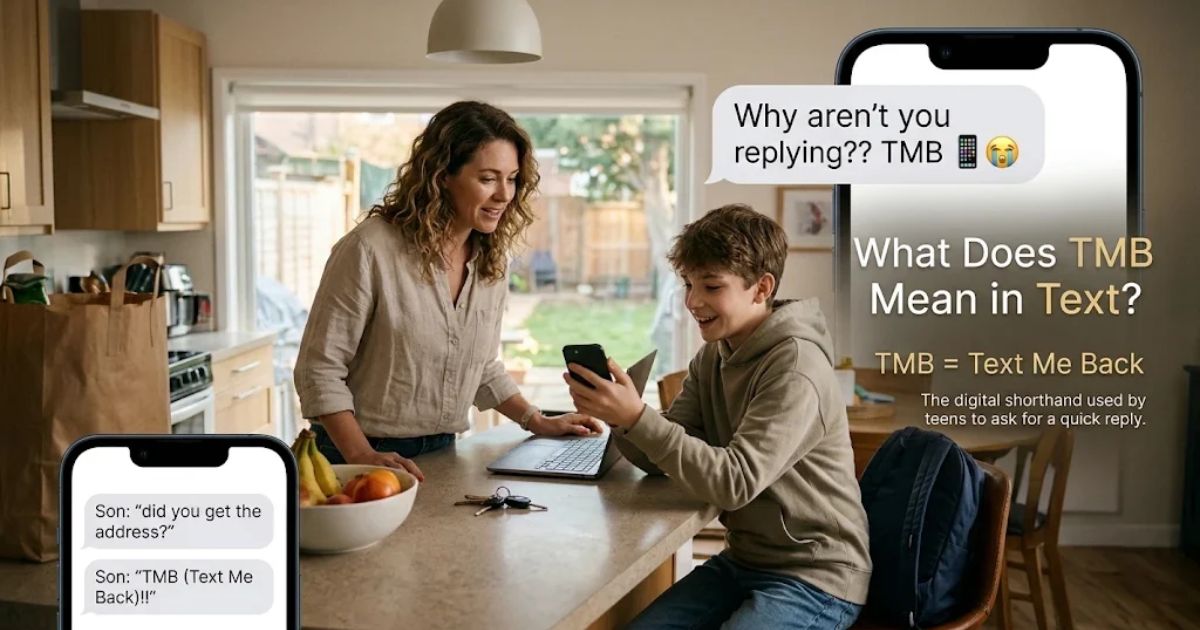
Have you received a message saying “TMB” and wondered what the person was trying to tell you? You’re not alone. TMB is a short texting abbreviation that can have different meanings depending on the conversation, social media platform, and relationship between the people using it.
In everyday texting, TMB commonly means “Text Me Back.” Someone might use it when they want you to reply, continue a conversation, or get back to them when you’re available. However, it can also stand for phrases like “Take Me Back,” “Tag Me Back,” or “Trust Me Bro” in certain situations.
Understanding the surrounding conversation is the easiest way to figure out which meaning applies. Let’s explore what TMB means in text messages, how people use it on Instagram and Snapchat, and what its other interpretations might be.
What TMB Means and Its Origin
The most common texting meaning of TMB is “Text Me Back.” It’s an informal abbreviation people use when they want someone to respond to their message.
For example, imagine your friend sends you a message about weekend plans, but you haven’t replied yet. They might follow up with:
“Hey, TMB when you get a chance!”
They’re simply asking you to text them back when you’re free.
Like many internet abbreviations, TMB developed through the habit of shortening everyday expressions. People often use acronyms to save time, especially when typing on smartphones or sending quick messages through social media.
However, TMB doesn’t have one universal definition. Its meaning can change depending on the situation.
What TMB Can Mean (and When to Pay Attention)
Although “Text Me Back” is a common interpretation, TMB can represent several different phrases.
Here are some possible meanings:
| TMB meaning | Explanation |
|---|---|
| Text Me Back | Asking someone to respond to a message |
| Take Me Back | Expressing a desire to return to a previous relationship or situation |
| Trust Me Bro | Asking someone to believe what you’re saying |
| Tag Me Back | Requesting a mention or tag on social media |
| Tell Me Baby | An affectionate or flirty expression |
| Text Me Baby | Asking someone to send a message |
| That My B | A context-dependent expression used in casual conversations |
These meanings aren’t equally common. Some are informal interpretations rather than widely established definitions.
How do you know which one someone means? Look at the message before and after TMB.
For instance:
- “I called you twice, TMB” probably means Text Me Back.
- “I miss those days, TMB” could mean Take Me Back.
- “This movie is amazing, TMB!” might suggest Trust Me Bro, depending on the conversation.
- “Post the picture and TMB” could mean Tag Me Back.
The sender’s tone also matters. A message from a close friend may sound playful, while the same abbreviation from someone waiting for an important response could feel more serious.
Read More: SN Meaning in Text (2026): Complete Guide to Its Meaning, Uses, Chat Slang & More
Tmb meaning spanish
When looking for the TMB meaning in Spanish, you’ll often find that its interpretation depends on the language and context.
In Spanish-language digital communication, “también” (meaning “also” or “too”) is sometimes shortened to “tmb” or “tmbn.” These are informal typing shortcuts used in chats and social media.
For example:
- “Yo tmb” means “Me too.”
- “A mí tmb me gusta” means “I like it too.”
- “Tmb quiero ir” means “I want to go too.”
This usage is different from the English texting abbreviation “Text Me Back.”
If someone writes “tmb” while speaking Spanish, don’t automatically assume they’re asking you to reply. They may simply be saying “also” or “too.”
The surrounding sentence will usually make the intended meaning clear.
TMB meaning Instagram
On Instagram, TMB can have different meanings depending on whether it appears in a direct message, comment, story, or caption.
One possible meaning is “Text Me Back.” Someone might send TMB in a DM when they want you to respond to an earlier message.
For example:
“Hey, TMB. I need to ask you something.”
However, the abbreviation can also appear in social media interactions where someone wants to be tagged back in a post or story.
For example:
“Thanks for the mention! TMB next time.”
Here, the person might be asking you to tag them back.
Instagram conversations are often informal, so users regularly shorten phrases to make communication faster. However, TMB isn’t an official Instagram feature or a platform-specific term with only one definition.
If you see it under a photo or in someone’s comments, check the conversation before deciding what it means.
Tmb meaning snapchat
Snapchat is known for quick messages, disappearing pictures, streaks, and casual conversations. That’s why abbreviations like TMB can appear in its chats.
On Snapchat, TMB can mean “Text Me Back.” Someone may send it when they’re waiting for a reply or trying to continue a conversation.
For example:
“Where did you go? TMB 😂”
This sounds like a friend jokingly asking you to respond.
Depending on the conversation, TMB could also mean “Take Me Back,” particularly when someone is discussing an old relationship, memory, or experience.
For example:
“Those summer nights were everything. TMB!”
The exact meaning isn’t determined by Snapchat itself. It’s based on the words, emotions, and situation surrounding the abbreviation.
TMB meaning medical
In medical settings, TMB has a completely different meaning from its casual texting definition.
TMB commonly stands for Tumor Mutational Burden. It’s a measurement of the number of mutations found in the DNA of cancer cells within a tumor.
Medical professionals may use TMB when discussing cancer research, tumor testing, and certain treatment decisions.
In simple terms, tumor mutational burden measures how many genetic changes are present in a tumor. Researchers and doctors may consider this information when evaluating whether certain cancer treatments, including some immunotherapies, could be appropriate.
However, TMB is only one factor in cancer care. A high or low result doesn’t independently determine which treatment a patient should receive.
Doctors interpret the result alongside other information, including cancer type, overall health, other test results, and established treatment guidelines.
So, if you encounter TMB in a medical report, don’t interpret it as “Text Me Back.” The medical context makes a significant difference.
Tmb meaning travel
In travel-related discussions, TMB can refer to Tour du Mont Blanc, a famous long-distance hiking route through the Alps.
The route passes through parts of France, Italy, and Switzerland, offering spectacular mountain scenery, villages, valleys, and alpine landscapes.
Travelers and hiking enthusiasts often use TMB as a convenient abbreviation when discussing the route.
For example:
- “I’m planning to hike the TMB next summer.”
- “How many days does the TMB take?”
- “Which TMB route has the best mountain views?”
In this context, TMB has nothing to do with texting or social media slang.
The surrounding topic is the biggest clue. If someone is discussing hiking, mountain trails, or European travel, they’re probably referring to the Tour du Mont Blanc.
Tmb meaning country
TMB isn’t a standard country name or a widely recognized country abbreviation in everyday communication.
However, you might encounter TMB in travel documents, international databases, business records, or location-related discussions where it represents a specific organization, location, or internal code.
It’s important not to confuse an abbreviation used in a particular database with an official country code.
For example, ISO country codes use standardized two-letter and three-letter identifiers. TMB isn’t an official ISO 3166-1 country code.
If you’ve seen TMB next to a country name, shipping destination, or travel booking, check the source to understand what the abbreviation represents.
TMB meaning portuguese
In Portuguese online conversations, TMB may appear as an informal abbreviation for “também,” which means “also” or “too.”
People sometimes shorten common words while messaging friends because it’s quicker than typing the complete expression.
For example:
- “Eu tmb” means “Me too.”
- “Quero ir tmb” means “I want to go too.”
- “Eu gosto tmb” means “I like it too.”
The abbreviation is casual rather than formal Portuguese.
You might see it in WhatsApp messages, Instagram comments, or other online conversations.
As with Spanish, the language of the conversation is an important clue. If someone uses TMB in a Portuguese sentence, they’re likely using it as a shortcut for “também,” not the English phrase “Text Me Back.”
TMB meaning cancer
When discussing cancer, TMB usually means Tumor Mutational Burden.
It describes the number of mutations present in the DNA of cancer cells. Medical laboratories can estimate this measurement through specialized genetic testing.
Why does it matter?
Some tumors contain more genetic mutations than others. These changes can sometimes affect how the immune system recognizes cancer cells.
Researchers have studied TMB as a potential biomarker for predicting responses to certain immunotherapy treatments.
Here are a few important points:
- High TMB: Indicates a relatively large number of mutations in the tested tumor.
- Low TMB: Indicates fewer mutations compared with the testing reference.
- TMB testing: Usually involves analyzing tumor DNA using specialized laboratory methods.
- Treatment decisions: Doctors consider TMB alongside other clinical and molecular information.
A high TMB result doesn’t automatically mean that cancer is more aggressive or that a particular treatment will work. Its significance depends on the cancer type, testing method, and clinical situation.
If you encounter this abbreviation in a pathology report or oncology discussion, it’s best to ask the treating doctor what the result means for that particular case.
Where You Might See TMB: From Text Messages to Social Media Platforms
TMB can appear in several digital spaces, and its meaning often changes with the platform and conversation.
Here’s where you might encounter it:
1. Text messages: Friends and family may use TMB to mean “Text Me Back” when they’re waiting for a response.
2. Instagram: It can appear in direct messages, comments, or story interactions. Depending on the context, it may mean Text Me Back or Tag Me Back.
3. Snapchat: Users may send TMB in quick conversations when they want someone to reply.
4. TikTok: The abbreviation may appear in comments, private messages, or discussions. However, it doesn’t have one universally recognized TikTok-specific definition.
5. WhatsApp: People may use TMB as a quick reminder to respond or as another informal abbreviation.
6. Online communities: In Spanish and Portuguese conversations, TMB can represent “también.”
The most important thing to remember is that platforms don’t always determine meaning. The language and subject of the conversation are often more useful clues.
How Kids Use TMB in Real Conversations
Teenagers and younger internet users often develop their own communication habits. They use abbreviations, emojis, inside jokes, and shortened phrases to communicate quickly.
TMB may appear in their conversations for several reasons. Sometimes it’s a simple request for a response. Other times, it can be part of a joke, a social media interaction, or a personal conversation.
Here are some situations where kids might use it.
Impatient request
A teenager might send TMB when a friend hasn’t responded to an earlier message.
For example:
- Friend 1: “Are you coming to the game?”
- Friend 2: “I’m not sure yet.”
- Friend 1: “TMB when you decide.”
In this situation, TMB means “Text Me Back.”
It doesn’t necessarily indicate anger. The sender may simply want an answer before making plans.
However, repeated messages like “TMB now!” can sound impatient or demanding, depending on the relationship.
Inside jokes and dares
Friends sometimes use abbreviations as part of jokes, challenges, or playful conversations.
For example:
- Friend 1: “You won’t believe what happened yesterday.”
- Friend 2: “What happened?”
- Friend 1: “TMB and I’ll tell you 😂”
The abbreviation encourages the other person to continue the conversation.
Some friend groups may also create their own meanings for common abbreviations. That’s why a phrase that makes sense within one group might confuse someone outside it.
Comments under photos (“shoutouts”)
On social media, teenagers often tag friends in pictures, stories, and posts.
TMB may be used when someone wants to receive a mention or tag in return.
For example:
“Thanks for the shoutout! TMB next time.”
Here, the intended meaning could be “Tag Me Back.”
This isn’t a universal definition, though. Some people may use different wording or abbreviations to request the same thing.
Private or flirty conversations
TMB can also appear in private conversations between people who are close to each other or interested in one another.
For example:
- “I liked talking to you last night. TMB later ❤️”
- “Don’t disappear again, TMB 😂”
- “I’ll tell you everything when you’re free. TMB!”
In these situations, TMB generally means “Text Me Back.”
The tone can be friendly, affectionate, playful, or flirty. However, the abbreviation alone doesn’t prove romantic interest.
If someone sends TMB, consider your existing relationship and the rest of the conversation before interpreting their intentions.
Why Slang Like TMB Can Be Confusing
Internet slang changes quickly. New expressions appear, existing abbreviations develop additional meanings, and different communities use the same letters in different ways.
That’s one reason TMB can be confusing.
For example, an English-speaking friend might use it to mean “Text Me Back,” while someone chatting in Spanish might use it as a shortcut for “también.”
The same abbreviation can also mean something different in a medical report or travel conversation.
Here are a few reasons these misunderstandings happen:
Different languages: English, Spanish, and Portuguese speakers may use the same letters differently.
Different platforms: An abbreviation in a private message may have a different purpose when used in a social media comment.
Personal meanings: Friends sometimes create their own shorthand based on shared experiences.
Missing context: A short message containing only three letters doesn’t provide much information.
Changing internet culture: Online expressions can develop new meanings as different age groups and communities adopt them.
When you’re unsure, the simplest solution is to ask what the sender means. A quick “What do you mean by TMB?” can prevent an unnecessary misunderstanding.
How Kids360 Helps Parents Stay in the Loop
Understanding internet slang is one part of helping children navigate digital communication. Parents also need to understand how their children use smartphones, social media, messaging apps, and online communities.
Kids360 is a parental control and digital well-being app designed to help parents manage aspects of their children’s screen time and encourage healthier technology habits.
Rather than treating every unfamiliar abbreviation as a problem, parents can use open conversations and reasonable digital boundaries to understand their children’s online experiences.
Here are some ways families can approach digital well-being.
Setting Up a Balanced Digital Routine
Children need time for schoolwork, family activities, sleep, hobbies, and entertainment.
However, constant notifications and messaging can make it difficult to maintain a healthy routine.
Parental control tools such as Kids360 can help families establish screen-time limits and create more structured device habits.
For example, parents might set reasonable limits around recreational screen use while keeping essential communication available.
The goal isn’t to prevent children from using technology. It’s to help them develop a balanced relationship with it.
Engagement and Motivation
Simply telling children to spend less time on their phones doesn’t always work.
A better approach is to involve them in setting realistic goals.
Parents can encourage activities such as reading, outdoor play, exercise, and family time. Some digital well-being apps also offer task-based features that encourage children to complete activities before earning additional screen time.
When children understand why certain limits exist, they’re more likely to participate in creating healthy habits.
Real-World Peace of Mind
Parents naturally want to know that their children are using technology responsibly.
Having clear rules about online communication, privacy, and screen time can make digital life easier to manage.
Kids360 offers parental control features that can help parents monitor and manage aspects of their children’s device use.
However, no app replaces an honest conversation. Children should feel comfortable discussing confusing messages, unfamiliar slang, uncomfortable interactions, or suspicious online behavior.
A supportive relationship makes it easier for them to ask for help when something doesn’t feel right.
Bridging the Digital Communication Gap
The language used online can sometimes feel like a different world, especially when teenagers use abbreviations that adults rarely encounter.
TMB is a good example. One person may understand it as “Text Me Back,” while another might interpret it as “Take Me Back” or “Trust Me Bro.”
Instead of assuming that every unfamiliar abbreviation has a negative meaning, take a moment to understand the context.
Parents can also use these moments to start conversations about online communication, respectful messaging, privacy, and digital boundaries.
For teenagers, the same advice applies: if you don’t understand an abbreviation, ask. Clear communication is always better than guessing.
Ultimately, learning internet slang isn’t about memorizing every abbreviation. It’s about understanding how people communicate and recognizing that words can have different meanings in different situations.
Conclusion
So, what does TMB mean? In everyday texting, it commonly stands for “Text Me Back.” People use it when they want someone to respond or continue a conversation.
However, the abbreviation can also mean “Take Me Back,” “Tag Me Back,” or other phrases depending on the situation. In Spanish and Portuguese chats, it may represent “también,” while in medical discussions, it commonly stands for “Tumor Mutational Burden.”
The easiest way to understand TMB is to consider the language, platform, and surrounding conversation. When you’re unsure, asking the sender is always a good option.
FAQs
What does TMB mean in text?
TMB commonly means “Text Me Back” in text messages. It’s an informal way of asking someone to respond when they have time.
What is the meaning of TMB in chat?
In online chats, TMB often stands for “Text Me Back.” Depending on the conversation, it can also mean “Take Me Back,” “Trust Me Bro,” or “Tag Me Back.”
What does TMB mean in TikTok?
On TikTok, TMB can be used in comments or messages to mean “Text Me Back.” Its interpretation depends on the context because it isn’t an official TikTok abbreviation with one fixed meaning.
What does TMB mean in Spanish slang?
In Spanish digital communication, TMB is sometimes used as a shortened form of “también,” meaning “also” or “too.” For example, “Yo tmb” means “Me too.”
What does TMF mean in slang?
TMF doesn’t have one universally accepted slang definition. Its meaning depends on the conversation and online community. If someone sends it without context, asking them what they mean is the safest approach.
What is slang for TMB?
TMB itself is an informal texting abbreviation. Its most common texting interpretation is “Text Me Back.” Similar expressions include “HMU” (Hit Me Up), “BRB” (Be Right Back), “TTYL” (Talk To You Later), and “LMK” (Let Me Know).
