

If someone sends you “CYA” in a text, you might wonder whether they’re simply saying goodbye or hinting at something else. In most casual conversations, CYA meaning in text is straightforward: “see ya” or “see you.” It’s a quick, informal way to end a conversation while suggesting you’ll talk or meet again.
However, CYA can have another meaning in certain situations: “cover your ass.” This version usually appears in workplace conversations, jokes, warnings, or situations where someone is talking about protecting themselves from blame or responsibility. So, the context matters.
Whether you see CYA in a text message, social media comment, group chat, or workplace conversation, understanding the surrounding message makes the meaning much easier to identify. Let’s break down both meanings, how people use CYA, and when you should or shouldn’t use it yourself.
What Does CYA Meaning in Text?
The most common CYA meaning in text is “see ya,” a casual shortened version of “see you.” It’s essentially a friendly goodbye.
For example:
“I gotta go now. CYA!”
This means:
“I have to go now. See you!”
CYA is especially common in texting, online chats, gaming conversations, and social media because people often shorten familiar phrases to save time. It has a relaxed tone and usually doesn’t carry any negative meaning.
There’s also a second meaning: “cover your ass.” In this context, CYA means taking precautions to protect yourself from possible blame, trouble, or consequences.
For example:
“Keep a copy of that email. CYA.”
Here, CYA means something like “protect yourself” or “make sure you have evidence.”
The easiest way to tell which meaning someone intends is to look at the conversation around it. If CYA appears at the end of a friendly chat, it probably means “see ya.” If someone is discussing responsibility, paperwork, mistakes, or workplace problems, “cover your ass” may be the intended meaning.
Real-Life Examples:
Example 1 — Casual goodbye
“I’m heading home. CYA tomorrow!”
Meaning: “I’ll see you tomorrow.”
Example 2 — Friendly chat
“I’ve gotta study now. CYA later!”
Meaning: “See you later!”
Example 3 — Workplace warning
“Save the confirmation email, just CYA.”
Meaning: “Keep it as proof to protect yourself.”
Example 4 — Gaming
“GG! CYA next round.”
Meaning: “Good game! See you next round.”
Example 5 — Group chat
“I’m logging off, CYA everyone!”
Meaning: “See you, everyone!”
These examples show why context is important. The same three letters can have completely different meanings depending on the conversation.
Read More: YWA Meaning: What Does YWA Mean in Texting and Chat?
Origin and Background of the Term
CYA developed as part of the broader culture of internet and text-message abbreviations. As online communication became faster and more casual, people began shortening common phrases such as “see you,” “talk to you later,” and “be right back.”
“See ya” already existed as an informal spoken goodbye before texting became popular. CYA simply turns that familiar phrase into a compact written abbreviation.
The abbreviation also overlaps with another long-established expression: “cover your ass.” This phrase refers to taking steps to protect yourself from blame, criticism, or potential consequences. In professional or organizational settings, people may use CYA when advising someone to keep documentation or proof.
Because both meanings existed in informal communication, CYA became a classic example of an abbreviation whose meaning depends heavily on context.
How CYA Is Used in Daily Life

You’ll usually encounter CYA in casual communication rather than formal writing. It works best when the people involved already understand texting shorthand.
1. Ending a Text Conversation
One of the most common uses is simply ending a conversation.
“I need to get some sleep. CYA tomorrow!”
Here, CYA feels quicker and more relaxed than writing “See you tomorrow.”
It can also appear as:
- “CYA later!”
- “Okay, CYA!”
- “Gotta go, CYA.”
- “CYA soon!”
The tone is generally friendly and informal.
2. After School or Work
Friends, classmates, and coworkers may use CYA when they expect to see each other again soon.
“I’m leaving now. CYA Monday!”
The phrase works particularly well when the next meeting is already understood.
For example, if two coworkers regularly see each other at the office, “CYA tomorrow” feels completely natural in a casual message.
3. Casual Group Chats
CYA is also useful when leaving a group conversation.
“Alright everyone, I’m off. CYA!”
It gives the message a light, friendly ending without sounding overly formal.
You might see it in gaming groups, friend groups, school chats, or online communities.
4. Friendly Goodbyes
CYA can make a goodbye sound casual rather than serious.
Compare:
“Goodbye. I’ll see you tomorrow.”
with:
“CYA tomorrow!”
The second version feels more relaxed and conversational.
That’s why CYA often appears between friends who already have an informal communication style.
5. Workplace Humor
The “cover your ass” meaning is especially common in workplace humor.
For example:
“Send yourself a copy of the approval email. CYA.”
In this situation, the person isn’t saying “see you.” They’re recommending that you keep documentation in case someone later questions what happened.
This usage is more sensitive than the goodbye meaning because “cover your ass” is mildly vulgar. In professional communication, it’s usually better to spell out a more neutral alternative, such as “keep a record for your protection.”
Emotional or Practical Meaning of CYA
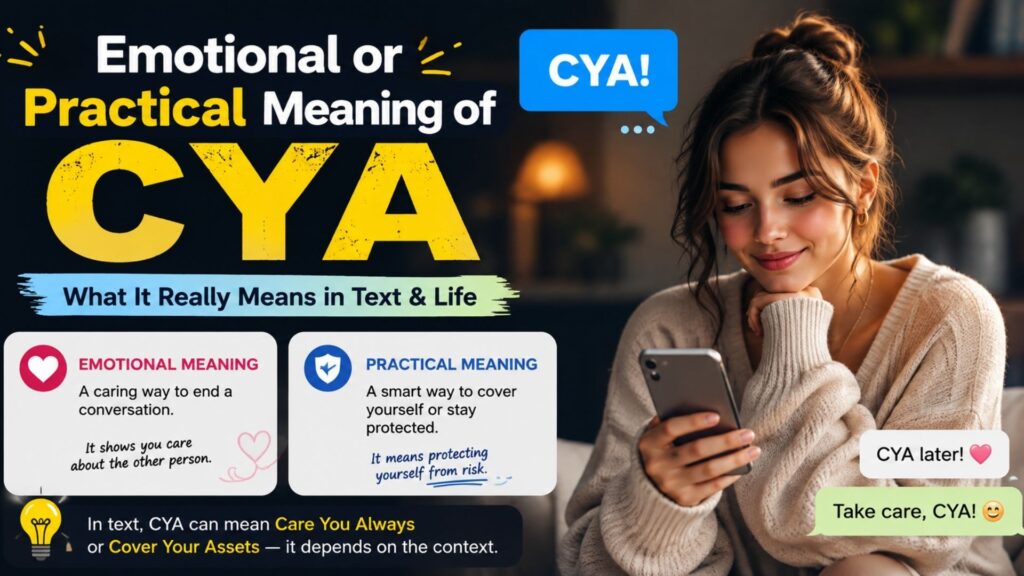
The emotional meaning of CYA depends on which definition the sender intends.
When CYA means “see ya,” it usually communicates a simple, friendly goodbye. It can feel warm, casual, and effortless, especially when paired with words such as “later,” “tomorrow,” or “soon.”
For example:
“CYA later 😊”
feels noticeably friendlier than simply sending:
“CYA.”
The second version can still be perfectly friendly, but it gives you less information about the sender’s emotional tone.
When CYA means “cover your ass,” the emotional purpose is different. It often communicates caution. Someone may be telling you to protect yourself, document something, or prepare for a possible disagreement.
So, CYA can communicate either connection or caution, depending on the context.
Similar or Related Terms
If you’re learning texting abbreviations, several expressions are closely related to CYA.
| Term | Meaning | Typical Use |
|---|---|---|
| CYA | See ya / See you | Casual goodbye |
| CU | See you | Informal goodbye |
| CUL8R | See you later | Very casual texting |
| TTYL | Talk to you later | Ending a conversation |
| GTG | Got to go | Leaving a chat |
| BRB | Be right back | Temporary absence |
| BBL | Be back later | Casual online chat |
| BYE | Goodbye | General farewell |
CYA is usually more personal than “GTG” because it can imply that you expect to see or talk to the person again.
For example, “GTG” focuses on the fact that you need to leave, while “CYA” focuses on the next interaction.
Common Misunderstandings About CYA
Because CYA has multiple meanings, people sometimes misunderstand it. Here are the most common misconceptions.
1. It’s Always Rude
CYA isn’t automatically rude. When it means “see ya,” it’s simply an informal goodbye.
“CYA tomorrow!”
is normally friendly.
That said, the tone can depend on the rest of the conversation. A very short “cya” after an argument might feel dismissive, but that’s because of the situation, not because CYA itself is inherently rude.
2. It Only Means “Cover Your A**”
Some people recognize CYA primarily as “cover your ass,” but that isn’t the only meaning.
In casual texting, “see ya” is extremely common. If someone writes:
“Gotta run, cya!”
they almost certainly mean “see ya.”
Context is the key.
3. It’s Outdated Slang
CYA has been around for a long time, but that doesn’t mean everyone has stopped using it.
You may still encounter it in texts, online chats, gaming communities, and casual messages. However, texting habits vary by age, platform, and social group, so some people may prefer newer or simpler expressions such as “cya,” “later,” or “ttyl.”
4. It’s Formal
CYA is definitely not formal language when it means “see ya.”
You wouldn’t normally use it in a formal letter, academic paper, official announcement, or professional email.
For a formal setting, use “See you soon,” “Best regards,” “I look forward to speaking with you,” or another appropriate closing.
5. It Shouldn’t Be Used in Professional Emails
There’s an important distinction here.
Using CYA as “see ya” in a professional email can sound too casual, especially when communicating with clients, managers, or people you don’t know well.
However, the phrase “CYA” meaning “cover your ass” may occasionally appear in informal workplace conversations. Even then, it’s slang and mildly vulgar, so it’s better to use a professional alternative when the situation calls for one.
Instead of:
“CYA and keep that receipt.”
you could write:
“Keep that receipt for your records.”
The second version communicates the same practical idea without the slang.
Examples of CYA in Sentences
Here are more examples showing how CYA works in everyday communication:
- “I’m going to grab some food. CYA later!”
- “CYA tomorrow at school.”
- “Okay, I’ve gotta go. CYA!”
- “Logging off now. CYA everyone!”
- “Thanks for chatting! CYA soon.”
- “I’ll meet you outside. CYA!”
- “CYA after work.”
- “I’m heading to bed. CYA tomorrow.”
- “Gotta run, CYA later!”
- “CYA at the game.”
- “Make sure you save the receipt. CYA.”
- “Keep the messages just in case. CYA.”
- “Get confirmation in writing, CYA.”
- “Save a copy of the agreement for CYA.”
Notice how the first group clearly uses CYA as “see ya,” while the later examples use it as “cover your ass.”
Why Understanding CYA Meaning in Text Matters Today
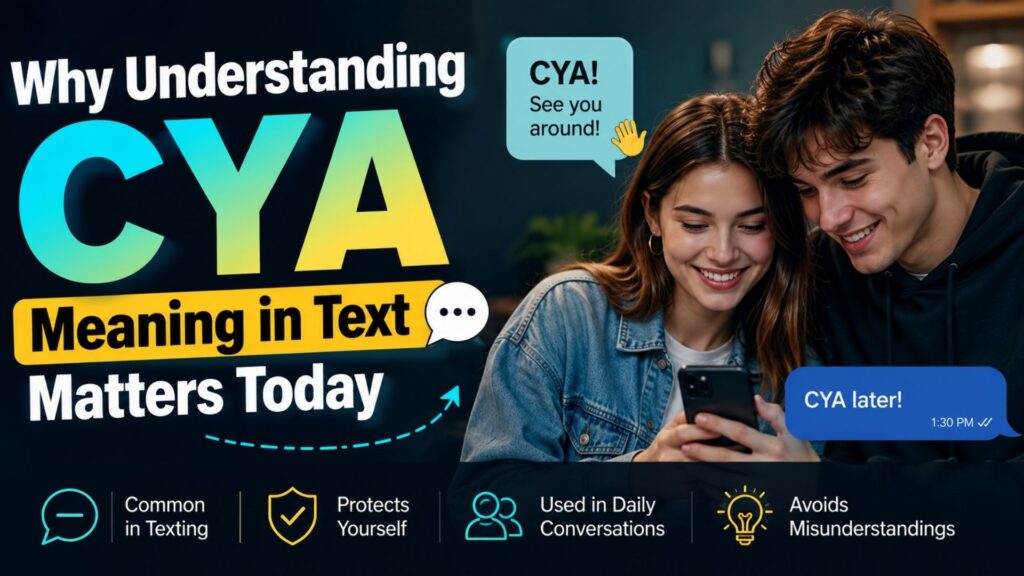
Understanding abbreviations like CYA can prevent surprisingly simple communication mistakes.
Imagine receiving:
“Save that screenshot. CYA.”
If you only know CYA as “see ya,” the message may seem confusing. But if you recognize the “cover your ass” meaning, the advice becomes clear: keep evidence in case you need it later.
The reverse can also happen. If a friend texts:
“I’m heading out now, CYA!”
there’s no reason to interpret it as workplace-style advice about protecting yourself.
Knowing both meanings helps you read the tone correctly instead of relying on a single dictionary definition.
This matters even more online because text removes many clues you normally get from voice and body language. A short abbreviation can carry different meanings depending on the surrounding words, relationship, and situation.
FAQs:
What does cya meaning in text mean in simple words?
The most common CYA meaning in text is “see ya” or “see you.” It’s an informal way to say goodbye. In some contexts, CYA can also mean “cover your ass.”
Is cya meaning in text positive or negative?
Usually, CYA is neutral or friendly when it means “see ya.” When it means “cover your ass,” it’s more practical and cautionary. The surrounding conversation determines the tone.
Where is cya meaning in text commonly used?
You’ll commonly see CYA in text messages, social media chats, gaming conversations, group chats, and other informal online communication. The “cover your ass” meaning can also appear in casual workplace conversations.
Is cya meaning in text formal or informal?
CYA is informal. It’s suitable for casual conversations with friends, classmates, or people who already use texting slang. Avoid using it in formal writing unless the context specifically calls for informal language.
Why do people search for cya meaning in text?
People often search for cya meaning in text because the abbreviation has more than one possible interpretation. Most of the time it means “see ya,” but in certain contexts it can mean “cover your ass.”
Conclusion:
The most common CYA meaning in text is “see ya” or “see you.” It’s a quick, casual way to end a conversation and usually suggests that you expect to talk to or see the person again.
However, CYA can also mean “cover your ass,” especially when someone is talking about protecting themselves, keeping records, or avoiding blame. The surrounding context tells you which meaning applies.
When you see CYA in a message, don’t overthink it. Look at the words around it, consider the situation, and think about your relationship with the sender. In a friendly goodbye, it almost certainly means “see ya.” In a conversation about responsibility or documentation, the second meaning may be intended.
