

Have you ever received a text like “I need smt to eat” or “Do you wanna do smt later?” and wondered what SMT means? Texting abbreviations can make online conversations confusing, especially when you come across a short form you haven’t seen before.
So, what does SMT mean in text? In most casual texting, chatting, and social media conversations, SMT means “something.” It’s an informal abbreviation people use to save time while typing. For example, “I need smt to eat” simply means “I need something to eat.”
However, context still matters. SMT can have other meanings in different situations, communities, or industries. That’s why it’s useful to look at the complete sentence instead of interpreting the abbreviation by itself.
In this guide, you’ll learn the smt meaning in text, how people use SMT in everyday conversations, where the abbreviation comes from, what emotional tone it can carry, and how it compares with similar texting shortcuts. You’ll also find plenty of real-world examples so you can recognize SMT quickly the next time it appears in a message.
What Does SMT Mean?
In casual texting, SMT usually means “something.” It’s a shortened version of the word “something,” commonly used in informal digital communication.
For example:
“I need smt to drink.”
This means:
“I need something to drink.”
The meaning is straightforward. Instead of typing all nine letters of “something,” the person uses three letters: SMT.
You may see this abbreviation in text messages, social media DMs, group chats, gaming conversations, and other informal online discussions. It’s especially useful when people want to type quickly or keep their messages short.
The important thing to remember is that SMT is informal texting shorthand, not standard formal English. You may see it frequently online, but that doesn’t mean you should use it in every type of writing.
For example, this would be perfectly normal in a casual chat:
“Let’s do smt tonight.”
But in a professional email, it’s better to write:
“Let’s do something tonight.”
In simple terms, if someone uses SMT in an ordinary text conversation, the safest first interpretation is “something.”
Simple Examples:
Here are some quick examples that make the smt meaning in text easy to understand:
- “I need smt to eat.” → “I need something to eat.”
- “Do you want smt?” → “Do you want something?”
- “Let’s do smt later.” → “Let’s do something later.”
- “I have smt to tell you.” → “I have something to tell you.”
- “I saw smt weird.” → “I saw something weird.”
- “Can you find smt interesting?” → “Can you find something interesting?”
- “I want smt sweet.” → “I want something sweet.”
- “We should watch smt tonight.” → “We should watch something tonight.”
- “I need smt new.” → “I need something new.”
- “Did you hear smt?” → “Did you hear something?”
- “There’s smt wrong.” → “There’s something wrong.”
- “Send me smt funny.” → “Send me something funny.”
Notice how the meaning becomes obvious when you read the entire sentence.
Origin and Background of the Term
SMT belongs to the larger world of internet slang and texting abbreviations. Unlike traditional words, many online abbreviations don’t have one clearly documented inventor or a precise date when they were created.
The growth of mobile texting and instant messaging encouraged people to shorten commonly used words. Typing on older mobile phones could be slow, so abbreviations became a practical way to communicate faster.
As texting evolved, users began creating shorthand for everyday words and phrases. Some abbreviations became widely recognized, while others remained popular within particular groups.
“Something” is a natural candidate for shortening because it appears frequently in everyday conversation. Instead of typing the complete word, some users choose “smt.”
Modern messaging platforms have made typing much easier, but texting shorthand has remained popular. Today, people use abbreviations for convenience, personality, speed, or simply because they’ve become accustomed to them.
You might encounter SMT on:
- Text messages
- Snapchat
- TikTok
- Facebook Messenger
- Discord
- Gaming chats
- Group messages
- Online forums
The exact popularity of SMT can vary between communities. Some people may prefer “smth,” “sth,” or simply writing “something” in full.
That’s one reason texting slang can sometimes feel confusing. There isn’t a single official dictionary that controls how every internet abbreviation must be used.
Read Moere: What Does SU Mean in Text? Meaning, Uses & Examples
How SMT Is Used in Daily Life

The most common everyday use of SMT is as a shortcut for “something.”
Imagine your friend texts:
“Wanna do smt later?”
They’re asking:
“Do you want to do something later?”
The abbreviation doesn’t change the meaning of the sentence. It simply makes the message shorter and more casual.
You can see the same pattern in many different situations.
SMT in Casual Conversations
A friend might write:
“I’m hungry. Need smt good.”
This means:
“I’m hungry. I need something good.”
Another example:
“I want smt different today.”
That means:
“I want something different today.”
SMT on Social Media
People may use SMT in DMs and comments because social media communication tends to be informal.
For example:
“Send me smt funny 😂”
means:
“Send me something funny.”
Or:
“I need smt new to watch.”
means:
“I need something new to watch.”
Read More: What Does SS Mean in Text? Meaning, Uses & Examples
SMT in Group Chats
Group chats often contain short, quick messages. Someone might write:
“Anyone wanna do smt tonight?”
The person is simply asking whether anyone wants to do something later.
Another example could be:
“Let’s plan smt for Saturday.”
That means:
“Let’s plan something for Saturday.”
SMT in Conversations With a Crush
SMT can also appear in romantic or flirty conversations.
For example:
“Wanna do smt this weekend?”
Here, SMT still means “something.” The flirty or romantic meaning comes from the context, not the abbreviation itself.
This distinction is important. SMT does not automatically mean anything romantic or suggestive. You need to consider the rest of the conversation and the relationship between the people involved.
Emotional or Practical Meaning of SMT
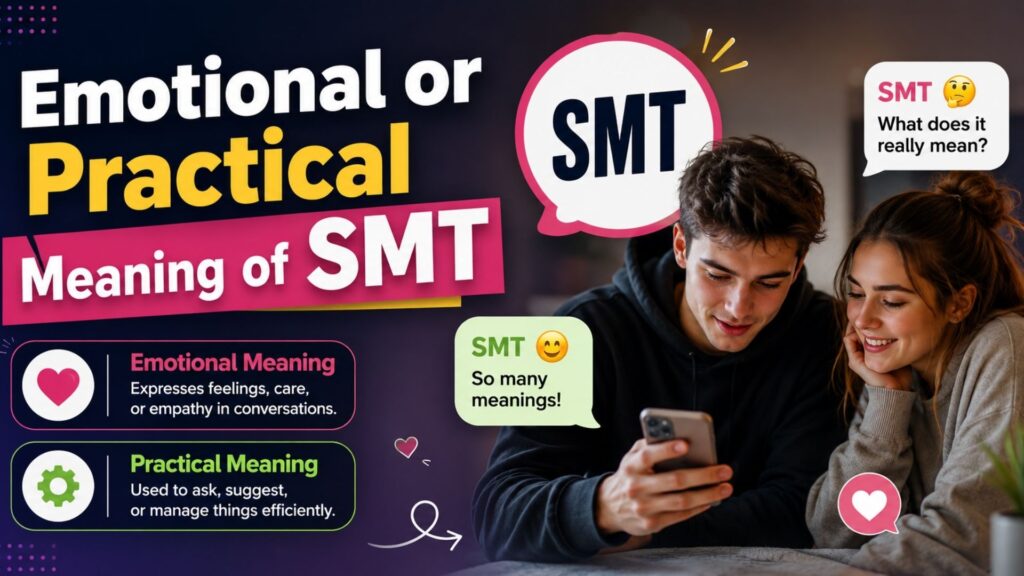
The abbreviation SMT has a simple practical meaning: “something.”
However, the sentence containing SMT can communicate almost any emotion.
For example:
“I have smt exciting to tell you!”
The message sounds enthusiastic because of the word “exciting,” not because SMT has a positive meaning.
Now consider:
“I think smt is wrong.”
That sounds worried or concerned, but again, the emotion comes from the rest of the sentence.
This is an important part of understanding the smt meaning in text. The abbreviation itself usually doesn’t communicate an emotion. Instead, it replaces the word “something” within a sentence that carries the actual tone.
SMT Makes Messages Feel More Casual
Compare these two messages:
“Would you like to do something later?”
and:
“Wanna do smt later?”
The first sounds more complete and polished. The second feels relaxed and conversational.
That difference is typical of texting shorthand.
SMT Can Make Messages Faster
When someone is having a quick conversation, they may not care about spelling every word completely.
For example:
“I need smt rn.”
This means:
“I need something right now.”
Using SMT makes the message shorter and quicker to type.
SMT Can Keep Something Vague
Sometimes people use “something” because they don’t want to specify exactly what they mean yet.
For example:
“I have smt to tell you.”
The speaker is saying they have something to share but hasn’t revealed what it is.
In this case, SMT contributes to the vagueness of the message simply because “something” itself is nonspecific.
Similar or Related Terms
SMT isn’t the only abbreviation people use to represent “something.” You may also encounter several similar forms in online communication.
| Abbreviation | Common Meaning | Typical Use |
|---|---|---|
| SMT | Something | Casual texting |
| SMTH | Something | Informal messaging |
| STH | Something | Informal writing |
| BTW | By the way | Texting/social media |
| IDK | I don’t know | Casual chats |
| TBH | To be honest | Social media/texting |
| IMO | In my opinion | Online conversations |
| LMK | Let me know | Texting |
| NVM | Never mind | Casual messages |
| RN | Right now | Texting/social media |
| WYD | What are you doing? | Casual texting |
| WBU | What about you? | Casual conversation |
| FYI | For your information | Casual/professional communication |
SMT vs. SMTH
SMT and SMTH can both represent “something.”
For example:
“I need smt to eat.”
and:
“I need smth to eat.”
Both can mean:
“I need something to eat.”
The difference is mainly the abbreviation people prefer.
SMT vs. STH
STH is another shortened form that may be used for “something.”
You could see:
“I want sth new.”
This means:
“I want something new.”
However, not every person uses the same abbreviation. Some people may understand SMT immediately but find STH unfamiliar, while others may have the opposite experience.
Why Are There Different Versions?
Texting language develops naturally. People shorten words based on convenience, habits, and the online communities they belong to.
There isn’t always one official rule saying which abbreviation is correct.
That’s why context and familiarity matter more than trying to find one universal spelling.
Common Misunderstandings About SMT
Because three letters can potentially stand for different phrases, SMT sometimes creates confusion.
Here are five common misunderstandings about the abbreviation.
1. SMT means “Send Me That”
Some people may interpret SMT as “send me that,” especially when the message involves sharing a photo, video, file, or link.
However, in ordinary texting where the sentence naturally calls for the word “something,” SMT usually means “something.”
For example:
“I need smt to eat.”
Clearly means:
“I need something to eat.”
It wouldn’t make sense to interpret SMT as “send me that” in this sentence.
On the other hand, if someone writes:
“SMT!”
after you mention a picture, they may have intended another phrase depending on their personal texting habits.
The solution is simple: read the context before deciding what SMT means.
2. SMT is always rude
SMT isn’t inherently rude, offensive, or disrespectful.
It’s simply an abbreviation.
For example:
“Can you send me smt funny?”
is informal but not rude.
Tone depends on the complete message, punctuation, relationship, and situation.
A short message can sound friendly when sent between close friends but blunt when sent in a formal setting. That’s a feature of communication, not a special meaning of SMT.
3. SMT is formal slang
SMT is informal texting shorthand, not formal English.
You generally shouldn’t use it in:
- Academic assignments
- Business reports
- Job applications
- Formal letters
- Professional documents
- Official communication
In those situations, simply write “something.”
For example, instead of:
“I need smt from the team.”
a professional version would be:
“I need something from the team.”
The full word is clearer and more appropriate.
4. Everyone understands SMT
Not everyone knows what SMT means.
Texting abbreviations can vary based on age, location, language background, online community, and personal habits.
Someone who spends a lot of time on social media might recognize SMT immediately. Someone who rarely uses texting slang may have no idea what it means.
So if someone asks:
“What does SMT mean?”
there’s no reason to assume they should already know.
Online language changes quickly, and unfamiliar abbreviations appear all the time.
5. SMT is universal
SMT does not have one guaranteed meaning in every context.
In casual texting, “something” is a common interpretation. However, the same three letters can represent different phrases in specialized fields, organizations, or communities.
For example, technology, business, education, and other industries may use SMT as an acronym for specific terms.
That’s why the phrase smt meaning in text is important. When you’re specifically talking about texting, “something” is the common interpretation, but outside texting, you should check the relevant context.
Examples of SMT in Sentences
Seeing SMT in realistic sentences makes the abbreviation much easier to understand.
Everyday Texting Examples
“I need smt to eat.”
Meaning: “I need something to eat.”
“Let’s do smt later.”
Meaning: “Let’s do something later.”
“I want smt sweet.”
Meaning: “I want something sweet.”
“I saw smt weird today.”
Meaning: “I saw something weird today.”
“Can you find smt interesting?”
Meaning: “Can you find something interesting?”
“I have smt to tell you.”
Meaning: “I have something to tell you.”
Social Media Examples
“Send me smt funny 😂”
Meaning: “Send me something funny.”
“I need smt new to watch.”
Meaning: “I need something new to watch.”
“Did you post smt today?”
Meaning: “Did you post something today?”
“I want smt different.”
Meaning: “I want something different.”
Friendly Conversation Examples
“Wanna do smt tonight?”
Meaning: “Do you want to do something tonight?”
“We should plan smt for the weekend.”
Meaning: “We should plan something for the weekend.”
“I heard smt about that.”
Meaning: “I heard something about that.”
“I have smt funny to show you.”
Meaning: “I have something funny to show you.”
Flirty Conversation Examples
“Wanna do smt together this weekend?”
Meaning: “Do you want to do something together this weekend?”
“I have smt cute to tell you.”
Meaning: “I have something cute to tell you.”
“We should definitely do smt soon.”
Meaning: “We should definitely do something soon.”
Again, SMT itself isn’t a romantic abbreviation. The surrounding words create the romantic or playful tone.
Why Understanding SMT Matters Today
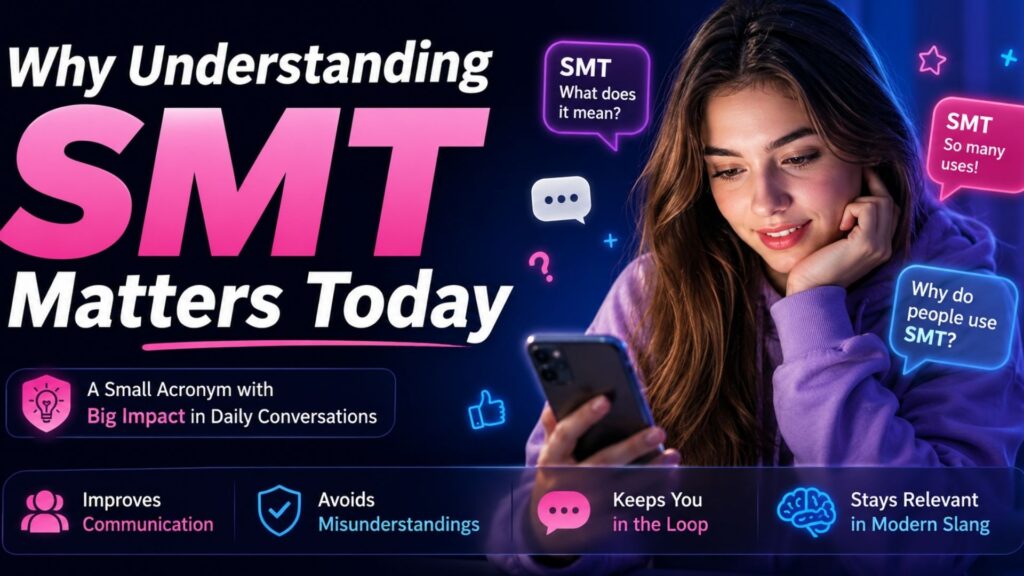
Digital communication has changed the way people write and interact.
You may have a conversation with someone without ever using a complete sentence. A message might contain abbreviations, emojis, slang, shortened words, and internet expressions all at once.
Understanding common texting terms helps you communicate more confidently and avoid unnecessary misunderstandings.
Knowing the smt meaning in text can help you:
- Understand messages more quickly
- Follow conversations on social media
- Communicate naturally with friends
- Understand texting slang
- Interpret unfamiliar messages
- Recognize informal language
- Know when an abbreviation is appropriate
- Avoid confusing casual and formal writing
However, learning abbreviations isn’t just about memorizing definitions.
Context is the real key.
Consider this message:
“I need smt.”
You know SMT probably means “something,” but you still don’t know what the person needs.
Now look at:
“I need smt to drink.”
The meaning is much clearer.
This is why you should always read the complete message before interpreting an abbreviation.
When Should You Use SMT?
SMT is appropriate when the conversation is relaxed and informal.
You can use it in:
- Text messages
- Casual DMs
- Group chats
- Social media conversations
- Gaming chats
- Conversations with friends
- Informal online communities
For example:
“Wanna do smt later?”
sounds perfectly natural in a casual chat.
When Should You Avoid SMT?
Avoid SMT when you’re writing something formal or when the reader may not understand texting abbreviations.
Instead of:
“I need smt from you.”
write:
“I need something from you.”
This is especially important in:
- Professional emails
- School assignments
- Business documents
- Job applications
- Formal reports
- Official messages
When clarity matters, spelling out the complete word is usually the better choice.
What If You Don’t Understand SMT?
Don’t guess if the context is unclear.
You can simply ask:
“What do you mean by SMT?”
Or:
“Do you mean something?”
A quick clarification can prevent an unnecessary misunderstanding.
FAQs:
What does smt meaning in text mean in simple words?
The smt meaning in text is usually “something.” It’s an informal abbreviation people use in casual messages to make texting quicker and shorter.
For example, “I need smt to eat” means “I need something to eat.”
Is SMT positive or negative?
Neither. SMT itself has no positive or negative emotion. It simply replaces the word “something.”
The tone depends on the rest of the sentence.
For example:
- “I have smt exciting to tell you!” → positive
- “I think smt is wrong.” → concerned
- “I need smt to eat.” → neutral
Where is SMT commonly used?
SMT is commonly used in casual digital communication, including text messages, social media DMs, group chats, gaming conversations, and informal online discussions.
You’re less likely to see it in formal writing.
Is SMT formal or informal?
SMT is informal texting shorthand.
It’s appropriate for casual conversations but generally not suitable for formal emails, academic writing, business documents, or official communication.
Why do people search for smt meaning in text?
People search for smt meaning in text because they may encounter the abbreviation in a message and not know what the sender intended.
Since abbreviations can vary between communities, people often look them up to confirm the most likely meaning.
Does SMT always mean “something”?
No. In casual texting, “something” is a common meaning, but SMT can represent other terms in different contexts.
If the message doesn’t make sense when SMT is replaced with “something,” consider whether the abbreviation has another meaning.
Is SMT the same as SMTH?
They can both be used to mean “something.”
For example:
“I need smt.”
and:
“I need smth.”
can both mean:
“I need something.”
The preferred form depends on the person and their texting habits.
Is SMT a slang word?
SMT is better described as an abbreviation or texting shorthand. It functions as a shortened form of “something” rather than as a slang word with its own separate definition.
Can SMT be used on Instagram?
Yes. You may see SMT in Instagram DMs, comments, or casual conversations. Social media encourages short, informal communication, so abbreviations like SMT are common.
What does “I need smt” mean?
It usually means:
“I need something.”
The specific thing the person needs depends on the rest of the conversation.
What does “let’s do smt” mean?
It usually means:
“Let’s do something.”
The speaker is suggesting an activity without saying exactly what they want to do.
What does “send me smt” mean?
In a context where SMT means “something,” “send me smt” means:
“Send me something.”
However, if the sentence doesn’t fit that interpretation, consider the context before deciding what the abbreviation means.
Is SMT used by teenagers?
Some teenagers and young adults may use SMT in casual digital conversations, but texting habits vary widely. Adults also use abbreviations, and not everyone uses SMT.
Can SMT be used in a romantic conversation?
Yes. Someone may use SMT while talking to a crush or partner.
For example:
“Wanna do smt this weekend?”
Here, SMT still means “something.” The romantic tone comes from the relationship and surrounding conversation, not the abbreviation itself.
Should I use SMT in a work email?
Usually, no. If you’re writing professionally, use “something” instead.
Writing the complete word makes your message clearer and more polished.
What should I do if someone uses SMT and I don’t understand it?
Look at the surrounding sentence first. If the meaning still isn’t clear, ask the person what they mean.
There’s nothing wrong with asking for clarification.
Conclusion
So, what does SMT mean in text? In most casual texting and social media conversations, SMT means “something.” It’s a simple piece of texting shorthand that helps people communicate quickly without typing the full word.
You might see messages such as “I need smt to eat,” “Let’s do smt later,” or “I have smt to tell you.” In each case, SMT works as a shortened form of “something.”
Still, context matters. SMT can have other meanings outside ordinary texting, and not everyone uses the same abbreviations. That’s why you should consider the complete message before deciding what someone means.
The easiest rule to remember is this: if SMT appears in a casual text and “something” makes sense in the sentence, that’s probably what the sender means.
Once you understand that basic usage, you’ll recognize SMT much more easily in texts, DMs, social media posts, and group chats. And when clarity matters, especially in professional or academic writing, it’s always better to write “something” in full.
