
Have you ever been chatting with someone online when they suddenly disappear, only to come back later and say, “Sorry, I was AFK”? If you’ve never seen the term before, you might wonder what they mean.
So, what does AFK mean in text? AFK stands for “away from keyboard.” It’s a common internet abbreviation people use to let others know they’re temporarily stepping away from their computer or device and won’t be actively responding for a while.
Although the term originally became popular in online gaming and computer chat rooms, its use has expanded. Today, you might see AFK in gaming communities, Discord servers, work chats, livestreams, online classes, and everyday messaging. The exact meaning stays essentially the same: the person is temporarily unavailable or not actively participating.
In this guide, we’ll explain what does AFK mean in text, where the term came from, how people use it in different situations, what it means emotionally, and how it compares with related expressions such as BRB, offline, and idle.
What Does AFK Meaning in Text?
The what does AFK mean in text question has a simple answer: AFK means “away from keyboard.”
When someone says they’re AFK, they’re telling you that they’re temporarily stepping away and may not respond immediately.
For example:
“AFK for 10 minutes. Need to grab some food.”
This means:
“I’m stepping away from my computer for about 10 minutes.”
The person isn’t necessarily ending the conversation. They simply won’t be actively available for a short period.
The abbreviation is especially common in situations where people communicate in real time. For example, if you’re playing an online game with friends, suddenly leaving without explanation could make teammates wonder where you went. Saying “AFK” lets everyone know you’re temporarily away.
What Does AFK Stand For?
AFK = Away From Keyboard
The phrase originally referred to people physically stepping away from their computer keyboard. However, modern usage has become broader.
Today, someone might say “AFK” even when they’re using:
- A smartphone
- A tablet
- A laptop
- A gaming console
- A work computer
The basic idea is still the same: I’m not currently available or actively responding.
Real-Life Examples:
Here are a few realistic examples that show how AFK works in conversation.
Example 1: Gaming
“AFK for five. My food just arrived.”
The player is temporarily leaving the game.
Example 2: Group Chat
“Sorry, I was AFK. What did I miss?”
The person was away and didn’t see the conversation.
Example 3: Work Chat
“I’ll be AFK during lunch.”
The person won’t be available to respond during lunch.
Example 4: Online Class
“AFK for a minute—my internet is acting up.”
The person is temporarily unable to participate.
Example 5: Casual Texting
“I went AFK for an hour and came back to 50 messages 😂.”
The person is joking about being away from their phone or computer.
In each example, AFK communicates temporary absence rather than permanent unavailability.
Origin and Background of the Term
The phrase “away from keyboard” developed alongside early online communication. Before smartphones and always-connected apps became normal, people often communicated through computer-based chat rooms, forums, and instant messaging services.
When someone physically stepped away from their computer, they couldn’t immediately respond. Saying “AFK” became a quick way to let others know why they weren’t replying.
The abbreviation became particularly popular in online gaming. Multiplayer games often require players to communicate and coordinate in real time. If someone suddenly stopped moving or responding, teammates needed to know whether the player had disconnected, encountered a technical problem, or simply stepped away.
AFK solved that problem with three letters.
Over time, the term spread beyond gaming. Online communities adopted it, and eventually people started using it in everyday digital conversations.
Today, the phrase has become part of internet vocabulary. Interestingly, the original reference to a keyboard isn’t always literal anymore. Someone might say:
“I’m AFK.”
while stepping away from their phone.
The meaning has evolved with technology, but the basic concept remains unchanged: temporarily away and not actively available.
How AFK Is Used in Daily Life
The what does AFK mean in text question becomes even clearer when you look at the different places where people use the abbreviation.
1. During Online Gaming
Gaming is probably the context most strongly associated with AFK.
Imagine you’re playing an online multiplayer game with three friends. Suddenly, one teammate stops moving. Instead of leaving everyone wondering what happened, they might type:
“AFK, grabbing water.”
This tells the team they’re temporarily stepping away.
In gaming, AFK can be especially important because an inactive player may affect the entire team. Depending on the game, an AFK player could leave teammates without support or create a disadvantage.
Players may also use phrases such as:
- “Going AFK.”
- “AFK for 5 mins.”
- “Sorry, was AFK.”
- “Back from AFK.”
- “I was AFK when that happened.”
The length of time can vary. Sometimes it means someone will be gone for thirty seconds. Other times, it might mean several minutes.
2. In Work Chats
You may also see AFK in workplace messaging platforms and team chats.
For example:
“I’ll be AFK from 12 to 1 for lunch.”
This tells coworkers that the person won’t be available during that period.
Another example:
“AFK for a doctor’s appointment. Back around 3.”
In a workplace context, AFK usually means temporarily unavailable.
However, because AFK is informal, it’s generally better suited to internal team chats than formal emails or official business documents.
For professional communication, you might instead write:
“I’ll be away from my desk until 3 PM.”
Still, in a relaxed workplace where abbreviations are common, AFK can be perfectly understandable.
3. On WhatsApp or Messenger
People sometimes use AFK in regular messaging apps, even though they’re not necessarily sitting at a keyboard.
For example:
“AFK, cooking dinner.”
Or:
“Sorry, I was AFK. Just saw your message.”
Here, AFK essentially means the person was away from their device or not actively checking messages.
In this context, the abbreviation is often used loosely. It doesn’t matter whether the person literally walked away from a keyboard. The intended meaning is simply “I wasn’t available for a while.”
4. In Livestreams
AFK is also common among livestreamers and their audiences.
A streamer might say:
“I’ll be AFK for a few minutes.”
This tells viewers that they’ll temporarily step away from the stream.
They may need to:
- Get a drink
- Use the bathroom
- Take a short break
- Handle something off-camera
- Fix equipment
Viewers might also use AFK in the chat:
“Sorry, I was AFK when that happened!”
This means they weren’t watching or participating at that moment.
5. In Online Classes
Students may occasionally use AFK in virtual classes or study groups.
For example:
“AFK for a minute. My doorbell rang.”
Or:
“Sorry, I was AFK and missed the question.”
In this situation, the person is explaining why they weren’t actively participating.
However, using AFK in a formal online class may not always be appropriate. If you’re communicating with an instructor, it’s usually clearer to say:
“Sorry, I had to step away for a moment.”
The right choice depends on the level of formality.
Read more: 250+ Best Friendly Text Messages to Send Anytime
Emotional or Practical Meaning of AFK
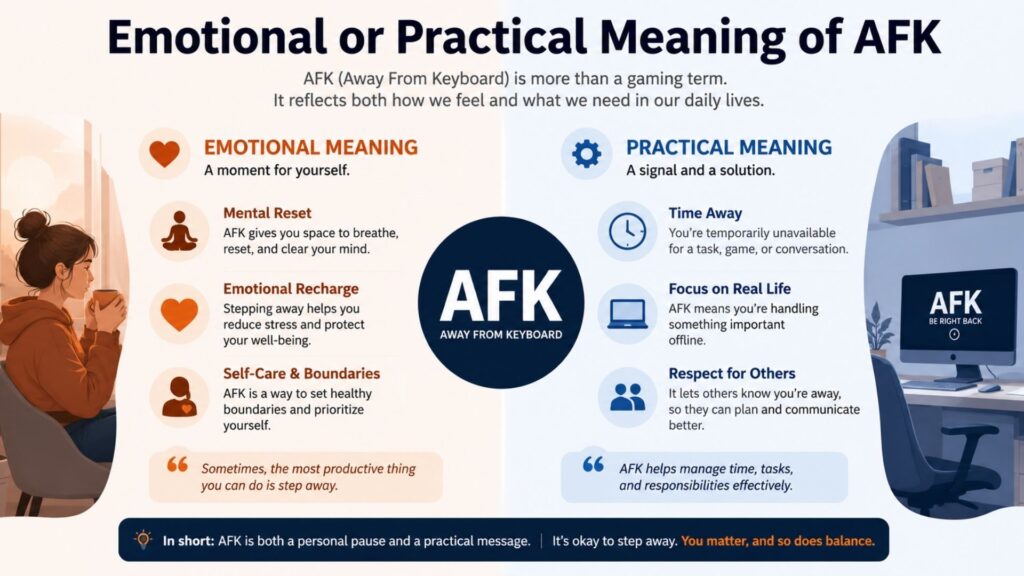
The what does AFK mean in text definition is practical, but the term can also carry subtle social meaning depending on the situation.
At its core, AFK is about availability rather than emotion.
AFK Usually Means Temporary Absence
When someone says:
“I’m AFK.”
they’re usually communicating:
“I’m temporarily unavailable.”
This helps manage expectations. You’re less likely to wonder why they aren’t responding.
AFK Can Explain a Delayed Reply
If someone returns after an hour and says:
“Sorry, I was AFK.”
they’re explaining why they didn’t answer earlier.
The person isn’t necessarily apologizing for ignoring you. They may simply have been away from their device.
AFK Can Be Completely Neutral
There’s nothing inherently positive or negative about being AFK.
For example:
“AFK, making coffee.”
That’s simply information.
AFK Can Sometimes Be Playful
Friends may use the term jokingly.
“I went AFK from adulthood for three hours.”
Here, the speaker is humorously saying they took a break from responsibilities.
Another example:
“My brain is AFK today.”
This doesn’t literally mean the person’s brain has gone somewhere. It’s a humorous way of saying they’re distracted, tired, or unable to concentrate.
AFK Doesn’t Always Mean Physically Far Away
Modern usage has expanded beyond the literal meaning of “away from keyboard.”
Someone might be sitting next to their phone but not checking it. They could still say:
“Sorry, I was AFK.”
In this case, they’re using AFK more generally to mean not actively available online.
Similar or Related Terms
If you’re learning what does AFK mean in text, you’ll likely come across several related expressions.
BRB
BRB means “be right back.”
It’s usually used when someone expects to return soon.
“BRB, getting some water.”
The difference is subtle:
- AFK emphasizes being away or unavailable.
- BRB emphasizes that the person expects to return shortly.
They can also be used together:
“BRB, AFK for a minute.”
BBL
BBL means “be back later.”
It’s generally used when someone expects to return after a longer period.
“BBL, I’ve got to go out.”
Offline
Being offline usually means you’re not connected or available online.
However, someone can be online but still AFK.
For example, their account might show them as active, but they’ve stepped away from the device.
Idle
Idle generally means inactive.
In gaming, an idle player may be connected to the game but not actively doing anything.
Someone can be AFK and therefore appear idle, but the terms aren’t exactly identical.
Away
Away is the simplest everyday alternative.
“I’m away for a few minutes.”
This communicates essentially the same basic idea as AFK but is easier to understand in formal or general communication.
Offline vs. AFK
Here’s a quick comparison:
| Term | Meaning | Typical Use |
|---|---|---|
| AFK | Away from keyboard / temporarily unavailable | Gaming and online chats |
| BRB | Be right back | Short breaks |
| BBL | Be back later | Longer absence |
| Offline | Not currently connected or available online | Messaging and apps |
| Idle | Not actively doing anything | Gaming and software |
| Away | Temporarily unavailable | General communication |
Common Misunderstandings About AFK
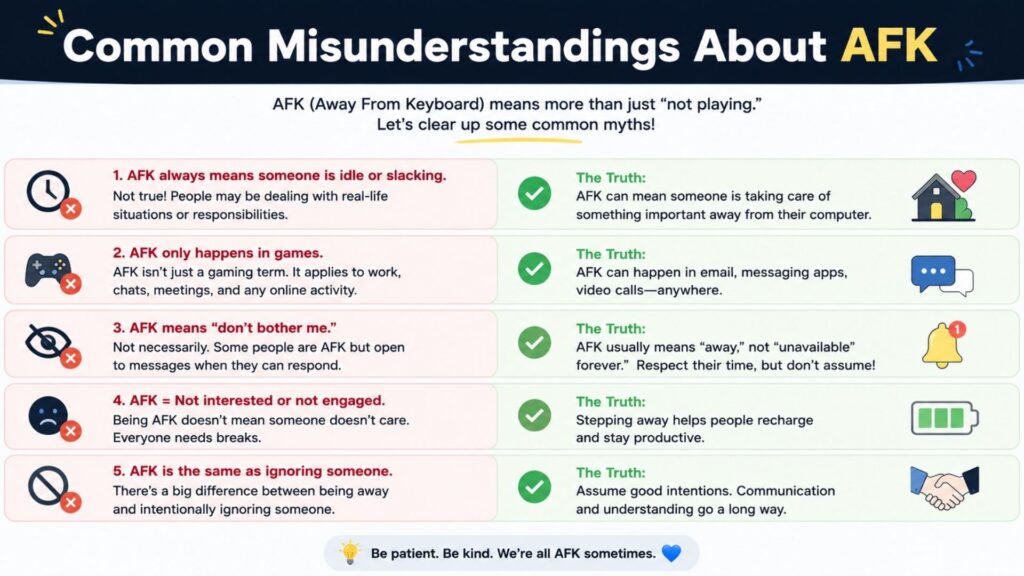
Even though AFK is widely used, people sometimes misunderstand what it actually means.
1. AFK Means Ignoring
Not necessarily.
If someone says:
“Sorry, I was AFK.”
they’re usually saying they weren’t available—not that they deliberately ignored you.
Of course, context matters. Someone could technically use AFK as an excuse, but the term itself doesn’t imply intentional avoidance.
2. AFK Is Rude
AFK isn’t inherently rude.
In fact, announcing that you’re AFK can be considered considerate because you’re letting others know why you aren’t responding.
For example:
“AFK for 10 minutes.”
is more informative than simply disappearing from a live conversation.
That said, repeatedly going AFK during an important activity—such as a team game or meeting—could frustrate others. The issue would be the behavior, not the abbreviation itself.
3. AFK Means Gone Forever
No. AFK generally indicates a temporary absence.
If someone says:
“I’m AFK.”
they usually intend to return at some point.
For a longer or permanent departure, people might say they’re leaving, logging off, or going offline.
4. AFK Is Only for Gamers
Gaming helped popularize AFK, but the term isn’t limited to gaming.
You can find it in:
- Work chats
- Group messages
- Livestreams
- Online classes
- Discord servers
- Social media
- General texting
Its meaning remains essentially the same: temporarily unavailable or away.
5. AFK Is Formal
AFK is informal internet shorthand.
It’s fine in casual messages and many online communities. However, it may not be the best choice for formal communication.
Instead of writing:
“I’ll be AFK during the meeting.”
in a formal email, you might say:
“I’ll be unavailable during the meeting.”
The full phrase is clearer and more professional.
Examples of AFK in Sentences
Here are more examples to help you understand how people naturally use the term.
Example 1: Gaming
“AFK for two minutes. Someone’s at the door.”
Meaning: The player is temporarily leaving the game.
Example 2: Returning to a Conversation
“Sorry, I was AFK. What did I miss?”
Meaning: The person was away and didn’t see what happened.
Example 3: Work
“I’ll be AFK for lunch, but I’ll check messages afterward.”
Meaning: The person won’t be available during lunch.
Example 4: Messaging
“I was AFK when you called.”
Meaning: The person wasn’t available when the call came in.
Example 5: Social Media
“Went AFK for the weekend. Just catching up now.”
Meaning: The person took a break from being online.
Example 6: Livestream
“AFK for a minute, guys. Don’t go anywhere!”
Meaning: The streamer is taking a short break.
Example 7: Online Class
“Sorry, I was AFK and missed the last part.”
Meaning: The student briefly stepped away and missed something.
Example 8: Humor
“My brain has been AFK since Monday.”
Meaning: The person is joking that they’ve been mentally tired or distracted.
Example 9: Group Chat
“I was AFK for an hour and came back to 200 messages.”
Meaning: The person wasn’t checking the group chat for an hour.
Example 10: Gaming Team
“Don’t start the match yet. Jake’s AFK.”
Meaning: Jake isn’t currently available or actively participating.
Why Understanding AFK Meaning in Text Matters Today
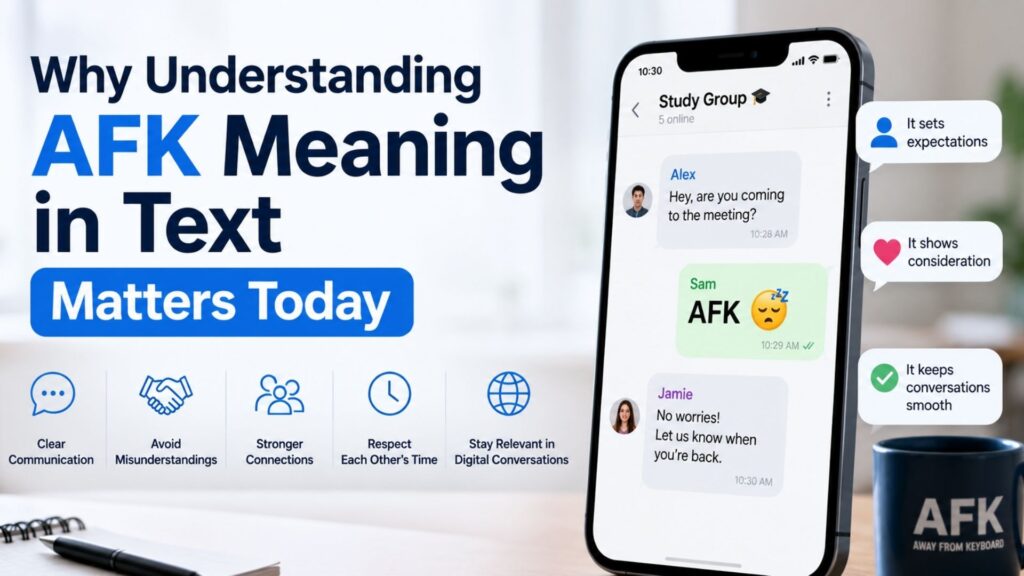
Understanding what does AFK mean in text isn’t just about learning another internet abbreviation. It helps you communicate more effectively in a world where digital conversations happen constantly.
It Helps You Understand Online Conversations
If someone says:
“AFK, back soon.”
you immediately know why they’re not responding.
Without understanding the term, you might incorrectly assume they’ve left the conversation permanently.
It Helps You Follow Gaming Conversations
If you’re new to online gaming, AFK is one of the terms you’re likely to encounter quickly.
Players use it to communicate their availability and explain why they’re temporarily inactive.
It Helps You Interpret Workplace Messages
Remote and hybrid work have made digital communication increasingly important. You may see terms like AFK used in internal chats to indicate when someone is away.
Understanding the abbreviation can make team communication smoother.
It Helps You Understand Social Media Language
Internet slang spreads quickly across platforms. A term that starts in gaming can eventually become common in everyday conversations.
AFK is a good example of how online language evolves.
It Helps You Avoid Misreading Someone’s Intent
Perhaps the biggest benefit is understanding that AFK usually describes availability, not attitude.
If someone says they’re AFK, don’t automatically assume they’re ignoring you. They may simply be away from their device.
As always, context matters. But knowing the basic meaning gives you a much better starting point.
FAQs:
What does AFK meaning in text mean in simple words?
The what does AFK mean in text answer is simple: AFK means “away from keyboard.” In modern digital communication, it usually means someone is temporarily away or unavailable and may not respond immediately.
Is AFK positive or negative?
AFK is generally neutral. It doesn’t express a positive or negative emotion. It simply tells others that someone is temporarily unavailable. The surrounding conversation determines the tone.
Where is AFK commonly used?
AFK is commonly used in online gaming, Discord, group chats, work messaging, livestreams, online classes, and social media conversations. It originally became especially popular in gaming and online chat communities.
Is AFK formal or informal?
AFK is informal internet shorthand. It’s appropriate for casual conversations and many online communities but may not be suitable for formal emails, official documents, or professional communication.
Why do people search for AFK meaning in text?
People search for AFK meaning in text because they may encounter the abbreviation in a message, game, livestream, or online community and not know what it stands for. Understanding it helps them follow digital conversations more easily.
What does AFK stand for?
AFK stands for “away from keyboard.” The term originally referred to someone stepping away from their computer but is now often used more broadly to mean temporarily unavailable.
Is AFK the same as BRB?
Not exactly. BRB means “be right back,” while AFK means “away from keyboard.” Both can describe a temporary absence, but BRB more directly suggests that the person expects to return soon.
Can I use AFK on WhatsApp?
Yes. People sometimes use AFK on WhatsApp and other messaging apps to explain that they’re temporarily away from their phone or not actively checking messages.
Does AFK mean someone is ignoring you?
Not usually. AFK generally means the person is temporarily unavailable. It doesn’t automatically mean they’re deliberately ignoring your messages.
Is AFK only used by gamers?
No. Although gamers helped popularize the term, AFK is now used in many digital environments, including work chats, livestreams, group messages, and online classes.
What does “going AFK” mean?
“Going AFK” means stepping away temporarily. For example, “I’m going AFK for 10 minutes” means the person won’t be actively available for the next 10 minutes.
Conclusion:
So, what does AFK mean in text? In most cases, it means “away from keyboard.” More broadly, it tells someone that you’re temporarily away, unavailable, or not actively participating in an online conversation.
The term has its roots in early computer communication and became especially popular in online gaming. However, its use has grown far beyond gaming. Today, you might see AFK in work chats, WhatsApp messages, livestreams, online classes, Discord servers, and everyday conversations.
Remember that AFK is informal shorthand. It usually describes a temporary absence and doesn’t automatically mean someone is ignoring you or being rude. If a friend says, “Sorry, I was AFK,” they’re most likely explaining that they stepped away and couldn’t respond at the time.
Once you understand the term, you’ll start noticing how naturally it fits into digital communication. Whether someone is grabbing a snack during a game, stepping away from a work chat, or taking a quick break from social media, AFK is simply a short way of saying, “I’m away right now.”
