
Have you ever seen someone write “opt” in a text message and wondered what they were trying to say? Unlike some texting abbreviations, OPT can be confusing because it isn’t always used in exactly the same way. In some conversations, it may simply be the shortened form of “option” or “optional.” In others, it can be the regular English verb “opt,” meaning to choose or select something.
So, what is the opt meaning in text? The answer depends heavily on the sentence and context. For example, “I’ll opt for pizza” means “I’ll choose pizza,” while “This feature is opt” might be an informal reference to something being optional, although that usage is less standard. You may also see OPT used as an acronym in specific communities, workplaces, schools, or online platforms.
In this guide, we’ll explore the opt meaning in text, its common uses, related terms, possible misunderstandings, and real examples. By the end, you’ll know how to interpret opt without having to guess what the sender meant.
What Does OPT Meaning in Text?
The most common opt meaning in text is connected to the verb “opt,” which means to choose or decide on something.
For example:
“I’ll opt for the cheaper one.”
This means:
“I’ll choose the cheaper one.”
The word opt isn’t necessarily texting slang. It’s a standard English word that people may use in casual messages, emails, social media posts, and everyday conversations.
You might see it used like this:
- “I’ll opt for the blue one.”
- “She opted to stay home.”
- “We decided to opt out.”
- “You can opt in if you want.”
- “I’d probably opt for the first choice.”
In these examples, opt means choose, select, or decide.
However, OPT can also appear as an abbreviation or acronym. Its meaning can change depending on the context.
For example, in a conversation about technology, OPT might refer to a specific feature or program. In an academic or immigration context, OPT can have a completely different meaning. That’s why it’s important to look at the words surrounding it.
Quick Meaning Guide
| Term | Common Meaning |
|---|---|
| Opt | Choose or select |
| Opt for | Choose something |
| Opt to | Choose to do something |
| Opt in | Choose to participate |
| Opt out | Choose not to participate |
| Optional | Not required |
| Option | A choice |
In everyday texting, the safest interpretation is usually related to choosing or selecting something.
Origin and Background of the Term
The word opt comes from the Latin word optare, meaning “to choose” or “to wish for.” It eventually became part of English as a verb meaning to make a choice.
Over time, opt became especially common in phrases such as:
- opt for
- opt to
- opt in
- opt out
These expressions are now used in everyday English.
For example:
“I opted for the train.”
This means:
“I chose the train.”
Or:
“She opted to work from home.”
This means:
“She chose to work from home.”
Because these phrases are relatively short, people often use them in digital conversations without thinking of them as slang.
It’s also important to distinguish opt from true texting abbreviations. Unlike expressions such as LOL or BRB, the word opt is a normal English verb. Someone using it in a message isn’t necessarily using internet slang at all.
That said, OPT in capital letters can sometimes represent an acronym. The meaning then depends entirely on the subject being discussed.
Read more: 250+ Best Friendly Text Messages to Send Anytime
How OPT Is Used in Daily Life
The opt meaning in text becomes much easier to understand when you see how the word works in everyday conversations.
“Opt For” Means “Choose”
This is probably the most common structure.
“I think I’ll opt for the chicken.”
The person is saying they have chosen chicken.
Another example:
“We opted for the cheaper hotel.”
This means they chose the less expensive hotel.
“Opt To” Means “Choose to Do Something”
The phrase opt to is followed by an action.
“I opted to stay home.”
This means:
“I chose to stay home.”
Another example:
“She opted to take the bus.”
The person chose to take the bus instead of another form of transportation.
“Opt In” Means “Choose to Participate”
If you opt in, you choose to participate in something.
For example:
“I opted in for email notifications.”
This means you chose to receive email notifications.
You might also see:
“You can opt in if you want updates.”
Here, the person is saying participation is your choice.
“Opt Out” Means “Choose Not to Participate”
If you opt out, you choose not to participate.
For example:
“I opted out of the group chat.”
This means the person chose not to remain involved in the group chat.
Another example:
“You can opt out of promotional emails.”
This means you can choose not to receive them.
OPT in Casual Conversations
Someone might text:
“I’ll opt for the first one.”
This is a straightforward way of saying:
“I’ll choose the first one.”
It can sound slightly more deliberate than simply saying “I’ll pick the first one,” but it’s perfectly natural.
OPT in Social Media
On social media, you may encounter phrases such as:
“I opted out of the trend.”
or:
“I’m opting for a simpler look.”
Here, the meaning is still related to choosing.
The word can appear in captions, comments, direct messages, and posts.
Emotional or Practical Meaning of OPT
Unlike slang terms that express emotions, opt usually communicates a decision or preference.
That’s an important distinction when understanding the opt meaning in text.
If someone says:
“I’ll opt for the second option.”
They’re not necessarily expressing excitement, sadness, or anger. They’re simply explaining their choice.
OPT Shows a Decision
When someone uses opt, they’re usually communicating that they’ve considered multiple possibilities and selected one.
For example:
“I opted for the earlier flight.”
This suggests the person had choices and selected the earlier flight.
OPT Can Sound Deliberate
The word opt sometimes gives the impression of a thoughtful or intentional choice.
Compare:
“I picked the blue shirt.”
with:
“I opted for the blue shirt.”
Both mean roughly the same thing, but opted for can sound slightly more deliberate.
OPT Can Communicate Preference
For example:
“I usually opt for tea instead of coffee.”
This means the person generally chooses tea.
OPT Doesn’t Automatically Show Emotion
The word itself isn’t positive or negative.
For example:
“I opted to stay home.”
This could be positive if the person wanted a relaxing evening. It could also be negative if they stayed home because they were feeling unwell.
The emotional meaning comes from the surrounding context, not from the word opt itself.
Similar or Related Terms
Understanding related words can make the opt meaning in text even clearer.
Choose
Choose is the most direct synonym.
“I chose the blue one.”
“I opted for the blue one.”
Both communicate a decision.
Pick
Pick is more casual.
“I picked the first option.”
“I opted for the first option.”
The first sounds more conversational, while the second can sound slightly more polished.
Select
Select is often used in formal, technical, or instructional contexts.
“Select your preferred language.”
This means:
“Choose your preferred language.”
Decide
Decide focuses more on the process of making a decision.
“I decided to stay.”
“I opted to stay.”
These can have similar meanings, although decide emphasizes the decision itself.
Optional
Optional means something is not required.
For example:
“The extra assignment is optional.”
This is different from opt, which is a verb meaning to choose.
Opt In
To opt in means to choose to participate or receive something.
“I opted in to receive notifications.”
Opt Out
To opt out means to choose not to participate or receive something.
“I opted out of the newsletter.”
Here’s a quick comparison:
| Word or Phrase | Meaning |
|---|---|
| Opt | Choose |
| Opt for | Choose something |
| Opt to | Choose to do something |
| Opt in | Choose to participate |
| Opt out | Choose not to participate |
| Choose | Select between possibilities |
| Pick | Casual word for choose |
| Select | Choose, often in a formal or technical context |
| Optional | Not required |
Common Misunderstandings About OPT
The word opt is relatively simple, but there are several ways people can misunderstand it.
OPT Doesn’t Always Mean “Option”
Some people assume opt is simply a shortened form of option. Usually, that’s not correct.
For example:
“I’ll opt for pizza.”
Here, opt means choose. It isn’t a shortened version of “option.”
An option is a choice that is available.
To opt means to choose.
OPT Isn’t Always Texting Slang
If someone writes:
“I opted for the earlier train.”
They’re using a standard English word, not necessarily internet slang.
This is different from abbreviations such as LOL, IDK, or OMG, which are strongly associated with digital communication.
OPT Doesn’t Mean “Optional”
The words are related but have different grammatical roles.
Opt is a verb:
“I opted to leave.”
Optional is an adjective:
“The meeting is optional.”
This difference is important when interpreting a message.
OPT Isn’t Always an Acronym
If someone writes OPT in uppercase letters, it could be an acronym in a specialized context. However, capitalization alone doesn’t tell you exactly what it means.
You need to look at the surrounding conversation.
For example, if you’re talking about career or immigration matters, OPT may refer to a specific program rather than the verb “opt.”
OPT Can Have Different Meanings in Different Communities
A short acronym can mean different things to different groups.
For example, a student, software developer, gamer, or employee may use OPT differently depending on the subject.
That’s why context matters more than capitalization.
Examples of OPT in Sentences
Let’s look at realistic examples to understand the opt meaning in text more clearly.
Example 1: Choosing Food
Alex: “What are you ordering?”
Sam: “I think I’ll opt for the pasta.”
Meaning: Sam has decided to choose the pasta.
Example 2: Choosing a Color
“I was going to buy the black one, but I opted for blue instead.”
Meaning: The person chose blue instead of black.
Example 3: Choosing to Stay Home
“It was raining, so I opted to stay home.”
Meaning: The person chose to stay home.
Example 4: Opting In
“I opted in to receive notifications.”
Meaning: The person chose to receive notifications.
Example 5: Opting Out
“I opted out of the promotional emails.”
Meaning: The person chose not to receive promotional emails.
Example 6: Casual Texting
Friend: “Movie tonight?”
You: “I’ll opt for the comedy.”
Meaning: You’re choosing the comedy movie.
Example 7: Making a Travel Choice
“We opted for the train instead of the bus.”
Meaning: The group chose to travel by train.
Example 8: Choosing Convenience
“I was tired, so I opted for delivery.”
Meaning: The person chose food delivery rather than going out.
Example 9: Making a Personal Decision
“She opted to take some time off.”
Meaning: She chose to take time off.
Example 10: Choosing Between Two Options
“Both are good, but I’d opt for the first one.”
Meaning: The speaker would choose the first option.
These examples show why the context surrounding opt is so useful. Once you identify what decision is being discussed, the meaning becomes clear.
Why Understanding OPT Meaning in Text Matters Today
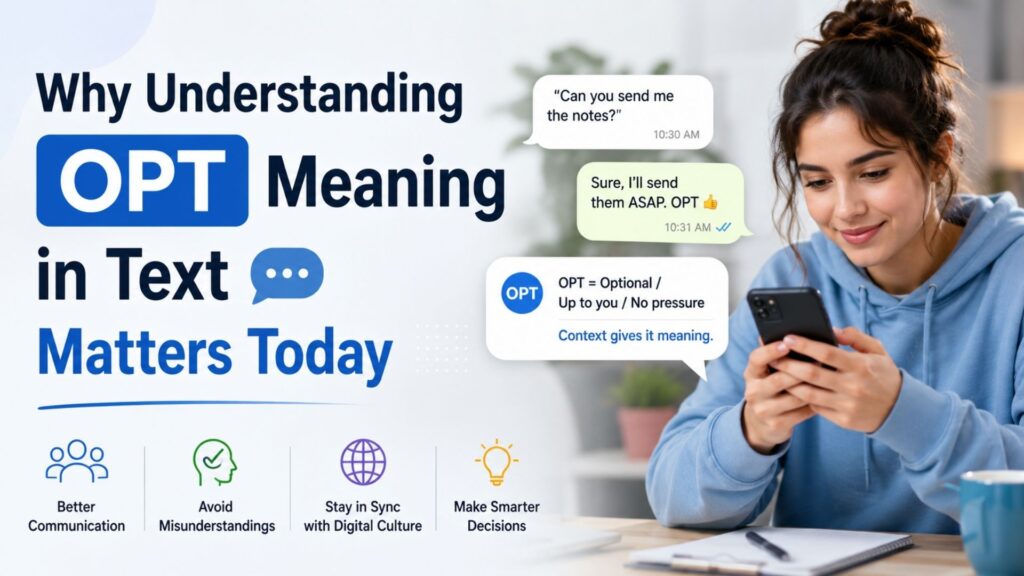
Why does understanding a simple word like opt matter? Because digital communication often removes the extra context you’d get from face-to-face conversations.
When you see a short message, you need to interpret the words based on the situation.
It Helps You Understand Someone’s Choice
If someone says:
“I opted for the earlier flight.”
you immediately know they’ve made a decision.
Understanding opt helps you follow the conversation without stopping to look up the word.
It Helps You Recognize Digital Communication Patterns
People often use concise language online. While opt isn’t necessarily slang, it frequently appears in messages because it’s a short and efficient way to describe a decision.
It Helps You Understand “Opt In” and “Opt Out”
These expressions are particularly important in modern digital life.
You may see them when dealing with:
- Email subscriptions
- Marketing messages
- App notifications
- Privacy settings
- Website cookies
- Online services
- Surveys
- Memberships
Knowing the difference can help you understand what you’re agreeing to—or declining.
It Helps Prevent Misunderstandings
If someone says:
“You can opt out.”
They’re telling you that you have the choice not to participate.
If you misunderstand opt out as something else, you could miss an important instruction.
Context Is Still the Key
The most important lesson is simple: don’t interpret OPT in isolation.
Look at the complete sentence.
For example:
“I’ll opt for this one.”
The meaning is easy: I’ll choose this one.
But:
“My OPT was approved.”
That may refer to a specific acronym rather than the ordinary verb opt.
The surrounding topic tells you which meaning makes sense.
FAQs:
What does opt meaning in text in simple words?
The opt meaning in text is usually “to choose” or “to select.” For example, “I’ll opt for the blue one” means “I’ll choose the blue one.”
Is opt positive or negative?
Opt is neutral. It doesn’t express a positive or negative emotion by itself. It simply describes making a choice. The context determines whether the decision is good, bad, exciting, or disappointing.
Where is opt commonly used?
The word opt appears in everyday conversations, text messages, emails, social media posts, websites, apps, and formal writing. You’ll often see it in phrases such as opt for, opt to, opt in, and opt out.
Is opt formal or informal?
Opt is a standard English word that can be used in both casual and formal communication. However, phrases such as “opt for” may sound slightly more polished than casual alternatives like “pick” or “go with.”
Why do people search for opt meaning in text?
People search for the opt meaning in text because they may see the word used in an unfamiliar way or encounter OPT as an acronym. The meaning can vary depending on the context, so checking the surrounding conversation is important.
What does “opt for” mean?
Opt for means to choose something.
For example:
“I opted for the blue shirt.”
This means:
“I chose the blue shirt.”
What does “opt to” mean?
Opt to means to choose to do something.
For example:
“She opted to stay home.”
This means:
“She chose to stay home.”
What does “opt in” mean?
Opt in means to choose to participate in something or agree to receive something.
For example:
“I opted in to receive updates.”
What does “opt out” mean?
Opt out means to choose not to participate in something or to stop receiving something.
For example:
“I opted out of the mailing list.”
Is OPT an abbreviation for option?
Not usually. Opt is a verb meaning to choose. The noun option refers to a choice that is available.
Can OPT have other meanings?
Yes. OPT can be an acronym for different terms in specialized fields, such as education, employment, technology, or immigration. The correct meaning depends on the context.
Conclusion:
The opt meaning in text is usually straightforward: to choose or select something. It’s a standard English verb rather than typical texting slang, and you’ll often see it in phrases such as opt for, opt to, opt in, and opt out.
For example, if someone says, “I’ll opt for the first one,” they’re simply saying, “I’ll choose the first one.” If they say, “I opted out,” they’re saying they chose not to participate.
However, OPT can also appear as an acronym with specialized meanings. That’s why context is essential. If you’re reading a casual conversation about dinner, travel, or shopping, opt probably means choose. If you’re discussing a specific professional or academic topic, the capitalized OPT could mean something entirely different.
So, when you come across opt in a message, look at the full sentence and the topic of the conversation. In most everyday cases, you’ll find that it simply means someone is making a choice.
