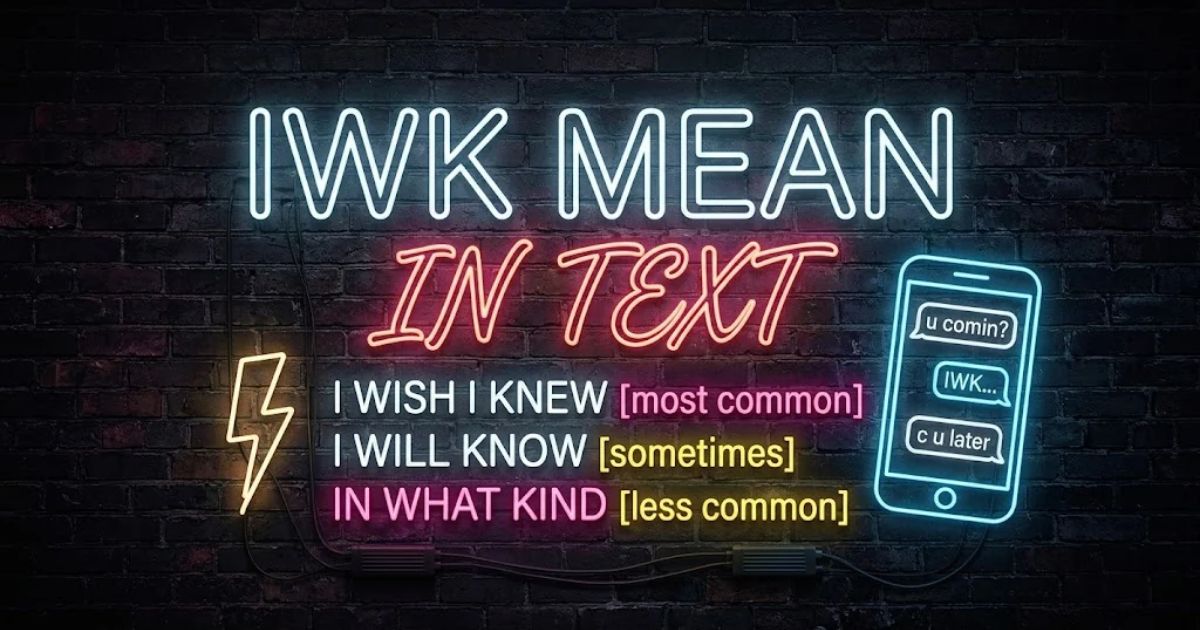
Have you ever received a message containing IWK and wondered what the sender was trying to say? Texting abbreviations can sometimes be confusing, especially when someone uses slang you haven’t seen before. The good news is that IWK has a simple, playful meaning in casual conversations.
IWK means “I Was Kidding.” People use it in text messages, social media comments, and online chats to explain that something they just said was a joke rather than a serious statement.
However, understanding this abbreviation involves more than knowing its full form. The situation, relationship, and tone of the conversation can change how it feels. Let’s explore its meaning, origin, examples, and everyday uses.
What Does IWK Mean in Text? (Simple Definition)
IWK is an informal texting abbreviation that stands for “I Was Kidding.” Someone typically uses it after making a joke, teasing another person, or saying something that might be misunderstood as serious.
For example, imagine your friend texts, “I’m never talking to you again!” You might feel confused or worried for a moment. A follow-up message saying “IWK 😂” makes it clear that they weren’t serious.
In simple terms, IWK helps people explain their joking intentions without writing a complete sentence. It’s a quick way to keep a conversation light and prevent unnecessary misunderstandings.
IWK = “I Was Kidding”
The full form of IWK is “I Was Kidding.”
Each letter represents part of the phrase:
- I = I
- W = Was
- K = Kidding
People use this short form when they want to clarify that a previous comment was meant humorously.
For instance:
“You’re paying for everyone’s dinner tonight. IWK!”
Here, the sender is joking about making their friend pay for the entire group.
Simple meaning:
In everyday texting, IWK means:
- I wasn’t serious.
- I was only joking.
- Don’t take what I said seriously.
- I didn’t actually mean that.
- It was just a joke.
The abbreviation usually creates a relaxed atmosphere, especially between friends who enjoy teasing each other.
However, remember that a joke isn’t automatically harmless just because someone adds IWK. If a comment hurts someone’s feelings, the sender may still need to apologize.
Example in simple words:
Consider this short conversation:
Person A: I’m going to tell everyone your biggest secret!
Person B: Seriously? Don’t do that!
Person A: Relax, IWK 😂
In this example, Person A uses IWK to explain that the threat wasn’t genuine. They were only teasing their friend.
That’s the basic meaning of IWK in texting.
Read More: WUT Mean in Text? Full Meaning on Snapchat, TikTok & Social Media
Other Possible Meanings of IWK
Although “I Was Kidding” is a possible interpretation of IWK in casual conversations, abbreviations can have different meanings depending on the community, workplace, or subject.
For example, someone might use IWK as an organization-specific abbreviation, a username, or a technical shorthand. These meanings aren’t necessarily related to internet slang.
If you encounter IWK in a conversation, look at the surrounding words before deciding what it means.
Here are a few situations where the interpretation might differ:
- Personal messages: It may mean “I Was Kidding” when someone is clarifying a joke.
- Online communities: It could be a group-specific abbreviation understood only by members.
- Professional communication: It might represent an internal company or project abbreviation.
- Gaming communities: Players may use personal shorthand that isn’t widely recognized outside their group.
One important point: IWK isn’t a universally standardized abbreviation with one guaranteed definition. If the conversation doesn’t involve joking, asking the sender what they mean is the safest approach.
Origin and History of IWK
Like many texting abbreviations, IWK fits into the broader development of internet shorthand. People have always looked for quicker ways to communicate, particularly when typing on small mobile keyboards or participating in fast-moving online conversations.
However, there isn’t a widely established historical record identifying the exact person, website, or year when IWK first appeared. Its development is better understood through the growth of online communication and the popularity of shortened expressions.
1. Early Internet Chat Rooms (2000s)
During the early 2000s, internet chat rooms and instant messaging services helped popularize abbreviated language. People wanted to send messages quickly without typing complete sentences.
Expressions such as LOL, BRB, and JK became familiar shortcuts in online conversations.
The phrase “I Was Kidding” naturally fits this communication style because it helps clarify jokes and playful comments. IWK follows the same general pattern of shortening everyday language.
However, there’s no reliable evidence that IWK originated in a particular chat room or became widely popular during this period.
2. Social Media Growth (2010–2020)
Between 2010 and 2020, social media platforms changed how people communicated online. Facebook, Instagram, Snapchat, and WhatsApp made short messages, comments, reactions, and private conversations part of everyday life.
As digital conversations became faster, users continued adopting abbreviations to save time.
People also began using emojis, GIFs, and reaction images to communicate emotions without lengthy explanations.
In this environment, a short expression such as IWK could help clarify a joke. For example, someone might post a teasing comment and follow it with IWK to make their playful intention clearer.
3. Modern Usage (2020–2026)
Today, online communication includes private messages, group chats, gaming communities, short-form videos, and public comments.
People regularly mix full sentences with abbreviations, emojis, and internet slang. Some expressions are widely recognized, while others remain limited to smaller communities.
IWK can be understood as a quick way to communicate “I Was Kidding” when the context supports that interpretation.
In 2026, it’s useful to understand abbreviations like IWK because digital conversations often move quickly. Still, don’t assume everyone knows the same slang. Writing the complete phrase can be clearer when talking to someone unfamiliar with texting abbreviations.
How IWK Is Used in Real Conversations
The meaning of IWK becomes easier to understand when you see how people use it naturally.
Most commonly, someone adds IWK after making a statement that sounds serious, surprising, dramatic, or slightly exaggerated.
For example, a friend might say, “I’m deleting your number!” Then they add “IWK 😂” to show that they’re teasing.
The abbreviation can also appear at the beginning of a message when someone wants to introduce a joke or clarify something they said earlier.
Main uses:
Here are the most common conversational situations where IWK may appear:
- Clarifying a joke: Someone uses it to explain that their previous statement wasn’t serious.
- Friendly teasing: Friends use it after making playful comments about each other.
- Avoiding confusion: It helps clarify an exaggerated statement that could otherwise sound genuine.
- Lighthearted flirting: Someone might use it after making a playful romantic comment.
- Reacting to misunderstandings: A person may send IWK when someone takes their joke literally.
- Group conversations: Friends can use it to keep a teasing exchange entertaining.
- Gaming chats: Players may use it after joking about another player’s performance.
The tone depends on the relationship between the people involved. A joke between close friends might feel completely normal, while the same comment could sound uncomfortable when sent to someone you barely know.
Real-Life Examples of IWK (With Explanations)
The easiest way to understand IWK meaning in text is through realistic examples. These situations show how someone might use the abbreviation in everyday conversations.
Example 1: Friendly Joke
Person A: You’re officially banned from my house!
Person B: What did I do? 😂
Person A: Nothing, IWK.
Explanation: Person A is joking with their friend. They use IWK to make it clear that the ban isn’t real.
Example 2: Fake Threat
Person A: I’m telling your mom about everything!
Person B: Please don’t 😭
Person A: Haha, IWK.
Explanation: The first message sounds like a serious threat, but the sender later explains that they were only teasing.
Example 3: Social Media Comment
Person A: Your new haircut looks like a bird’s nest.
Person B: That’s so rude! 😂
Person A: IWK, it actually looks great!
Explanation: Here, IWK helps soften a teasing comment. The sender follows it with a compliment to show their real opinion.
Example 4: Gaming Chat
Player A: You’re the worst player on this team.
Player B: Bro, what? 💀
Player A: IWK. You’re actually carrying us!
Explanation: Player A makes a sarcastic comment and then clarifies that it was a joke. The follow-up compliment makes the playful intention clearer.
Short Dialogues Using IWK
Sometimes a short conversation explains an abbreviation better than a dictionary definition. These dialogues show how IWK might fit into different texting situations.
Dialogue 1
Alex: I’m never sharing my snacks with you again.
Sam: Why? I only took one!
Alex: IWK 😂
Meaning: Alex is joking about not sharing snacks anymore.
Dialogue 2
Mia: I think you have a secret admirer.
Noah: Wait, who?
Mia: Nobody. IWK!
Meaning: Mia creates a little excitement and then reveals that she was teasing Noah.
Dialogue 3
Jake: You’re officially the slowest person in our group.
Ryan: That’s unnecessary, bro!
Jake: IWK. You’re doing great!
Meaning: Jake uses IWK to clarify that his comment was playful rather than a genuine insult.
These conversations also show why context matters. A message can sound completely different depending on what was said before and after it.
Personality Traits of People Who Use IWK
Using IWK doesn’t reveal someone’s entire personality. However, the abbreviation can reflect the communication style they prefer in a particular conversation.
People who use it may enjoy casual language, playful interactions, and quick ways of expressing humor.
Here are some communication habits commonly associated with this type of expression.
1. Playful Nature
People may use IWK when they enjoy making jokes and teasing their friends. They might exaggerate situations or make funny statements to get a reaction.
For example, someone might text, “I’m stealing all your fries tonight. IWK!”
The playful message helps create a fun interaction without making the conversation too serious.
2. Friendly Tone
IWK can help maintain a friendly atmosphere when someone makes a teasing comment.
Instead of allowing a joke to create confusion, the sender clarifies their intention.
However, friendliness also depends on the words used. Adding IWK doesn’t automatically make an offensive statement acceptable.
3. Casual Communication
People who prefer relaxed texting often use abbreviations rather than complete sentences.
They might write IWK, LOL, JK, or IDK because these expressions are quick and familiar in their social circles.
This style is common in conversations where speed and convenience matter more than formal writing.
4. Social Media Active
Someone who regularly uses social media may be familiar with different internet expressions.
They might encounter abbreviations in Instagram comments, Snapchat messages, TikTok discussions, and group chats.
However, using IWK doesn’t necessarily mean someone is highly active on social media. People also pick up slang through friends and everyday conversations.
5. Emotionally Expressive
Some people use short abbreviations to communicate their feelings more naturally.
For example, IWK combined with 😂 or 😭 can make a playful message easier to understand.
The abbreviation provides clarification, while the emoji adds emotional context.
Together, they can make a short message feel more personal and expressive.
When Should You Use IWK? (Usage Context)
IWK works best in informal conversations where both people understand casual internet language.
You can use it with friends, siblings, gaming teammates, or people who regularly communicate through texting abbreviations.
For example, if you tell your friend, “I’m blocking you forever!” and immediately add “IWK 😂,” they can understand that you’re joking.
You can also use it when someone misunderstands your previous message. A simple “I was kidding” may prevent an unnecessary argument.
However, timing matters. If your joke has genuinely hurt someone, don’t rely on an abbreviation to fix the situation. A sincere apology is usually more appropriate.
Avoid using IWK in:
Although IWK is useful in casual chats, it isn’t suitable for every situation.
Avoid using it in these contexts:
- Professional emails: Write complete sentences so your message remains clear and respectful.
- Business conversations: Casual abbreviations can make important communication less precise.
- Academic writing: Use standard English rather than informal internet slang.
- Serious discussions: Avoid making sensitive conversations seem less important.
- Arguments: Adding IWK after an insulting comment may appear dismissive.
- Messages to unfamiliar people: They might not recognize the abbreviation.
For example, writing “IWK” in a formal email to your manager could create unnecessary confusion.
A better choice is to write, “I was only joking,” if the situation genuinely calls for clarification.
Table: IWK vs Similar Text Abbreviations
IWK is related to several other texting expressions, but they don’t all communicate exactly the same thing.
Understanding the differences helps you choose the right abbreviation for your message.
| Abbreviation | Full Form | Meaning |
|---|---|---|
| IWK | I Was Kidding | Explaining that something was a joke |
| JK | Just Kidding | Clarifying that a statement wasn’t serious |
| LOL | Laughing Out Loud | Expressing amusement |
| IDK | I Don’t Know | Showing uncertainty |
| BRB | Be Right Back | Temporarily leaving a conversation |
| IYKWIM | If You Know What I Mean | Suggesting an implied or indirect meaning |
| LMAO | Laughing My Ass Off | Expressing strong amusement |
IWK vs JK: Both can clarify a joke, but their wording is different. IWK describes what the sender was doing, while JK is a shorter way to say the statement was not serious.
IWK vs LOL: IWK clarifies the intention behind a statement. LOL expresses amusement or laughter. They aren’t interchangeable.
IWK vs IYKWIM: IYKWIM suggests that a message has an implied meaning. IWK directly explains that something was intended as a joke.
For everyday texting, JK is generally the more familiar shorthand. IWK may be understood from context, but it’s not as universally recognized.
Modern Usage of IWK in 2026
Texting language continues to change, but the basic purpose of playful abbreviations remains the same. People want to communicate quickly while making their intentions understandable.
In 2026, you may encounter IWK in private messages, online communities, social media comments, and gaming conversations.
Its meaning doesn’t depend on a specific platform. Instead, the surrounding conversation helps determine whether the sender means “I Was Kidding.”
Modern examples:
Here are some examples of how IWK could appear in today’s digital conversations.
- Snapchat: “I’m exposing your embarrassing pictures 😂 IWK.”
- Instagram: “Your outfit is too good. I’m jealous, IWK!”
- WhatsApp: “I’m not inviting you next time. IWK bro.”
- TikTok: “That comment scared me for a second. IWK 😭”
- Facebook: “You’re officially the family comedian. IWK!”
- Gaming chat: “I’m reporting you for being too good. IWK 😂”
- Group chat: “Nobody is allowed to eat my pizza. IWK, maybe one slice.”
These examples demonstrate how the abbreviation can fit into different online environments.
Why it is still used:
There are several reasons why people continue using short expressions like IWK:
1. Saves typing time: Short abbreviations make casual messages quicker to send.
2. Easy clarification: IWK can explain that a previous statement wasn’t serious.
3. Casual communication: It fits naturally into relaxed conversations between friends.
4. Works with emojis: Adding 😂, 😭, or 😉 can make the intended tone easier to recognize.
5. Fits digital conversations: Short expressions are convenient in fast-moving group chats and online discussions.
Still, don’t assume IWK is among the most popular texting abbreviations. Its recognition may vary depending on the platform and social circle.
Common Mistakes People Make With IWK
Although the definition is simple, people can misunderstand IWK when they use it without considering the conversation.
Here are some common mistakes worth avoiding.
1. Thinking it is serious
One mistake is interpreting IWK as a serious statement or warning.
When someone writes “IWK” after a joke, they’re generally explaining that they weren’t being serious.
However, always consider the full conversation rather than relying on the abbreviation alone.
2. Using in formal messages
IWK belongs to informal digital communication.
Using it in a business email, official document, or professional discussion may confuse the reader.
If you need to explain that something was a joke in a formal setting, write the complete phrase instead.
3. Confusing with other acronyms
People sometimes mix up IWK with JK, LOL, and other texting expressions.
Although these abbreviations can appear in the same conversation, their meanings aren’t identical.
Remember:
- IWK = I Was Kidding
- JK = Just Kidding
- LOL = Laughing Out Loud
Knowing these differences makes online communication easier.
4. Overusing it
Adding IWK to every playful sentence can make your messages feel repetitive.
You don’t need to explain every obvious joke. Sometimes an emoji or the context is enough.
Use the abbreviation when clarification is genuinely helpful.
Common Misconceptions About IWK
Internet slang can be confusing because people often assume that every abbreviation has one universal meaning or is equally popular across platforms.
Let’s clear up a few common misunderstandings.
Misconception 1: IWK is very popular slang
Some people assume IWK is as widely recognized as LOL, BRB, or IDK.
That’s not necessarily true. While people may understand IWK from context, its recognition varies between communities.
If you aren’t sure whether someone knows it, writing “I was kidding” is clearer.
Misconception 2: It has only one meaning
In casual texting, IWK can mean “I Was Kidding.”
However, abbreviations may have different meanings in specialized communities, workplaces, or private conversations.
Always consider the context before deciding what an unfamiliar abbreviation means.
Misconception 3: It is new slang
IWK follows an older internet communication pattern: shortening everyday phrases into memorable abbreviations.
Although its current usage may vary, the idea of using shortened expressions to clarify jokes isn’t new.
Internet slang develops gradually, and not every abbreviation has a documented creation date.
FAQs About IWK Meaning in Text
Here are answers to some common questions about the IWK meaning in texting, including how to use it and what it means on social media.
1. What does IWK mean in texting?
IWK means “I Was Kidding” in casual texting. Someone uses it to explain that a previous statement was a joke and shouldn’t be taken seriously.
2. Is IWK the same as JK?
They have similar meanings, but they’re not exactly the same. IWK stands for “I Was Kidding,” while JK means “Just Kidding.” Both are used to clarify that something wasn’t serious.
3. Can I use IWK in formal chats?
It’s better to avoid IWK in professional emails, academic writing, and formal conversations. Use the complete phrase “I was kidding” when you need to clarify a joke in a more professional way.
4. Is IWK still used in 2026?
IWK can still appear in casual online conversations in 2026. However, its popularity and recognition vary between users and social communities. It’s not as universally recognized as some common abbreviations.
5. What is the difference between IWK and IYKWIM?
IWK means “I Was Kidding” and clarifies that something was a joke. IYKWIM means “If You Know What I Mean” and suggests an implied or indirect meaning.
6. Where do people use IWK most?
You may encounter IWK in casual text messages, private chats, group conversations, gaming discussions, and social media comments. Its meaning remains dependent on context rather than a particular platform.
7. Is IWK rude?
No, IWK isn’t inherently rude. It’s generally used to explain a joke or playful statement. However, the original comment can still be offensive or hurtful, even if the sender adds IWK afterward.
Conclusion
Understanding IWK meaning in text is simple once you know its full form: I Was Kidding. It’s an informal abbreviation people can use to clarify jokes, playful comments, and statements that shouldn’t be taken seriously.
You might encounter it in Snapchat messages, Instagram comments, WhatsApp conversations, gaming chats, or other online discussions.
The most important thing is context. Although IWK can make a conversation feel more relaxed, not everyone recognizes the abbreviation. When clarity matters, writing “I was kidding” or using the more familiar “JK” can be a better choice.
Now that you know what IWK means, you’ll have an easier time understanding it when it appears in your next conversation.
