Have you ever received a message containing the word “mean” and wondered what the sender actually meant? Perhaps someone asked, “What do you mean?” or replied, “That’s mean!” Although it’s a simple everyday word, its meaning can change depending on the conversation, the sender’s intention, and the emotional tone.
The mean in text doesn’t have just one interpretation. It can describe unkind behavior, ask someone to explain something, express an intention, or refer to the definition of a particular word or situation. It can even describe an average in mathematical conversations.
Understanding the context is the easiest way to avoid confusion. In this guide, you’ll learn the meaning of mean in text messages, how people use it on social media, common examples, and how to respond naturally when someone uses it in a conversation.
What Does “The Mean in Text” Mean?
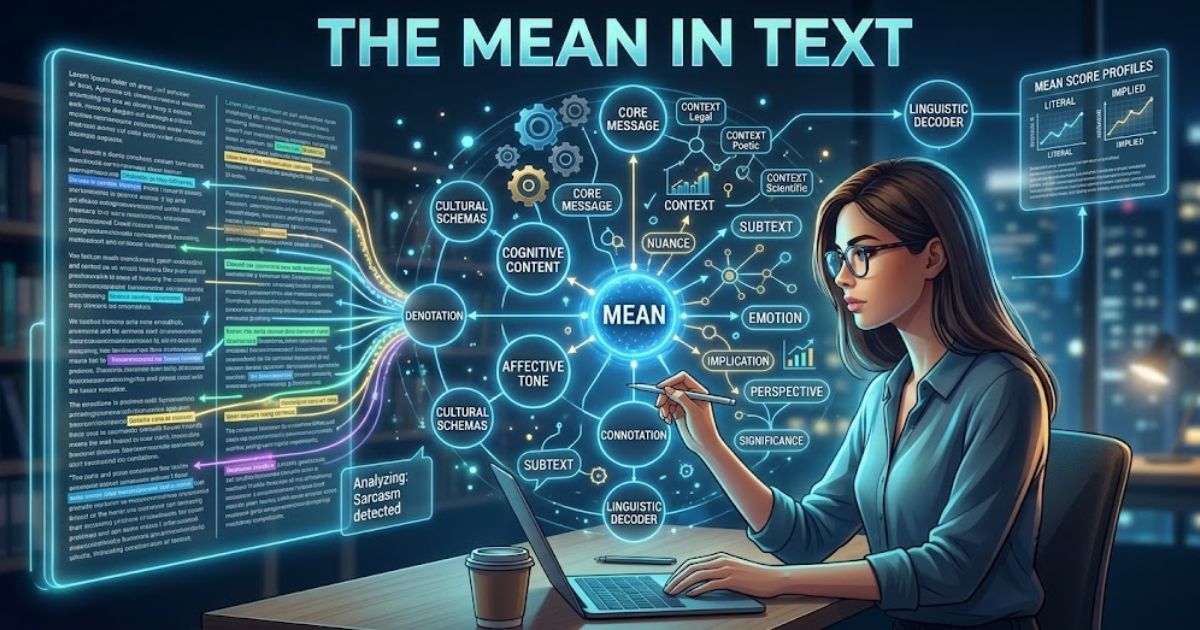
The word mean in text messages usually has two common meanings: to intend something or to behave in an unkind way. However, it can also refer to the definition or significance of something.
For example, when someone texts, “What do you mean?”, they’re asking you to explain your statement. They’re not necessarily upset or being rude. They’re simply trying to understand what you said.
On the other hand, if someone writes, “That was mean,” they’re probably saying that your words or actions were hurtful, rude, or inconsiderate.
Consider these examples:
- “What do you mean?” – Asking someone to explain their message.
- “You are being mean.” – Saying someone’s behavior is unkind.
- “I didn’t mean it.” – Explaining that something wasn’t intentional.
- “I mean it.” – Showing that you’re serious about something.
- “What does this mean?” – Asking for the definition or interpretation of something.
The important thing to remember is that the meaning depends on how the word appears in the sentence. A single word can communicate curiosity, frustration, affection, seriousness, or disappointment.
Simple Meaning (Explained in Easy Words)
In simple words, mean can describe what someone intends to say or do, what something represents, or how someone treats another person.
Think of it this way: when you’re talking to a friend and they say something you don’t understand, you might ask, “What do you mean?” You’re asking them to explain their intention.
However, if your friend makes an embarrassing joke about you, you might reply, “That’s mean!” Here, you’re telling them that their joke wasn’t kind.
Here are the main meanings in everyday language:
| Expression | Simple meaning |
|---|---|
| What do you mean? | Explain what you’re saying. |
| I mean it | I’m serious. |
| I didn’t mean it | It wasn’t intentional. |
| That’s mean | That’s unkind or hurtful. |
| What does it mean? | What’s its definition? |
| You mean a lot to me | You’re important to me. |
| I mean, seriously | Used to emphasize a point. |
You might also encounter the mathematical meaning of mean. In that context, it refers to the average of a group of numbers. For example, the mean of 2, 4, and 6 is 4.
Therefore, don’t assume that every use of mean in texting is slang or has a negative meaning. It’s an ordinary English word with several different uses.
Read More: SMTH Meaning in Text: Definition, Examples, and How to Use It (2026 Edition)
Where Is “Mean” Used in Texting?
The word mean appears in almost every type of digital communication. People use it in personal messages, social media comments, group chats, and online discussions.
Its meaning usually stays connected to everyday English, but the tone can change depending on the platform and the relationship between the people communicating.
Let’s look at where you’ll commonly see it.
1. Regular Text Messages
In regular SMS and private conversations, people often use mean to explain their intentions or react to someone’s behavior.
For example, imagine you’re texting your friend and accidentally send a message that sounds offensive. Your friend might respond, “That was mean.”
You could reply, “Sorry, I didn’t mean it that way.”
In this situation, the word helps both people communicate their feelings and clarify what they intended.
Common examples include:
- “What do you mean by that?”
- “I didn’t mean to upset you.”
- “You’re being mean today.”
- “I mean every word I said.”
- “That comment was a little mean.”
These expressions are common in everyday texting because they help people explain their thoughts without needing a long conversation.
2. Social Media
On social media, mean often appears in comments, direct messages, captions, and reactions to posts.
You might see someone write, “Why are people so mean in the comments?” when discussing negative remarks or online bullying.
Similarly, friends might jokingly comment, “That’s so mean 😂” under a funny video or embarrassing picture.
The tone matters here. A comment can be playful between close friends but genuinely offensive when directed at someone who doesn’t share that relationship.
You’ll commonly encounter these expressions on platforms such as:
- WhatsApp: “What do you mean by that message?”
- Instagram: “That comment was mean.”
- Snapchat: “I didn’t mean to leave you on opened.”
- TikTok: “People can be so mean online.”
Social media also makes it easier to misunderstand someone’s intention because you can’t always hear their voice or see their facial expression.
3. Online Arguments
During online arguments, mean usually describes behavior that someone considers disrespectful, offensive, or hurtful.
For example, if two people disagree in a comment section, one might write, “There’s no need to be mean.”
This statement suggests that the discussion has become personal rather than remaining focused on the original topic.
Other examples include:
- “Why are you being so mean?”
- “I was just asking a question. Don’t be mean.”
- “Your words were unnecessarily hurtful.”
- “You don’t have to be rude to make your point.”
In these conversations, mean can express emotional frustration. However, it’s worth remembering that calling someone mean doesn’t automatically prove that they intended to hurt anyone.
Sometimes people misunderstand each other, especially when messages are short or written in anger.
Why Do People Use “Mean” So Much in Text?
People use the word mean frequently because it helps them communicate intention, describe behavior, and express emotional reactions with very little effort.
Instead of writing a long explanation about why something felt hurtful, someone can simply say, “That was mean.”
Likewise, rather than asking someone to explain an entire statement in detail, they can write, “What do you mean?”
Here are some common reasons people use it.
1. To clarify information: People use “What do you mean?” when a message is confusing or unclear.
2. To explain intentions: Expressions such as “I didn’t mean that” help people correct misunderstandings.
3. To express emotions: Someone might say “That’s mean” when they feel offended or embarrassed.
4. To emphasize seriousness: “I mean it” communicates that a statement isn’t a joke.
5. To describe behavior: People use mean to identify actions that seem unkind or inconsiderate.
6. To understand definitions: “What does that mean?” is a natural way to ask about an unfamiliar word, phrase, or situation.
Another reason is convenience. Digital conversations move quickly, and people prefer familiar words that communicate their thoughts without unnecessary explanations.
Real-Life Examples of “Mean” in Text
The easiest way to understand the meaning of mean in text messages is to see how people use it in realistic conversations.
The same word can have completely different meanings depending on the surrounding sentence. Here are four examples that show how it works.
Example 1: Confusion About Meaning
Imagine you’re discussing weekend plans with a friend.
Text conversation
Friend: We should probably do something different this time.
You: What do you mean?
Friend: Maybe try a new restaurant instead of going to the mall.
Explanation: Here, “What do you mean?” is a simple clarification question. You’re asking your friend to explain their suggestion.
There’s no negative emotion or rude intention involved.
Example 2: Emotional Meaning
Imagine someone makes a joke about your appearance in a group chat.
Text conversation
Friend: That picture is embarrassing 😂
You: That’s mean. I actually liked that picture.
Explanation: In this example, mean describes an unkind or hurtful comment. You’re letting your friend know that their joke affected your feelings.
The expression can be playful or serious depending on your relationship and the way you deliver it.
Example 3: Clarifying Intention
Sometimes people send messages that sound different from what they intended. This expression helps clear things up.
Text conversation
Friend: Your idea doesn’t make any sense.
You: That sounded rude.
Friend: Sorry, I didn’t mean it that way. I just think we need another approach.
Explanation: “I didn’t mean it that way” communicates that the speaker’s intention was different from how their message sounded.
It’s a useful expression when someone wants to avoid unnecessary conflict.
Example 4: Definition Use
Suppose you’re chatting with someone who uses an unfamiliar expression.
Text conversation
Friend: I think this decision is significant.
You: What does significant mean?
Friend: It means something is important or has a noticeable effect.
Explanation: Here, the word mean refers to the definition of another word. You’re asking what a particular expression represents.
This is one of the most common ways people use mean when learning English or discussing unfamiliar vocabulary.
“Mean” vs Similar Words in Texting
Mean is closely related to several other English words, but they don’t always communicate exactly the same idea.
Understanding these differences helps you choose the right expression and avoid misunderstandings in digital conversations.
| Word | Meaning | Example |
|---|---|---|
| Mean | Intend or describe unkind behavior | I didn’t mean that. |
| Meaning | The definition or significance of something | What’s the meaning of this? |
| Imply | Suggest something indirectly | Are you implying something? |
| Intend | Have a particular purpose | I didn’t intend to hurt you. |
| Signify | Represent or indicate something | What does this symbol signify? |
| Rude | Disrespectful or impolite | That reply was rude. |
| Hurtful | Causing emotional pain | Your words were hurtful. |
| Average | A mathematical value | The mean is 10. |
One particularly important difference is between mean and meaning.
Mean is commonly used as a verb or adjective.
- “What do you mean?” (verb)
- “That’s mean.” (adjective)
Meaning is a noun that describes what a word, action, or statement represents.
- “What’s the meaning of this message?”
- “I understand the meaning now.”
Although these words are related, they’re not interchangeable in every sentence.
When Should You Use “Mean” in Text?
You can use mean whenever you want to explain an intention, ask for clarification, describe unkind behavior, or discuss the definition of something.
However, choosing the right expression makes your message easier to understand.
Here are some situations where using mean is appropriate:
- When something is unclear: Write “What do you mean?” to ask for an explanation.
- When correcting a misunderstanding: Use “That’s not what I meant” to clarify your intention.
- When apologizing: Say “I didn’t mean to hurt you” when your words have upset someone.
- When expressing seriousness: Use “I mean it” to show that you’re not joking.
- When reacting to unkind behavior: Say “That was mean” when someone’s actions feel hurtful.
- When asking for a definition: Write “What does this word mean?” when you don’t understand an expression.
For example, if a friend misunderstands your joke, you could say, “I didn’t mean to offend you. I was only joking.”
This sounds more thoughtful than simply responding, “You misunderstood me.”
The best approach is to choose words that communicate your actual intention rather than making the conversation more confusing.
Common Misunderstandings About “Mean” in Text
Because texting doesn’t include facial expressions, voice changes, or body language, people sometimes interpret the word mean incorrectly.
A sentence that seems rude to one person might be completely normal to another. Understanding these common misunderstandings can help you communicate more confidently.
1. Assuming Someone Is Being Mean
One common mistake is assuming that someone is being rude whenever they ask, “What do you mean?”
However, this question is usually neutral. It simply asks for clarification.
For example:
- “What do you mean by that?”
- “Can you explain what you mean?”
- “I’m not sure I understand.”
These statements don’t automatically indicate anger or frustration.
Before reacting negatively, consider the rest of the conversation and your relationship with the sender.
2. Thinking “Mean” Always Means Rude
Another misunderstanding is believing that mean always describes unkind behavior.
In reality, the word has several meanings.
For example:
- “I mean what I say.” – I’m serious.
- “What does this mean?” – What’s its definition?
- “That was mean.” – That was unkind.
- “I didn’t mean to call you.” – It wasn’t intentional.
The surrounding words determine which meaning applies.
This is why understanding the full sentence is more useful than interpreting one word by itself.
3. Overusing “What Do You Mean?”
Although “What do you mean?” is a normal question, repeating it too frequently can make a conversation feel uncomfortable.
If someone is explaining something and you repeatedly ask the same question, they might feel that you’re challenging their statement rather than trying to understand it.
Instead, try more specific alternatives:
- “Could you explain that a little more?”
- “What did you mean by the last part?”
- “Are you saying that we should change the plan?”
- “I think I misunderstood your point.”
- “Can you give me an example?”
These alternatives sound more natural when you need additional information.
Pro Tips for Using “Mean” in Text Conversations
Knowing the definition is only part of understanding a word. You also need to know how to use it naturally.
Here are some practical tips that can make your text conversations clearer and more comfortable.
1. Add Context
Context makes a big difference in digital communication.
Instead of sending a short message such as “I didn’t mean that,” explain what you’re referring to.
For example:
- Unclear: “I didn’t mean it.”
- Clearer: “I didn’t mean to criticize your decision. I was only sharing my opinion.”
The second message gives the other person enough information to understand your intention.
When emotions are involved, a little extra explanation can prevent unnecessary arguments.
2. Use Emojis (If Appropriate)
Emojis can help communicate the emotional tone behind a message.
For example:
- “That’s mean 😂” – May suggest playful teasing.
- “I didn’t mean to hurt you ❤️” – Can communicate affection and regret.
- “What do you mean? 🤔” – May show curiosity or confusion.
- “I mean it! 😅” – Can make a serious statement feel lighter.
However, emojis don’t guarantee that someone will understand your intention correctly. A laughing emoji might even make a hurtful comment seem more offensive.
Use them naturally, especially when communicating with people who understand your sense of humor.
3. Explain Your Intention
If your message could be misunderstood, explain what you actually mean.
For example, instead of writing:
“That’s not what I meant.”
You could say:
“That’s not what I meant. I was talking about the situation, not criticizing you personally.”
This makes your message more specific and reduces the chances of another misunderstanding.
It’s particularly helpful when discussing sensitive topics, relationships, disagreements, or personal feelings.
4. Don’t React Too Fast
Short messages can sometimes sound harsher than the sender intended.
Before assuming someone is being mean, read the message again and consider the conversation around it.
For example, your friend might reply, “Fine, do whatever you want.”
That sentence could express frustration, disappointment, or simply a desire to let you decide. You can’t always know the intention from those words alone.
If you’re unsure, ask politely instead of immediately responding with anger.
A simple question such as “Are you upset, or did I misunderstand your message?” can make a big difference.
Emotional Side of “Mean” in Texting
The emotional meaning of mean is especially important because words can affect relationships, friendships, and personal confidence.
When someone says, “You’re being mean,” they’re usually expressing that your behavior has made them feel uncomfortable, embarrassed, ignored, or hurt.
Sometimes the comment refers to a serious situation, such as repeated insults or disrespectful behavior. In other situations, it might be a playful reaction between friends.
For example, imagine sending an old embarrassing photograph of your friend to a group chat. They might respond, “You’re so mean 😂.”
If you share a close friendship, the comment could be playful. However, if your friend seems genuinely upset, it’s better to take their feelings seriously.
The emotional meaning also changes with the relationship.
Between close friends: Mean can describe harmless teasing or playful jokes.
Between romantic partners: It may express disappointment, hurt feelings, or frustration.
Between strangers: It usually refers to behavior perceived as rude or disrespectful.
During arguments: It can communicate that someone’s words have crossed an emotional boundary.
One important thing to remember is that intention and impact aren’t always the same. You might not intend to hurt someone, but your message can still make them feel bad.
Good communication means being willing to explain your intentions and listen to how your words affect others.
How to Respond When Someone Says “That’s Mean”
If someone tells you that something you said or did was mean, your response should depend on the situation.
The best approach is to understand why they feel that way before becoming defensive.
Here are some natural responses you can use.
| Situation | Possible response |
|---|---|
| You accidentally hurt someone | “I’m sorry. I didn’t mean to hurt you.” |
| You were joking | “I was only joking, but I understand how it sounded.” |
| You disagree with their reaction | “I didn’t intend it that way. Can you explain what upset you?” |
| You want to be playful | “Okay, okay! I’ll be nice 😂” |
| You genuinely made a mistake | “You’re right. That wasn’t a nice thing to say.” |
| Someone misunderstood you | “That’s not what I meant. Let me explain.” |
| You want to end the argument | “Let’s not argue. I don’t want to upset you.” |
You can also use these shorter replies in casual conversations:
- “Sorry, my bad.”
- “I didn’t mean it like that.”
- “I was just playing.”
- “Didn’t realize it sounded that way.”
- “You’re right. I’ll be more careful.”
- “No hard feelings?”
- “I apologize if that hurt you.”
However, don’t apologize automatically just to end a conversation. If you genuinely believe there’s a misunderstanding, explain your point calmly.
A good response acknowledges the other person’s feelings without creating another argument.
The Psychology Behind “Mean” in Text
The word mean can carry emotional weight because people naturally pay attention to how others communicate with them.
In face-to-face conversations, you can use facial expressions, eye contact, voice, and body language to understand someone’s intention. Text messages remove many of these signals.
As a result, people sometimes interpret neutral statements as negative.
For example, consider this message:
“Okay. Whatever.”
Depending on the situation, it might communicate frustration, disappointment, indifference, or simply a desire to end the conversation.
The receiver may interpret it as mean even if the sender didn’t intend to sound rude.
Several psychological and communication factors contribute to this problem.
1. Lack of emotional cues
Texting doesn’t show facial expressions or vocal tone. You have to interpret the sender’s feelings through words alone.
2. Personal expectations
If you already feel upset or insecure, you may interpret a short reply more negatively than you normally would.
3. Previous experiences
Someone who has experienced repeated criticism might be more sensitive to comments that resemble earlier hurtful conversations.
4. Different communication styles
Some people write short, direct messages, while others prefer detailed and emotionally expressive conversations. These differences can create misunderstandings.
5. Emotional reactions
When people feel criticized, embarrassed, or ignored, they may respond defensively before understanding the original intention.
This doesn’t mean every hurtful message is an innocent mistake. Sometimes people deliberately use words to offend others. The key is to consider the situation, the person’s behavior, and whether the problem happens repeatedly.
Understanding these factors can help you avoid unnecessary conflict and become a better digital communicator.
Final Thoughts
Understanding the mean in text is easier when you pay attention to the complete sentence and its context. The word can describe unkind behavior, express an intention, ask for clarification, or explain the definition of something.
For example, “That’s mean” usually describes hurtful behavior, while “What do you mean?” asks someone to explain their statement. Similarly, “I didn’t mean it” communicates that something wasn’t intentional.
The biggest takeaway is simple: context determines meaning. Don’t judge an entire conversation based on one word. Consider the sender’s intention, the relationship, and the surrounding messages before responding.
Once you understand these differences, you’ll find it much easier to interpret messages, avoid misunderstandings, and communicate naturally online.
Frequently Asked Questions
1. What does “mean” usually mean in text messages?
Mean usually refers to someone’s intention or describes behavior that is unkind or hurtful. For example, “What do you mean?” asks for clarification, while “That’s mean” describes something rude or unkind.
2. Is saying “What do you mean?” rude?
No. It’s generally a normal question used to ask someone to explain their statement. However, depending on the conversation and tone, it can sometimes sound impatient, defensive, or confrontational.
3. Does “mean” always mean unkind?
No. Mean has several meanings in everyday English. It can describe unkind behavior, express intention, refer to a definition, or describe a mathematical average. The sentence determines its meaning.
4. Why do texts sound mean sometimes?
Text messages can sound mean because they lack facial expressions, voice tone, and body language. Short replies, punctuation, and unclear wording can also make a neutral message seem rude or emotionally distant.
5. Is mean considered slang?
No. Mean isn’t originally slang. It’s a standard English word that people commonly use in texting, social media, and everyday conversations.
6. What does “I mean it” mean in text?
“I mean it” means you’re serious about what you’re saying. It communicates that your statement isn’t a joke or something you’re saying casually.
7. What does “I didn’t mean it” mean in texting?
It means you didn’t intend to say or do something in a particular way. People often use it to explain misunderstandings or apologize after accidentally hurting someone’s feelings.
8. What does “What do you mean?” mean in texting?
It means you’re asking someone to explain their message, statement, or intention. It’s commonly used when something is unclear or confusing.
9. How do you respond when someone says “That’s mean”?
You can respond with “Sorry, I didn’t mean to hurt you,” if you accidentally upset them. If you were joking, you can explain your intention while acknowledging their feelings.
10. Can mean have different meanings in texting?
Yes. It can describe unkind behavior, express intention, ask for clarification, or refer to a definition. Its meaning depends on the words around it and the conversation’s context.
