Have you ever opened a message, social media post, or online link and noticed the warning NSFW? If you’re unsure what it means, you’re not alone. This abbreviation appears across the internet, but its meaning can depend on the content and situation.
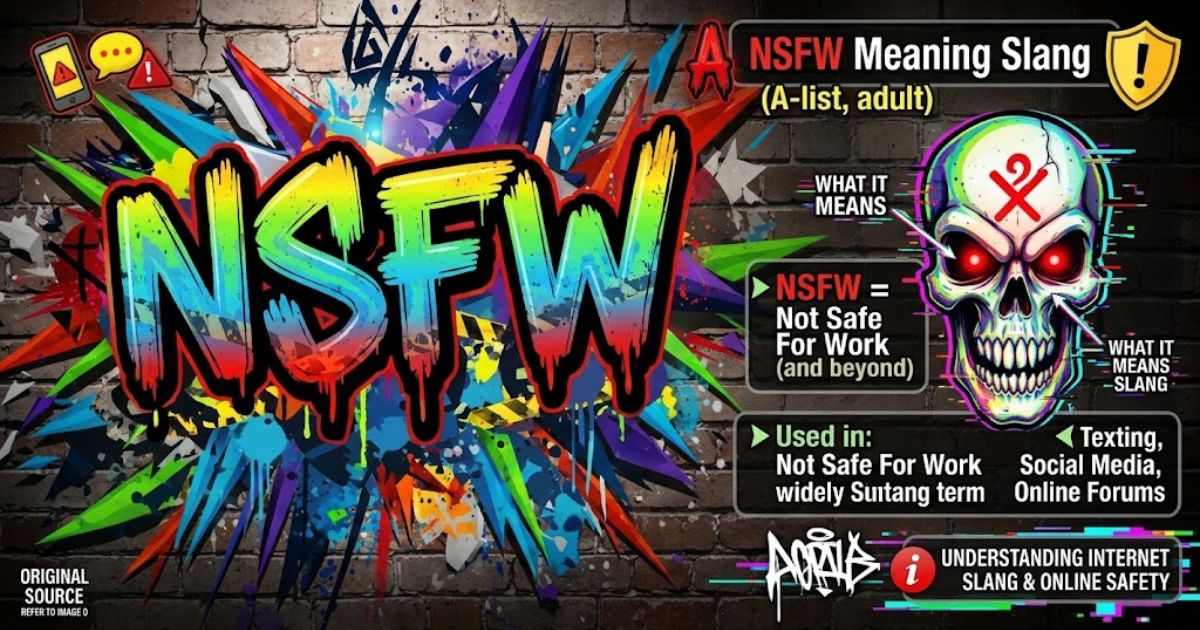
NSFW stands for “Not Safe For Work.” It’s an internet slang term used to warn people that something may be inappropriate to view in a professional or public environment. This can include adult content, nudity, explicit jokes, graphic images, or other material that might make someone uncomfortable at work.
However, NSFW isn’t limited to office conversations. You’ll also see it in texting, dating apps, social media posts, online communities, and private messages.
In this guide, you’ll learn the NSFW meaning in slang, how people use it in different situations, what it communicates socially, and how to respond when someone sends you an NSFW warning.
Quick Answer / Quick Definition of “NSFW Meaning Slang”
NSFW means “Not Safe For Work.” It’s a common internet abbreviation used to warn someone that a message, image, video, website, or other content may be unsuitable for viewing at work or in public.
For example:
“Don’t open this video at work. It’s NSFW!”
This means the video contains something that might be inappropriate or embarrassing to watch around colleagues.
NSFW warnings commonly refer to:
- Nudity or sexually explicit material.
- Adult jokes or inappropriate language.
- Graphic violence or disturbing images.
- Offensive or sensitive content.
- Material that isn’t suitable for a professional environment.
The important thing to understand is that NSFW doesn’t automatically mean pornography. It can describe different types of content that people may not want to see in public.
NSFW at a glance
Not Safe For Work
Full form of NSFW
- Type: Internet slang / abbreviation
- Purpose: Content warning
- Common use: Social media, messaging, websites, and workplace chats
- Tone: Informal and cautionary
- Opposite: SFW (Safe For Work)
Read More: SMTH Meaning in Text: Definition, Examples, and How to Use It (2026 Edition)
Detailed Meaning Breakdown
Although NSFW has one widely recognized primary meaning, people sometimes use it in different ways depending on the content they’re sharing.
Understanding these variations helps you avoid confusion when someone uses the abbreviation.
Primary Meaning
The primary meaning of NSFW is Not Safe For Work.
People use it as a warning before sharing content that might be inappropriate in a workplace or another public setting.
Imagine you’re sitting in an office and a friend sends you a funny video. Before the link, they write:
“Warning: NSFW 😂”
They’re telling you to be careful because the video might contain adult humor, inappropriate language, or something that could cause embarrassment if other people see it.
The warning doesn’t necessarily mean the content is dangerous. It simply suggests that you should consider your surroundings before opening it.
Secondary Meanings
NSFW can also be used more broadly to describe content that isn’t suitable for certain audiences or situations.
For example:
- Adult material: Images or videos containing nudity or sexual themes.
- Strong language: Videos or posts with frequent profanity.
- Graphic content: Disturbing images, injuries, or violent scenes.
- Inappropriate humor: Sexual jokes or offensive comedy.
- Sensitive discussions: Content that may be uncomfortable to view around other people.
Sometimes people use NSFW playfully, even when the content isn’t particularly explicit.
For example:
“This chocolate cake looks NSFW!”
Here, the sender may be joking that the dessert looks ridiculously tempting or indulgent. They’re using the term humorously rather than giving a serious warning.
Rare or Misinterpreted Meanings
NSFW is sometimes misunderstood because people assume it always refers to sexual content.
That’s not correct.
The original and widely accepted meaning remains Not Safe For Work. However, its use has expanded to cover different types of unsuitable or potentially embarrassing material.
Another common misunderstanding is treating NSFW as a description of the person sending something.
For example, if someone says, “This picture is NSFW,” they’re describing the picture, not calling the sender inappropriate.
You should also avoid assuming that every NSFW warning indicates illegal, harmful, or extreme material. The actual content can range from a mildly inappropriate joke to explicit imagery.
What “NSFW” Means in Different Contexts
The meaning of NSFW stays generally consistent across platforms, but the way people use it can change.
A warning in a private message may feel casual, while the same warning on a public website may serve as a content label.
In Texting and Messaging
In text messages, NSFW usually appears before someone shares a picture, video, joke, or link that might be inappropriate to open around other people.
For example:
“I’m sending you something funny, but it’s NSFW.”
This tells the receiver to check their surroundings before viewing the content.
Friends may also use it jokingly:
“Your search history is definitely NSFW 😂”
In this situation, the sender is teasing someone about potentially embarrassing online activity.
NSFW in texting is usually a quick heads-up rather than a serious statement. Still, it’s worth taking the warning seriously when the sender is sharing unknown content.
On Social Media Platforms
Social media users encounter NSFW warnings in posts, comments, private messages, and online communities.
The warning helps viewers decide whether they want to open or interact with particular content.
Different platforms handle sensitive material differently. Some use content labels, blurred previews, audience restrictions, or moderation systems.
Here’s how NSFW commonly appears across popular platforms.
On Instagram, NSFW may appear in direct messages, captions, comments, or conversations about sensitive content.
For example:
“Check your DMs. I sent you an NSFW meme.”
The sender is warning you that the meme may contain adult humor or inappropriate material.
Instagram also has content moderation and sensitive-content controls, but an NSFW label written by a user isn’t the same as an official platform warning.
Snapchat
On Snapchat, NSFW is often used in private conversations before someone sends a picture, video, or potentially inappropriate snap.
For example:
“Don’t open this snap around your family. NSFW 😂”
The sender is suggesting that the content might be embarrassing or unsuitable for public viewing.
Because Snapchat conversations can feel personal and informal, people sometimes use NSFW as a playful warning between friends or romantic partners.
TikTok
On TikTok, users may write NSFW in comments, captions, or discussions about videos containing mature themes.
For example:
“This video is NSFW, so don’t watch it in class.”
The warning tells viewers that the video might include inappropriate language, sexual references, or graphic material.
However, writing NSFW in a caption doesn’t automatically make content acceptable under TikTok’s community guidelines. Platform rules still apply.
Threads
Threads users may use NSFW when discussing sensitive topics or sharing links to potentially inappropriate content.
For example:
“Just a heads-up: the attached article contains NSFW images.”
This tells readers what to expect before opening the material.
In public discussions, the abbreviation can also help people communicate content warnings without writing a lengthy explanation.
In Dating and Relationships
In dating and romantic conversations, NSFW often refers to sexually suggestive messages, adult jokes, explicit pictures, or intimate content.
For example:
“Can I send you something NSFW?”
The sender is asking whether you’re comfortable receiving potentially explicit material.
This question is important because it gives the other person an opportunity to agree or decline before receiving something intimate.
NSFW can also appear in playful flirting.
For example:
“You’re making this conversation NSFW 😂”
Here, someone may be joking that the discussion has become sexually suggestive.
However, context matters. Not everyone is comfortable with adult jokes or explicit messages, even in a romantic relationship.
A useful rule: An NSFW warning isn’t permission to send intimate content without consent. Always respect the other person’s boundaries and preferences.
In Professional Communication
NSFW is particularly important in workplace communication because employees often share links, images, documents, and messages through professional platforms.
Someone might write:
“Please review this article. The original images are NSFW.”
This tells colleagues to be cautious before opening the material.
In some workplaces, NSFW warnings are useful when discussing sensitive subjects as part of legitimate professional work, such as journalism, research, healthcare, or content moderation.
However, the label shouldn’t be used as an excuse to share inappropriate material with colleagues.
A professional environment requires consideration of workplace policies, audience expectations, and the purpose of the content.
For example, a graphic image may be necessary for a medical training session but completely unsuitable in an ordinary team chat.
The difference is context, relevance, and appropriate handling.
Cultural or Regional Differences
NSFW is widely recognized in online English, but people’s familiarity with the abbreviation and expectations about appropriate content can vary across cultures and age groups.
The underlying definition doesn’t change. What changes is how people interpret the warning and what they consider unsuitable.
United States
In the United States, NSFW is commonly used in workplace conversations, online forums, social media, and private messaging.
People may use it to warn about nudity, adult jokes, profanity, or graphic material.
It’s also familiar in professional digital environments where employees share external links or discuss sensitive subjects.
Europe
Across Europe, NSFW appears in English-language online communities, international workplaces, social platforms, and gaming discussions.
However, attitudes toward nudity, humor, privacy, and workplace behavior differ between countries and communities.
For example, a person may consider certain artistic images acceptable in one setting but inappropriate in another.
That’s why NSFW should be understood as a general warning rather than a universal judgment about every culture.
Asia
In many Asian online communities, NSFW is used in English-language conversations, gaming groups, social media discussions, and international messaging.
However, familiarity varies depending on language, platform, and online experience.
Some users may recognize the abbreviation immediately, while others may understand it more easily when someone writes its full form.
Cultural expectations around public behavior, adult content, and workplace communication can also influence how seriously people interpret an NSFW warning.
Different Age Groups
Age can influence how frequently people encounter internet slang.
- Teenagers: May encounter NSFW through social media, gaming, memes, and online discussions.
- Young adults: Often use it in private messages, dating conversations, and online communities.
- Working professionals: May use it as a practical warning before sharing sensitive links or documents.
- Older adults: Some may recognize the term immediately, while others may prefer the complete phrase.
These are general usage patterns, not strict rules. Anyone who regularly uses the internet can understand and use NSFW.
Tone, Psychology & Why People Use It
NSFW is more than a collection of letters. It’s also a way to communicate awareness, set expectations, and give someone a choice before they view particular content.
The sender is essentially saying, “Be careful before opening this.”
Why People Use It & What It Signals Socially
People use NSFW for several practical and social reasons.
1. To give a warning: The most important purpose is to alert someone that content may be inappropriate for a public or professional setting.
2. To show consideration: Adding an NSFW warning suggests that the sender is thinking about the receiver’s surroundings and comfort.
3. To create curiosity: Sometimes people use the label to make a post or message sound more intriguing.
4. To set expectations: The receiver knows that the content may include adult themes, offensive language, or graphic material.
5. To keep communication short: Instead of explaining everything in advance, users can simply write NSFW.
For example:
“NSFW link below. Open it when you’re alone.”
This short message communicates a clear warning without revealing the content.
Emotional Layer Behind It
The emotional meaning of NSFW depends on the relationship between the people communicating.
It can suggest:
- Caution: The sender wants you to be careful.
- Playfulness: They’re sharing something funny or slightly inappropriate.
- Embarrassment: They think the content might be awkward to view publicly.
- Flirting: They may be introducing an adult or suggestive topic.
- Respect: They’re giving you a chance to decide whether you want to view the material.
For example, a friend sending “NSFW 😂” may simply be joking about a funny meme.
A romantic partner asking, “Are you okay with NSFW messages?” may be checking your boundaries.
The abbreviation itself doesn’t tell you exactly how someone feels. You need to consider the conversation and your relationship with the sender.
10 Real Conversation Examples (Explained)
The easiest way to understand NSFW is to see how people use it in everyday conversations. Here are ten realistic examples showing different situations, tones, and meanings.
1. Warning a Friend
Alex: I found a really funny video.
Sam: Send it to me!
Alex: NSFW though 😂
Meaning: Alex is warning Sam that the video may contain inappropriate jokes, language, or images.
2. Sharing a Link
Emma: Did you read that article I sent?
Lily: Not yet.
Emma: Just a heads-up, it’s NSFW.
Meaning: Emma is letting Lily know that the article contains material that may not be suitable for viewing at work or in public.
3. Romantic Conversation
Jake: Can I send you something NSFW?
Mia: What kind of something? 😂
Meaning: Jake is asking whether Mia is comfortable receiving potentially explicit or sexually suggestive content.
4. Social Media Post
Ryan: Check out my latest post.
Chris: Is it safe to open at work?
Ryan: Probably not. NSFW!
Meaning: Ryan is jokingly warning Chris that the post may be inappropriate for a professional environment.
5. Workplace Chat
Manager: Please review the research folder.
Employee: Are all the images suitable for the team meeting?
Manager: No, some are NSFW. I’ve marked them separately.
Meaning: The manager is identifying images that shouldn’t be displayed casually during a professional meeting.
6. Funny Group Chat
Daniel: I can’t believe someone actually posted this.
Mike: Bro, that’s definitely NSFW 😂
Meaning: Mike thinks the shared content is inappropriate, probably because it contains adult humor or offensive material.
7. Online Gaming
Player 1: Did you see that new gaming meme?
Player 2: Yeah, but it’s NSFW.
Meaning: The meme contains something that might be inappropriate for younger players or public viewing.
8. Unexpected Content
Sara: I opened the link you sent.
Tom: Wait, didn’t you see my NSFW warning?
Sara: I did, but I wasn’t expecting that!
Meaning: Tom had already warned Sara that the content might be unsuitable. Sara is expressing surprise about what she saw.
9. Setting Boundaries
Noah: Can I share an NSFW joke?
Olivia: I’d rather not, thanks.
Noah: No problem!
Meaning: Noah checks whether Olivia is comfortable with potentially inappropriate humor. Olivia politely declines, and he respects her preference.
10. Content Creator Conversation
Creator: Is this image okay for the public page?
Editor: No, keep that version NSFW and use the edited version instead.
Meaning: The editor wants the potentially inappropriate image separated from the version intended for a general audience.
These conversations demonstrate that NSFW can be used as a warning, a joke, a boundary-setting phrase, or a description of sensitive content.
Where Misunderstandings Happen
Even though NSFW has a widely recognized definition, misunderstandings can happen when people don’t consider the context.
Here are three common situations where confusion occurs.
Context Confusion
The most common misunderstanding is assuming NSFW always refers to sexual content.
For example:
“This documentary is NSFW.”
Someone might think the documentary contains adult material. However, it could actually include graphic medical images, violence, or disturbing footage.
The sender may also use NSFW jokingly to describe something mildly embarrassing.
How to avoid confusion: Look at the surrounding conversation. If you’re unsure, simply ask what type of content the warning refers to.
Generational Gap
Different age groups may have different levels of familiarity with internet abbreviations.
A younger person might recognize NSFW immediately, while someone less familiar with online slang may need the full phrase explained.
For example:
Person A: This website is NSFW.
Person B: What does that mean?
Person A: It means the content isn’t suitable for viewing at work.
There’s nothing unusual about this misunderstanding. Internet slang isn’t automatically familiar to everyone.
Platform Differences
NSFW can appear on Instagram, Snapchat, TikTok, Reddit, Threads, and messaging applications.
However, each platform has its own rules for sensitive content.
A user-written NSFW warning doesn’t necessarily mean the platform has officially reviewed or approved the material. Similarly, a label doesn’t guarantee that the content is safe or accurately described.
Remember: NSFW is generally a user-facing content warning, not a universal platform classification.
Similar Words, Symbols, or Abbreviations
NSFW is part of a larger group of internet abbreviations used to describe content, warn viewers, or communicate online.
Understanding these related terms will help you recognize similar warnings.
| Term | Full Form | Meaning |
|---|---|---|
| SFW | Safe For Work | Suitable for general or workplace viewing |
| NSFL | Not Safe For Life | Extremely disturbing or graphic content |
| CW | Content Warning | A notice about potentially sensitive material |
| TW | Trigger Warning | A warning about content that may be distressing |
| 18+ | 18 and Above | Content intended for adults |
| PG | Parental Guidance | Content that may require parental guidance |
| XXX | Adult Content | Common label for sexually explicit material |
| R-rated | Restricted Rating | A film classification indicating restricted audiences in certain rating systems |
NSFW vs SFW
These two abbreviations have opposite meanings.
- NSFW means Not Safe For Work.
- SFW means Safe For Work.
For example:
“Here’s an SFW version of the video.”
This means the sender has shared a version that is more suitable for general viewing.
NSFW vs NSFL
NSFW warns about material that may be inappropriate in a workplace or public environment.
NSFL stands for Not Safe For Life. It’s commonly used as a stronger warning for extremely disturbing content, such as graphic injuries or severe violence.
In simple terms, NSFL generally signals a more serious level of disturbing material than an ordinary NSFW warning. 40687240.fs1.hubspotusercontent-na1.net+2
NSFW vs CW and TW
CW and TW are broader content-warning labels.
They may be used before discussions or material involving topics such as violence, abuse, self-harm, or other potentially distressing subjects.
Unlike NSFW, they don’t specifically refer to workplace suitability.
When Not to Use “NSFW”
NSFW is useful, but there are situations where using it may create confusion or make communication inappropriate.
Knowing when to avoid it is just as important as understanding its meaning.
Professional Risks
Avoid casually sharing NSFW material in workplace conversations.
For example, sending an explicit meme to a colleague without knowing their preferences could create an uncomfortable situation.
Even adding an NSFW warning doesn’t automatically make sharing inappropriate content acceptable.
Before sharing something in a professional environment:
- Consider your organization’s communication policies.
- Think about who will receive the material.
- Avoid unsolicited explicit images or jokes.
- Use appropriate content labels when sensitive material is genuinely necessary.
- Keep professional conversations focused on their purpose.
A warning is helpful, but it doesn’t replace professional judgment.
Cultural Risks
People have different cultural expectations regarding nudity, sexual references, humor, and public behavior.
Something considered harmless by one person may be uncomfortable or offensive to another.
For example, an adult joke shared in a private group might not be appropriate in a family conversation or international workplace.
When communicating with people from different backgrounds, avoid assuming everyone has the same comfort level.
Tone Risks
Sometimes NSFW can sound playful, but it can also make a conversation feel uncomfortable.
For example:
“I’m sending you an NSFW picture.”
Depending on the relationship, this may sound like flirting or an unwanted suggestion.
A better approach is to communicate clearly and ask for permission before sharing intimate material.
Also, avoid using NSFW as a joke when discussing serious or disturbing situations. The warning should help people understand what they’re about to see, not minimize someone’s discomfort.
Expert Tips for Using “NSFW” Correctly
If you want to use NSFW naturally and avoid misunderstandings, follow these practical tips.
1. Understand the full meaning.
Always remember that NSFW stands for Not Safe For Work. It’s primarily a warning about content that may be unsuitable for a professional or public environment.
2. Give the warning before sharing content.
Don’t send a potentially disturbing image and explain afterward. Place the warning before the link, attachment, or description.
3. Be specific when necessary.
NSFW can cover many types of material. If the content is graphic, sexually explicit, or disturbing, a more specific warning may help.
For example:
“NSFW: Contains graphic medical images.”
4. Respect people’s boundaries.
An NSFW warning doesn’t mean someone has agreed to receive explicit material. Ask first when sharing intimate content.
5. Understand the platform.
A private WhatsApp conversation, a public Instagram post, and a workplace Slack channel have different audiences and expectations.
Choose your language accordingly.
6. Don’t assume NSFW means illegal content.
The label describes suitability for an environment, not whether something is legal or unlawful.
7. Use SFW when appropriate.
If you’re sharing a version that doesn’t contain inappropriate material, SFW can help distinguish it from the original.
8. Don’t rely on the label alone.
A link marked NSFW may still contain unexpected or more disturbing content than you anticipate. Be cautious with unfamiliar links and senders.
9. Avoid unnecessary warnings.
If you’re sharing an ordinary picture of food or a harmless video, NSFW isn’t needed unless you’re clearly using it as a joke.
10. Prioritize clear communication.
The purpose of NSFW is to help people make informed choices. Use it in a way that makes the warning easy to understand.
Frequently Asked Questions
1. What does NSFW mean in slang?
NSFW stands for Not Safe For Work. It’s internet slang used to warn people that content may contain adult material, nudity, graphic images, offensive language, or other things unsuitable for viewing in public or professional environments. English meaning – Cambridge Dictionary+1
2. Is NSFW always about adult content?
No. Although NSFW frequently refers to sexually explicit material, it can also describe graphic violence, disturbing images, strong language, and offensive jokes. The exact meaning depends on the content being shared.
3. Is NSFW considered offensive?
No. NSFW itself isn’t an offensive word. It’s a content warning that helps people understand what they’re about to view. However, the material being shared may be offensive or inappropriate.
4. Can NSFW be used in romantic conversations?
Yes. People sometimes use NSFW when discussing intimate pictures, sexually suggestive messages, or adult jokes with romantic partners. However, always make sure the other person is comfortable before sharing explicit content.
5. What’s the difference between NSFW and NSFL?
NSFW means Not Safe For Work, while NSFL means Not Safe For Life.
NSFW generally warns about content unsuitable for public or workplace viewing. NSFL is a stronger warning commonly associated with extremely disturbing or graphic material.
6. Should I use NSFW on social media?
Yes, you can use NSFW as a warning when discussing or sharing potentially inappropriate material. However, remember that individual platforms have their own content policies. Adding an NSFW label doesn’t make prohibited content acceptable.
7. Can I use NSFW in workplace chats?
Yes, when there’s a legitimate reason to identify sensitive material, such as a graphic image in a research document or a potentially inappropriate external link.
However, don’t use the abbreviation as an excuse to share explicit jokes, images, or unwanted content with colleagues.
8. How should I respond when someone sends an NSFW warning?
Your response depends on whether you’re comfortable viewing the content.
Here are some natural replies:
- “Okay, I’ll check it later.”
- “Thanks for the warning!”
- “What’s in it?”
- “I’ll open it when I’m alone.”
- “I’d rather not see that.”
- “Is it really that inappropriate? 😂”
You don’t have to open anything just because someone sends it to you. It’s completely fine to decline.
Final Summary & Smart Usage Advice
Understanding NSFW is important if you regularly use social media, messaging apps, online communities, or workplace communication tools.
The abbreviation stands for Not Safe For Work and serves as a warning that certain content may be inappropriate to view around colleagues, family members, or other people.
You’ll commonly encounter NSFW in text messages, Instagram conversations, Snapchat, TikTok, Threads, dating discussions, and online forums.
Remember these important points:
- NSFW means Not Safe For Work.
- It’s an internet slang abbreviation and content warning.
- It can refer to adult content, nudity, violence, profanity, or disturbing images.
- It’s not automatically offensive or illegal.
- SFW means Safe For Work, while NSFL means Not Safe For Life.
- Always respect people’s comfort levels before sharing sensitive material.
- A warning doesn’t override workplace rules or social media guidelines.
The smartest way to use NSFW is to give people a clear warning before they open potentially inappropriate content. Whether you’re texting a friend, sharing a link, or communicating professionally, a little consideration can prevent unnecessary embarrassment and misunderstandings.
In short: NSFW = Not Safe For Work. Think before you click, and always consider your audience.
