
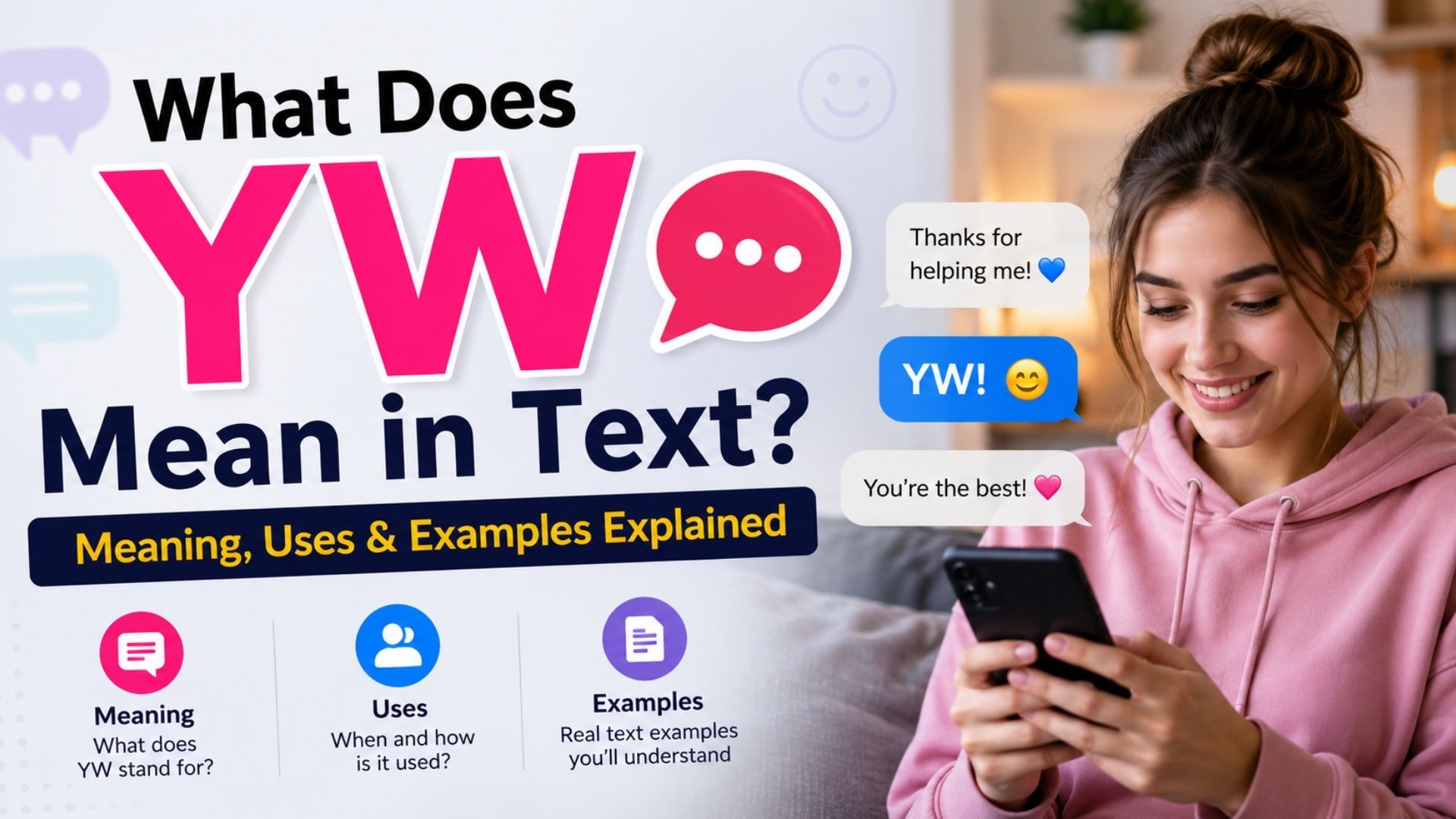
Have you ever received a message that simply says “YW” and wondered what the person meant? If you’ve seen this abbreviation in a text, Snapchat message, Instagram DM, or online chat, you’re probably looking for a quick explanation. So, what does yw mean in a text?
In most cases, YW means “you’re welcome.” People use it as a short, casual way to respond after someone says “thank you.” Instead of typing the full phrase, they simply write “YW,” making the conversation faster and more relaxed. For example, if you text someone, “Thanks for helping me,” they might reply, “YW!” It’s essentially the same as saying, “You’re welcome!”
However, like many texting abbreviations, the tone can change depending on the situation. A simple “YW” might sound friendly and polite in one conversation but slightly dry or dismissive in another. The surrounding messages, punctuation, and relationship between the people involved can all affect how it comes across.
In this guide, we’ll explain what does yw mean in a text, where the abbreviation came from, how people use it in everyday conversations, and what it can communicate emotionally. You’ll also find real-life examples, similar terms, common misunderstandings, and answers to frequently asked questions.
What Does YW Mean?
The most common answer to what does yw mean in a text is “you’re welcome.”
People typically use “YW” as a quick response when someone thanks them. It’s especially common in casual digital communication, where people often shorten familiar phrases to save time.
For example:
Person 1: “Thanks for sending me the notes!”
Person 2: “YW!”
Here, “YW” simply means “You’re welcome!”
The abbreviation is similar to saying:
- “No problem.”
- “No worries.”
- “My pleasure.”
- “Anytime.”
- “Of course.”
However, these phrases don’t always have exactly the same emotional tone. “YW” is generally a straightforward acknowledgment of someone’s thanks.
You may see it written in different ways, including:
- YW
- yw
- Yw!
The capitalization usually doesn’t change the meaning. In texting, lowercase “yw” is often more casual, while “YW!” may feel slightly more enthusiastic.
Real-life examples:
Here are some examples that show how YW works in everyday conversations:
Example 1:
“Thanks for picking me up!”
“YW!”
The person is simply saying, “You’re welcome!”
Example 2:
“Thank you so much for helping with my project.”
“Yw, happy to help.”
Here, the abbreviation sounds friendly and supportive.
Example 3:
“Thanks for the birthday wishes!”
“YW 😊”
The emoji makes the response feel warmer and more cheerful.
Example 4:
“Thank you for explaining that to me.”
“yw, anytime!”
This response communicates that the person is happy to help again.
Example 5:
“Thanks for saving me a seat!”
“YW 😂”
The laughing emoji adds a playful tone to an otherwise simple response.
These examples show why context matters. The basic meaning stays the same, but the emotional tone can change depending on the words, punctuation, and emojis around “YW.”
Origin and Background of the Term
“YW” comes from the phrase “you’re welcome,” a common English response to “thank you.” Like many internet abbreviations, it became popular as online communication and texting made short-form language more common.
Early text messaging encouraged people to use abbreviations because typing on mobile phones was slower and less convenient than it is today. Short expressions such as “LOL,” “BRB,” “TY,” and “YW” helped people communicate quickly.
As smartphones, instant messaging, and social media became part of everyday life, these abbreviations continued to spread. Today, people use “YW” across many informal platforms, including text messages, group chats, social media DMs, and online communities.
The abbreviation is especially easy to understand because it represents a phrase people already use frequently. When someone sees “YW” after saying “thank you,” the meaning is usually obvious from the conversation.
Over time, however, texting language has become more flexible. People don’t always use abbreviations strictly to save time anymore. Sometimes, they use them because they fit the casual tone of digital communication.
For example, typing “yw” can feel more relaxed than writing “You’re welcome.” In a fast-moving conversation, that shorter response may feel perfectly natural.
Read more: What Does STG Mean in Text? Meaning, Uses, and Examples
How YW Is Used in Daily Life

“YW” is mainly used after someone expresses gratitude. It can appear in almost any casual conversation where one person thanks another.
You might see it after someone thanks you for:
- Helping with homework
- Sending information
- Giving advice
- Sharing a photo or file
- Holding a door
- Giving someone a ride
- Answering a question
- Offering emotional support
- Doing a small favor
For example:
“Thanks for sending me that link.”
“YW!”
Or:
“Thank you for staying late to help me.”
“YW. Glad I could help.”
The abbreviation works because the meaning is already established by the previous message. You don’t need to explain anything else.
However, “YW” is generally best suited to informal conversations. If you’re responding to a formal business email or an important professional message, writing “You’re welcome” or “My pleasure” may sound more polished.
The relationship also matters. With a close friend, “yw” may feel completely natural. With someone you don’t know well, the same response could come across as brief or impersonal.
That’s not necessarily a problem. Texting styles vary from person to person. Some people naturally write short messages, while others prefer complete sentences.
Emotional or Practical Meaning of YW
Although “YW” literally means “you’re welcome,” its emotional meaning can vary slightly depending on the context.
At its core, the abbreviation acknowledges someone’s gratitude. It tells the other person that their thanks have been received and that the favor or action wasn’t a burden.
In simple terms, it’s like opening the door for someone and saying, “No problem.”
Positive side:
The positive side of “YW” is its simplicity.
It can make conversations quick and efficient without losing the basic message of politeness. When someone says “Thank you,” replying with “YW” shows that you recognize their appreciation.
For example:
“Thanks for helping me study!”
“YW! Hope the exam goes well.”
The first part acknowledges the thanks, while the second part adds genuine warmth.
“YW” can also feel friendly when combined with emojis or additional words:
“YW 😊”
“YW, anytime!”
“YW! Happy to help.”
“yw haha”
These variations show that a short abbreviation doesn’t have to feel cold. The surrounding language can add personality.
Potential downside:
The potential downside is that “YW” can sometimes sound too brief.
Imagine someone sends a heartfelt message:
“Thank you so much for being there for me when I really needed someone.”
If the response is simply:
“YW.”
The recipient might feel that the answer is a little distant, even though the sender probably meant nothing negative.
In this situation, a warmer response might be better:
“Of course. I’m always here for you.”
Or:
“You’re very welcome. I’m glad I could be there.”
This is an important part of understanding what does yw mean in a text. The abbreviation itself isn’t rude, but the context can influence how it feels.
Punctuation can also affect perception. “YW!” may sound upbeat, while “yw” can feel more relaxed. “YW.” might sometimes appear more serious or abrupt, depending on the person.
Still, you shouldn’t automatically assume someone is annoyed just because they replied “YW.” Some people simply prefer short texts.
Similar or Related Terms
If you’re learning texting abbreviations, you’ll often see “YW” alongside other short expressions.
| Term | Meaning | Common Use |
|---|---|---|
| YW | You’re welcome | Replying to thanks |
| TY | Thank you | Expressing gratitude |
| TYSM | Thank you so much | Stronger appreciation |
| THX | Thanks | Casual gratitude |
| NP | No problem | Responding to thanks |
| NVM | Never mind | Taking back or dismissing a request |
| IDC | I don’t care | Showing indifference |
| BRB | Be right back | Temporarily leaving a chat |
| LOL | Laughing out loud | Showing amusement |
| OFC | Of course | Agreement or reassurance |
The closest alternatives to “YW” are probably “NP” (“no problem”), “no worries,” and “anytime.”
However, there are subtle differences.
“YW” directly responds to “thank you.”
“NP” suggests that the favor wasn’t difficult or troublesome.
“No worries” reassures the person that they didn’t cause any inconvenience.
“Anytime” suggests that you’re willing to help again.
For example:
“Thanks for helping me move!”
“YW!” — You’re welcome.
“NP!” — It wasn’t a problem.
“No worries!” — Don’t worry about it.
“Anytime!” — I’d gladly help again.
All four responses are positive, but they carry slightly different shades of meaning.
Common Misunderstandings About YW
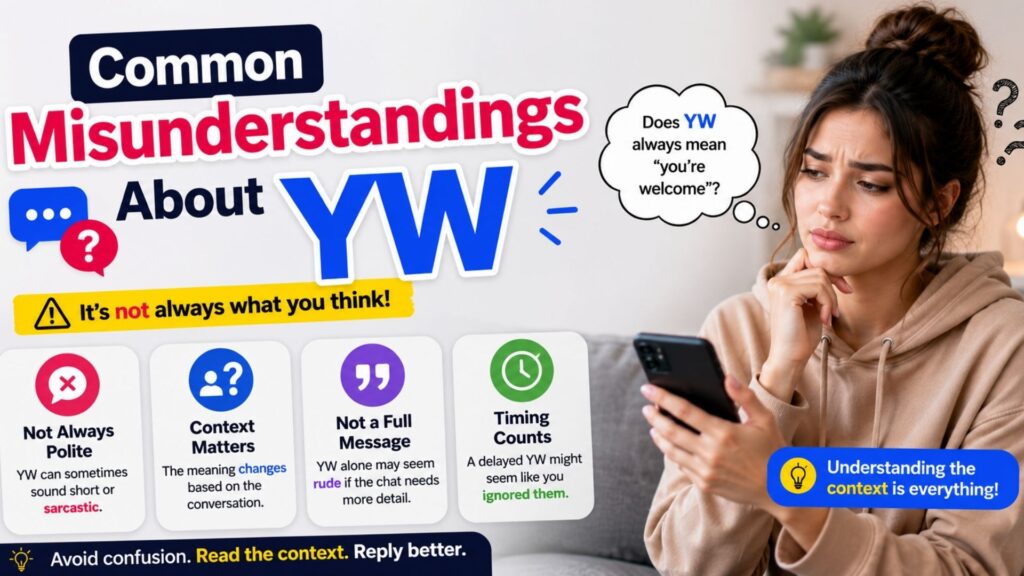
Because texting abbreviations are short, they can sometimes cause confusion. Here are a few common misunderstandings about “YW.”
YW always sounds friendly
Not necessarily.
While “YW” is usually neutral or positive, the tone depends on context. A person who regularly sends very short messages may use “YW” without any hidden meaning.
However, if the conversation is already tense, a short “YW.” might feel less warm than a longer response.
The best approach is to look at the person’s overall communication style instead of judging one message by itself.
YW is rude
“YW” is not inherently rude.
It’s simply an abbreviation for “you’re welcome.” Millions of casual conversations use shortened phrases without any negative intention.
That said, the setting matters. In a professional or formal situation, a full phrase may be more appropriate.
YW can mean something else
In most texting conversations, “YW” means “you’re welcome.” However, abbreviations can have different meanings in specific communities or contexts.
If “YW” doesn’t make sense as “you’re welcome,” look at the surrounding conversation. The context may reveal another interpretation.
For everyday texting, though, “you’re welcome” is by far the most common meaning.
YW means the person is being distant
Not always.
Some people naturally prefer short replies. They might type “yw” instead of “you’re welcome” simply because it’s faster.
If you’re unsure about someone’s tone, consider their usual texting habits. One short message isn’t enough to determine someone’s feelings.
YW is only used by young people
That’s also not true.
People of different ages use texting abbreviations. The frequency may vary, but “YW” is simple enough that anyone familiar with casual digital communication can understand and use it.
Examples of YW in Sentences
Let’s look at more examples of how “YW” can appear in real conversations.
Example 1: Simple response
“Thanks!”
“YW!”
This is the most basic use. The person is simply saying, “You’re welcome.”
Example 2: Helping a friend
“Thanks for helping me finish my assignment.”
“YW! Glad I could help.”
The added sentence makes the response warmer.
Example 3: Casual conversation
“Thanks for the recommendation!”
“yw 😊”
The lowercase abbreviation and emoji create a relaxed tone.
Example 4: Playful response
“Thanks for finally answering my question 😂”
“YW 😂”
The emojis make the exchange feel humorous rather than formal.
Example 5: Supporting someone
“Thank you for listening to me last night. I really needed that.”
“Of course. YW. I’m always here if you need to talk.”
Here, “YW” is part of a longer, more caring response.
Example 6: Group chat
“Thanks everyone for helping with the event!”
“YW!”
In a group conversation, “YW” can be a quick way to acknowledge someone’s appreciation.
Example 7: Professional but casual
“Thanks for sending over the document.”
“YW. Let me know if you need anything else.”
Although still informal, the second message adds clarity and professionalism.
These examples demonstrate an important point: YW doesn’t have one fixed emotional tone. Its basic meaning stays the same, but the words around it shape how the message feels.
Why Understanding YW Matters Today

Understanding texting abbreviations like “YW” may seem like a small thing, but digital communication plays a huge role in everyday life.
People now communicate through short messages, DMs, group chats, comments, and online communities. These conversations often rely on abbreviations that aren’t always obvious to everyone.
Knowing what does yw mean in a text helps you understand conversations without having to stop and search every unfamiliar term.
It also helps you interpret tone more accurately.
For example, if someone replies “YW!” after you thank them, you can usually take it as a friendly acknowledgment. If they respond with “yw 😊,” the emoji adds warmth. If they simply say “yw,” the tone may be more casual.
Understanding these small differences can prevent unnecessary misunderstandings.
However, it’s also important not to overanalyze every abbreviation. Texting styles differ greatly. One person’s “yw” may feel perfectly normal, while another person’s “YW!” may be their usual way of sounding enthusiastic.
The best way to understand a message is to consider the whole conversation. Look at the words, emojis, punctuation, relationship, and the person’s usual communication habits.
In other words, don’t judge the meaning of two letters in isolation.
FAQs
What does yw mean in simple words?
“YW” usually means “you’re welcome.” It’s a short, informal response people use after someone says “thank you.”
Is yw positive or negative?
“YW” is generally positive or neutral. It usually shows that someone acknowledges your thanks. However, depending on the context and punctuation, it may sometimes feel brief or less warm.
Where is yw commonly used?
“YW” is commonly used in text messages, social media DMs, group chats, online messaging, and other casual digital conversations. It’s less common in formal or professional communication.
Is yw formal or informal?
“YW” is informal. It’s appropriate for casual conversations with friends, family, and people you regularly communicate with online. In formal situations, it’s usually better to write “You’re welcome” or “My pleasure.”
Why do people search for yw meaning in text?
People search for what does yw mean in a text because texting abbreviations aren’t always obvious, especially when someone encounters them for the first time. In most cases, “YW” means “you’re welcome,” but people may want to confirm the meaning or understand the tone behind the message.
Conclusion
So, what does yw mean in a text? In most situations, it simply means “you’re welcome.” It’s a quick and casual way to respond when someone thanks you.
You’ll commonly see “YW” in text messages, social media conversations, DMs, and group chats. While the abbreviation is usually positive or neutral, the exact tone can depend on the context. “YW!” may sound enthusiastic, while “yw” can feel more relaxed. A simple “YW.” might seem brief, but it doesn’t automatically mean the person is upset or being rude.
The key is to look at the entire conversation rather than focusing on the abbreviation alone. When you understand the relationship, context, punctuation, and surrounding words, you’ll have a much better idea of what the sender intends.
In short, the next time someone replies “YW” after you say “thank you,” you can confidently understand it as a simple digital version of “You’re welcome.”
