

Have you ever opened a text message and seen “STG” with no clue what the person means? If you’re wondering what is STG in text, you’re not alone. Texting slang changes quickly, and abbreviations that seem confusing at first can become common in everyday conversations.
In most text messages and social media conversations, STG means “Swear to God.” People use it to emphasize that they’re telling the truth, making a serious promise, or strongly expressing an emotion. For example, if someone says, “STG, I didn’t take your phone,” they’re emphasizing that they’re being honest.
However, STG doesn’t always sound serious. Depending on the context, it can show frustration, excitement, disbelief, surprise, or even humor. Let’s break down the STG meaning, where it comes from, how people use it, and what someone might actually mean when they send it to you.
What Does STG Meaning in Text?
If you’re searching for what is STG in text, the most common answer is “Swear to God.”
In simple terms, STG is used to add extra emphasis to something you’re saying. It’s similar to saying:
- “I swear.”
- “I promise.”
- “Honestly.”
- “I’m telling you the truth.”
- “Believe me.”
For example:
“STG, I didn’t know about the party.”
This means:
“I swear to God, I didn’t know about the party.”
The abbreviation can also add intensity to a statement without necessarily being a literal promise.
For example:
“STG, this traffic is terrible.”
Here, the speaker isn’t necessarily swearing to a fact. They’re using STG to emphasize how frustrated they feel.
You might also see it used to express excitement:
“STG, that was the best movie I’ve ever watched!”
In this case, STG strengthens the person’s opinion.
So, when you’re trying to understand what is STG in text, think of it as a phrase that adds emphasis, sincerity, or emotional intensity to a message.
Read more: HML Meaning in Texting: Full Definition, Examples & How to Use It
Origin and Background of the Term

The phrase “Swear to God” has been part of everyday spoken English for a long time. People traditionally use it when they want to emphasize that they’re telling the truth or making a serious promise.
As digital communication became more popular, people began shortening familiar phrases to save time and make texting faster. That’s how abbreviations like STG became common in casual online conversations.
Today, you may come across STG in:
- Text messages
- Group chats
- Social media comments
- Direct messages
- Online forums
- Gaming chats
- Casual conversations
The abbreviation became useful because it lets people express strong emotion without typing the entire phrase.
For example:
“STG, I’ve told you this five times.”
is quicker and more casual than:
“I swear to God, I’ve told you this five times.”
It’s also important to understand that not everyone uses the phrase with a literal religious meaning. For many people, STG has become a casual expression that simply emphasizes honesty, frustration, or emotion.
How STG Is Used in Daily Life
STG can appear in several types of conversations. Although its basic meaning stays the same, the intention behind it can change depending on the situation.
Emphasizing Honesty
One of the most common uses is to convince someone that you’re telling the truth.
“STG, I didn’t break your headphones.”
The sender wants the other person to believe their statement.
Making a Strong Promise
STG can also be used when someone wants to make a promise sound more serious.
“STG, I’ll be there on time tomorrow.”
Here, the person is emphasizing their commitment.
Showing Frustration
Sometimes STG is used to make a complaint sound stronger.
“STG, my Wi-Fi has stopped working all morning.”
The abbreviation adds emotional weight to the frustration.
Expressing Excitement
STG isn’t only used when something goes wrong. People also use it when they’re excited about something.
“STG, that concert was incredible!”
The person is emphasizing how strongly they feel about the experience.
Reacting to Something Unexpected
You may also see STG when someone is telling a dramatic or surprising story.
“STG, I almost missed my flight!”
Here, the abbreviation adds intensity to the story.
The easiest way to understand the intended meaning is to look at the words around STG. The surrounding message usually tells you whether the sender is being serious, excited, frustrated, or playful.
Emotional or Practical Meaning of STG

The emotional meaning of STG depends on the context in which someone uses it.
| Situation | Example | What STG Communicates |
|---|---|---|
| Defending yourself | “STG, I didn’t do it.” | Strong honesty |
| Making a promise | “STG, I’ll call you.” | Serious commitment |
| Showing frustration | “STG, this is annoying.” | Emotional emphasis |
| Showing excitement | “STG, that was amazing!” | Strong enthusiasm |
| Expressing surprise | “STG, I can’t believe it!” | Intense reaction |
| Making a joke | “STG, I need a vacation.” | Playful exaggeration |
Think of STG as an emotional amplifier. The basic sentence may make sense without it, but adding STG tells the reader that the speaker feels strongly about what they’re saying.
Compare:
“I didn’t do it.”
with:
“STG, I didn’t do it.”
The second statement sounds much more emphatic.
Likewise:
“That movie was great.”
sounds casual, while:
“STG, that movie was amazing.”
sounds much more enthusiastic.
That’s why the STG meaning can’t always be understood by looking at the abbreviation alone. You need to consider the entire message.
Similar or Related Terms
If you’re learning what is STG in text, it can help to compare STG with other popular texting abbreviations.
| Abbreviation | Meaning | Typical Use |
|---|---|---|
| STG | Swear to God | Emphasis, honesty, promises |
| ISTG | I Swear to God | Strong personal emphasis |
| FR | For Real | Sincerity or agreement |
| FRFR | For Real, For Real | Extra emphasis |
| TBH | To Be Honest | Sharing an honest opinion |
| NGL | Not Gonna Lie | Introducing a candid statement |
| IKR | I Know, Right? | Agreeing with someone |
| IMO | In My Opinion | Sharing a personal view |
STG and ISTG are particularly easy to confuse.
For example:
“STG, I’m telling the truth.”
means:
“Swear to God, I’m telling the truth.”
While:
“ISTG, I’m telling the truth.”
means:
“I Swear to God, I’m telling the truth.”
The difference is small, and people may use both in similar situations. However, ISTG places the speaker more directly at the center of the statement.
STG is also different from FR or FRFR. Those abbreviations usually express sincerity or agreement, while STG tends to add stronger emotional emphasis.
Common Misunderstandings About STG
The abbreviation STG is usually easy to understand once you know the basic definition, but its tone can still be misunderstood.
STG Always Has a Religious Meaning
Not necessarily.
Although STG literally includes a reference to God, many people use it as a casual expression. They may simply be emphasizing that they’re telling the truth or expressing a strong feeling.
The intended meaning depends on the individual and the conversation.
STG Always Means the Person Is Angry
That’s not true.
For example:
“STG, that was the funniest thing ever 😂”
The sender is clearly not angry. They’re using STG to emphasize their excitement or amusement.
Look at the rest of the message before deciding what emotion the sender is expressing.
STG Means the Person Is Making a Serious Promise
Sometimes it does, but not always.
Consider:
“STG, this pizza is incredible.”
The speaker isn’t making a promise. They’re simply using STG to make their opinion sound stronger.
STG Is Always Formal
STG is informal texting slang. It’s common in casual conversations but isn’t generally suitable for formal writing.
If you’re writing a professional email, you might say:
“I can confirm that this information is correct.”
rather than:
“STG, this information is correct.”
The first version is clearer and more professional.
STG Is the Same as ISTG
They’re closely related but technically different.
STG means “Swear to God,” while ISTG means “I Swear to God.”
Both can emphasize honesty, promises, frustration, or strong emotions. The difference is simply that ISTG explicitly includes “I.”
Examples of STG in Sentences
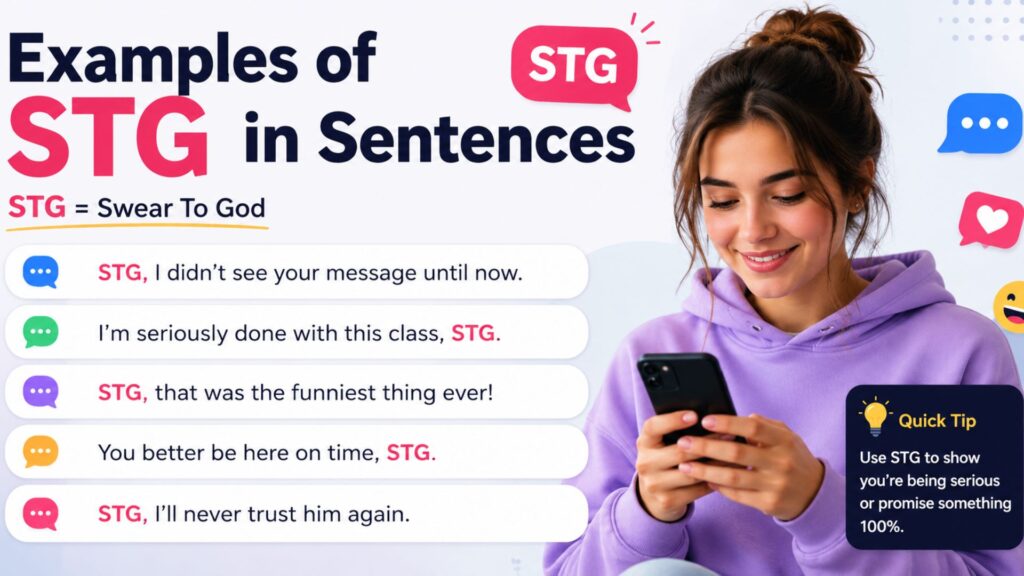
Here are some examples of how people might naturally use STG in everyday texts.
To emphasize honesty:
“STG, I didn’t know you were coming.”
To defend yourself:
“STG, I never said that.”
To make a promise:
“STG, I’ll never do that again.”
To express frustration:
“STG, this computer is driving me crazy.”
To show excitement:
“STG, that was the best game ever!”
To express surprise:
“STG, I thought I was going to miss the bus.”
To emphasize an opinion:
“STG, this is the best restaurant in town.”
To react dramatically:
“STG, I nearly screamed when I saw it.”
To joke with a friend:
“STG, if you eat my fries again, we’re going to have a problem 😂”
To express disbelief:
“STG, you actually did that?”
Notice how the same abbreviation can work in completely different situations. The sentence around STG determines whether it sounds serious, funny, emotional, or dramatic.
Why Understanding STG Meaning in Text Matters Today
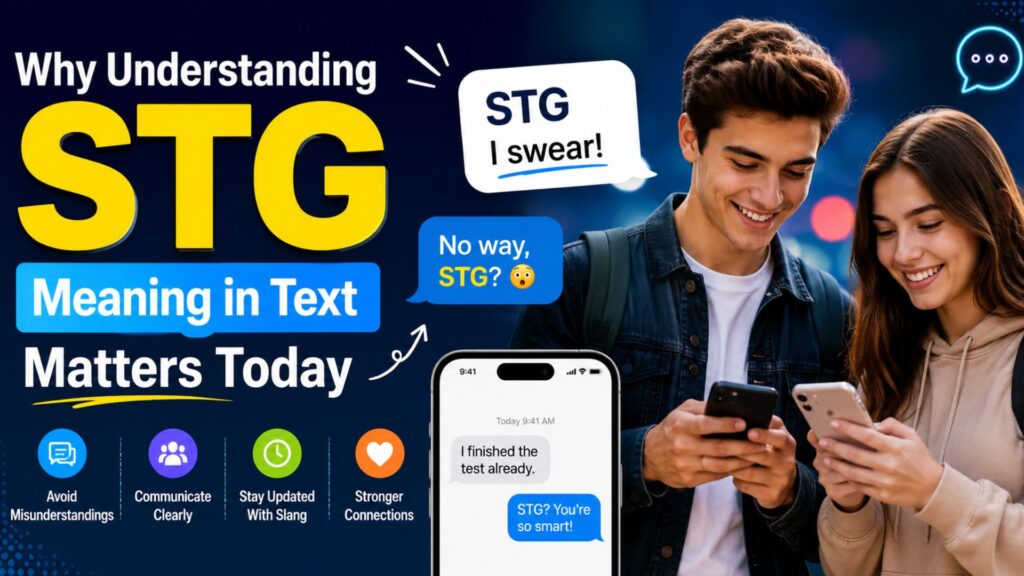
Knowing what is STG in text helps you understand more than just the words someone typed. It also helps you understand the emotion behind those words.
Text messages don’t provide the same clues as face-to-face conversations. You can’t hear someone’s voice, see their expression, or notice their body language. As a result, people often rely on slang, abbreviations, emojis, and punctuation to communicate emotion.
Consider these two messages:
“I didn’t do it.”
“STG, I didn’t do it.”
The second message sounds more intense. The sender is emphasizing their honesty.
Now compare:
“That was amazing.”
with:
“STG, that was amazing!”
The second message feels much more enthusiastic.
Understanding these subtle differences can prevent misunderstandings. If someone sends you STG, don’t automatically assume they’re angry or making a literal religious statement. Instead, look at the surrounding conversation and think about how that person normally communicates.
As digital language continues to evolve, knowing common texting abbreviations makes it easier to communicate naturally online.
FAQs:
What does STG meaning in text in simple words?
STG usually means “Swear to God.” People use it in texts to emphasize that they’re telling the truth, making a promise, or strongly expressing an emotion.
Is STG positive or negative?
STG can be positive, negative, or neutral. The meaning depends on the context. Someone might use it to express excitement, frustration, honesty, surprise, or humor.
Where is STG commonly used?
STG is commonly used in text messages, social media comments, group chats, direct messages, gaming conversations, and other informal online communication.
Is STG formal or informal?
STG is informal texting slang. It’s suitable for casual conversations but generally isn’t appropriate for professional emails, academic writing, or formal documents.
Why do people search for STG meaning in text?
People search for what is STG in text because they may have seen the abbreviation in a message, comment, or social media post and want to understand what it means. Knowing the definition also helps them interpret the sender’s tone and intention.
Conclusion:
So, what is STG in text? In most casual digital conversations, STG means “Swear to God.” People use it to emphasize honesty, strengthen a promise, or add emotional intensity to a statement.
However, the exact tone depends on the context. Someone might use STG to defend themselves, express excitement, complain about a frustrating situation, or make a dramatic joke with a friend.
The best way to understand STG is to read the entire message instead of focusing only on the abbreviation. Once you consider the surrounding words and the relationship between the people involved, the intended meaning is usually much easier to recognize.
If you see STG in a text, remember that it’s generally informal slang used to add emphasis. Whether the sender is being serious, emotional, excited, or playful, the rest of the conversation will usually give you the answer.
