
Have you ever received a message that simply said “TBD” and wondered what it actually meant? Maybe someone texted, “Meeting time: TBD,” or you noticed it on an event schedule online. If you’re unfamiliar with the abbreviation, it can be confusing at first.
The good news is that what does TBD mean in text is one of the easiest texting abbreviations to understand. Whether you’re chatting with friends, organizing a project, planning an event, or reading an online announcement, you’ll come across TBD quite often. Once you know its meaning, you’ll recognize why it’s used in both casual conversations and professional communication. Let’s break it down in simple terms so you can use it confidently.
What Does TBD Meaning in Text?
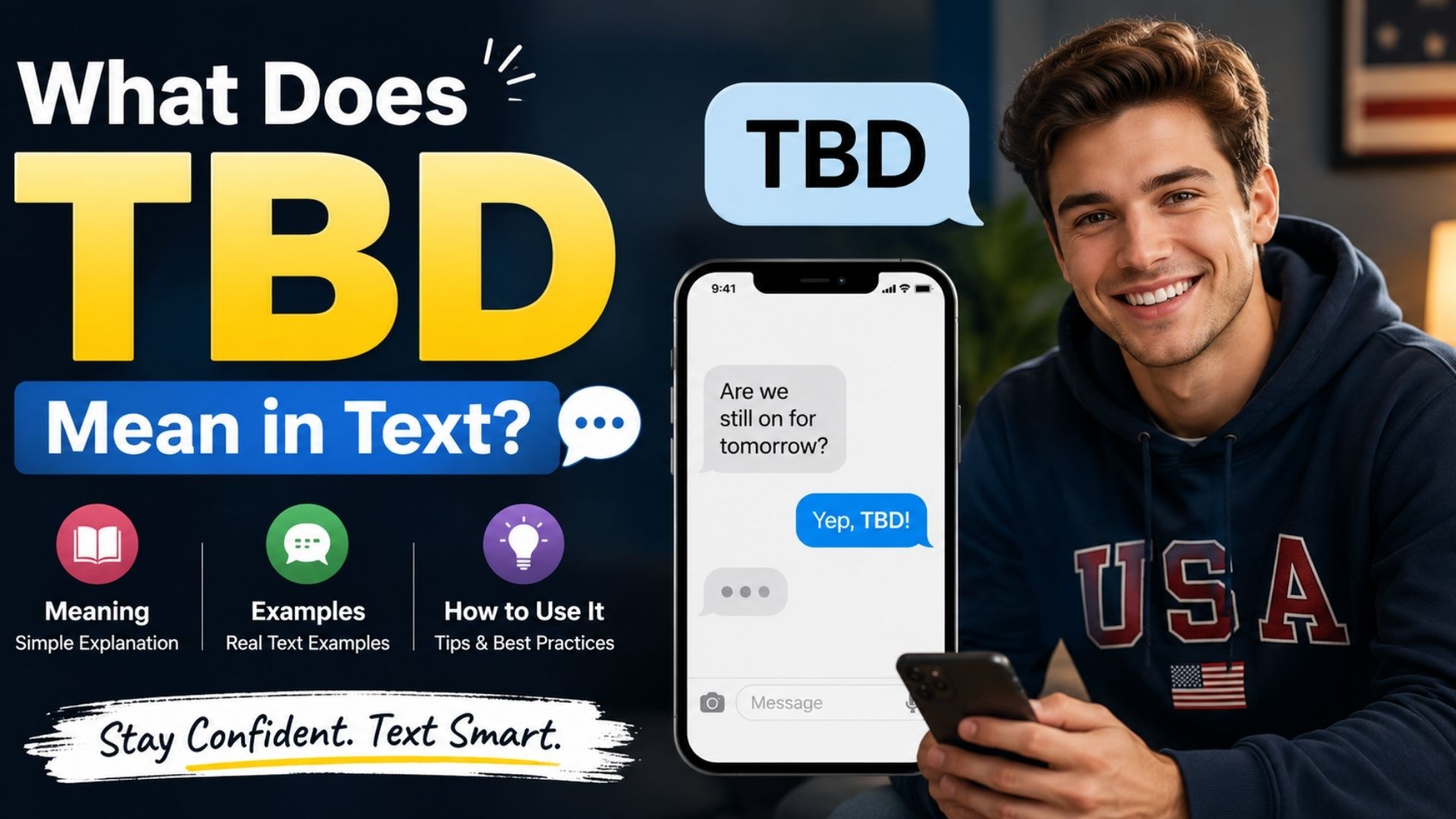
If you’re asking what does TBD mean in text, the answer is straightforward.
TBD stands for “To Be Determined.” It means that a specific detail hasn’t been decided yet but will be confirmed later.
In simple terms, when someone uses TBD, they’re saying, “We don’t know this information yet.”
For example:
- The meeting date is TBD.
- Dinner location is TBD until everyone replies.
- Our vacation plans are still TBD.
- The concert lineup is TBD.
- Class schedules are TBD for now.
Instead of guessing or giving incorrect information, people use TBD as a placeholder until the final decision is made.
Simple Example
Friend: “What time are we leaving tomorrow?”
You: “It’s TBD. We’re waiting for Sarah to finish work.”
This tells your friend that the departure time hasn’t been finalized yet.
What Does “To Be Determined” Really Mean?
Think of TBD like an empty space waiting to be filled.
Imagine you’re planning a birthday party. You know the party is happening, but you haven’t picked the venue yet. Instead of leaving the invitation blank, you write:
Venue: TBD
Later, once you’ve booked the place, you’ll replace TBD with the actual location.
That’s exactly how people use it in texts, emails, calendars, announcements, and work documents.
Common Situations Where TBD Appears
You’ll often see TBD when information is still pending.
| Situation | Example |
|---|---|
| Meetings | Time: TBD |
| School | Exam room: TBD |
| Events | Guest speaker: TBD |
| Sports | Match location: TBD |
| Travel | Departure time: TBD |
| Business | Launch date: TBD |
In every case, the information will be announced once it’s confirmed.
Origin and Background of the Term
Although TBD is extremely popular in texting today, it didn’t begin with smartphones or social media.
The abbreviation has been used for decades in business, government, education, publishing, and event planning. Long before text messages existed, organizations needed a quick way to indicate that information wasn’t available yet.
Instead of writing “to be determined” repeatedly, people shortened it to TBD.
As email became common in the 1990s, TBD spread even further. Later, messaging apps, workplace collaboration tools, and social media made it part of everyday communication.
Today, you’ll find TBD almost everywhere, including:
- Emails
- Text messages
- Meeting invitations
- School schedules
- Conference programs
- Sporting events
- Business presentations
- Product launch announcements
- Online calendars
- Wedding planning checklists
Its popularity comes from its simplicity. Three letters instantly tell everyone that a decision hasn’t been made yet.
Why Has TBD Stayed Popular?
Unlike many internet slang terms that disappear after a few years, TBD remains widely used because it’s practical.
It saves space, avoids confusion, and clearly communicates that information is still pending.
Whether you’re a student, employee, business owner, or event organizer, TBD works in almost every situation.
Read more: TYSM Meaning in Chat: What It Means, How to Use It & Real Examples
How TBD Is Used in Daily Life
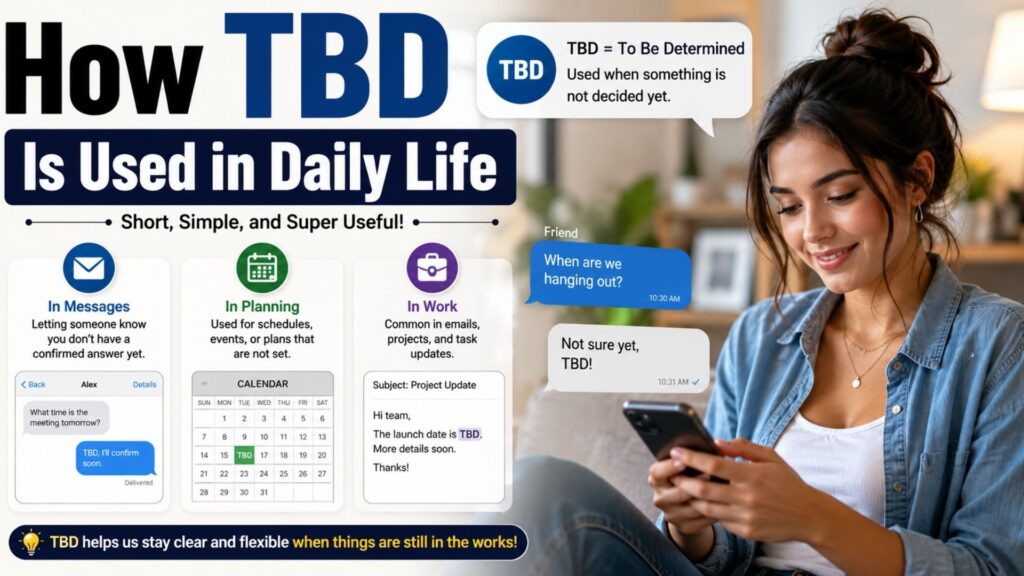
Once you understand what does TBD mean in text, you’ll begin noticing it everywhere.
People use TBD whenever they know something will happen but don’t yet know one or more important details.
In Personal Text Messages
Friends often use TBD while making plans.
Examples:
Friend: “Movie tonight?”
You: “Yes! Time is TBD.”
Sibling: “Where are we eating?”
You: “Restaurant is TBD.”
Family Member: “Who’s driving?”
You: “Still TBD.”
This lets everyone know that planning is still in progress.
At School
Students and teachers frequently use TBD.
Examples include:
- Project presentation date: TBD
- Final exam location: TBD
- Field trip schedule: TBD
- Guest lecture details: TBD
Instead of giving incorrect information, schools wait until everything is finalized.
At Work
Businesses rely on TBD every day.
Examples include:
- Budget approval: TBD
- Product launch date: TBD
- Interview schedule: TBD
- Meeting agenda: TBD
- Office relocation: TBD
Using TBD keeps everyone informed without making promises that may change.
During Event Planning
Event organizers often have incomplete information while planning.
For example:
- Speaker: TBD
- Venue: TBD
- Ticket price: TBD
- Performance time: TBD
- Special guests: TBD
This allows organizers to publish schedules before every detail is confirmed.
On Social Media
You’ll also find TBD in captions, posts, and announcements.
Examples:
- “Vacation dates: TBD.”
- “New video coming soon—release date TBD.”
- “Big announcement… details TBD.”
Creators use it to build excitement while they finalize plans.
In Everyday Conversations
People often say TBD naturally in conversation.
For example:
“We know we’re going this weekend. The exact plan is TBD.”
“The budget is still TBD.”
“Our next vacation destination is TBD.”
In all these examples, TBD simply means the answer will come later—it hasn’t been decided yet.
Emotional or Practical Meaning of TBD
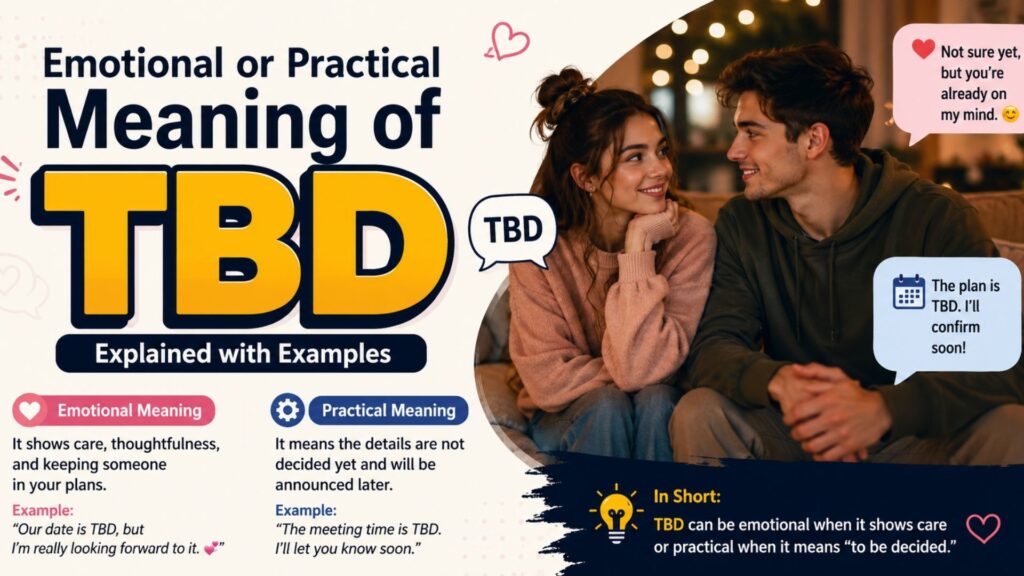
While what does TBD mean in text has a simple dictionary definition—“To Be Determined”—its practical meaning depends on the conversation. Most of the time, it doesn’t express an emotion. Instead, it tells you that a decision is still pending.
However, the context can give TBD a slightly different tone.
When TBD Shows Flexibility
Sometimes TBD means the person is keeping their options open.
For example:
Alex: “Which restaurant are we going to?”
Emma: “It’s TBD. We’re waiting to hear what everyone wants.”
Here, TBD isn’t negative. It simply shows that the group hasn’t made a final choice.
When TBD Shows Uncertainty
In other situations, TBD may indicate that something is uncertain.
For example:
- The release date is TBD.
- Our travel plans are TBD because of the weather.
- The interview schedule is TBD until the manager returns.
These examples suggest that the decision depends on other factors.
When TBD Creates Anticipation
Businesses, content creators, and event organizers often use TBD to build curiosity.
Examples include:
- Surprise guest: TBD
- New product launch: TBD
- Season finale date: TBD
In these cases, TBD creates excitement because people know more information is coming soon.
Practical Benefits of Using TBD
Using TBD offers several advantages:
- Prevents sharing incorrect information.
- Lets everyone know a decision is still pending.
- Keeps schedules organized.
- Reduces confusion when plans change.
- Saves time by replacing a longer explanation.
Instead of saying, “We haven’t decided yet,” people can simply write TBD.
Similar or Related Terms
When learning what does TBD mean in text, it’s helpful to know a few related abbreviations. They all deal with information that is missing or will be provided later, but each has a different meaning.
| Abbreviation | Full Form | Meaning |
|---|---|---|
| TBD | To Be Determined | A decision hasn’t been made yet. |
| TBA | To Be Announced | The information is decided but hasn’t been shared yet. |
| TBA | To Be Assigned | Sometimes used when a person or role hasn’t been chosen. |
| TBC | To Be Confirmed | Information is expected but still needs confirmation. |
| N/A | Not Applicable | The information doesn’t apply. |
| ETA | Estimated Time of Arrival | The expected arrival time. |
TBD vs. TBA
People often confuse these two.
TBD means the decision hasn’t been made.
Example:
- Meeting location: TBD
No one has chosen the location yet.
TBA means the decision has already been made but hasn’t been announced.
Example:
- Award winner: TBA
The organizers may already know the winner, but they aren’t revealing it yet.
TBD vs. TBC
These abbreviations are also similar.
TBD means something hasn’t been decided.
TBC means there’s already a likely answer, but someone still needs to confirm it.
For example:
- Flight departure time: TBC
- Hotel booking: TBC
The information probably won’t change much, but it isn’t officially confirmed.
Common Misunderstandings About TBD Meaning in Text
Although TBD is simple, people sometimes misunderstand it.
Misunderstanding #1: It Means “Maybe”
Not exactly.
TBD doesn’t mean something might happen. It means a decision hasn’t been made yet.
Misunderstanding #2: It’s Only Used in Business
Many people think TBD belongs only in offices or formal emails.
In reality, it’s also common in:
- Text messages
- Family chats
- School assignments
- Social media posts
- Sports schedules
- Travel planning
Misunderstanding #3: TBD Means Something Is Cancelled
This is incorrect.
If an event says:
Time: TBD
The event is still happening.
The organizers simply haven’t finalized the time.
Misunderstanding #4: TBD Is Internet Slang
Unlike abbreviations such as LOL, BRB, or IDK, TBD isn’t internet slang.
It’s a professional abbreviation that has become popular in everyday texting because it’s short and useful.
Examples of TBD in Sentences
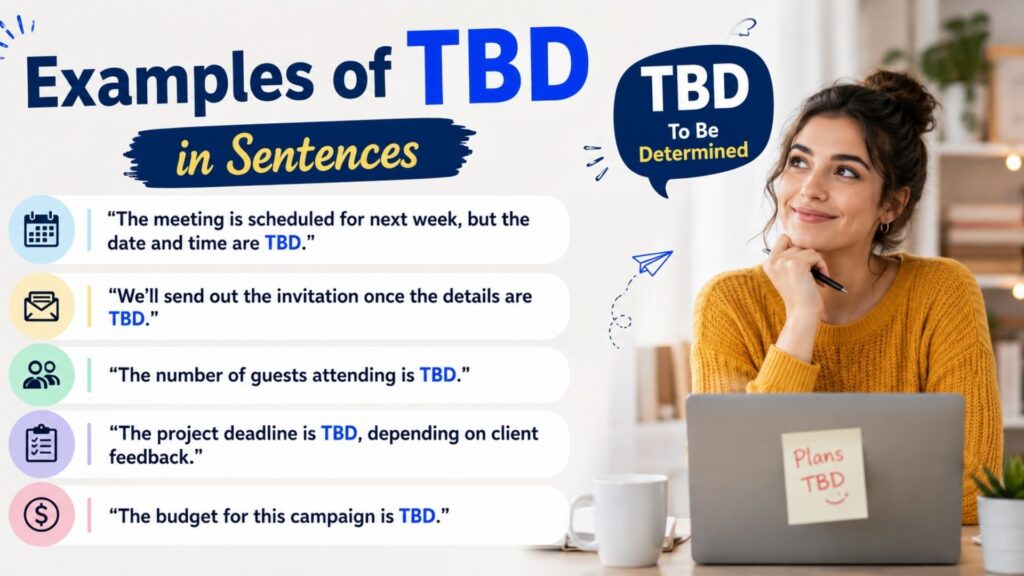
Seeing what does TBD mean in text in real conversations makes it easier to understand.
Friends Planning a Trip
Liam: “What hotel are we staying at?”
Olivia: “That’s TBD until everyone confirms the budget.”
Family Chat
Mom: “Dinner at Grandma’s?”
Dad: “Yes. The exact time is TBD.”
Workplace Conversation
Manager: “We’ll hold another meeting next week.”
Employee: “Has the time been decided?”
Manager: “Not yet. It’s TBD.”
School Example
Teacher: “Our science fair date is TBD. We’ll announce it once the auditorium is available.”
Event Planning
Poster:
- Venue: TBD
- Guest Speaker: TBD
- Ticket Price: TBD
Each detail will be updated when it’s finalized.
Product Launch
“Our newest smartphone is coming soon. Official release date: TBD.”
These examples show that TBD works in both casual conversations and professional communication, making it one of the most useful abbreviations you’ll encounter.
Why Understanding TBD Meaning in Text Matters Today
Today, people communicate faster than ever through text messages, emails, social media, and workplace apps. Because of this, abbreviations like TBD have become part of everyday communication. If you know what does TBD mean in text, you’ll understand messages more quickly and avoid unnecessary confusion.
Whether you’re planning a family gathering, working on a school project, or organizing a business meeting, you’ll likely see TBD whenever details haven’t been finalized.
It Helps You Understand Messages Faster
Imagine receiving this message:
“Team meeting: Friday, time TBD.”
If you already know what TBD means, you’ll immediately understand that the meeting is happening on Friday, but the exact time will be shared later.
Without knowing the abbreviation, you might think important information is missing or wonder if the meeting is still taking place.
It Improves Professional Communication
Many companies use TBD in emails, reports, presentations, and project plans.
For example:
- Project deadline: TBD
- Interview location: TBD
- Product launch date: TBD
Understanding these messages helps you stay informed without needing to ask for clarification every time.
It Makes Planning Easier
Plans often change before they’re finalized. Instead of updating everyone repeatedly, people simply write TBD until they have confirmed information.
This keeps everyone on the same page while reducing confusion.
It Helps You Use the Abbreviation Correctly
Once you know what does TBD mean in text, you can also use it naturally.
For example:
- “The vacation dates are TBD until everyone gets time off.”
- “The restaurant is TBD because we’re waiting for more people to vote.”
- “Our next meeting location is TBD.”
Using TBD correctly makes your messages shorter, clearer, and more professional.
FAQs
What does TBD meaning in simple words?
TBD means “To Be Determined.” In simple words, it tells you that something hasn’t been decided yet. The final information will be provided later.
Is TBD positive or negative?
Neither. TBD is neutral. It doesn’t express happiness, disappointment, or excitement. It simply indicates that a decision is still pending.
Where is TBD commonly used?
You’ll commonly see TBD in:
- Text messages
- Emails
- Business meetings
- School schedules
- Event planning
- Sports fixtures
- Travel itineraries
- Social media announcements
It’s useful anywhere information hasn’t been finalized.
Is TBD formal or informal?
One reason TBD is so popular is that it works in both settings.
In professional environments, it’s commonly used in reports, presentations, and official documents. In casual conversations, friends and family also use it when making plans.
Why do people search for TBD meaning in text?
People search for what does TBD mean in text because they often see the abbreviation in messages, emails, calendars, event announcements, or social media posts. Understanding its meaning helps them interpret conversations correctly and avoid confusion.
Conclusion
If you’ve ever wondered what does TBD mean in text, the answer is simple: TBD stands for “To Be Determined.” It’s used whenever a decision hasn’t been made yet or certain details are still being finalized.
Although it’s only three letters, TBD plays an important role in everyday communication. You’ll see it in text messages, emails, school notices, business documents, travel plans, and event schedules. Rather than guessing or sharing incomplete information, people use TBD as a placeholder until the correct details are available.
Now that you understand what does TBD mean in text, you’ll recognize it instantly whenever it appears. More importantly, you’ll know exactly when to use it yourself to keep your messages clear, accurate, and easy to understand.
