Have you ever been texting a friend when they suddenly replied with “IKR”? If you weren’t sure what it meant, you’re definitely not alone. With new internet slang and texting abbreviations appearing all the time, it can be difficult to keep up. That’s why many people search for the IKR full meaning after seeing it in text messages, TikTok comments, Instagram captions, Snapchat chats, or online conversations.
The good news is that IKR is one of the easiest abbreviations to understand once you know its meaning. It’s commonly used when two people strongly agree about something or share the same opinion. Whether you’re chatting with friends, commenting on social media, or replying in a group conversation, knowing the IKR full meaning will help you understand online communication more naturally. Let’s break it down in simple terms.
The Basics: What Does “IKR” Mean Exactly?
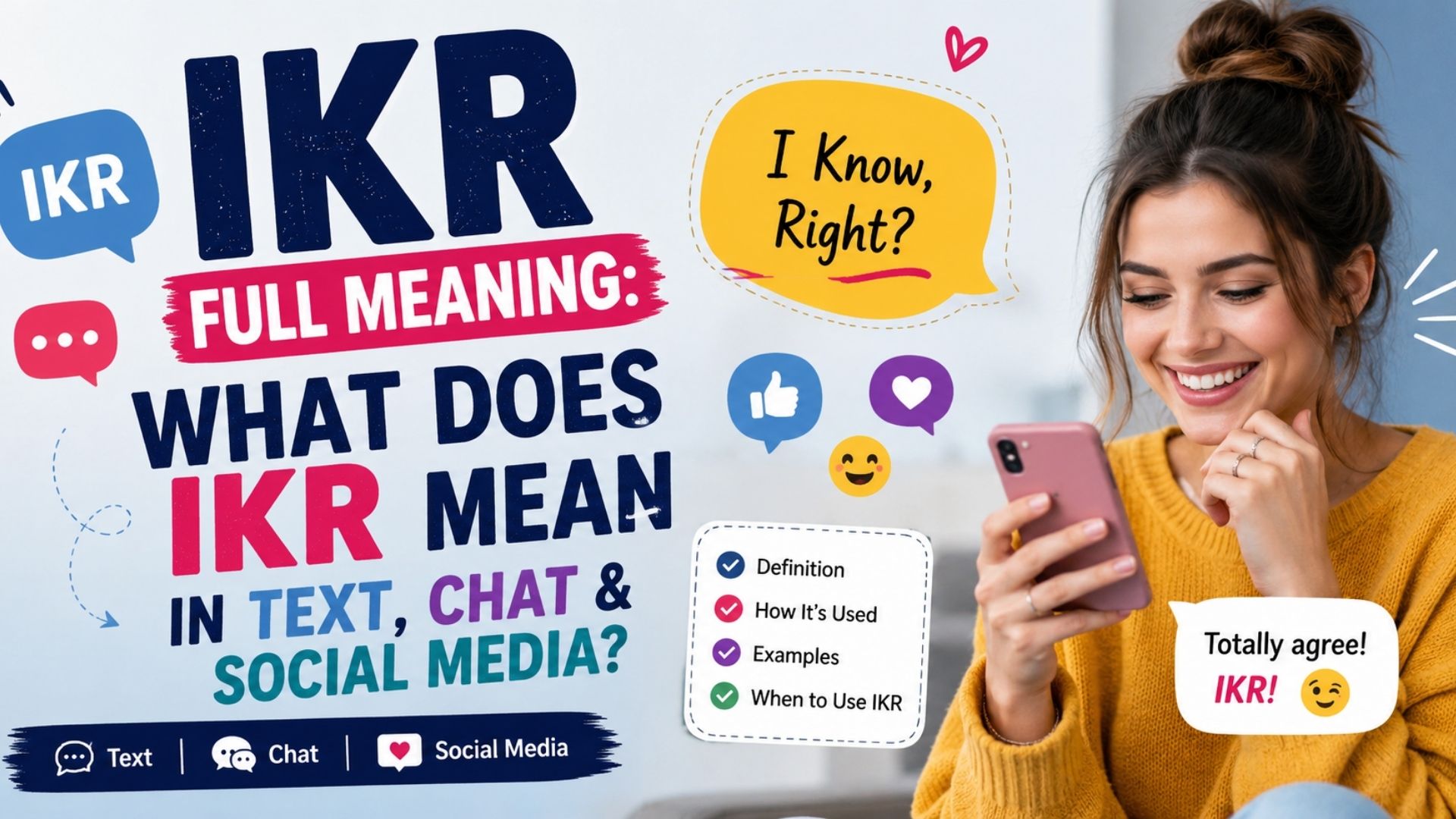
IKR is short for “I Know, Right?” It’s an informal expression people use when they strongly agree with something another person has said.
Unlike a simple “yes,” IKR often communicates a shared reaction. It suggests that you already understand the point being made and feel the same way about it.
For example:
- Friend: “That movie was surprisingly good!”
- You: “IKR! I wasn’t expecting to love it.”
In this conversation, you’re doing more than confirming that the movie was good. You’re emphasizing that you share your friend’s enthusiasm.
IKR can also express frustration, surprise, excitement, or disbelief.
Here are a few everyday examples:
- “IKR, Mondays should be optional. 😭”
- “IKR! That outfit looks amazing.”
- “IKR, I can’t believe the weekend is already over.”
- “IKR 😂 That was the funniest thing I’ve seen all day.”
The exact feeling depends on what you’re responding to. However, the basic purpose remains the same: to show agreement and connect with the other person.
Read More: IMK Mean in Text? The Real Meaning, Uses & Examples 2026
Where Did “IKR” Come From?
IKR developed as part of the broader growth of internet slang, text messaging, and online communication. As people began communicating more frequently through instant messages, chat rooms, and mobile phones, short expressions became a convenient way to communicate familiar ideas quickly.
The phrase “I know, right?” existed in spoken English before it became a common internet abbreviation. People have long used it in conversations to emphasize agreement or express a shared reaction. Online communication simply made it easy to shorten the phrase to three letters.
As texting and social media became more widespread, abbreviations such as LOL (“laughing out loud”), TBH (“to be honest”), IMO (“in my opinion”), and IKR became familiar parts of digital conversations.
IKR fits especially well into messaging because it captures both agreement and emotion without requiring a lengthy response. It can also be paired with emojis to make the intended tone clearer.
Although it’s difficult to identify one definitive moment when IKR first appeared online, its popularity reflects a broader trend: people naturally develop shortcuts for expressions they use frequently.
Today, IKR is widely understood in casual English-language texting and social media conversations.
IKR Meaning in Text: How It Feels to Use It
When you see IKR in a text message, think of it as an enthusiastic version of “I agree.” It often sounds more personal and expressive than a plain “yes” or “exactly.”
However, the emotional tone can change depending on the situation.
1. Excitement
When someone shares exciting news or a positive opinion, IKR can show that you’re just as enthusiastic.
Example:
- Friend: “Our favorite singer is releasing a new album!”
- You: “IKR!! I’ve been waiting forever. 🎶”
2. Frustration
IKR can also help you express shared annoyance about something that bothers both of you.
Example:
- Friend: “Why are assignments always due at the same time?”
- You: “IKR 😭 It’s like every teacher planned it together.”
3. Surprise
Sometimes, IKR emphasizes how unbelievable or unexpected something feels.
Example:
- Friend: “Can you believe she finished that entire project in one day?”
- You: “IKR! That’s seriously impressive.”
4. Humor and sarcasm
IKR can also be used sarcastically when someone makes an exaggerated statement or points out something obvious.
Example:
- Friend: “I think staying up until 4 a.m. is why I’m tired.”
- You: “IKR 😂 What a mystery.”
In each example, IKR creates a sense of shared understanding. Instead of simply acknowledging what someone said, you’re joining their reaction.
“IKR” Meaning from a Girl — Does It Mean Something Else?
When a girl texts you “IKR,” it generally means exactly the same thing as it does when anyone else uses it: “I Know, Right?”
She might be agreeing with your opinion, reacting to something funny, sharing your excitement, or expressing frustration. The abbreviation itself doesn’t automatically mean she’s flirting or has romantic feelings for you.
For example:
- You: “That café has the best coffee.”
- Her: “IKR! Their iced latte is amazing. ☕”
She’s simply agreeing with you.
Now consider a different conversation:
- You: “We’d probably have so much fun hanging out together.”
- Her: “IKR 😂”
This could be a friendly agreement, a playful response, or potentially part of a flirty conversation. You’d need to consider the surrounding messages and your existing relationship to understand her intention.
How can you interpret it more accurately?
Look at the full conversation rather than focusing on one abbreviation. Does she ask questions, keep the conversation going, or respond warmly to your messages? Those details can help you understand the interaction, although none of them proves romantic interest on its own.
The same principle applies when a guy uses IKR. The abbreviation doesn’t have a different definition based on gender.
Is “IKR” Rude?
No, IKR isn’t inherently rude. It’s a common, informal expression of agreement that usually sounds friendly or enthusiastic.
For example, if your friend says, “That concert was incredible,” and you reply “IKR!”, you’re showing that you share their excitement.
However, the tone can sometimes come across as dismissive or sarcastic.
Imagine someone says, “I’m really tired after working all day,” and you respond, “IKR 🙄.” Depending on your relationship, this might sound like you’re agreeing sarcastically rather than showing sympathy.
IKR can also be inappropriate in formal situations where a more complete response is expected. In a professional email, for example, “I agree with your assessment” is generally more suitable than “IKR.”
The important distinction is between the abbreviation itself and the way you use it. IKR is normally harmless in casual conversations, but the context determines how it comes across.
IKR Meaning in Chat: The Internet’s Shortcut for Connection
In online chats, IKR is more than a time-saving abbreviation. It’s a way to show someone that you’re on the same page.
Imagine you’re chatting with a friend about a television series. They say, “That ending was completely unexpected!” You reply, “IKR? I still can’t stop thinking about it.”
Your response confirms that you had a similar reaction and gives the conversation room to continue.
IKR works particularly well in group chats because it allows several people to respond to the same opinion quickly. One person might complain about an early Monday meeting, and three others could respond with “IKR 😭” to show that they share the frustration.
You’ll commonly encounter IKR in:
- Private text messages between friends.
- Instagram comments and direct messages.
- Snapchat conversations.
- TikTok comment sections.
- WhatsApp group chats.
- Online communities discussing entertainment, hobbies, or everyday life.
The abbreviation is especially useful when a long explanation isn’t necessary. Sometimes, three letters are enough to communicate, “I get it, and I feel the same way.”
Linguistic Insights: Why “IKR” Works So Well
IKR is a good example of how language adapts to the way people communicate. Online conversations often move quickly, and users prefer expressions that are short, recognizable, and emotionally meaningful.
Several features make IKR effective.
It compresses a familiar phrase. Instead of typing “I know, right?” users can communicate the same basic idea with three letters. This is especially convenient in fast-moving conversations.
It expresses agreement and emotion together. A simple “yes” confirms a statement, while IKR often adds emphasis. It can suggest excitement, disbelief, frustration, or shared amusement.
It relies on shared understanding. People who recognize the abbreviation can interpret it without needing an explanation. That familiarity helps conversations flow naturally.
It adapts to different tones. Adding punctuation, capitalization, or emojis can change how a message feels. “IKR!” may sound enthusiastic, while “ikr 🙄” could feel sarcastic.
IKR also illustrates a common feature of informal language: meaning depends on context. The letters themselves provide a starting point, but the surrounding conversation supplies much of the emotional meaning.
The Psychology Behind “IKR”
One reason IKR feels natural in conversation is that people often enjoy discovering that someone else shares their opinions or reactions.
When you agree with a friend, you’re acknowledging their perspective. A response such as “IKR!” can make that agreement feel immediate and personal.
Consider these two responses:
- “Yes, that was frustrating.”
- “IKR! I couldn’t believe it either.”
Both communicate agreement, but the second sounds more conversational and emphasizes a shared reaction.
IKR can also create a sense of belonging. When people use familiar expressions in group chats or online communities, they participate in a shared style of communication. Recognizing the abbreviation helps conversations feel less formal and more relaxed.
However, agreement doesn’t always mean that two people feel exactly the same way. Someone might use IKR simply to keep a conversation moving or acknowledge a point without having a strong opinion.
It’s best to understand the expression as a conversational signal rather than proof of someone’s deeper feelings or personality.
IKR in Academic and Student Contexts
Students frequently use informal abbreviations when messaging classmates, discussing assignments, or chatting about school life. IKR can be a convenient way to agree with a friend’s observation about exams, deadlines, or campus experiences.
For example:
- Classmate: “Why do all our exams happen in the same week?”
- You: “IKR 😭 I haven’t even finished studying for the first one.”
Or:
- Friend: “That lecture was actually really interesting.”
- You: “IKR! I thought it would be boring.”
These are natural uses of IKR in casual student conversations.
However, the abbreviation isn’t usually appropriate for formal academic writing. In an essay, research paper, or assignment, you should express agreement using complete, precise language.
For example, instead of writing “IKR, the results support the hypothesis,” you could write, “These results support the proposed hypothesis.”
Similarly, when emailing a professor, academic adviser, or university administrator, a complete response is usually more professional.
The general rule is straightforward: use IKR when chatting informally with classmates, but choose standard English for academic work and formal communication.
IKR Meaning in English and Across Cultures
In English, IKR stands for “I Know, Right?” It’s an informal expression used to agree with someone or emphasize a shared reaction.
Although English-language internet slang has spread across many countries, not every speaker will recognize every abbreviation. Someone who mainly uses another language online might understand the full phrase but be unfamiliar with its shortened form.
The expression also doesn’t always translate neatly into other languages. Many languages have their own informal ways of expressing agreement, surprise, or shared frustration, and those phrases may not carry exactly the same tone as IKR.
For example, a direct translation of “I know, right?” might sound unnatural in another language even when the intended meaning is clear. A local expression may communicate the same feeling more naturally.
If you’re chatting with someone who may not understand English abbreviations, writing out the full phrase can prevent confusion.
It’s also worth remembering that familiarity varies between individuals. Some English speakers use internet slang constantly, while others prefer complete sentences. Neither style is inherently better; the right choice depends on the conversation.
Quick Comparisons: IKR vs. Other Expressions
IKR is one of several abbreviations people use to express agreement or react to a message. However, each expression has a slightly different conversational purpose.
| Expression | Full form | Typical use |
|---|---|---|
| IKR | I Know, Right? | Strong agreement or shared reaction |
| LOL | Laughing Out Loud | Laughter or amusement |
| TBH | To Be Honest | Introducing an honest opinion |
| FR | For Real | Emphasizing agreement or authenticity |
| IMO | In My Opinion | Sharing a personal viewpoint |
| SAME | Same | Saying you feel or think similarly |
| NGL | Not Gonna Lie | Introducing a candid comment |
| YEAH | Yeah | General agreement or acknowledgment |
IKR vs. FR: Both can express agreement, but IKR often emphasizes a shared reaction, while FR can mean “seriously” or “that’s true.”
IKR vs. SAME: SAME directly says that you share the same experience or feeling. IKR adds a conversational sense of emphasis, as if you’re saying, “Exactly! You get it.”
IKR vs. LOL IKR: Adding LOL introduces laughter or a playful tone. It can make the agreement sound more amused, though the exact feeling depends on the conversation.
Choosing between these expressions depends on what you want to communicate. If you strongly agree with someone’s observation, IKR is a natural option. If you’re simply laughing at a joke, LOL may be more appropriate.
IKR in Internet Culture and Memes
IKR has become a familiar part of internet conversation because it captures a reaction many people recognize: hearing someone say something and immediately thinking, “Exactly!”
This makes it useful in memes, relatable posts, and comment threads about everyday experiences.
For example, imagine a meme about setting five alarms and still waking up late. Someone comments, “Why is this literally me?” Another person replies, “IKR 😭.” The response signals that they recognize the situation and share the same experience.
IKR also appears in discussions about popular television shows, music releases, celebrity moments, food trends, and other topics that inspire strong reactions.
Its flexibility is part of its appeal. A single abbreviation can communicate excitement, agreement, frustration, or amusement without interrupting the conversation.
However, the expression doesn’t belong to one specific meme or online community. It’s a general texting abbreviation that people use wherever casual digital conversation takes place.
As internet slang evolves, familiar abbreviations such as IKR often remain useful because they express common feelings in a compact, recognizable way.
The Future of “IKR”
Internet slang changes constantly. New abbreviations appear, existing ones gain different meanings in certain communities, and some expressions gradually become less popular.
IKR has a practical advantage: it’s short, easy to type, and built from a phrase that people already use in spoken English. That makes it easy to understand for many people who regularly communicate in English online.
Even as new slang develops, the basic purpose of IKR—expressing agreement and shared understanding—remains relevant.
Its popularity may vary across platforms, age groups, and online communities. Some people may prefer newer expressions, while others continue to use IKR because it feels natural.
Rather than predicting that one abbreviation will dominate future conversations, it’s more useful to recognize that internet language continually adapts to people’s communication habits.
IKR is a good example of how a familiar spoken phrase can become a convenient part of digital communication.
Fun Facts About “IKR”
Here are a few interesting details about this everyday abbreviation:
- It contains just three letters. IKR compresses the phrase “I Know, Right?” into a quick response.
- It existed as a spoken phrase first. The full expression was used in everyday English before its abbreviated form became familiar online.
- It can express different emotions. Depending on the context, IKR may convey excitement, frustration, surprise, agreement, or sarcasm.
- Punctuation can change the tone. “IKR!” may feel enthusiastic, while “IKR?” can sound like a rhetorical question or an invitation to agree.
- Emojis add extra context. “IKR 😂” often feels playful, while “IKR 😭” can express exaggerated frustration or amusement.
- It works in many casual settings. You’ll commonly see IKR in messages, comments, and group chats.
- It isn’t limited to one gender. People of different genders use the abbreviation with the same basic meaning.
- It isn’t a formal writing term. In professional documents or academic papers, writing out the intended meaning is generally clearer.
These details show why IKR remains a useful expression: it saves time while retaining much of the feeling behind the original phrase.
Learn Smarter with Scifocus.ai
Understanding abbreviations such as IKR is one small part of becoming more confident with digital communication. Online language includes slang, idioms, abbreviations, and expressions whose meanings can shift depending on context.
When learning a new term, focus on more than its full form. Look at how people use it in actual conversations, notice the tone, and compare examples from different situations. This approach can help you understand not only what a phrase means but also when it’s appropriate to use.
If you’re exploring additional learning resources, Scifocus.ai may be worth investigating for relevant educational tools and explanations. Check its current features and available materials to see whether they fit your learning goals.
The most useful approach is to combine definitions with practical examples. Once you understand how expressions work in context, reading messages and participating in online conversations becomes much easier.
FAQs About “IKR Meaning”
What does “IKR” mean in text?
IKR stands for “I Know, Right?” It’s an informal abbreviation people use to agree with someone, emphasize a shared opinion, or show that they have the same reaction. For example, “That movie was amazing!” followed by “IKR!” communicates enthusiastic agreement.
What does “IKR” mean from a girl?
When a girl sends IKR, it generally means “I Know, Right?” She may be agreeing with you, sharing your excitement, or reacting to something funny or frustrating. It doesn’t automatically indicate flirting or romantic interest; the surrounding conversation matters.
Is “IKR” rude?
No, IKR isn’t inherently rude. It’s usually a casual way to express agreement. However, it can sound sarcastic or dismissive depending on the message, punctuation, emojis, and relationship between the people chatting.
What’s the difference between “IKR” and “LOL IKR”?
IKR means “I Know, Right?” and expresses agreement or a shared reaction. LOL means “Laughing Out Loud.” When someone writes “LOL IKR,” they’re combining agreement with a sense of amusement, often because they find the situation funny or relatable.
What’s another short form like “IKR”?
FR (“For Real”), SAME, and TBH (“To Be Honest”) are common alternatives, although they aren’t exact substitutes. FR emphasizes that something is true, SAME indicates a shared feeling or experience, and TBH introduces an honest opinion. Choose the one that best matches your intended meaning.
Conclusion
IKR stands for “I Know, Right?” and is one of the many abbreviations that make casual digital conversations quick and expressive. People use it to agree, share excitement, emphasize a reaction, or connect with someone who feels the same way.
Whether you encounter IKR in a text message, a Snapchat conversation, an Instagram comment, or a TikTok discussion, its basic meaning usually remains the same. The tone can change, however, depending on the context and the way the sender uses it.
The next time someone texts you “IKR,” you’ll know they’re probably saying, “Exactly! I feel the same way.” And if you want to join the conversation, you can use it naturally whenever you genuinely agree with what someone has said.
