
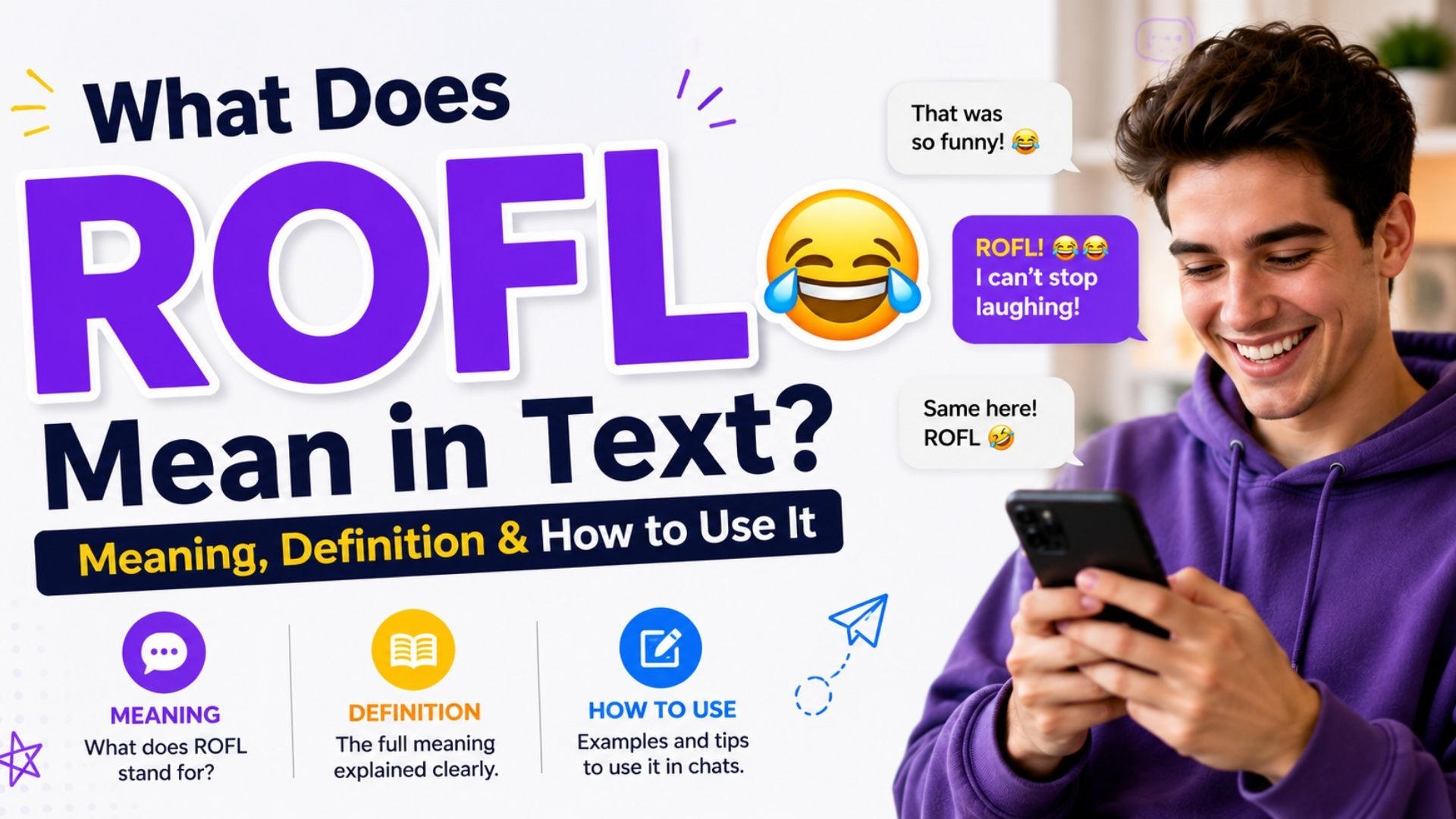
Have you ever received a message that says “ROFL” and wondered what those four letters actually mean? If you’re new to texting slang, internet abbreviations can sometimes feel like a completely different language. You might know “LOL,” but what does ROFL mean in text?
ROFL stands for “Rolling On the Floor Laughing.” It’s an internet and texting abbreviation people use when something is extremely funny. In simple terms, it means, “That’s really, really funny!” The expression is usually stronger than “LOL,” although people don’t always use it literally.
You might see ROFL in a text message after a funny joke, a hilarious video, a ridiculous story, or an unexpected comment. For example, if your friend sends you a funny meme, you could reply, “ROFL 😂.” You’re not necessarily claiming that you’ve actually fallen onto the floor laughing. Instead, you’re using an exaggerated expression to show that you found something incredibly amusing.
In this guide, we’ll explain the what does ROFL mean in text definition, where the expression came from, how people use it in everyday conversations, and how it differs from similar terms such as LOL and LMAO. We’ll also cover common misunderstandings and give you plenty of examples so you can use ROFL naturally.
What Does ROFL Meaning in Text?
The most common answer to what does ROFL mean in text is “Rolling On the Floor Laughing.”
ROFL is used to express strong amusement. When someone sends “ROFL,” they’re essentially saying that something is so funny that they’re imagining themselves laughing uncontrollably.
For example:
“I just watched that video you sent me. ROFL 😂”
The person probably isn’t literally rolling around on the floor. Instead, they’re emphasizing how funny they found the video.
ROFL can be written in several ways:
- ROFL
- rofl
- ROFL 😂
- ROFL!!!
- ROFLMAO
The capitalization usually doesn’t change the basic meaning. Lowercase “rofl” often feels more casual, while “ROFL!!!” may appear more energetic or dramatic.
The abbreviation is especially common in informal digital communication. You’ll see it in text messages, social media posts, online chats, gaming conversations, and comment sections.
Real-life examples:
Example 1: A funny joke
“Why did the computer go to the doctor? It had a virus.”
“ROFL 😂”
The response shows that the person found the joke very funny.
Example 2: A funny video
“You have to watch this video. The ending is crazy.”
“ROFL, I wasn’t expecting that!”
Here, ROFL emphasizes the person’s strong reaction.
Example 3: A friend’s embarrassing story
“I walked into the wrong classroom and sat there for ten minutes.”
“ROFL 😂 How did you not notice?”
The sender is laughing at the situation in a playful way.
Example 4: A funny meme
“This meme is literally you.”
“ROFL, okay, that’s actually accurate.”
The abbreviation adds humor and shows that the person isn’t taking the comparison seriously.
Example 5: A group chat
“Guys, I just tried to open the door with my car keys.”
“ROFL 😂”
The person uses ROFL to react to the funny story.
These examples show that ROFL is mainly about intense amusement. The exact level of laughter can vary, but the expression usually communicates a stronger reaction than a simple “haha.”
Origin and Background of the Term
ROFL comes from the phrase “Rolling On the Floor Laughing.” It developed during the early growth of internet culture and online chat.
As people began communicating through instant messaging, forums, and chat rooms, they needed quick ways to express emotions through text. Unlike face-to-face conversations, online messages don’t naturally include facial expressions, body language, or tone of voice.
Abbreviations helped fill that gap.
Terms like “LOL” and “ROFL” became popular ways to communicate laughter without having to write a full explanation. Instead of typing, “That was extremely funny, and I laughed a lot,” someone could simply write “ROFL.”
The phrase is also an example of internet humor that uses exaggeration. Most people who write ROFL aren’t literally lying on the floor. It’s similar to saying, “I’m dying laughing” or “I can’t stop laughing.” The expression is meant to emphasize the strength of the reaction.
Over time, ROFL became part of the broader vocabulary of internet slang. Even though newer expressions have appeared, the abbreviation remains recognizable to many people who use digital communication.
Today, you may encounter ROFL in:
- Text messages
- Social media DMs
- Group chats
- Online forums
- Gaming chats
- YouTube comments
- Meme conversations
- Messaging apps
The term has also influenced variations such as “ROFLMAO,” which combines ROFL with “LMAO” for an even more exaggerated expression of laughter.
Read more: What Does STSU Mean in Text? Meaning, Slang & Examples
How ROFL Meaning in Text Is Used in Daily Life
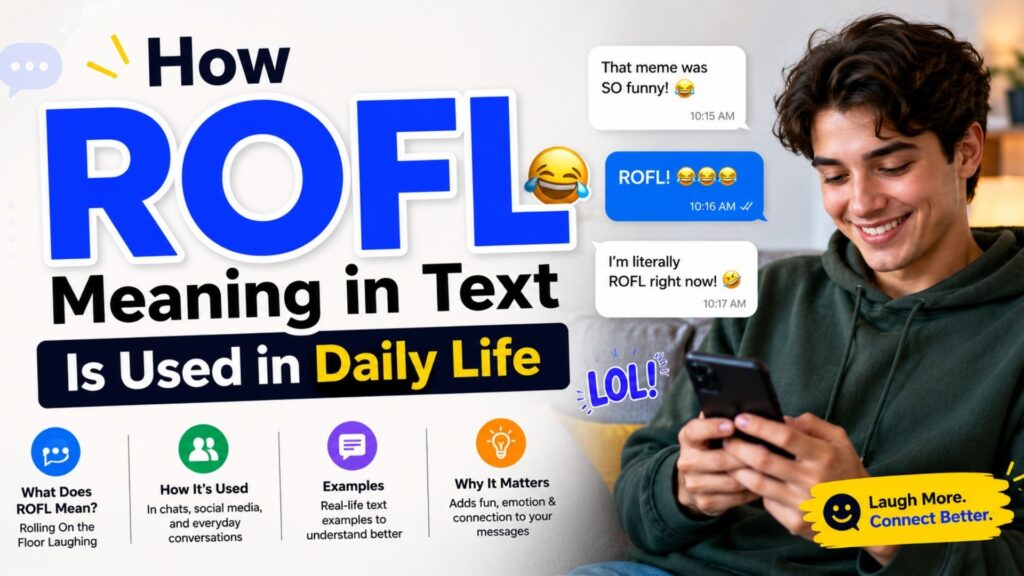
The ROFL meaning in text is generally straightforward: someone is expressing strong amusement.
However, people use it in different situations. Sometimes they’re reacting to a genuinely hilarious joke. Other times, they’re using it to make a conversation more playful.
For example:
“I accidentally sent my boss a message meant for my friend.”
“ROFL 😭”
The sender is laughing at the situation.
ROFL can also be used as a standalone response:
“ROFL 😂”
This usually means the previous message was extremely funny.
It can also be included in a longer sentence:
“ROFL, you seriously did that?”
Here, the person is both laughing and reacting with surprise.
You might even see it used sarcastically:
“ROFL, yeah, because that’s definitely going to work.”
In this case, the person may not literally find the situation hilarious. They could be using ROFL to exaggerate their reaction or poke fun at an idea.
This is why context matters. The same abbreviation can communicate genuine laughter, playful teasing, or sarcasm.
Emotional or Practical Meaning of ROFL
ROFL has a strong emotional purpose in digital communication. It helps show that the sender is amused, entertained, or surprised by something funny.
In face-to-face conversation, you can hear someone’s laughter and see their expression. In a text message, those signals disappear. ROFL helps replace some of that emotional information.
For example, compare these two responses:
“That’s funny.”
and:
“ROFL 😂”
The first sounds calm and straightforward. The second communicates a much stronger reaction.
ROFL can also help prevent a message from sounding too serious. Imagine someone says:
“You really thought you could beat me at this game?”
If you respond:
“ROFL, keep dreaming.”
The abbreviation makes the response feel playful rather than genuinely hostile.
However, the meaning can depend on the relationship between the people involved. Close friends may use ROFL casually, while strangers might interpret it differently.
It’s also worth remembering that people don’t always use internet slang literally. Someone might type “ROFL” even if they’re only mildly amused. Digital expressions often work as emotional signals rather than precise measurements of someone’s reaction.
Similar or Related Terms
If you’re learning what does ROFL mean in text, it’s useful to compare it with other expressions that communicate laughter.
| Term | Meaning | Typical Intensity |
|---|---|---|
| LOL | Laughing out loud | Mild to moderate |
| LMAO | Laughing my ass off | Strong |
| ROFL | Rolling on the floor laughing | Strong or exaggerated |
| ROFLMAO | Rolling on the floor laughing my ass off | Very strong or highly exaggerated |
| LMFAO | Laughing my freaking/f***ing ass off | Very strong, informal |
| Haha | A simple expression of laughter | Mild to moderate |
| 😂 | Face with Tears of Joy emoji | Depends on context |
| 💀 | “I’m dead” from laughing | Often exaggerated or humorous |
The most common comparison is between ROFL and LOL.
“LOL” is often used casually. Sometimes people type “LOL” simply to acknowledge something funny or keep the conversation friendly.
ROFL usually suggests a stronger reaction.
For example:
“My dog stole my sandwich. LOL.”
This sounds like mild amusement.
Compare:
“My dog stole my sandwich and then ran into the wall. ROFL 😂”
This suggests a much bigger reaction.
That said, modern texting isn’t always so precise. Many people use LOL, LMAO, and ROFL interchangeably. The intended tone depends on the person and the context.
Common Misunderstandings About ROFL Meaning in Text
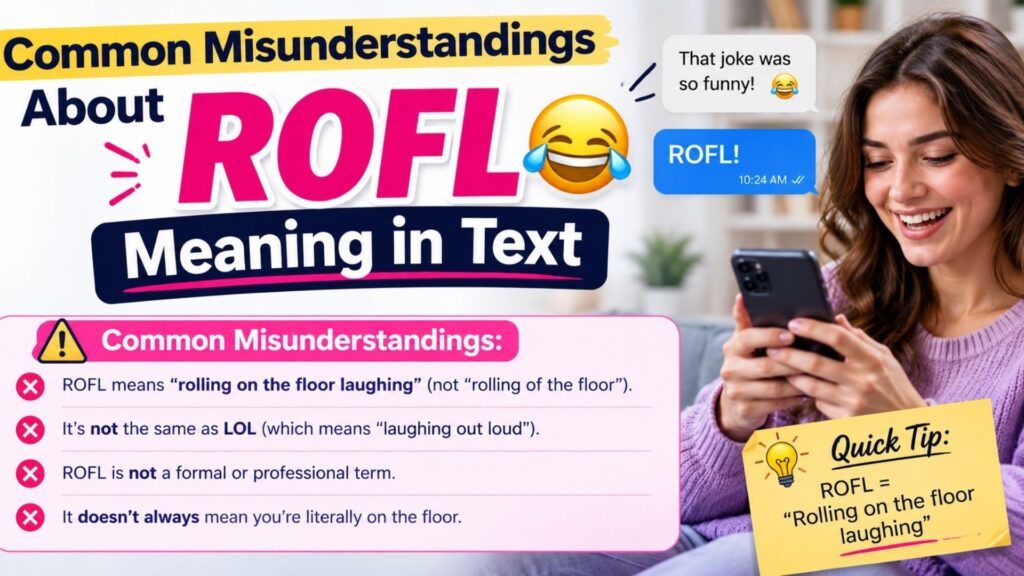
People often have questions about ROFL because internet slang can be exaggerated or confusing. Here are some of the most common misunderstandings.
1. “People actually roll on the floor.”
Not usually.
ROFL is an exaggerated expression. Most people aren’t literally rolling around on the floor when they type it.
It’s similar to saying:
“I’m dying laughing.”
The phrase communicates strong amusement without being a literal description of what the person is doing.
2. “It’s outdated slang.”
ROFL may be less common in some conversations than it once was, but that doesn’t mean everyone has stopped using it.
Internet slang changes constantly. Some people prefer newer expressions, emojis, or phrases such as “I’m dead.” Others still use ROFL because it’s familiar and easy to understand.
Its popularity may vary depending on age, platform, and personal texting style.
3. “It’s rude.”
ROFL isn’t inherently rude.
In most situations, it simply communicates laughter. However, the context matters.
If someone shares something serious and you respond with “ROFL,” that could obviously be insensitive.
For example, if a friend tells you they’re having a difficult day, responding with ROFL would probably come across as disrespectful.
The problem isn’t the abbreviation itself. It’s using it in a situation where laughter isn’t appropriate.
4. “It’s the same as LOL.”
ROFL and LOL are related, but they aren’t always identical.
Both communicate laughter, but ROFL traditionally suggests a stronger reaction.
Think of it this way:
- LOL: “That’s funny.”
- LMAO: “That’s really funny.”
- ROFL: “That’s extremely funny.”
- ROFLMAO: “That’s ridiculously funny.”
Of course, people don’t always follow these distinctions strictly. Someone might use “LOL” after something hilarious or “ROFL” after something only mildly amusing.
Still, understanding the traditional difference can help you interpret the intended tone.
5. “It’s appropriate everywhere.”
Not at all.
ROFL is informal internet slang. It’s fine in casual texts, social media conversations, and friendly chats.
However, you probably wouldn’t use it in:
- A formal business email
- An academic assignment
- A professional report
- A job application
- A serious customer complaint
In those settings, it’s better to use clear, professional language.
The key is to match your communication style to the situation.
Examples of ROFL Meaning in Text in Sentences
Here are some realistic examples showing how people use ROFL in different conversations.
Example 1: Reacting to a joke
“Why don’t scientists trust atoms? Because they make up everything.”
“ROFL 😂”
The person is expressing strong amusement.
Example 2: Laughing at a friend’s mistake
“I put my phone in the fridge instead of the kitchen counter.”
“ROFL, what were you thinking? 😂”
The abbreviation adds playful humor.
Example 3: Reacting to a meme
“This meme is literally your life.”
“ROFL, I hate how accurate this is.”
Here, ROFL shows that the person finds the meme very relatable and funny.
Example 4: Group chat humor
“I just waved back at someone who wasn’t waving at me.”
“ROFL 😭”
The response shows amusement at the awkward situation.
Example 5: Playful teasing
“You think you’re going to beat me?”
“ROFL. Keep telling yourself that.”
Here, ROFL makes the teasing feel more playful.
Example 6: Unexpected situation
“The teacher walked in while everyone was trying to sneak out.”
“ROFL, no way!”
The abbreviation emphasizes surprise and amusement.
Example 7: Sarcastic use
“Sure, because ignoring the problem always works.”
“ROFL, exactly.”
Here, the term may be used sarcastically to emphasize the absurdity of the situation.
Example 8: With emojis
“I just tripped over absolutely nothing.”
“ROFL 😂💀”
The emojis reinforce the exaggerated laughter.
These examples show that ROFL is flexible. It can stand alone, appear at the beginning of a sentence, or be combined with emojis and other slang.
Why Understanding ROFL Meaning in Text Matters Today
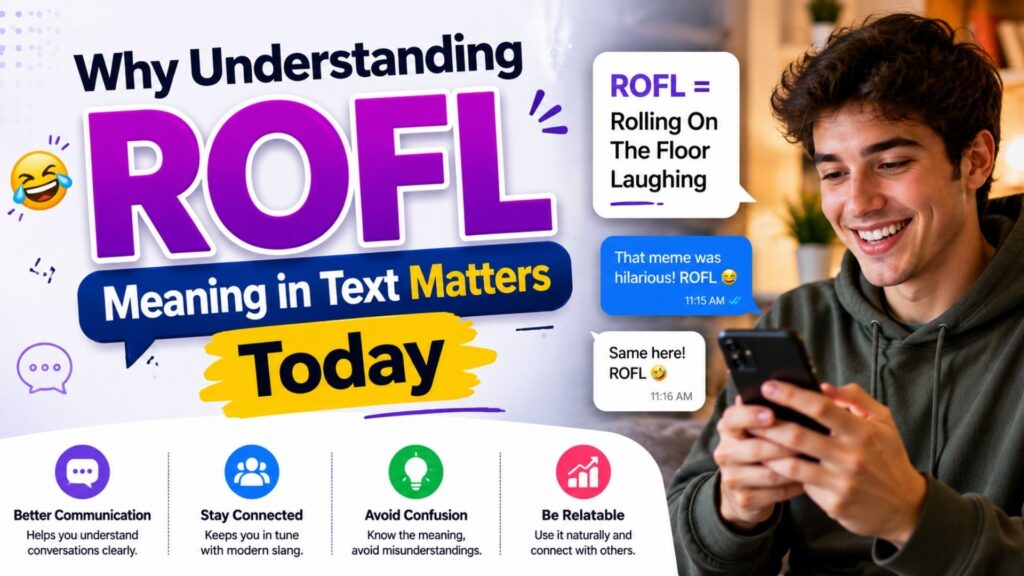
Digital communication has created a language filled with abbreviations, emojis, memes, and slang. Understanding these expressions helps you communicate more naturally and avoid misunderstandings.
Knowing what does ROFL mean in text is useful because it tells you that the person is probably expressing strong amusement rather than making a literal statement.
It also helps you understand the emotional tone of a message.
For example, if someone replies:
“ROFL 😂”
to your joke, you can reasonably assume they found it funny.
If they write:
“ROFL, you’re serious?”
they may be laughing while also expressing disbelief.
And if someone responds:
“ROFL, that’s not happening.”
they could be teasing or sarcastically rejecting an idea.
The abbreviation itself doesn’t tell the entire story. Context does.
Understanding internet slang also makes it easier to communicate across different platforms. Whether you’re texting a friend, chatting on Snapchat, or reading comments on social media, you’ll encounter expressions like ROFL regularly.
However, it’s important to use these terms thoughtfully. Digital communication moves quickly, but that doesn’t mean every situation calls for humor. Knowing when to use ROFL—and when not to—is just as important as knowing what it means.
FAQs
What does ROFL meaning in simple words?
ROFL means “Rolling On the Floor Laughing.” In simple words, it’s an informal way to say that something is extremely funny.
Is ROFL positive or negative?
ROFL is generally positive because it expresses amusement or laughter. However, using it in response to something serious or sensitive could be considered inappropriate or insensitive.
Where is ROFL commonly used?
ROFL is commonly used in text messages, social media, online chats, gaming conversations, forums, group chats, and other informal digital communication.
Is ROFL formal or informal?
ROFL is informal internet slang. It’s suitable for casual conversations but generally shouldn’t be used in formal emails, professional documents, academic assignments, or other serious settings.
Why do people search for ROFL meaning in text?
People search for what does ROFL mean in text because internet abbreviations aren’t always obvious, especially to people who are unfamiliar with texting slang. ROFL is commonly used to express strong laughter and amusement.
Conclusion
So, what does ROFL mean in text? ROFL stands for “Rolling On the Floor Laughing.” It’s a popular internet abbreviation used to show that something is extremely funny.
Although the phrase sounds literal, most people aren’t actually rolling on the floor. It’s simply an exaggerated way to communicate laughter and amusement in a text-based conversation.
ROFL is similar to LOL and LMAO, but it traditionally suggests a stronger reaction. Still, people use these expressions differently, so the exact tone depends on the person and the context.
You’ll usually see ROFL in casual texts, social media chats, group conversations, gaming communities, and other informal online spaces. Just remember that it’s not appropriate for every situation. If someone is sharing serious news or discussing a sensitive topic, a laughing abbreviation could easily come across as insensitive.
Once you understand the ROFL meaning in text, it’s easy to recognize. The next time you see someone type “ROFL,” you’ll know they’re most likely saying, “That is seriously funny!”
