
Introduction
Have you ever sent someone a message and received a simple “K” as the entire reply? Technically, it can mean nothing more than “okay.” Yet depending on the situation, that tiny one-letter response can feel surprisingly cold, annoyed, or even passive-aggressive.
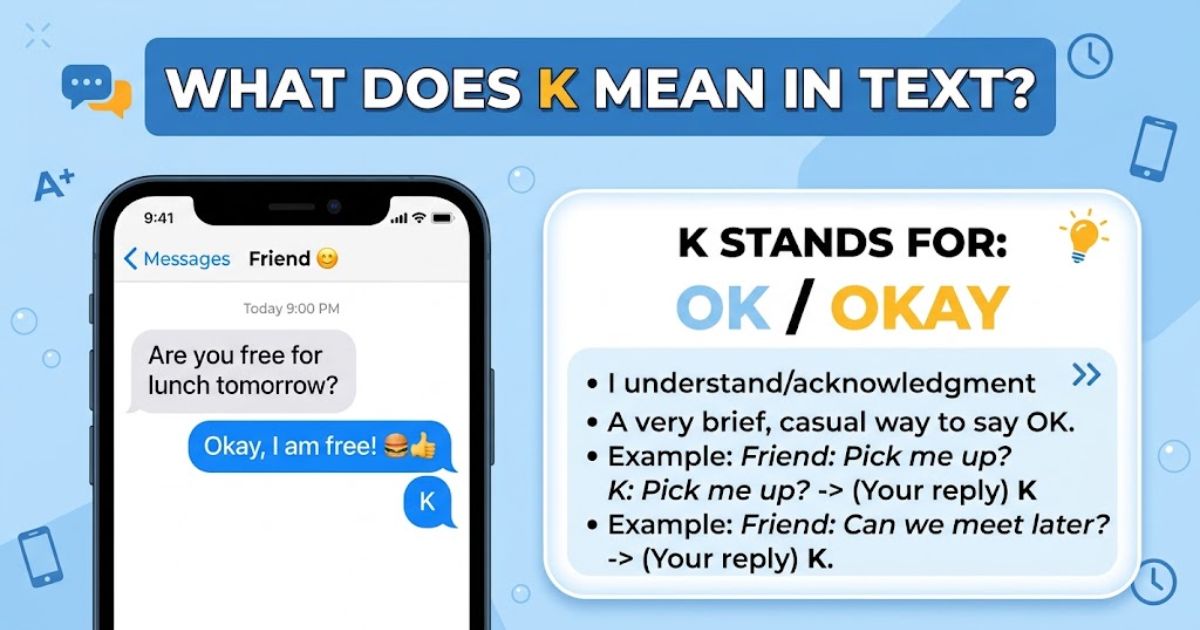
So, what does K mean in text? The basic meaning is usually “okay” or “alright,” but the tone can change dramatically depending on the conversation, relationship, timing, and what happened before the message.
A friend might type “K” because they’re busy. A partner might use it because they’re irritated. Someone at work might simply be acknowledging your message. In other words, the meaning isn’t contained in the letter alone.
Let’s look at the most common meanings of K and how you can tell which one someone probably intends.
What Does K Mean in Text?
In texting, K usually means “okay,” “OK,” or “alright.” It’s one of the shortest possible ways to acknowledge a message.
For example:
You: “I’ll meet you outside at 7.”
Them: “K.”
The straightforward interpretation is:
“Okay, I understand.”
However, K can carry different emotional tones. It may be neutral, rushed, dismissive, irritated, or passive-aggressive depending on the context.
That’s why what does K mean in text doesn’t have one universal answer. The same “K” can feel completely different in two separate conversations.
Why Do People Use “K” Instead of “Okay”?
There are several reasons someone might choose K instead of typing the longer word.
Convenience
K is extremely quick to type. When someone is busy, walking, working, driving as a passenger, or handling several things at once, a one-letter response can be convenient.
For example:
“Dinner at 8?”
“K.”
The person may simply be acknowledging the plan without wanting to spend time typing a longer response.
Quick Acknowledgment
Sometimes you don’t need a full response. K can simply communicate that the other person has received and understood your message.
It can function like a nod in a face-to-face conversation.
Ending the Conversation
K can also signal that someone doesn’t have anything else to add.
For example:
“I’ve explained everything. I’ll talk to you tomorrow.”
“K.”
Here, the person may be closing the conversation rather than expressing anger.
Minimal Effort Communication
Texting often involves very short responses. People use abbreviations, emojis, reactions, and single words because digital conversations don’t always require complete sentences.
K is simply one of the most minimal forms of acknowledgment.
What Does K Mean Emotionally?
The emotional meaning of K depends heavily on context. You shouldn’t automatically assume someone is angry just because they sent one letter.
Neutral Meaning
The most straightforward interpretation is simply “okay.”
For example:
“The meeting starts at 10 instead of 9.”
“K.”
There may be no hidden message at all. The person could simply be acknowledging the information.
Pay attention to the person’s normal texting habits. If they regularly send short replies, K may be completely ordinary for them.
Read More: CS Mean in Text: Meaning, Uses & Real Chat Examples
Passive-Aggressive Meaning
Sometimes K can sound passive-aggressive because it feels deliberately short.
Imagine this conversation:
You: “I’m sorry, but I can’t come tonight.”
Them: “K.”
If that person normally writes longer messages, the sudden one-letter response might suggest irritation or disappointment.
Still, you shouldn’t treat K alone as proof of passive aggression. The preceding conversation matters much more.
Cold or Dismissive Meaning
K can sometimes communicate emotional distance.
For example:
You: “I really wanted to explain what happened.”
Them: “K.”
In this situation, the response may feel like the person isn’t interested in continuing the discussion.
The word itself hasn’t changed. The surrounding emotional context has.
Angry Meaning
After an argument, K may be interpreted as an angry or frustrated response.
For example:
You: “I don’t think you understand what I’m saying.”
Them: “K.”
Here, the person could be frustrated and unwilling to continue arguing.
However, K doesn’t automatically mean anger. Some people naturally use short replies even when they’re perfectly calm.
Why Does “K” Feel So Rude?
Many people perceive K as rude because it removes almost everything that normally softens a text message.
Compare these responses:
“Okay!”
“Okay 😊”
“Sure, no problem.”
“K.”
The final version contains almost no emotional information. Because there’s no extra wording, punctuation, or emoji, the reader may fill in the missing tone themselves.
This is one of the challenges of digital communication: you can’t hear someone’s voice or see their facial expression.
A simple K may therefore feel harsher than the sender intended.
K vs OK vs Okay
These three responses can communicate the same basic idea, but they often create slightly different impressions.
| Reply | Common impression |
|---|---|
| K | Very brief; may feel cold depending on context |
| OK | Short and neutral |
| Okay | Slightly warmer or more complete |
| Okay! | Often enthusiastic or friendly |
| Okay 😊 | Usually warmer and reassuring |
| Okkk | Often playful, casual, or expressive |
These aren’t strict rules. People have different texting styles, so you should consider how that particular person normally communicates.
What Does K Mean in Text From a Girl?
If you’re wondering what does K mean in text from a girl, the answer depends on the situation rather than gender.
She may simply be acknowledging your message, especially if she’s busy or naturally uses short replies.
It May Mean She Is Busy
If she sends K while she’s working, studying, traveling, or dealing with something else, it may simply mean:
“Got it.”
A short reply doesn’t necessarily indicate a problem.
It May Mean She Is Annoyed
If K appears immediately after a disagreement or an uncomfortable message, it could reflect irritation.
For example:
You: “I forgot to tell you I changed the plan.”
Her: “K.”
The context might suggest disappointment, but you shouldn’t assume it without more evidence.
It May Mean She Wants Space
Sometimes a person uses a short response because they don’t want to continue a conversation right now.
If the conversation has become tense, giving the person some space can be more helpful than repeatedly asking what K means.
What Does K Mean in Text From a Guy?
When a guy sends K, it can mean exactly what it means for anyone else: okay, got it, understood, or conversation over.
Some people naturally text with extremely short replies. Others use K when they’re busy or don’t have anything meaningful to add.
If he normally sends detailed messages but suddenly switches to K after an argument, the change in communication style may be more informative than the letter itself.
What Does K Mean in Text From a Woman?
The K meaning in text from a woman isn’t fundamentally different from its meaning from a man.
It can indicate acknowledgment, impatience, busyness, irritation, or a desire to end the conversation.
Rather than interpreting K according to gender, look at three things: the previous message, the person’s usual texting style, and what happens afterward.
K in Dating and Relationships
In dating and relationships, short replies can attract more attention because people naturally look for emotional clues in their partner’s messages.
A K after a normal logistical message may mean very little. A K after an emotional conversation may carry more weight.
Common Relationship Meanings of K
Depending on the context, K might mean:
“Okay, I understand.”
“Fine.”
“I don’t want to argue anymore.”
“I’m busy right now.”
“I’m annoyed.”
“Let’s stop talking about this.”
The safest approach is to avoid reading too much into one message. Look for a pattern rather than treating a single K as definitive evidence of how someone feels.
K in Friendships
Friends often use K casually, especially when they’re making plans or exchanging simple information.
Casual Acknowledgment
“I’ll bring the snacks.”
“K.”
This could simply mean:
“Sounds good.”
Sarcasm
In a playful friendship, K can occasionally be used sarcastically.
“Yeah, because you’re definitely going to wake up at 6 AM 😂”
“K.”
Here, the tone may be playful rather than genuinely hostile.
Irritation
After repeated messages or an argument, K can also communicate frustration.
“I told you three times already.”
“K.”
The context makes the response feel much sharper.
K in Professional or Work Texts
In a workplace conversation, K can be interpreted as a simple acknowledgment, but it may sound abrupt.
For example:
Manager: “Please send the updated document before noon.”
Employee: “K.”
The employee may simply mean “Okay.” However, “Okay, I’ll send it before noon” sounds clearer and more professional.
When communicating with clients, managers, customers, or coworkers, a slightly fuller response usually avoids unnecessary ambiguity.
K on Social Media
The meaning of K remains context-dependent across social platforms.
Instagram and Snapchat
On Instagram and Snapchat, K can appear in DMs, replies, or conversations between friends.
Because these platforms are highly informal, a one-letter response isn’t unusual.
Discord and Gaming
Gaming conversations often move quickly, so short replies are common.
“Round starts in 2 minutes.”
“K.”
Here, K is probably just an acknowledgment.
TikTok Comments
In TikTok comments, K can sometimes be used as a quick reaction rather than a literal answer.
Its meaning may depend on the comment, creator, and surrounding replies. Online communities can also develop their own slang conventions.
Variations of K and Their Meanings
Small changes to a short response can affect its perceived tone.
K — Extremely brief; neutral or potentially cold.
Kk — Often more casual and friendly than a single K.
KK — Can simply mean “okay,” although tone varies by person.
Okay — More complete and generally less abrupt.
OK — Short and usually neutral.
Okaaay — Can express hesitation, surprise, suspicion, or playful disbelief.
K… — Often suggests hesitation, awkwardness, or an unfinished thought.
Again, these aren’t fixed definitions. Personal texting habits matter.
Generational Differences in Using K
Different age groups may have different texting habits, although there are plenty of individual exceptions.
Gen Z Users
Many Gen Z users are comfortable with highly compressed digital communication, but they also tend to pay close attention to subtle differences in texting tone.
For some people, a single K can feel noticeably colder than “okay.”
Millennials
Millennials grew up alongside the transition from traditional SMS to smartphones and social media. Many use both standard words and older texting abbreviations depending on the situation.
Older Adults
Older adults may use K simply as a practical abbreviation for “okay” without intending any emotional message.
This is one reason it’s risky to assume that everyone interprets K the same way.
Cultural Differences in Texting
Texting conventions can differ across countries, languages, age groups, and online communities.
A short response that feels cold in one culture or social group may be completely normal in another.
For that reason, understanding context-dependent meaning is more reliable than applying a universal rule to every K you receive.
Common Situations Where K Is Totally Normal
There are plenty of situations where K shouldn’t concern you at all.
Logistics Conversations
“Meet me at the entrance.”
“K.”
That’s a simple acknowledgment.
Busy Situations
If someone is at work, driving as a passenger, shopping, exercising, or otherwise occupied, they may send K because they don’t have time to type more.
Group Chats
Group conversations move quickly, and short responses can help people acknowledge information without interrupting the flow.
“We’re meeting at 6 instead.”
“K.”
There’s nothing inherently negative about that exchange.
When K Might Be a Red Flag
A single K isn’t enough to conclude that something is wrong.
However, you may want to pay attention when it appears alongside a noticeable change in someone’s overall communication pattern.
For example, if someone who normally communicates warmly suddenly responds with repeated one-word messages after a serious disagreement, the broader change may be worth noticing.
The useful signal isn’t necessarily the letter K. It’s the change in behavior and context surrounding it.
How to Respond to “K”
If someone sends K and you’re unsure about the tone, you have several options.
Option 1: Match the Tone
If the conversation is casual and there’s nothing important to discuss, you can simply move on.
You don’t need to turn every short response into a serious conversation.
Option 2: Ask Directly
If the conversation matters and K seems unusually cold, you can ask:
“Everything okay?”
This gives the person an opportunity to explain rather than forcing you to guess.
Option 3: Give Space
If the conversation has become tense, a little breathing room may help.
You don’t have to send several follow-up messages demanding an explanation.
Option 4: Change the Topic
If the conversation was casual, simply move to another subject.
For example:
“Anyway, did you see that new movie?”
Sometimes K really does just mean “okay.”
Should You Use K Yourself?
You can use K in casual conversations if it matches your normal texting style and the other person understands your tone.
However, be aware that some people interpret K as cold or annoyed.
If you want to sound warmer, use “Okay,” “Sure,” “Got it,” or “Sounds good.”
Choosing a slightly longer response can prevent unnecessary misunderstandings.
Common Misunderstandings About K
Short messages often create myths because readers have to interpret tone without hearing the speaker’s voice.
Myth 1: K Always Means Anger
It doesn’t. K can simply mean “okay” or “got it.”
Myth 2: K Is Always Rude
Not necessarily. Some people use K regularly without intending any negative tone.
Myth 3: K Ends Relationships
A single K doesn’t tell you the state of a relationship. It can be an ordinary acknowledgment, even between close partners.
Myth 4: Men and Women Use K the Same Way
There isn’t a universal gender-specific definition of K. Individual communication habits matter more than gender.
Texting Psychology Behind Short Replies
Text messages remove many of the signals we use in face-to-face communication.
When you talk to someone in person, you can hear their voice, see their facial expression, and observe their body language. Texting removes most of that information.
As a result, readers often infer emotion from small details such as:
- Message length
- Punctuation
- Emojis
- Response time
- Changes in normal texting habits
- The topic of the conversation
That’s why K can sometimes feel more emotionally loaded than its literal meaning suggests.
A useful rule is simple: interpret patterns, not isolated messages.
Real-Life Examples of K in Text Messages
Neutral Example
You: “I’ll send you the address.”
Friend: “K.”
Meaning: “Okay, got it.”
Irritated Example
You: “I forgot again. Sorry.”
Them: “K.”
After repeated problems, the short reply may suggest irritation or disappointment.
Romantic Example
Partner: “I’m going to sleep now. Goodnight ❤️”
Partner: “K.”
If this is very different from their usual style, you might wonder whether something is wrong. But the message alone doesn’t prove it.
Friendly Example
You: “Movie at 8?”
Friend: “K.”
Here, K may simply mean they agree with the plan.
Helpful Communication Tips
If you’re trying to understand a short reply, don’t immediately assume the worst.
First, consider the conversation. Then think about whether the person normally texts this way. Finally, look at what happens afterward.
If you’re genuinely concerned, direct communication is usually more reliable than trying to decode one letter.
For your own messages, use a fuller response when you want to make your tone unmistakably friendly or professional. “Okay, sounds good!” communicates more warmth than K, while “Got it, thanks” makes acknowledgment especially clear.
Frequently Asked Questions
What does K mean in text?
K usually means “okay,” “OK,” or “alright.” Depending on context, it can also sound neutral, rushed, cold, dismissive, or irritated.
What does k mean when texting after an argument?
After an argument, K may be interpreted as frustration, dismissal, or a desire to stop the discussion. However, the message alone doesn’t prove what the person feels.
Is K rude in texting?
K isn’t inherently rude. Some people use it casually, while others interpret it as cold or dismissive. The sender’s normal texting style and the situation matter.
What does K mean in text from a guy?
It usually means “okay” or “got it.” If it appears after an argument or alongside a sudden change in his usual communication style, the context may suggest a different tone.
What does K mean in text from a girl?
It generally means “okay,” but it can also feel dismissive or irritated depending on the conversation. Gender doesn’t create a fixed meaning for K.
Is K the same as OK?
They can have the same literal meaning, but K is shorter and may feel more abrupt than OK or “Okay.”
Why does responding with K feel passive-aggressive?
Because it’s extremely short and provides little emotional information. If the sender normally writes more warmly, the sudden use of K can feel intentionally distant.
Should I worry if someone replies with K?
Not necessarily. One K isn’t enough to determine someone’s feelings. Look at the wider conversation and their usual communication style before drawing conclusions.
Conclusion
So, what does K mean in text? Most of the time, it simply means “okay,” “OK,” or “alright.” The interesting part is its tone.
Depending on the context, K can be a quick acknowledgment, a sign that someone is busy, a way to end a conversation, or a response that feels cold or irritated. After an argument, it may carry more emotional weight, but you still shouldn’t assume that one letter tells you exactly how someone feels.
If you receive K, consider the full conversation rather than immediately assuming it’s rude. And when you’re sending messages yourself, remember that a slightly longer response can make your intended tone much clearer.
