Have you ever received a text that says “IMA call you later” or “IMA head home” and wondered what “IMA” actually means? You’re not alone. This short expression appears often in texting, DMs, Snapchat, TikTok comments, gaming chats, and everyday online conversations.
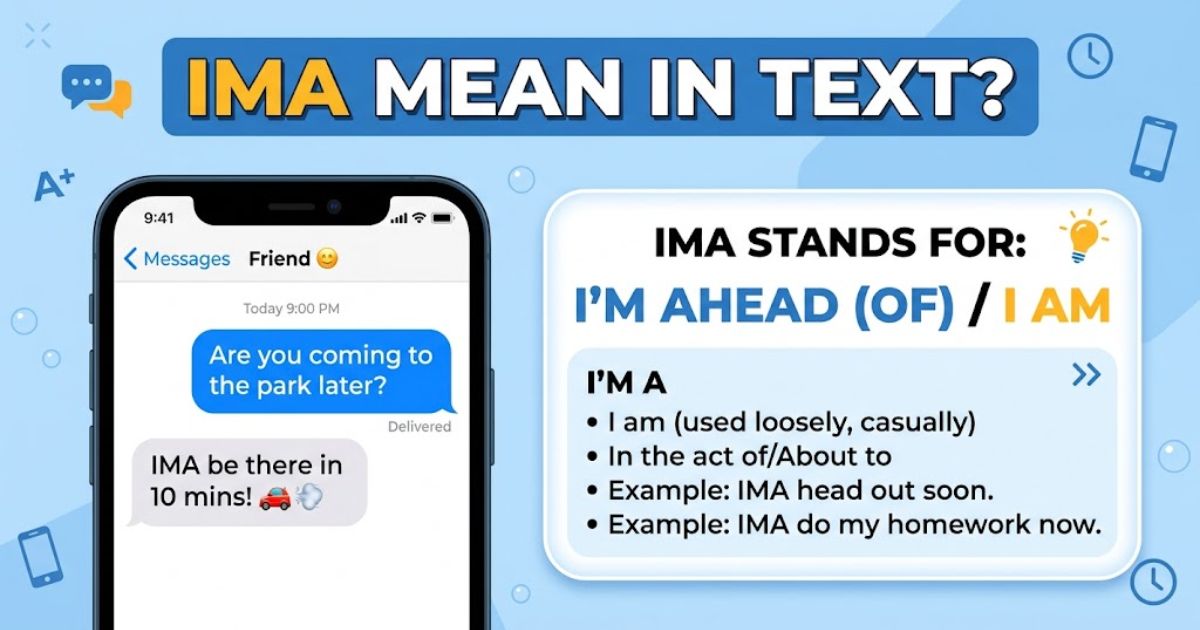
In most casual conversations, IMA means “I’m going to” or “I am going to.” It usually introduces something a person plans or intends to do. For example, “IMA get some food” simply means “I’m going to get some food.”
However, context matters. In some situations, “IMA” can have another meaning, such as “In My Area.” That’s why understanding the sentence around it is more useful than memorizing just one definition.
Let’s break down the IMA meaning in text, how people use it, and when you should avoid it.
What Does IMA Mean in Text?
The most common IMA meaning in text is “I’m going to” or “I am going to.” It’s an informal texting shortcut used to describe a future action, plan, or intention.
For example:
“IMA grab some coffee.”
This means:
“I’m going to grab some coffee.”
IMA is especially common in casual conversations because it’s quick to type and resembles the way some people pronounce the phrase in relaxed speech.
It’s closely related to “I’ma” and “IMMA.” You may see all three forms used online, although “I’ma” and “IMMA” can make the intended pronunciation more obvious.
Quick Example
Friend: “Are you coming to the game tonight?”
You: “Yeah, IMA be there around 8.”
Here, IMA clearly means “I’m going to.”
The sentence could be rewritten as:
“Yeah, I’m going to be there around 8.”
The meaning stays the same; only the level of formality changes.
What Does IMA Mean in Text Message Conversations?
In text message conversations, IMA usually signals a planned or intended action. Someone might use it before talking about where they’re going, what they’re about to do, or what they intend to do next.
For example, you might see:
“IMA call you after work.”
“IMA watch that movie tonight.”
“IMA send it in a minute.”
“IMA check and let you know.”
These messages all describe future actions.
The expression is particularly common when people are chatting quickly. Instead of typing “I am going to,” they shorten it to IMA. It works much like other informal texting abbreviations and spoken-English shortcuts.
IMA Meaning in Text Explained Simply
In simple terms, IMA means “I’m going to” in most texting situations.
Think of it as a quick bridge between the person speaking and the action they plan to take.
IMA + action = a future intention
For example:
IMA eat = I’m going to eat.
IMA call = I’m going to call.
IMA leave = I’m going to leave.
IMA check = I’m going to check.
This is why context is important. The word after IMA often makes the intended meaning immediately obvious.
Why Do People Use IMA in Texting?
People use IMA because modern digital conversations tend to favor speed, simplicity, and a relaxed tone. It isn’t necessarily about avoiding proper English. In many cases, it’s simply how people communicate with friends online.
Faster Typing
Typing “IMA” takes less time than writing “I’m going to.” When someone is having a fast conversation, small shortcuts can make messages feel more natural.
For example, instead of:
“I’m going to send you the picture when I get home.”
Someone might write:
“IMA send you the pic when I get home.”
The meaning remains clear while the message feels more casual.
Casual Tone
IMA creates an informal, relaxed tone. It can make a message sound more like everyday speech between friends.
Compare:
“I am going to call you later.”
with:
“IMA call you later.”
The first sounds neutral or formal. The second feels much more casual.
Read More: WBU Mean in Text: Meaning on Snapchat, TikTok & Social Media
Social Media Culture
Social media has helped popularize short expressions and informal English. People regularly shorten words and phrases in comments, captions, DMs, and direct messages.
IMA fits naturally into this environment because it’s short and easy to understand when the surrounding context is clear.
Mobile-Friendly Communication
Texting from a phone encourages concise messages. Abbreviations such as IMA, IDK, IMO, BRB, and TBH can make conversations faster without requiring long sentences.
These shortcuts are especially common when people already understand each other well.
Different Meanings of IMA in Text
Although “I’m going to” is the most common interpretation, IMA can have different meanings depending on context.
1. I’m About To
In some casual conversations, people may use IMA to express that something is about to happen.
For example:
“IMA leave now.”
Depending on the speaker’s style, this could communicate the idea of:
“I’m about to leave now.”
However, this usage can overlap with the more common “I’m going to” meaning. You should look at the complete sentence and conversation rather than assuming a separate definition.
2. I Am Going To
This is the primary meaning in most texting contexts.
“IMA buy a new phone.”
means:
“I am going to buy a new phone.”
It communicates an intention or planned action.
3. In My Area
In a location-related conversation, IMA can sometimes mean “In My Area.”
For example:
“There aren’t many restaurants IMA.”
In this context, the writer may mean:
“There aren’t many restaurants in my area.”
This meaning is much more dependent on context and is less common than “I’m going to.”
How Context Changes the Meaning of IMA
The surrounding words usually tell you which IMA slang meaning the writer intends.
Action Context
If IMA appears directly before a verb describing an action, it most likely means “I’m going to.”
For example:
“IMA play later.”
“IMA call her.”
“IMA order pizza.”
Each sentence describes an intended future action.
Location Context
If the conversation focuses on places, neighborhoods, stores, or nearby services, IMA could potentially mean “In My Area.”
For example:
“That store isn’t available IMA.”
Here, the location-based context changes how you might interpret the abbreviation.
When you’re unsure, read the complete message instead of interpreting IMA by itself.
Examples of IMA in Real Conversations
Seeing the expression in realistic situations makes its meaning much easier to understand.
Example 1: Friends Chat
Alex: “What are you doing tonight?”
Sam: “IMA stay home and play games.”
Meaning: Sam is saying, “I’m going to stay home and play games.”
Example 2: Family Conversation
Mom: “Are you coming home for dinner?”
You: “Yeah, IMA be home around 7.”
Meaning: “Yeah, I’m going to be home around 7.”
The expression is casual, so it works naturally in a relaxed family text.
Example 3: Social Media Post
Post: “IMA finally try this challenge 😂”
Here, IMA means “I’m going to.” The writer is announcing an intended action in a casual social media style.
Example 4: Gaming Chat
Player 1: “Need someone to cover the left side.”
Player 2: “IMA cover you.”
Here, IMA means “I’m going to.” The player is saying they intend to provide cover.
Is IMA Formal or Informal?
IMA is informal texting slang. You’ll generally see it in texts, DMs, social media posts, gaming chats, and conversations between people who are comfortable with casual language.
It isn’t normally appropriate for formal documents, academic writing, business reports, or professional correspondence.
Incorrect Professional Example
“IMA send the report to the client tomorrow.”
This may be understandable, but it looks too casual for most professional communication.
Better Professional Version
“I’m going to send the report to the client tomorrow.”
Or, depending on the situation:
“I will send the report to the client tomorrow.”
The professional version is clearer and follows standard written English.
IMA on Snapchat, TikTok, and Instagram
The IMA meaning on Snapchat, TikTok, and Instagram is generally the same as in ordinary texting: “I’m going to.”
However, the surrounding culture can make the abbreviation appear more frequently because these platforms encourage short, informal communication.
Snapchat
On Snapchat, IMA can appear in direct messages, captions, or quick replies.
“IMA snap you later.”
means:
“I’m going to message you later.”
TikTok
On TikTok, you might see IMA in comments, captions, or replies.
“IMA try this 😂”
means:
“I’m going to try this.”
The casual style fits the platform’s conversational environment.
The IMA meaning on Instagram is also usually “I’m going to.”
It can appear in DMs, comments, Stories, and captions.
“IMA post the full video tonight.”
means:
“I’m going to post the full video tonight.”
IMA vs Similar Text Slang
IMA is closely related to several other informal expressions. Knowing the differences can help you understand online conversations more accurately.
| Term | Common meaning | Typical use |
|---|---|---|
| IMA | I’m going to / I am going to | Casual texting |
| IMMA | I’m going to / I am going to | Very informal texting |
| I’ma | I’m going to | Informal writing |
| Gonna | Going to | Casual spoken/written English |
| Wanna | Want to | Casual communication |
| Gotta | Got to / have to | Casual communication |
| IDK | I don’t know | Texting |
| WYD | What are you doing? | Texting |
| BRB | Be right back | Texting |
IMA vs IMMA
IMA and IMMA are often used to communicate essentially the same idea: “I’m going to.”
“IMA call you.”
and
“IMMA call you.”
can carry the same meaning.
The spelling varies because these expressions represent informal speech rather than standardized written English.
IMA vs Gonna
“Gonna” is a shortened form of “going to,” while IMA usually represents “I’m going to.”
“I’m gonna call you.”
and
“IMA call you.”
are both casual ways to describe a future action.
Common Mistakes People Make With IMA
Understanding the definition is only part of using texting slang correctly. You also need to know when it fits the situation.
Using It Professionally
The biggest mistake is using IMA in formal communication.
If you’re emailing a manager, writing a business proposal, submitting an assignment, or communicating with a client, standard English is usually more appropriate.
Assuming One Meaning Always Applies
Not every occurrence of IMA automatically means “I’m going to.”
If the conversation is about location, IMA could potentially mean “in my area.” Always consider the context.
Overusing Slang
Using too much slang can make your messages harder to read, especially when talking to someone who isn’t familiar with internet abbreviations.
A few shortcuts can make a conversation feel natural. Too many can make the message confusing.
Typing Unclear Sentences
IMA works best when the rest of the sentence makes the intended action obvious.
“IMA later.”
is unclear.
“IMA call you later.”
is much easier to understand.
Good texting isn’t just about being short. It’s about being clear.
Is IMA Safe to Use?
Yes. IMA is generally harmless casual texting slang. It doesn’t inherently contain offensive or inappropriate meaning.
The main concern is simply whether your audience understands the abbreviation.
With close friends, it’s usually easy to understand. With unfamiliar people or in professional situations, writing “I’m going to” is safer and clearer.
How Text Slang Like IMA Became Popular
Texting slang developed partly because digital communication rewards speed. Early text messaging encouraged people to shorten words because typing was slower and messages could be limited.
Social media later expanded this style of communication.
Main Reasons
People use expressions like IMA because they’re:
- Quick to type
- Easy to recognize in casual conversations
- Similar to spoken language
- Common across social platforms
- Useful for keeping messages short
Over time, these shortcuts became part of modern internet slang and everyday digital communication.
Should You Use IMA?
You can use IMA when you’re having a casual conversation and the other person is likely to understand it.
For example:
“IMA grab lunch.”
works naturally in a conversation with a friend.
But if you’re writing a formal email or professional message, use:
“I’m going to grab lunch.”
The choice isn’t really about whether IMA is “correct” or “incorrect.” It’s about matching your language to the situation.
Real-World Communication Tip
When you see IMA in a message, don’t interpret the abbreviation alone. Look at the words immediately after it and the topic of the conversation.
If you see:
“IMA call you.”
the meaning is obvious.
If you see:
“IMA find a better one.”
it still refers to an intended action.
But if IMA appears in a location-based conversation, check whether “in my area” makes more sense.
This simple habit helps you understand context-dependent meaning in texting and online communication.
Other Popular Texting Terms Related to IMA
If you’re learning modern texting language, you’ll probably come across several related expressions.
IMMA — Usually “I’m going to.”
I’ma — Another informal spelling of “I’m going to.”
Gonna — Casual form of “going to.”
Wanna — “Want to.”
Gotta — “Got to” or “have to.”
WYA — “Where you at?”
WYD — “What are you doing?”
BRB — “Be right back.”
IMO — “In my opinion.”
IDK — “I don’t know.”
TBH — “To be honest.”
FR — “For real.”
These expressions are common examples of how online communication often compresses longer phrases into shorter forms.
Frequently Asked Questions
What Does IMA Mean in Text?
IMA usually means “I’m going to” or “I am going to.” It’s an informal abbreviation commonly used in texts, DMs, and social media.
What Does IMA Mean in Text Message Apps?
In messaging apps, IMA generally means “I’m going to.” The exact interpretation can depend on the sentence and conversation.
Is IMA Slang?
Yes. IMA is generally considered informal texting slang rather than standard formal English.
What Does IMA Mean on Snapchat?
On Snapchat, IMA usually means “I’m going to.” For example, “IMA call you later” means “I’m going to call you later.”
Can I Use IMA in Professional Messages?
It’s better to avoid IMA in most professional messages. Use “I’m going to,” “I am going to,” or “I will” instead.
Is IMA Popular in 2026?
IMA remains recognizable in casual digital communication, particularly where informal English and texting shortcuts are common. However, usage varies by person, age group, platform, and online community.
How Do You Pronounce IMA?
When it represents “I’m going to,” IMA is commonly read in a way similar to “I’ma.” It reflects casual spoken English rather than a formal pronunciation rule.
Conclusion
The most common IMA meaning in text is “I’m going to” or “I am going to.” People use it to describe a future action, plan, or intention in casual conversations.
You may see IMA in text messages, Snapchat chats, TikTok comments, Instagram DMs, gaming conversations, and other online spaces. It’s closely related to expressions such as IMMA, I’ma, and gonna, although the exact spelling and usage can vary.
The key is context. If someone writes “IMA call you later,” they’re saying they’re going to call you later. If the conversation is about locations, however, IMA could potentially mean “in my area.”
So, when you come across IMA, read the whole sentence rather than focusing on the abbreviation alone. That’s the easiest way to understand modern texting slang accurately.
