
Have you seen “POCO” in a text, comment, caption, or social media post and wondered what it means? Unlike some popular texting abbreviations, POCO can have several meanings depending on where you see it.
So, what does POCO mean in text? In casual online conversations, POCO can sometimes be used as shorthand for “piece of cake”, meaning something is easy. However, POCO isn’t a universal texting abbreviation, so its meaning depends heavily on the context.
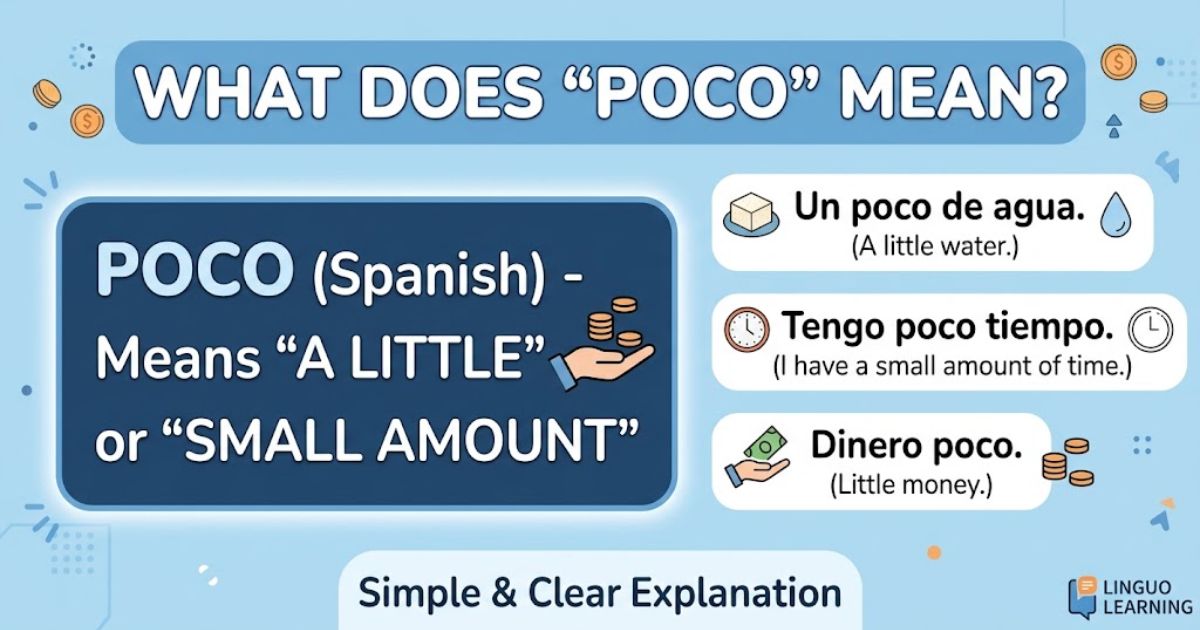
POCO can also refer to the Spanish and Italian word “poco,” which means “little,” “few,” or “a small amount.” In music, poco is also used as a direction meaning “a little” or “slightly,” such as poco a poco, meaning “little by little.”
There’s another very common meaning: POCO is the name of a smartphone brand associated with Xiaomi. If you saw POCO in a discussion about phones, apps, gaming, processors, or devices, it probably refers to the technology brand rather than texting slang.
This guide explains the different POCO meanings, how context changes the definition, and how to tell which meaning someone intends.
Discover Why Mexicans Say ¿A POCO? to Mean “Really?” or “No Way!”
In Mexican Spanish, ¿A poco? is an informal expression people use to react to information that surprises them or sounds difficult to believe. Imagine telling your friend that you met a famous singer at the supermarket. Your friend might respond, “¡A poco!” to show that they’re surprised and want to know more.
The expression doesn’t always mean the speaker doubts you. Sometimes it communicates genuine excitement, while other times it sounds skeptical or teasing. The same words can have different shades of meaning depending on facial expressions, voice, and the relationship between the people talking.
Here are the most common English equivalents:
- Really? — when you’re surprised by new information.
- No way! — when something sounds unbelievable.
- Seriously? — when you want confirmation.
- You don’t say! — when you’re reacting to news, sometimes sarcastically.
- Is that so? — when you’re curious or slightly doubtful.
Although Spanish speakers in other regions may understand the phrase, ¿A poco? is particularly associated with Mexican Spanish. It’s a useful example of how everyday expressions can carry a meaning that isn’t obvious from a literal translation.
Read More: ROFL Mean in Text? Discover Its Meaning on Snapchat, TikTok & More
The Literal Meaning
To understand the a poco definition, it helps to separate the literal words from their conversational meaning.
In Spanish, a is a preposition that can mean “to,” “at,” or “by,” depending on context. Poco generally means “little,” “few,” or “not much.” However, translating ¿A poco? word for word doesn’t explain how Mexican speakers use it as a reaction.
Think of it this way: the phrase has developed a conversational function beyond the ordinary meanings of its individual words. When someone says “¿A poco?” after hearing unexpected news, they’re usually asking whether the information is true or expressing surprise about it.
For example:
Spanish: —Me voy a casar el próximo mes.
English: —I’m getting married next month.
Spanish: —¿A poco? ¡Felicidades!
English: —Really? Congratulations!
Here, the listener isn’t asking about something being “little.” They’re reacting to surprising news and inviting the speaker to share more.
What Does A Poco Mean in Spanish?
The meaning of a poco depends on how it’s used. In ordinary Spanish, poco refers to a small amount or quantity. In the informal Mexican expression ¿A poco?, however, the phrase commonly means “Really?” or “Is that true?”
It’s important to distinguish the expression from other phrases that contain the word poco.
| Spanish expression | English meaning | Typical use |
|---|---|---|
| Poco | Little; few | Describing a small quantity |
| Un poco | A little; somewhat | Expressing a small amount or degree |
| Poco a poco | Little by little | Describing gradual progress |
| ¿A poco? | Really? No way? | Reacting to surprising information |
| ¿A poco sí? | Really? Is that so? | Asking for confirmation |
| ¿A poco no? | Really not? Isn’t that so? | Expressing disbelief or seeking agreement |
For example, if someone says Tengo poco tiempo, they mean “I have little time.” If they say ¿A poco ya llegaste?, they mean something closer to “Really? You’re already here?”
The key is context. The expression ¿A poco? is an informal conversational reaction, not a universal translation for every sentence containing poco.
What Does A Poco Mean in Mexican Spanish?
In Mexican Spanish, ¿A poco? is a familiar way to respond when something catches you off guard. Friends, relatives, coworkers, and other speakers may use it in casual conversations.
Picture a conversation about an upcoming trip. You tell your cousin that you’re flying to Spain tomorrow, and they answer, “¿A poco?” They’re expressing surprise and may be asking whether you’ve really booked the trip.
The expression can also introduce playful disbelief. If you tell a friend that you finished an entire pizza by yourself, they might say “¡A poco!” with a laugh. They aren’t necessarily accusing you of lying; they may simply find the story amusing or hard to believe.
Mexican speakers also combine the phrase with other words to make their reaction clearer:
- ¿A poco? — Really?
- ¡A poco! — No way!
- ¿A poco sí? — Really? Is that true?
- ¿A poco no? — Really not? Isn’t that right?
- ¡No, a poco! — A colloquial reaction of disbelief in some conversational contexts.
The exact tone varies from person to person. A rising voice can suggest a genuine question, while an exaggerated or drawn-out delivery may communicate playful skepticism.
Because it’s informal, the expression fits naturally into conversations with friends and family. In a formal presentation or professional email, a more neutral phrase such as ¿Es verdad? or ¿De verdad? may be more appropriate.
How Is A Poco Used in Everyday Conversation?
The easiest way to learn how to use a poco in Spanish is to listen for the information that comes before it. The expression usually responds to something the other person has just said, rather than introducing a completely new topic.
1. Reacting to surprising news
Imagine your friend tells you they’ve won a free vacation. You might answer:
Spanish: —¡Me gané un viaje a Cancún!
English: —I won a trip to Cancún!
Spanish: —¿A poco? ¡Qué padre!
English: —Really? That’s awesome!
Here, ¡Qué padre! is another common Mexican expression meaning “That’s cool!” or “That’s awesome!”
2. Asking whether a story is true
You can use ¿A poco? when you want someone to confirm what they’ve told you.
Spanish: —Mi hermano conoció a un actor famoso.
English: —My brother met a famous actor.
Spanish: —¿A poco? ¿A quién conoció?
English: —Really? Who did he meet?
The follow-up question makes it clear that you’re interested in the story.
3. Expressing playful disbelief
Sometimes, you hear something that sounds exaggerated. In that situation, ¿A poco? can sound like “Seriously?” or “Come on!”
Spanish: —Dormí doce horas seguidas.
English: —I slept for twelve hours straight.
Spanish: —¡A poco! ¿No te despertaste ni una vez?
English: —No way! You didn’t wake up even once?
Your tone matters here. A friendly voice makes the reaction playful, while a sharp tone could make it sound doubtful.
4. Keeping a conversation going
You don’t always need a long response. A quick ¿A poco? can encourage someone to continue talking.
Spanish: —Voy a empezar clases de japonés.
English: —I’m going to start Japanese classes.
Spanish: —¿A poco? ¿Por qué japonés?
English: —Really? Why Japanese?
This is one reason the phrase feels so natural in everyday Mexican conversation. It communicates a reaction and creates an opening for the next question.
A Poco Meaning in English With Examples
The a poco meaning in English changes slightly with the situation. “Really?” is a good general translation, but “No way!” may sound more natural when the speaker is amazed. If someone is teasing a friend, “You don’t say!” might capture the tone better.
Here’s how the expression works in several common situations.
| Spanish sentence | Natural English translation |
|---|---|
| ¿A poco vives aquí? | Really? You live here? |
| ¿A poco tienes un perro? | You have a dog? Really? |
| ¡A poco! No sabía eso. | No way! I didn’t know that. |
| ¿A poco ya terminaste? | Really? You’re already finished? |
| ¿A poco te vas mañana? | You’re leaving tomorrow? Seriously? |
| ¿A poco ganaste el partido? | You actually won the game? |
| ¿A poco nunca has probado sushi? | Really? You’ve never tried sushi? |
| ¿A poco te dieron el trabajo? | You got the job? Really? |
| ¿A poco cuesta tanto? | Is it really that expensive? |
| ¿A poco sí pasó? | Did that really happen? |
Notice that English often doesn’t need a direct, word-for-word equivalent. A native English speaker might simply say “You got the job?” with a surprised tone. That communicates the same basic reaction as ¿A poco te dieron el trabajo?
When translating Spanish expressions, aim to preserve the speaker’s intention rather than the exact structure of the sentence.
What Does ¿A Poco Sí? Mean?
¿A poco sí? generally means “Really?”, “Is that so?” or “Are you serious?” It’s a common way to ask whether something surprising is actually true.
The word sí means “yes,” but the full phrase isn’t simply a literal question about the word “yes.” Together, the words create a familiar conversational reaction in Mexican Spanish.
For example:
Spanish: —Me ofrecieron un trabajo en otra ciudad.
English: —They offered me a job in another city.
Spanish: —¿A poco sí? ¿Y te vas a mudar?
English: —Really? And are you going to move?
In this exchange, the listener sounds interested and perhaps a little surprised. The question invites the other person to explain what happens next.
You can also use ¿A poco sí? when a statement contradicts what you expected.
Spanish: —Luis ya habla francés.
English: —Luis speaks French now.
Spanish: —¿A poco sí? ¡Qué rápido aprendió!
English: —Really? He learned so quickly!
Depending on tone, the phrase can express excitement, curiosity, or skepticism. If you want to show that you’re genuinely happy about the news, add a positive response such as ¡Qué bueno! (“That’s great!”).
What Does ¿A Poco No? Mean?
¿A poco no? can mean “Really not?”, “Isn’t that so?” or “Don’t you think so?” The precise English translation depends on the sentence and the speaker’s intention.
Unlike ¿A poco sí?, which often asks for confirmation of something positive or surprising, ¿A poco no? may challenge a negative statement or encourage someone to agree.
Consider this example:
Spanish: —No me gusta el chocolate.
English: —I don’t like chocolate.
Spanish: —¿A poco no? ¡A casi todos les gusta!
English: —Really? You don’t? Almost everyone likes it!
Here, the speaker expresses surprise that the other person dislikes chocolate.
The phrase can also be used to seek agreement:
Spanish: —Esta comida está buenísima, ¿a poco no?
English: —This food is amazing, don’t you think?
In this case, the speaker expects the listener to agree that the food tastes great.
However, don’t assume ¿A poco no? always translates to “Don’t you think so?” In other situations, it may express disbelief, especially when the speaker hears something unexpected. The surrounding words and the conversation’s tone determine the most natural translation.
Difference Between Poco, Un Poco, and A Poco
Although these expressions share the word poco, they don’t serve the same purpose. Understanding the difference will help you avoid one of the most common mistakes Spanish learners make.
1. Poco = Little or few
Use poco to describe a small amount or number.
Spanish: Tengo poco dinero.
English: I have little money.
2. Un poco = A little
Use un poco to describe a small quantity or degree. It’s often used with adjectives or verbs.
Spanish: Estoy un poco cansado.
English: I’m a little tired.
3. ¿A poco? = Really?
In informal Mexican Spanish, use ¿A poco? as a reaction to something surprising.
Spanish: —Me voy a vivir a España. —¿A poco?
English: —I’m moving to Spain. —Really?
There’s another useful expression: poco a poco, which means “little by little” or “gradually.”
For example:
Spanish: Estoy aprendiendo español poco a poco.
English: I’m learning Spanish little by little.
You may also encounter al poco in certain contexts, usually as part of a longer expression related to a short period of time. Its meaning depends on the sentence and isn’t interchangeable with the Mexican slang expression ¿A poco?
Is A Poco the Same as Un Poco?
No. This is one of the most important distinctions to remember.
- Un poco de agua means “a little water.”
- Tengo poco tiempo means “I have little time.”
- ¿A poco tienes tiempo? means something like “Oh, really? You have time?”
The first two examples describe quantity. The third expresses a reaction to information.
You can remember the difference with a simple rule: when you hear ¿A poco? as a standalone question in Mexican conversation, think “Really?” rather than “A little?”
How Do You Pronounce A Poco?
The phrase is pronounced approximately ah POH-koh.
The emphasis falls on the first syllable of poco, and the final o is pronounced clearly. Spanish vowels are generally more consistent than English vowels, so both o sounds should be short and rounded rather than turning into an English-style diphthong.
The inverted question mark in ¿A poco? marks the beginning of the written question. In speech, the words flow together naturally.
Try saying it with different emotions:
- Curious: ¿A poco?
- Excited: ¡A poco!
- Skeptical: ¿A poco sí?
The words stay almost the same, but your intonation changes how the expression feels.
How to Respond to ¿A Poco?
If someone says ¿A poco? to you, you can answer in several ways. The best response depends on whether they’re asking for confirmation, showing excitement, or expressing doubt.
| Spanish response | English meaning | When to use it |
|---|---|---|
| Sí, de verdad. | Yes, really. | Confirming that your story is true |
| ¡Sí, en serio! | Yes, seriously! | Emphasizing your surprise or excitement |
| Sí, ¿por qué? | Yes, why? | Asking why they’re surprised |
| ¡Te lo juro! | I swear! | Convincing someone that you’re telling the truth |
| Pues sí. | Well, yes. | Giving a casual confirmation |
| No, era broma. | No, I was joking. | Revealing that the statement wasn’t serious |
| Así es. | That’s right. | Confirming something more neutrally |
| ¡Sí, imagínate! | Yes, can you imagine? | Sharing excitement or amazement |
Here’s a realistic exchange:
Friend 1: Me voy a mudar a Guadalajara.
Friend 2: ¿A poco? ¿Cuándo?
Friend 1: El próximo mes.
Friend 2: ¡Qué padre! ¿Ya encontraste casa?
English translation:
Friend 1: I’m moving to Guadalajara.
Friend 2: Really? When?
Friend 1: Next month.
Friend 2: That’s awesome! Have you found a place yet?
Notice that the response doesn’t require complicated grammar. A simple confirmation followed by a question keeps the conversation moving.
If you aren’t sure whether the other person is being serious or sarcastic, you can clarify with ¿En serio? (“Seriously?”) or ¿De verdad? (“Really?”). Both are widely understood Spanish expressions.
Other Mexican Spanish Expressions Like A Poco
If you’re learning Mexican Spanish, you’ll notice that people have several ways to express surprise, disbelief, and curiosity. Some sound neutral, while others are more casual or emotionally expressive.
Here are common alternatives to ¿A poco? and when you might hear them.
Friends having fun
¿En serio? — Seriously?
A widely understood expression for asking whether something is true. It’s suitable for casual conversations and many more formal situations.
¿En serio te vas mañana? — Are you seriously leaving tomorrow?
two friends meeting
¿De verdad? — Really?
A natural way to ask for confirmation. It works in conversations with friends, family, or people you don’t know well.
¿De verdad ganaste? — Did you really win?
Friends drinking coffee
¿Neta? — For real?
A very informal expression strongly associated with Mexican Spanish. It’s common in casual conversations and can communicate surprise or disbelief.
¿Neta te dijo eso? — Did they really tell you that?
Two young women enjoying a joyful moment together in a cozy living room setting during a relaxing weekend at home
¡No manches! — No way! / Come on!
An informal Mexican expression used for surprise, frustration, excitement, or disbelief. The meaning depends heavily on context.
¡No manches! ¿Te compraste un carro nuevo? — No way! You bought a new car?
A woman listens in amazement to what her friend is saying.
No puede ser — It can’t be!
Use this when news sounds almost impossible or extremely surprising.
¡No puede ser! ¿Es cierto? — No way! Is it true?
Other useful expressions include ¿Es verdad? (“Is it true?”) and ¿Me estás diciendo en serio? (“Are you being serious with me?”).
While these phrases overlap in meaning, they aren’t always interchangeable. ¿A poco? has a particularly conversational feel in Mexican Spanish, while ¿De verdad? is more broadly useful across Spanish-speaking regions.
Common Mistakes When Using A Poco
The phrase may look simple, but learners can misunderstand it if they translate each word separately or use it in the wrong setting.
1. Translating it literally
The most common mistake is assuming a poco means “a little.” That interpretation doesn’t work when someone uses ¿A poco? to react to surprising news.
Instead of translating the words individually, learn the phrase as a complete conversational expression.
2. Confusing it with un poco
Remember that un poco describes a small amount or degree, while the Mexican expression ¿A poco? commonly communicates surprise or asks for confirmation.
Compare Quiero un poco de café (“I want a little coffee”) with ¿A poco quieres café? (“Oh, really? You want coffee?”).
3. Using it in every Spanish-speaking country
Although people elsewhere may understand the expression, it’s especially characteristic of Mexican Spanish. Other regions may prefer alternatives such as ¿En serio?, ¿De verdad?, or local expressions.
If you’re speaking with someone from Mexico, ¿A poco? is a useful phrase to recognize and learn. When talking to Spanish speakers from other regions, pay attention to their local usage.
4. Ignoring the speaker’s tone
A person saying ¡A poco! excitedly may be delighted by your news. The same expression delivered slowly or sarcastically may suggest doubt.
Don’t judge the meaning by the words alone. Consider the situation, facial expressions, and what the speaker says next.
5. Using informal slang in formal situations
You can use ¿A poco? with friends, relatives, and people you know comfortably. In a formal meeting, academic presentation, or professional conversation, ¿Es cierto? or ¿De verdad? may be more appropriate.
Informal language isn’t incorrect; it simply fits certain situations better than others.
Everyday Examples
The best way to understand the a poco meaning in conversation is to see how it works in different situations. These short dialogues show how Mexican speakers might use the phrase when reacting to good news, gossip, disappointment, or an unbelievable story.
1. 🥳 The Surprise Party
Birthday parties | LearnEnglish
learnenglish.britishcouncil.org
Spanish conversation
—Mañana te vamos a hacer una fiesta sorpresa.
—¿A poco? ¡No me digas!
—¡Sí! Pero no le cuentes a nadie.
English translation
—We’re throwing you a surprise party tomorrow.
—Really? No way!
—Yes! But don’t tell anyone.
Why it works: The expression shows genuine surprise. The listener didn’t expect a party and immediately wants to know more.
2. 💋 The Hot Gossip
Modismos ingleses divertidos y sin sentido | practiceme.app
practiceme.app
Spanish conversation
—Dicen que Ana está saliendo con el chico nuevo.
—¿A poco sí? ¡Yo pensé que solo eran amigos!
—Pues eso dicen.
English translation
—They say Ana is dating the new guy.
—Really? I thought they were just friends!
—Well, that’s what people are saying.
Why it works: Here, ¿A poco sí? expresses curiosity and surprise. The listener isn’t necessarily confirming the rumor; they’re reacting to what they’ve heard.
3. 😭 The Bad News
Two Friends Having a Serious Conversation on a Park Bench
Spanish conversation
—Me cancelaron el viaje que llevaba meses planeando.
—¿A poco? ¡Qué mala onda!
—Sí, ya tenía todo listo.
English translation
—They canceled the trip I’d been planning for months.
—Really? That’s rough!
—Yeah, I already had everything ready.
Why it works: The expression communicates surprise before the listener responds sympathetically. ¡Qué mala onda! is an informal Mexican phrase meaning something like “That’s awful!” or “That’s really unfortunate!”
4. 😲 The Over-the-Top Story
Why Real Conversations Matter in a Digital World – Miora
Spanish conversation
—Ayer corrí diez kilómetros sin parar y ni siquiera me cansé.
—¡A poco! ¿Y luego ganaste las Olimpiadas?
—¡Ja, ja! Bueno, tampoco exageres.
English translation
—Yesterday I ran ten kilometers without stopping, and I didn’t even get tired.
—No way! What happened next, did you win the Olympics?
—Ha ha! Okay, don’t exaggerate.
Why it works: The response is teasing rather than genuinely skeptical. The exaggerated question makes the conversation funny and shows how tone can turn ¡A poco! into playful disbelief.
These examples demonstrate an important point: ¿A poco? doesn’t have one perfect English translation for every situation. You need to consider what happened before the phrase and how the speaker delivers it.
The Mexican Attitude in One Phrase
One reason ¿A poco? is so useful is that it does more than ask a question. It can show that you’re engaged, surprised, amused, or eager to hear the rest of a story.
Imagine a conversation where someone tells you they found a wallet full of money and returned it to its owner. You might respond with ¿A poco? to show surprise, then ask what happened next. The expression gives the conversation a lively, personal feel without requiring a long response.
It can also help people build rapport. Among friends, an exaggerated ¡A poco! may be part of a joke, while a quiet ¿A poco sí? may show sincere interest.
However, it wouldn’t be accurate to say every Mexican uses the phrase in exactly the same way. Speech varies by region, age, personality, and social setting. Some speakers use it frequently, while others prefer ¿Neta?, ¿En serio?, or ¿De verdad?
The useful lesson for Spanish learners is to recognize the phrase, understand its tone, and notice how native speakers use it naturally. You don’t have to imitate every slang expression to communicate well.
Variations You’ll Hear
Once you recognize ¿A poco?, you’ll start noticing related forms in casual Mexican Spanish. Small changes can make the question more specific or change its emotional tone.
| Variation | Approximate English meaning | Common purpose |
|---|---|---|
| ¿A poco? | Really? | General surprise or curiosity |
| ¡A poco! | No way! | An emphatic reaction |
| ¿A poco sí? | Really? Is that so? | Confirming surprising news |
| ¿A poco no? | Really not? Isn’t that so? | Expressing disbelief or seeking agreement |
| ¿A poco ya? | Already? Really? | Reacting to something happening sooner than expected |
| ¿A poco tan rápido? | That fast? Really? | Expressing surprise about speed |
| ¿A poco tú? | You, really? | Expressing surprise about a particular person, depending on context |
Some of these forms are more context-dependent than others. For example, ¿A poco ya? is understandable as a reaction to something happening earlier than expected, but its naturalness depends on the full conversation.
You’ll also hear speakers combine the expression with words such as no manches, neta, and de verdad. These combinations can make a reaction stronger, more playful, or more personal.
For instance:
Spanish: —Ya terminé toda la tarea.
Response: —¿A poco? ¡Qué rápido!
English: —I already finished all my homework.
Response: —Really? That was fast!
The phrase remains flexible because people use it to respond to the situation rather than follow a strict grammatical formula.
Insider Spanish Humor Corner
Mexican Spanish is full of expressions that become funnier when you understand the tone behind them. ¿A poco? is particularly useful for playful teasing because you can react to a friend’s story without directly calling them a liar.
Here are a few lighthearted examples you might hear among friends.
When your friend says they woke up early to exercise
—Hoy me levanté a las cinco para ir al gimnasio.
—¿A poco? ¿Y quién eres tú y qué hiciste con mi amigo?
English:
—Today I got up at five to go to the gym.
—Really? Who are you, and what have you done with my friend?
When someone claims they never procrastinate
—Yo nunca dejo nada para el último minuto.
—¿A poco? ¿Y esa tarea que entregaste a las 11:59?
English:
—I never leave anything until the last minute.
—Really? What about that assignment you submitted at 11:59?
When your friend says they’re saving money
—Este mes no voy a gastar en nada innecesario.
—¿A poco? ¿Y esas tres bolsas de compras?
English:
—This month, I’m not spending money on anything unnecessary.
—Oh, really? What about those three shopping bags?
The humor comes from the contrast between what someone claims and what their friend knows. ¿A poco? sets up the teasing, while the follow-up delivers the punchline.
Of course, this style works best when you know the other person well enough to joke with them. A playful tone can make the exchange friendly, but the same words may sound confrontational if delivered harshly.
Final Takeaway
So, what does ¿A poco? mean? In informal Mexican Spanish, it most often means “Really?”, “No way!” or “Is that true?” It’s a conversational expression used to react to surprising information, ask for confirmation, or playfully question a story.
Remember these three essentials:
- ¿A poco? — Really? No way?
- ¿A poco sí? — Really? Is that so?
- ¿A poco no? — Really not? Isn’t that so?
Don’t confuse the expression with poco (“little” or “few”) or un poco (“a little”). Although they share a word, their meanings and uses differ.
If you’re learning Mexican Spanish, start by recognizing ¿A poco? in conversations, videos, and informal dialogue. Then practice using it when a friend shares unexpected news. Pay attention to tone, because that’s what helps you distinguish genuine surprise from sarcasm or playful disbelief.
With a little practice, you’ll understand not just the words but also the conversational feeling behind this familiar Mexican expression.
Frequently Asked Questions (FAQs)
1. What does a poco mean in Spanish?
In informal Mexican Spanish, ¿A poco? commonly means “Really?”, “No way!” or “Is that true?” The exact translation depends on the context and tone.
2. Does a poco mean really?
Yes, when used as the Mexican Spanish expression ¿A poco?, it often means “Really?” It can also express surprise, disbelief, or curiosity.
3. Is a poco Mexican slang?
Yes. ¿A poco? is a common informal expression strongly associated with Mexican Spanish. It’s especially useful in casual conversations with friends and family.
4. What does a poco sí mean?
¿A poco sí? usually means “Really?”, “Is that so?” or “Are you serious?” It’s often used when someone wants confirmation of surprising information.
5. What does a poco no mean?
¿A poco no? can mean “Really not?”, “Isn’t that so?” or “Don’t you think so?” The best translation depends on whether the speaker expresses disbelief or seeks agreement.
6. Is a poco the same as un poco?
No. Un poco means “a little” and describes a small quantity or degree. ¿A poco? is an informal Mexican expression that usually communicates surprise or asks whether something is true.
7. How do you pronounce a poco?
It’s pronounced approximately ah POH-koh, with the stress on the first syllable of poco. The two words flow together naturally in conversation.
8. When do Mexicans use a poco?
Mexican Spanish speakers use ¿A poco? when reacting to unexpected news, expressing curiosity, or teasing someone about a surprising claim. It’s most common in informal conversation.
9. How do you use a poco in a sentence?
You can use it as a reaction or as part of a question.
Example: ¿A poco ya terminaste tu trabajo?
Translation: “Really? You already finished your work?”
10. What is the English equivalent of a poco?
Common equivalents include “Really?”, “No way!”, “Seriously?” and “You don’t say!” Choose the translation that best matches the situation and the speaker’s tone.
11. What does a poco mean in text messages?
In text messages, ¿A poco? usually expresses surprise or disbelief, just as it does in spoken Mexican Spanish. For example, ¿A poco tienes novia? means “Wait, you have a girlfriend?”
12. How do you say “really” in Mexican Spanish?
You can say ¿A poco?, ¿En serio?, ¿De verdad? or ¿Neta? The last two informal options are especially useful for understanding everyday Mexican conversations, although ¿De verdad? is also widely used across the Spanish-speaking world.
