
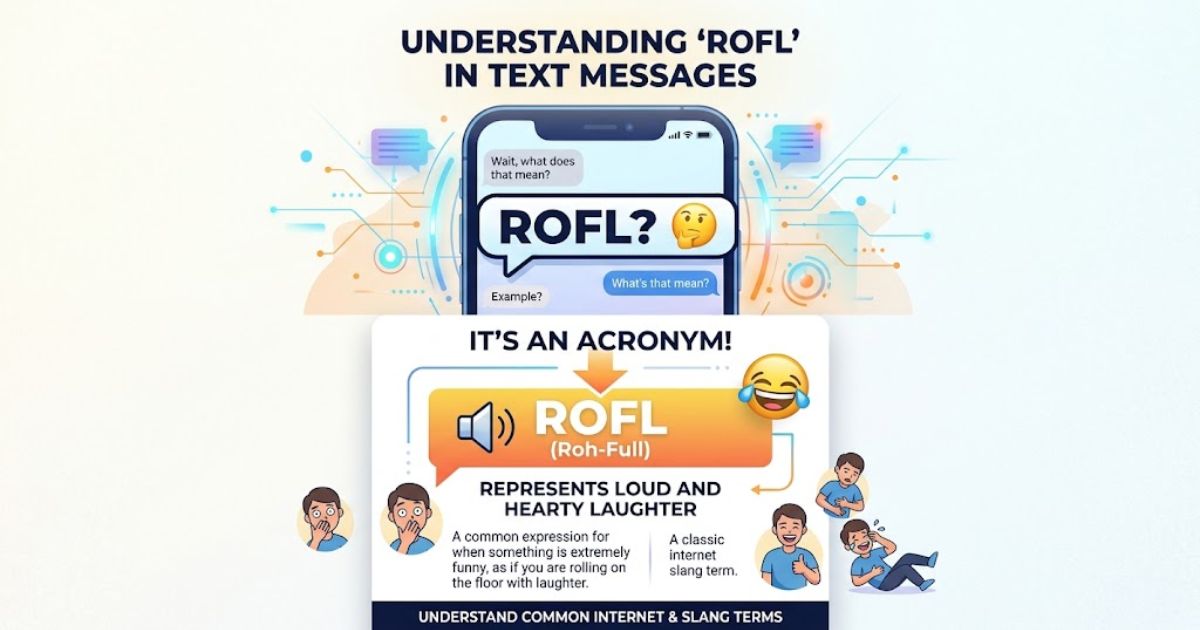
Have you ever received a message that says “ROFL 😂” and wondered what those four letters actually mean? If you’ve seen ROFL in a text, Snapchat message, TikTok comment, gaming chat, or meme reaction, you’re looking at one of the classic expressions of internet laughter.
So, what does ROFL mean in text? ROFL stands for “Rolling On the Floor Laughing.” It’s used when something is extremely funny and the person wants to show a stronger reaction than a simple “haha.”
You don’t always have to take the phrase literally. Nobody necessarily means they’re physically rolling around on the floor. It’s an exaggerated way of saying, “That is really funny!”
What Does ROFL Mean in Text?
ROFL means “Rolling On the Floor Laughing.” It’s an informal internet abbreviation used to express strong amusement.
For example:
Friend: “I walked into the wrong classroom and sat there for ten minutes before realizing it.”
You: “ROFL 😂”
Here, you’re saying that the story is extremely funny.
ROFL can appear in text messages, social media comments, DMs, gaming chats, memes, forums, and group conversations. It’s generally more expressive than a simple “LOL.”
Quick Answer
ROFL = Rolling On the Floor Laughing.
It means something is very funny and you’re reacting with exaggerated laughter.
What Does ROFL Mean in Text Speak?
In text speak, ROFL is a shorthand expression for strong laughter.
Instead of typing:
“I’m laughing so hard at this!”
someone can simply write:
“ROFL!”
It’s part of the broader collection of internet slang that developed to make digital conversations faster and more expressive.
The phrase is usually playful and isn’t meant literally. If someone says “ROFL”, they normally mean the message, joke, picture, video, or situation made them laugh a lot.
Why People Use ROFL Instead of “Haha”
“Haha” communicates laughter, but it doesn’t always show how strongly someone is reacting.
Compare:
“Haha.”
with:
“ROFL 😂😂”
The second response feels much more energetic.
People use ROFL when they want to emphasize that something is especially funny. It can also make a response feel more dramatic, playful, or enthusiastic.
In a fast-moving online conversation, four letters can communicate an entire emotional reaction.
What Does ROFL Stand For in Online Chats?
ROFL stands for:
R — Rolling
O — On
F — Floor
L — Laughing
The complete phrase is “Rolling On the Floor Laughing.”
It’s an exaggerated image of someone laughing so hard that they’re supposedly rolling on the floor.
Like many internet expressions, the literal phrase isn’t usually what matters. The abbreviation has become a convenient way to express intense amusement.
The History of ROFL
ROFL emerged during the early development of internet chat culture and became popular alongside other abbreviations such as LOL and LMAO.
As people moved from face-to-face conversations to chat rooms, instant messaging, forums, and eventually social media, they needed quick ways to express emotions through text.
ROFL filled a useful role: it represented laughter without requiring a long explanation.
Over time, it became part of the vocabulary of online communication and was especially common in older internet forums, messaging platforms, gaming communities, and early social networks.
Read More: MMCHT Mean in Text? 5 Possible Meanings Explained Simply
How ROFL Is Used in Real Conversations
The meaning becomes easier to understand when you see how people actually use it.
Example 1: Funny Joke
Friend: “Why did the computer go to the doctor? It had a virus.”
You: “ROFL 😂”
The response shows that you found the joke very funny.
Example 2: Meme Reaction
Friend: “Look at this meme.”
You: “ROFL this is too accurate.”
Here, ROFL emphasizes your reaction to the meme.
Example 3: Gaming Chat
Player 1: “I accidentally jumped off the map again.”
Player 2: “ROFL 😂”
In gaming, ROFL can react to a funny mistake, unexpected event, or ridiculous moment.
Example 4: Family Group Chat
Dad: “I tried to take a selfie and somehow turned on the flashlight.”
You: “ROFL 😂”
In this situation, ROFL simply communicates strong amusement in a casual family conversation.
ROFL vs LOL vs LMAO
ROFL, LOL, and LMAO all communicate laughter, but they can suggest different levels or styles of amusement.
| Expression | Meaning | Typical tone |
|---|---|---|
| LOL | Laughing out loud | Common, casual |
| LMAO | Laughing my ass off | Stronger, very informal |
| ROFL | Rolling on the floor laughing | Strong, exaggerated |
| ROFLMAO | Rolling on the floor laughing my ass off | Extremely exaggerated |
These aren’t strict levels of laughter. People often choose them based on personal texting style rather than a precise emotional scale.
Still, ROFL generally feels more dramatic than LOL.
Is ROFL Still Popular in 2026?
ROFL is still recognizable in 2026, although texting language changes constantly.
Newer users may prefer expressions such as LOL, LMAO, LMFAO, 😂, 😭, or other platform-specific reactions. Some people still use ROFL because it’s familiar, while others may consider it somewhat old-school.
That doesn’t make it meaningless or unusable. If the people you’re talking to understand it, ROFL still works perfectly well in casual conversations.
When Should You Use ROFL?
ROFL works best when you genuinely want to show strong amusement.
Use ROFL When:
Use ROFL in situations such as:
- Reacting to a very funny joke
- Responding to a hilarious meme
- Laughing at a friend’s funny story
- Reacting to an amusing gaming mistake
- Joining a playful group conversation
- Commenting on something unexpectedly funny
The key is to match the intensity of the abbreviation to the situation.
Avoid ROFL When:
You should generally avoid ROFL in serious conversations, formal writing, professional communication, or situations where laughter could appear insensitive.
If someone is telling you about a serious problem, responding with ROFL could obviously send the wrong message.
Example
Friend: “I finally passed my exam!”
You: “ROFL”
That response could be confusing because the situation isn’t necessarily funny.
A better response would be:
“Congratulations! 🎉”
Can ROFL Be Rude?
ROFL isn’t inherently rude. However, context determines whether laughter is appropriate.
If you’re laughing at someone’s harmless joke, ROFL is friendly.
If you’re using it to mock someone’s serious problem or embarrassment, it can become insensitive.
Bad Example
Friend: “My pet is sick and I’m really worried.”
You: “ROFL.”
This would likely come across as extremely rude because the emotional context doesn’t call for laughter.
Digital slang doesn’t remove the need for empathy. Always consider what the other person is actually saying before reacting.
ROFL Variations You May See Online
Internet users sometimes create exaggerated or playful variations of common slang.
ROFLMAO
ROFLMAO combines ROFL with LMAO.
It can be interpreted as:
“Rolling on the floor laughing my ass off.”
It’s intentionally exaggerated and very informal.
ROFLCOPTER
ROFLCOPTER is an old internet-style joke based on the idea of someone spinning around like a helicopter while laughing.
It’s usually humorous rather than a serious expression.
ROFLLOL
ROFLLOL combines multiple laughter abbreviations for extra emphasis.
It’s generally playful and intentionally excessive.
These variations aren’t necessary for ordinary conversations. They’re more likely to appear as jokes, memes, or nostalgic internet slang.
What Does ROFL Mean in Text Talk on Social Media?
On social media, ROFL usually means “Rolling On the Floor Laughing.”
You may see it in:
Instagram comments
Snapchat messages
TikTok comments
Facebook posts
Discord chats
Gaming communities
For example:
“That last part took me out 😂 ROFL.”
The person is emphasizing that they found the content extremely funny.
On modern platforms, people may also replace ROFL entirely with laughing emojis or newer slang. The underlying purpose remains the same: communicating strong amusement.
Why ROFL Became So Popular
ROFL became popular because text communication lacks the facial expressions, voice changes, and body language that normally communicate laughter.
If someone laughs in person, you can hear it. In a text conversation, the other person can’t see your reaction.
Abbreviations such as ROFL solved part of that problem.
Instead of simply responding:
“That’s funny.”
you could write:
“ROFL 😂”
That immediately communicates a stronger emotional reaction.
The abbreviation was also short, memorable, and easy to type, which helped it spread through online communities.
Is ROFL Used Worldwide?
Yes. ROFL is recognized in many parts of the world where English-language internet culture is common.
However, not everyone uses it regularly.
People may use different laughter expressions depending on their country, language, age, online community, and preferred platform. Some may use “haha,” while others prefer emojis or local equivalents.
This is why internet slang shouldn’t always be interpreted as a universal language. Online communities constantly adapt expressions to their own communication styles.
Common Mistakes People Make With ROFL
Using It Too Often
If every message gets a ROFL, the expression can lose its impact.
Save stronger laughter abbreviations for moments that genuinely deserve them.
Using It in Serious Conversations
ROFL is designed to communicate amusement. Using it during a serious conversation can make you appear insensitive or dismissive.
Always consider the emotional context before responding.
Using It Professionally
ROFL is informal slang and generally doesn’t belong in professional emails, reports, business proposals, or formal workplace communication.
A professional message should communicate the idea directly.
Instead of:
“ROFL, that’s hilarious.”
you might say:
“That was amusing.”
if the situation genuinely calls for a light reaction.
Psychology Behind Digital Laughter
Digital laughter is more complicated than simply saying something is funny.
When people communicate face-to-face, laughter can signal friendliness, agreement, nervousness, surprise, or social connection.
Online, abbreviations and emojis serve some of the same functions.
ROFL can tell the other person:
“I understood your joke.”
“I’m enjoying this conversation.”
“Your story made me laugh.”
“I’m reacting strongly to what you just sent.”
This emotional information helps make text conversations feel less flat.
What Does ROFL Mean in Text Language for Parents?
If you’re a parent trying to understand what your child or teenager means when they use ROFL, the basic definition is simple:
ROFL = Rolling On the Floor Laughing.
It usually means something is extremely funny.
For example:
Teen: “Dad just sent the funniest picture 😂 ROFL.”
That doesn’t literally mean they’re rolling around on the floor. It’s an exaggerated way to express laughter.
Parents should also remember that online slang changes quickly. An unfamiliar abbreviation isn’t automatically inappropriate. Context is the key to understanding it.
Frequently Asked Questions
What does ROFL mean in text exactly?
ROFL stands for “Rolling On the Floor Laughing.” It’s an informal abbreviation used to show strong amusement.
What does ROFL mean in text messaging?
In text messaging, ROFL means that the sender finds something extremely funny. It can be used after jokes, memes, stories, videos, or funny situations.
Is ROFL stronger than LOL?
Generally, ROFL sounds more exaggerated than LOL. However, people use both according to personal style, so there isn’t a strict ranking of laughter.
Is ROFL outdated in 2026?
ROFL is less dominant than some newer expressions and emojis, but it’s still recognizable and can be used in casual online conversations.
What does ROFL mean in text talk?
ROFL means “Rolling On the Floor Laughing.” In everyday text talk, it communicates strong laughter or amusement.
Can I use ROFL in professional conversations?
It’s best to avoid ROFL in professional conversations because it’s informal internet slang. Use clear, appropriate language instead.
Conclusion
So, what does ROFL mean in text? It stands for “Rolling On the Floor Laughing” and is used to show that something is extremely funny.
You’ll find ROFL in texts, Snapchat, TikTok, Instagram, gaming chats, group conversations, and other online spaces. It’s generally more exaggerated than LOL, although people use these expressions differently depending on their personal style.
ROFL is still understandable in 2026, even though many people now rely more heavily on emojis and newer internet expressions. The most important rule is to use it when the situation genuinely calls for laughter.
And remember: while ROFL is usually playful, context matters. The same abbreviation that makes a joke funnier can sound rude if someone is discussing something serious.
