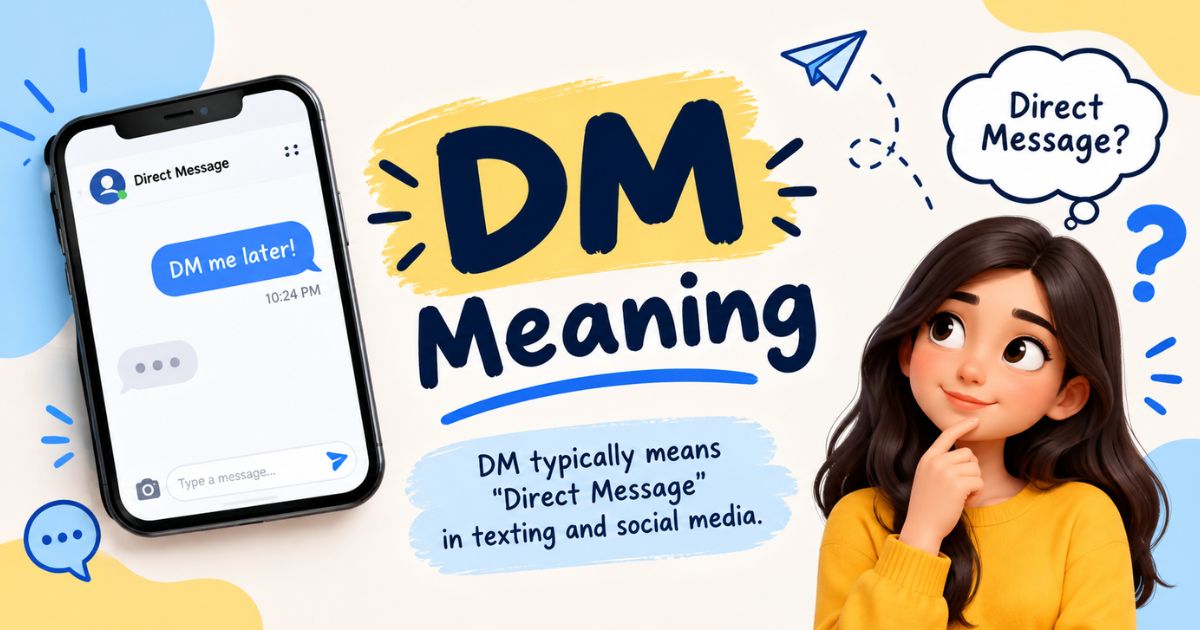
Have you ever seen someone write “DM me” or “check your DMs” and wondered exactly what they mean? If so, you’re not alone. DM meaning is simple, but the way people use it can change depending on the platform and situation.
In texting and social media, DM usually stands for Direct Message. It refers to a private message sent directly to another person rather than posted publicly as a comment or reply. You’ll see DMs used on Instagram, X (formerly Twitter), Facebook, LinkedIn, TikTok, Snapchat, and other social platforms.
So, what does DM mean in text? In most cases, it means “direct message” or “send me a private message.” For example, if someone says, “DM me the details,” they’re asking you to contact them privately.
Let’s break down the DM definition, where the term came from, how it works on different platforms, and how to use DMs properly and safely.
What Does DM Stand For?
DM stands for “Direct Message.” A direct message is a private online message sent from one user to another person, or sometimes to a group of users.
Unlike a public comment, a DM normally appears inside a private inbox or chat area. This makes it useful when you want to discuss something that doesn’t belong in a public conversation.
For example:
“I have a question about your post. I’ll DM you.”
Here, the person is saying they’ll send a private message instead of asking the question publicly.
The DM meaning in texting can also be used as a verb. Someone might say, “DM me,” meaning “send me a direct message.”
You may also see phrases such as:
- “Send me a DM.”
- “Check your DMs.”
- “I’ll DM you.”
- “DM me the link.”
- “Can you DM me?”
- “Shoot me a DM.”
All of these generally refer to private online communication.
DM vs PM
DM and PM are very similar terms. DM means Direct Message, while PM usually means Private Message.
Both describe a message that isn’t intended for a public feed or comment section. The main difference is terminology. Social media platforms such as Instagram and X commonly use “DM,” while some websites, forums, and older messaging systems have traditionally used “PM.”
| Term | Full Form | Meaning |
|---|---|---|
| DM | Direct Message | A private message sent directly to another user |
| PM | Private Message | A private message between users |
| Comment | Public comment | A message visible to people who can access the post |
| Chat | Online conversation | A real-time or ongoing conversation between users |
In everyday social media communication, DM and PM can often be used interchangeably.
History and Origin of DM
The idea behind direct messaging existed before the term became popular on modern social media.
Early internet communities, forums, chat services, and online networks already allowed users to communicate privately. Different platforms used different names for these messages, including private messages, personal messages, and direct messages.
The abbreviation DM became especially common as social media platforms grew. Services that centered on public posts also needed a way for users to have one-to-one conversations away from the public timeline.
Twitter, now known as X, played an important role in making “DM” part of everyday internet language. As social media expanded, the expression spread to platforms such as Instagram and Facebook and became a familiar part of online communication.
Today, direct message is more than a technical feature name. It has become common internet slang. People use “DM me” in ordinary conversation, advertisements, networking, customer service, dating, and casual chats.
DM Across Different Platforms
The basic idea behind a DM stays the same across social networks: you privately contact another user. However, each platform handles messages a little differently.
A person may also receive a message request instead of having the message immediately appear in their normal inbox, particularly when the sender isn’t already connected to them.
An Instagram DM is a private message sent through Instagram’s messaging system.
You can use Instagram direct messages to send text, photos, videos, posts, profiles, links, and other supported content. DMs are commonly used for everything from chatting with friends to contacting creators and businesses.
For example, someone might comment on a public post:
“I’ll DM you the information.”
That means they intend to continue the conversation privately.
If you message someone who doesn’t already have an established connection with you, your message may appear as a message request, depending on the recipient’s settings and the circumstances.
Read More: WYD Meaning: What Does WYD Mean in Text, Chat & Social Media?
Twitter/X
On X, formerly known as Twitter, direct messages allow users to communicate privately rather than posting publicly on the timeline.
An X DM can be useful for personal conversations, networking, customer support, or discussing something that doesn’t belong in a public post.
For example:
“Can you DM me your email address?”
The person is asking you to send the information through a private message rather than posting it publicly.
Facebook Messenger
Facebook generally uses Messenger for private conversations. People often still say “Facebook DM” even though the messaging experience is closely associated with Messenger.
You can use Facebook’s messaging system to communicate privately with friends, contacts, businesses, and other accounts where messaging is available.
The phrase “DM me on Facebook” essentially means “send me a private message.”
LinkedIn messaging is particularly useful for professional communication.
You might receive a message from a recruiter, colleague, potential client, business owner, or professional connection. People also use private messages for networking and discussing job opportunities.
A professional DM should usually be more thoughtful than a casual social media message. Instead of simply writing “Hi,” explain why you’re contacting the person and keep the message relevant.
For example:
“Hi Sarah, I saw your post about SEO content strategy and found your point about search intent interesting. I’d love to discuss it further.”
That’s much more useful than sending a vague message with no context.
Snapchat & TikTok
Snapchat has long centered on private communication, so users commonly use its chat features for one-to-one conversations.
TikTok also provides direct messaging for eligible users and supported interactions. Because TikTok is heavily focused on short-form video, users may send each other videos or continue a conversation privately after seeing public content.
The exact availability and controls can depend on the platform, account, age, region, and privacy settings.
DM Feature Comparison Table
| Platform | Common Term | Main Use | Typical Content |
|---|---|---|---|
| DM | Private social conversations | Text, photos, videos, posts | |
| X | Direct Message / DM | Private communication | Text and shared content |
| Messenger | Private chats | Text, photos, videos, shared posts | |
| Message | Professional communication | Text, links, professional information | |
| Snapchat | Chat | Personal conversations | Text, photos, videos |
| TikTok | Direct Message | Private conversations and shared content | Text and supported TikTok content |
The important point is that the DM meaning on social media remains essentially the same even when the interface or available features differ.
Common Contexts and Uses of DM
People use direct messages for far more than casual chatting. The meaning stays the same, but the purpose can vary considerably.
One common use is starting a private conversation after a public interaction. For example, someone might comment on your post and then ask you to continue the conversation through DMs.
Businesses also use DMs to answer customer questions. A customer may ask about pricing publicly, and the company might respond, “Please DM us your order number so we can help.”
Creators and influencers often receive DMs from followers. These can include questions, feedback, collaboration requests, or personal messages.
Dms are also common in professional networking. Someone might discover a potential business contact on LinkedIn and send a direct message instead of immediately sending an email.
You’ll also encounter several common expressions:
“DM me” means “send me a direct message.”
“Send me a DM” means “contact me privately.”
“Check your DMs” means “look at your private messages.”
“Slide into my DMs” is informal slang for starting a private conversation with someone, sometimes with a flirtatious meaning.
“Hit me up” can mean “contact me,” and in a social media context, that contact may happen through DMs.
For example:
“If you’re interested in the collaboration, DM me.”
The intended meaning is simply: “If you’re interested, contact me privately.”
How to Send a DM Properly
Sending a direct message is usually easy, but the exact steps depend on the platform and its current interface.
The basic process is to open the person’s profile or messaging area, select the message option, write your message, and send it.
However, sending a DM properly involves more than pressing the Send button. Your message should make sense, respect the recipient’s time, and match the context.
Step-by-Step by Platform
Instagram: Open Instagram, go to the person’s profile or your messages area, choose the messaging option, type your message, and send it. If the person isn’t connected with you, the message may be handled as a request.
X: Open the user’s profile or your Messages section, choose the direct-message option when available, enter your message, and send it.
Facebook: Open Messenger or the person’s profile where messaging is available, select the conversation, write your message, and send it.
LinkedIn: Open the person’s profile or your messaging area, choose the available message option, introduce yourself clearly, and explain why you’re reaching out.
Snapchat: Open your chat area, select the person, type your message or send supported content, and tap send.
TikTok: Open your messages or the relevant user’s profile when messaging is available, select the chat option, write your message, and send it.
Keep in mind that privacy settings, account restrictions, age requirements, and platform changes can affect whether you can message a particular person.
DM Etiquette
Good DM etiquette is about respecting boundaries and communicating clearly.
A private inbox may feel informal, but that doesn’t mean every message is appropriate. The same basic rule applies online as it does in real life: consider the person you’re contacting and the reason you’re contacting them.
Do’s
Be clear about your reason for messaging. If you’re asking a question, say what you need.
Introduce yourself when necessary. This is especially important for professional DMs.
Keep your first message reasonably short. Give the recipient enough information without sending a huge block of text.
Be respectful. A private message is still communication with another person.
Respond when a response is appropriate. If someone has taken the time to provide useful information, a brief thank-you can go a long way.
Don’ts
Don’t spam someone with repeated messages. If they haven’t replied, sending ten more messages rarely improves the situation.
Don’t demand an immediate response. People may be busy or may not want to continue the conversation.
Don’t send sensitive information unnecessarily. Avoid sharing passwords, verification codes, financial details, or other private information through casual DMs.
Don’t assume a DM is completely confidential. Messages can potentially be reported, forwarded, captured in screenshots, or accessed through account systems.
Don’t use DMs to harass or pressure people. Respect a person’s boundaries if they don’t want to communicate.
DM in Popular Culture and Slang
The abbreviation has become deeply connected with internet culture.
One of the most recognizable expressions is “slide into my DMs.” It generally means to privately contact someone, often with a playful, romantic, or flirtatious tone.
For example:
“If you want to collaborate, slide into my DMs.”
Here, the phrase doesn’t necessarily have a romantic meaning. The surrounding context determines how it’s being used.
Other common expressions include “DM me,” “check your DMs,” “drop me a DM,” “shoot me a DM,” and “in my DMs.”
Because social media communication moves quickly, these expressions have become part of everyday social media slang, even outside the platforms where DMs originated.
Security and Privacy Concerns
Although DMs are generally designed for private communication, you shouldn’t treat them as an absolutely private or risk-free space.
Scammers may use phishing messages, fake giveaways, suspicious links, impersonation, or urgent requests to trick users. A message that looks like it came from a friend or business may not actually be legitimate.
Be especially careful when a stranger asks for passwords, login codes, bank details, money, or other sensitive information.
Your account security matters too. Using a strong, unique password and enabling two-factor authentication can reduce the risk of unauthorized account access.
It’s also important to remember that a private conversation can still be shared. Someone may take a screenshot, forward a message, report an account, or otherwise preserve the conversation.
If a DM looks suspicious, don’t rush to click a link simply because the sender creates a sense of urgency. Verify who contacted you and use the platform’s official reporting or blocking tools when necessary.
Alternatives to DMs
A direct message isn’t always the best communication method.
For quick public questions, a comment may make more sense. If you’re discussing confidential business information, email may be more appropriate. For ongoing group communication, a dedicated messaging app or collaboration platform may work better.
Common alternatives include:
- Public comments
- WhatsApp messaging
- SMS or text messaging
- Group chats
- Video calls
- Business contact forms
- Professional networking messages
The right option depends on what you’re trying to discuss and how private or formal the conversation needs to be.
FAQs
1. What does DM mean in text?
DM means Direct Message. In texting and social media conversations, it usually refers to sending someone a private message rather than communicating publicly.
2. How do I use DM on Instagram or Twitter?
On Instagram or X, open the messaging area or the person’s profile and select the available message option. Write your message and send it. Some accounts may restrict who can message them.
3. Is DM only for friends?
No. You can use DMs to contact friends, family, creators, businesses, colleagues, recruiters, and other users when the platform allows it. However, some users restrict incoming messages.
4. What does “DM me” mean?
“DM me” means “send me a direct message.” The person is asking you to contact them privately through the platform.
5. Are DMs always private?
DMs are designed for private communication, but they shouldn’t be treated as perfectly confidential. Messages may be reported, forwarded, screenshotted, or accessed through account or platform processes.
6. Can I DM on TikTok?
Yes, TikTok supports direct messaging for eligible users and supported interactions. Messaging availability can depend on account settings, age, region, and other platform requirements.
7. Is it professional to use DM?
Yes, professional DMs are common, especially on platforms such as LinkedIn. Keep the message relevant, polite, and concise, and explain why you’re contacting the person.
8. What’s the difference between DM and comment?
A DM is generally private, while a comment is normally visible to other people who can access the post. DMs work better for personal or detailed conversations, while comments are useful for public interaction.
9. Can businesses use DMs?
Yes. Businesses frequently use direct messages for customer questions, support, product inquiries, collaboration requests, and other conversations. Businesses should still follow the platform’s communication and privacy rules.
10. What’s the correct way to respond to a DM?
Read the message carefully, understand what the sender wants, and respond clearly. If it’s a professional message, use a polite and direct tone. If you don’t want to continue the conversation, you don’t have to respond.
Conclusion
So, what does DM mean? In most online conversations, DM means Direct Message, a private message sent directly to another user.
You’ll see the term everywhere, from Instagram and X to TikTok, Snapchat, Facebook, and LinkedIn. The exact features can vary between platforms, but the basic idea remains the same: DMs let people communicate privately instead of posting publicly.
Once you understand phrases like “DM me,” “send me a DM,” “check your DMs,” and “slide into my DMs,” social media conversations become much easier to follow.
Just remember that private doesn’t always mean completely confidential. Use good DM etiquette, avoid sharing sensitive information, watch for phishing and spam, and think carefully before clicking unfamiliar links. Used responsibly, direct messaging is a simple and useful way to connect with people online.
