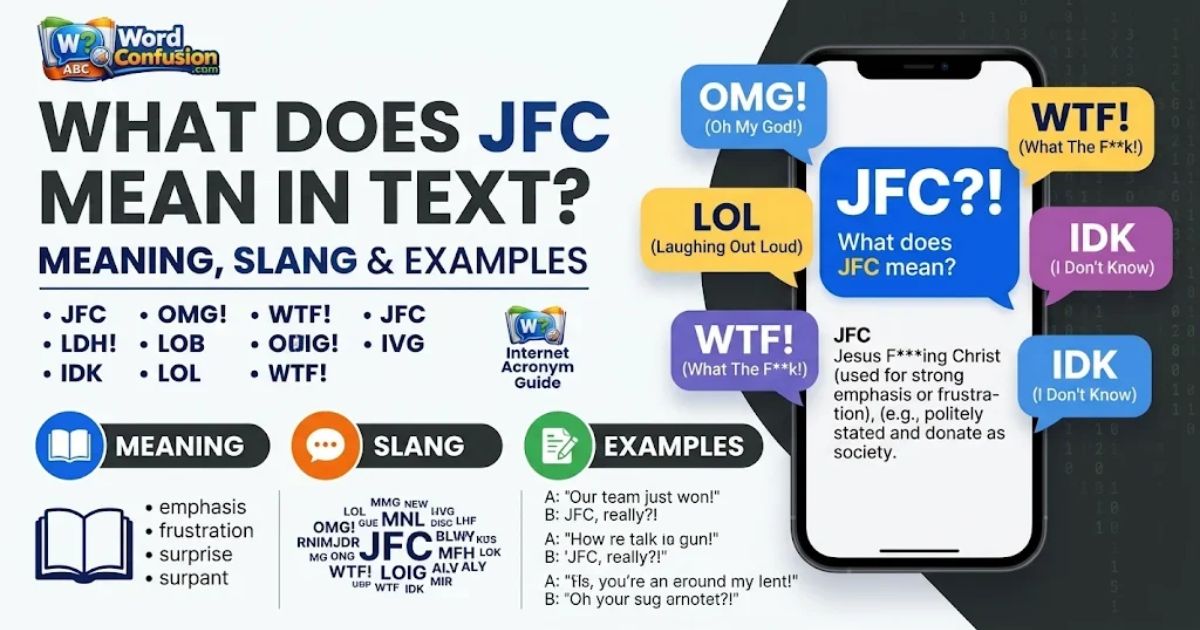
Have you received a text saying “JFC” and wondered what those three letters mean? You’re not alone. JFC is a popular internet abbreviation used in text messages, social media comments, and everyday online conversations. People often use it to express shock, frustration, anger, disbelief, or surprise when something catches them off guard.
In simple terms, JFC stands for “Jesus Fing Christ.”* It’s a strong, informal expression that people use when they’re having an intense emotional reaction. Depending on the conversation, it can sound funny, annoyed, shocked, or even disrespectful.
If you’ve seen JFC on Snapchat, TikTok, Instagram, or WhatsApp, understanding its meaning will help you interpret the message correctly. Let’s explore its definition, examples, appropriate uses, and common alternatives.
What Does JFC Mean in Text? (Quick Answer)
JFC means “Jesus Fing Christ.”* It’s a texting abbreviation used to express strong emotions such as frustration, shock, disbelief, annoyance, or surprise.
For example:
- “JFC, that was expensive!”
- “JFC, I can’t believe he actually did that.”
- “JFC, you’re telling me we have another meeting?”
The abbreviation is common in casual conversations, especially among people who regularly use internet slang. However, because it includes profanity and a religious reference, it’s not suitable for every audience.
Introduction: Why JFC Is So Common in Text Messages
Text messages don’t always make it easy to express emotions. You can’t rely on facial expressions, voice changes, or body language to show how you feel. That’s why people use abbreviations like JFC to communicate their reactions quickly.
Instead of typing a complete sentence about being frustrated or surprised, someone can simply write “JFC!” and let the context explain the emotion.
For example, imagine your friend tells you that a concert ticket costs $500. You might respond, “JFC, that’s way too much!”
The abbreviation has also become popular because online conversations move quickly. People use it in group chats, gaming discussions, memes, comment sections, and everyday messaging.
In American texting culture, JFC is generally understood as an informal expression of strong emotion. It’s especially common in conversations between friends who are comfortable using profanity.
What Does JFC Mean in Text?
JFC stands for “Jesus F***ing Christ.” It’s an expression that combines a religious name with an intensifying swear word to communicate a powerful reaction.
Although the phrase has religious origins, most people using it in modern digital conversations aren’t necessarily making a religious statement. They’re usually expressing an immediate emotional response.
The exact meaning depends on the situation.
- Shock: When something unexpected happens.
- Frustration: When something becomes irritating.
- Disbelief: When something seems impossible to believe.
- Anger: When someone or something makes you upset.
- Surprise: When an event catches you completely off guard.
- Overwhelm: When you’re dealing with too much at once.
For instance, if someone tells you they lost their phone twice in one week, you might reply, “JFC, how does that keep happening?”
The abbreviation doesn’t always mean the sender is genuinely angry. Sometimes people use it humorously or dramatically to make an ordinary situation sound more entertaining.
Example Text Messages
Here are some realistic examples showing how people use JFC in everyday conversations.
| Text message | Intended meaning |
|---|---|
| “JFC, that’s expensive!” | Surprise about the price |
| “JFC, I’m so tired.” | Extreme exhaustion |
| “JFC, what happened here?” | Shock or disbelief |
| “JFC, not again!” | Frustration |
| “JFC, you scared me!” | Strong surprise |
| “JFC, this traffic is terrible.” | Annoyance |
| “JFC, that movie was amazing.” | Excitement or amazement |
| “JFC, I forgot my keys again.” | Frustration with oneself |
Notice how the same abbreviation can communicate different emotions. You need to read the surrounding message to understand what someone actually means.
Read More: IFK Mean in Text: Meaning, Examples & How to Use It (2026)
JFC Acronym Meaning Explained
The JFC acronym contains three letters that represent the words in the expression “Jesus F***ing Christ.”
Here’s a simple breakdown:
- J: Jesus
- F: F***ing
- C: Christ
Sometimes people write the full phrase as “Jesus freaking Christ” to soften the profanity. However, the commonly understood full form of JFC contains the stronger swear word.
JFC is considered an initialism because people generally pronounce each letter separately rather than saying it as one word.
You might see it written in different ways:
- JFC
- jfc
- J.F.C.
- Jesus F***ing Christ
- Jesus freaking Christ
The uppercase and lowercase versions generally have the same meaning. Using capital letters can make the reaction look more intense, especially when someone writes the entire message in uppercase.
What Does JFC Mean in Text Slang?
In internet slang, JFC is an emotional reaction rather than a regular conversational abbreviation.
People use it when something is so surprising, frustrating, ridiculous, or unbelievable that a simple “wow” doesn’t feel strong enough.
For example:
Friend: “I accidentally deleted the entire project.”
You: “JFC, did you have a backup?”
Here, JFC communicates immediate shock and concern.
You’ll also encounter this abbreviation on different social media platforms. Its meaning generally stays the same, although the context and tone can change.
- Snapchat: Used in private snaps and conversations to react to unexpected news or funny situations.
- TikTok: Common in comments and discussions about surprising videos, dramatic moments, or frustrating experiences.
- Instagram: Appears in direct messages, reels comments, stories, and reactions to unexpected posts.
- WhatsApp: Used in personal chats and group conversations to express strong emotions.
- Online gaming: Used when a match becomes frustrating, surprising, or unusually difficult.
Acceptable situations:
JFC is generally acceptable in relaxed conversations when everyone involved is comfortable with profanity.
You can use it when:
- You’re chatting with close friends.
- Someone shares unbelievable news.
- You’re reacting to an unexpectedly high price.
- You’re joking about a frustrating situation.
- You’re commenting on a surprising video or meme.
- You’re discussing a difficult gaming experience.
For example, if your friend tells you that they waited three hours for a five-minute appointment, you could respond, “JFC, that’s ridiculous!”
Situations to avoid it:
Even though JFC is common online, it isn’t appropriate everywhere.
Avoid using it:
- In formal emails or professional messages.
- When communicating with your manager or clients.
- In conversations with people who dislike profanity.
- In religious discussions where it may seem disrespectful.
- In school assignments or official documents.
- When you’re trying to resolve a serious disagreement politely.
Remember, not everyone interprets profanity the same way. A phrase that sounds funny to your friends might offend someone else.
Why Americans Use JFC in Texting
JFC is particularly recognizable in American online conversations because it reflects a casual style of expressing strong emotions.
Americans often use short expressions and abbreviations to make digital communication faster and more expressive. JFC fits naturally into this style because it communicates frustration, disbelief, or surprise without requiring a long explanation.
Here are some common reasons people use it:
1. To express frustration: When plans go wrong, traffic gets worse, or technology stops working, JFC can communicate immediate irritation.
2. To show disbelief: If someone shares unbelievable news, JFC makes the reaction sound stronger than a simple “really?”
3. To add humor: Friends sometimes use it dramatically when something relatively unimportant goes wrong.
4. To emphasize a reaction: A surprising price, unexpected result, or ridiculous situation can inspire a quick JFC response.
5. To save time: Like other texting abbreviations, it allows people to communicate an emotional reaction with just three letters.
However, JFC isn’t exclusive to Americans. English-speaking internet users worldwide recognize and use it across messaging platforms.
JFC vs Other Popular Text Slang
JFC belongs to a larger group of internet slang expressions used to communicate emotions quickly. However, it carries a stronger tone than many common abbreviations.
Understanding the differences can help you choose the right expression for your conversation.
| Slang | Full meaning | Common use |
|---|---|---|
| JFC | Jesus F***ing Christ | Strong shock or frustration |
| OMG | Oh My God | Surprise or excitement |
| WTF | What the F*** | Confusion, shock, or anger |
| SMH | Shaking My Head | Disappointment or disbelief |
| FR | For Real | Agreement or confirmation |
| NGL | Not Gonna Lie | Honest opinion |
| FML | F*** My Life | Frustration or bad luck |
| ISTG | I Swear to God | Emphasis or frustration |
| LMAO | Laughing My A** Off | Strong amusement |
| IDK | I Don’t Know | Uncertainty |
JFC vs OMG
Both expressions communicate surprise, but they aren’t equally strong.
- JFC: Usually expresses intense shock, disbelief, or frustration and contains profanity.
- OMG: A more flexible expression that can communicate excitement, surprise, happiness, or concern.
Example:
Friend: “I just won two concert tickets!”
You: “OMG, that’s amazing!”
Now imagine your friend says the tickets cost $900.
You: “JFC, that’s expensive!”
OMG is generally safer for everyday conversations, while JFC communicates a stronger emotional reaction.
JFC vs WTF
JFC and WTF can both express frustration, disbelief, and surprise.
However, WTF literally means “What the F***,” so it often sounds like a direct question or reaction to something confusing.
JFC is more commonly used as an emotional exclamation.
Example:
- “JFC, I’m late again!” expresses frustration.
- “WTF is happening here?” expresses confusion or disbelief.
How to Use JFC Correctly
Knowing the JFC meaning in text is only half the story. You should also understand when and how to use it without making your message sound unnecessarily rude.
Here are four practical tips.
1. Understand the conversation tone
Before using JFC, consider what’s happening in the conversation.
If your friend is joking about a minor problem, the abbreviation might sound funny. However, if they’re discussing something serious, it could make your response seem insensitive.
For example:
Casual conversation:
Friend: “I spilled coffee on my shirt again.”
You: “JFC, that’s the third time this week!”
The reaction sounds playful because the situation is relatively harmless.
2. Know your audience
Your relationship with the person matters.
Close friends might understand JFC as an ordinary expression of frustration. However, someone who avoids profanity may find it offensive.
If you’re unsure how the other person feels about swear words, choose a softer alternative such as OMG, goodness, or seriously.
3. Use it sparingly
Using JFC in every message can make your communication sound aggressive or repetitive.
Save it for moments when you genuinely want to emphasize shock, frustration, or disbelief.
For example, writing “JFC!” after every small inconvenience can weaken its impact. Using it occasionally makes the expression feel more natural.
4. Choose alternatives when needed
You don’t always need strong language to communicate your feelings.
Consider these alternatives:
| Alternative | Best situation |
|---|---|
| OMG | General surprise |
| Seriously? | Disbelief |
| Goodness! | Mild shock |
| What on earth? | Confusion |
| No way! | Unexpected news |
| That’s unbelievable! | Strong surprise |
| Oh my goodness! | Polite frustration |
| Are you kidding me? | Disbelief or annoyance |
Choosing the right expression helps you communicate clearly without creating unnecessary tension.
Real-Life Examples in the U.S.
To understand how Americans use JFC in everyday communication, it helps to look at situations where the abbreviation feels natural.
These examples show how the meaning changes depending on the setting.
Social Media Example
Imagine someone uploads a video showing an expensive restaurant bill.
A commenter might write:
“JFC, $300 for dinner? What did you even order?”
Here, the abbreviation expresses disbelief about the price. The person isn’t necessarily angry; they’re reacting to something unexpected.
Another example:
“JFC, this video has me laughing so hard.”
In this situation, the expression adds excitement and humor.
Sports Example
Sports fans often use emotional language when reacting to unexpected plays, close games, and surprising results.
For example:
Friend: “Did you see that last-minute touchdown?”
You: “JFC, that ending was insane!”
Here, JFC expresses excitement and amazement.
It can also communicate frustration when a favorite team makes a costly mistake.
Workplace Group Chat
Imagine coworkers discussing a delayed project in an informal group chat.
Coworker: “The system crashed again, and we lost another hour of work.”
You: “JFC, not again. Did anyone save the latest version?”
This sounds like a frustrated reaction between colleagues who have a relaxed communication style.
However, you should be careful. A workplace group chat isn’t automatically a safe place for profanity.
If managers, clients, or senior employees are included, a more professional response would be:
“Oh no, not again. Did anyone save the latest version?”
Travel Example
Travel situations can create plenty of unexpected moments, from delayed flights to expensive hotel bookings.
For example:
Friend: “Our flight has been delayed by six hours.”
You: “JFC, that’s a long wait. Did they offer another flight?”
Here, JFC expresses frustration and disbelief.
Another example:
Friend: “The hotel wants an extra $200 for one night.”
You: “JFC, that’s way more than we expected!”
These examples show how the abbreviation fits into casual conversations about everyday problems.
Common Mistakes People Make
Although JFC is a short abbreviation, people sometimes misunderstand its meaning or use it in the wrong situation.
Here are some common mistakes worth avoiding.
1. Thinking it’s a polite abbreviation: JFC contains profanity, so it isn’t suitable for every conversation. Don’t assume it’s harmless just because it’s written as three letters.
2. Confusing it with OMG: Both expressions can communicate surprise, but JFC is generally stronger and more likely to sound offensive.
3. Assuming someone is angry: A person using JFC isn’t necessarily upset with you. They might simply be reacting to an unexpected situation.
4. Using it in professional communication: Sending JFC to a client or manager can create an unprofessional impression.
5. Ignoring the surrounding context: The same abbreviation can communicate excitement, frustration, shock, or disbelief. Always consider the complete message.
6. Assuming it’s always religious: Although the expression contains religious language, people commonly use it as an emotional exclamation rather than a literal religious statement.
7. Overusing it: Repeating JFC too often can make your messages sound unnecessarily aggressive.
The best way to understand the abbreviation is to consider the sender’s relationship with you, the situation, and the overall tone of the conversation.
Is JFC Offensive?
Yes, JFC can be offensive to some people because its full form includes a strong swear word and uses the name of Jesus Christ as an emotional expression.
However, whether someone finds it offensive depends on their personal beliefs, communication style, and the situation.
For example, close friends who regularly use internet slang may not consider JFC particularly serious. They might use it casually when reacting to a funny video or frustrating experience.
On the other hand, religious individuals may consider it disrespectful because it uses a sacred name alongside profanity.
There are also professional and social situations where JFC can create a negative impression, even if you don’t intend to offend anyone.
Is JFC a bad word?
It’s generally considered profanity because of the word represented by the letter F. That doesn’t mean every use is intended as an insult, but it’s still stronger than ordinary expressions such as “wow” or “OMG.”
If you want to express the same feeling without potentially offending someone, try:
- Oh my goodness!
- Good grief!
- Seriously?
- That’s unbelievable!
- What on earth?
- I can’t believe it!
These alternatives communicate surprise or frustration without using strong language.
How to Respond When Someone Sends JFC
If someone sends you JFC, you don’t need to take it personally. The abbreviation usually expresses an emotional reaction rather than targeting the person receiving the message.
Your response should depend on why they used it.
If they’re frustrated:
If someone sounds annoyed or irritated, acknowledge their feelings and respond calmly.
Examples:
- “I know, it’s been a rough day.”
- “Yeah, that’s really frustrating.”
- “Hopefully, things get better.”
- “I get why you’re annoyed.”
- “Tell me what happened.”
These responses show understanding without making the situation worse.
If they’re shocked:
When someone uses JFC because something unexpected happened, you can share their surprise.
Examples:
- “I know, right?”
- “I couldn’t believe it either!”
- “Seriously, that was unexpected.”
- “No way! What happened next?”
- “That’s absolutely crazy!”
These replies keep the conversation natural and engaging.
If they’re overwhelmed:
Sometimes people use JFC when they have too many things happening at once.
In that situation, a supportive response is usually better than another dramatic reaction.
Examples:
- “Take a breath. It’ll be okay.”
- “That’s a lot to deal with.”
- “Want to talk about it?”
- “One thing at a time.”
- “I’m here if you need anything.”
A little understanding can make a big difference when someone is having a difficult day.
Frequently Asked Questions
What does JFC mean in text messages?
JFC stands for “Jesus F***ing Christ.” It’s an informal texting abbreviation used to express strong emotions such as shock, frustration, anger, disbelief, or surprise.
What does JFC stand for in texting?
JFC stands for “Jesus F***ing Christ.” People use it as an emotional exclamation in text messages, group chats, and social media conversations.
Is JFC a bad word?
Yes, JFC is generally considered profanity because its full form includes a swear word. It’s best reserved for informal conversations with people who are comfortable with strong language.
Is JFC offensive or disrespectful?
It can be. Some people find it offensive because it combines profanity with a religious reference. Others use it casually without intending to disrespect anyone.
What does JFC mean on Snapchat?
On Snapchat, JFC has the same meaning: “Jesus F***ing Christ.” People commonly use it in snaps and private chats to express surprise, frustration, or disbelief.
How do you use JFC in a sentence?
You can use JFC at the beginning of a sentence to emphasize a strong reaction.
For example: “JFC, I can’t believe how expensive these concert tickets are!”
How should you respond to JFC?
Your response depends on the situation. If someone is frustrated, show understanding. If they’re surprised, share their reaction. If they’re overwhelmed, offer support.
Is JFC stronger than OMG?
Yes, JFC generally sounds stronger than OMG because it contains profanity. OMG is more flexible and suitable for a wider range of conversations, while JFC is usually reserved for more intense reactions.
Final Thoughts on What Does JFC Mean in Text
Understanding the JFC meaning in text makes it easier to follow modern texting conversations and recognize emotional expressions online.
JFC stands for “Jesus F***ing Christ.” People commonly use it to express shock, frustration, disbelief, anger, or surprise. You’ll find it in private messages, social media comments, group chats, and casual online discussions.
However, remember that JFC contains profanity and may offend some people, particularly in religious or professional settings. If you’re unsure whether it’s appropriate, expressions like OMG, goodness, or seriously are safer alternatives.
The main takeaway is simple: JFC is a strong informal reaction, so always consider the conversation and your audience before using it.
