Have you received a message saying “IFK” and wondered what the person was trying to tell you? Internet slang can be confusing, especially when three little letters carry a strong emotion.
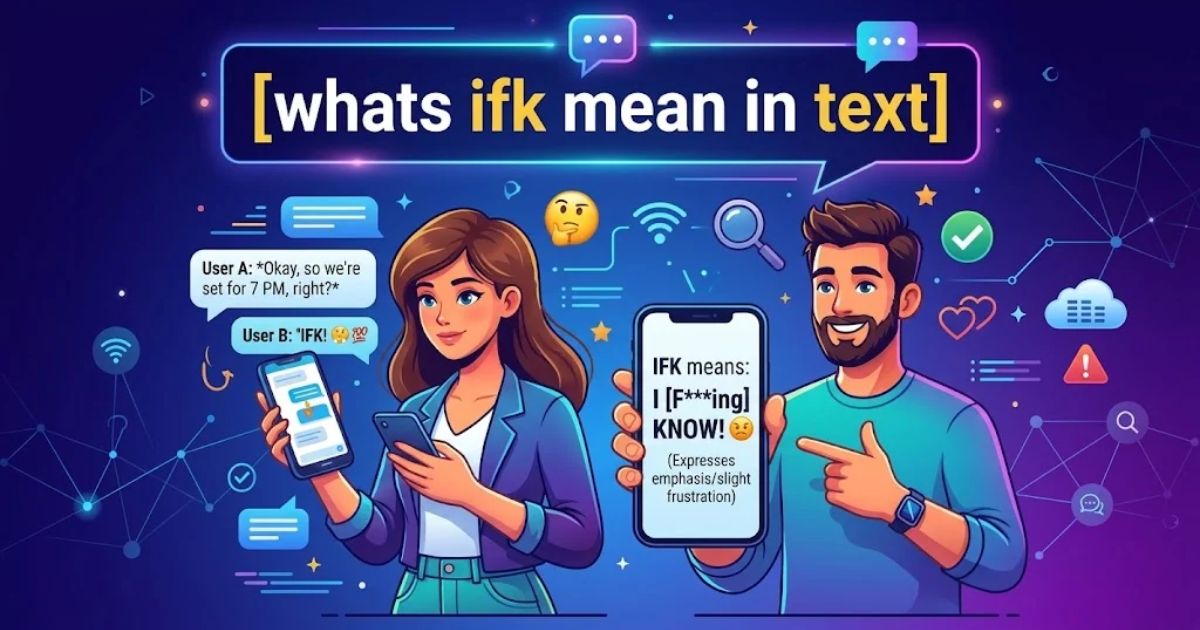
IFK commonly means “I Fing Know” in texting.* It’s an informal expression people use to show strong agreement, frustration, excitement, or confidence. Depending on the conversation, it can sound playful, sarcastic, or slightly aggressive.
You might see IFK in messages between friends, social media comments, gaming chats, and group conversations. However, understanding its tone is just as important as knowing its full form.
Let’s explore what IFK means, where people use it, how it differs from similar abbreviations, and how to use it naturally in everyday conversations.
What Does IFK Mean in Text?
In texting, IFK stands for “I Fing Know.”* It’s a stronger and more emotional version of saying “I know.” People use it when they already understand something, strongly agree with another person, or feel frustrated because someone is repeating information they already know.
For example:
Friend 1: This summer is getting way too hot!
Friend 2: IFK 😭
Here, the second person is saying, “I know! It’s unbelievably hot!” They’re agreeing with the complaint and expressing the same feeling.
The F in IFK represents profanity, which adds extra emphasis. Some people interpret it as “I Freaking Know” when they want a cleaner version. Both interpretations communicate the same basic idea, but the original expression is stronger.
You should also remember that IFK isn’t always angry or aggressive. It can sound funny, excited, sarcastic, or annoyed depending on the conversation. meaningdive.com+2
Simple Meaning of IFK
In simple English, IFK means “I already know, and I strongly agree or feel something about it.”
Think of it as a more intense way of responding to someone who says something obvious, relatable, or familiar.
For example:
- IK: I know.
- IFK: I really know!
- IKR: I know, right?
The abbreviation can communicate different emotions:
- Agreement: You completely agree with what someone said.
- Frustration: You’re tired of hearing something you already know.
- Excitement: You’re enthusiastic about a shared experience.
- Sarcasm: You’re responding dramatically to an obvious statement.
- Confidence: You’re emphasizing that you already understand something.
One important distinction: IFK doesn’t mean “If I Know.” It generally represents “I F***ing Know” in casual texting.
Where Is IFK Used?
IFK is mainly used in informal digital communication. You might see it when friends discuss everyday problems, share exciting news, complain about something, or react to funny situations.
It’s a short response that communicates more emotion than a simple “I know.”
People can use IFK as a standalone reply or include it in a longer sentence. For instance, “IFK, that was the best concert ever!” expresses enthusiastic agreement.
Common platforms include:
1. Snapchat
People may use IFK in Snapchat messages when agreeing with friends, reacting to funny snaps, or sharing relatable experiences.
Example: “This homework is killing me. IFK 😭”
2. Instagram
On Instagram, IFK can appear in direct messages, comment sections, and conversations about posts or reels.
Example: “That outfit is absolutely perfect. IFK!”
3. WhatsApp
Friends and family may use IFK in private chats and group conversations, especially when discussing something frustrating or funny.
Example: “We have another meeting tomorrow? IFK, I’m exhausted.”
4. TikTok
TikTok comments often contain short reactions to relatable videos, jokes, and trending topics. IFK can communicate strong agreement with a video’s message.
Example: “This is exactly how Mondays feel. IFK 😭”
5. Facebook
People may use IFK in comments and Messenger conversations when reacting to posts, personal updates, and shared experiences.
Example: “The weekend went by too quickly. IFK!”
6. Gaming Chats
Players may use IFK when discussing game updates, difficult missions, frustrating teammates, or familiar gaming experiences.
Example: “That final boss is impossible. IFK bro!”
Although IFK can appear across these platforms, it isn’t necessarily equally popular on all of them. Its use depends on individual communities and texting habits.
Read More: IWK Meaning in Text: Definition, Usage & Real Examples (2026)
Why Do People Use IFK?
People use IFK because sometimes a simple “I know” doesn’t express enough emotion. When someone strongly agrees with a statement or feels frustrated about something familiar, IFK adds extra emphasis.
It also helps people communicate quickly without writing a long response.
Imagine your friend says, “Why does Monday always arrive so quickly?”
You could reply, “I know.”
But “IFK 😭” sounds more dramatic and relatable.
Here’s why it’s popular:
1. It saves time: Instead of typing a complete sentence, you can use three letters to communicate a strong reaction.
2. It expresses emotions: IFK can show excitement, annoyance, frustration, or agreement.
3. It creates connection: When friends share the same experience, IFK can make the conversation feel more relatable.
4. It adds emphasis: The expression communicates a stronger reaction than ordinary “I know.”
5. It fits casual conversations: It’s easy to include in messages, comments, and group chats.
6. It can add humor: When combined with emojis, IFK can make an exaggerated reaction feel playful rather than serious.
However, its popularity shouldn’t be confused with universal recognition. Some people understand IFK immediately, while others may mistake it for IDK or an unfamiliar abbreviation.
Examples of IFK in Real Conversations
Real conversations are the best way to understand how IFK works. The following examples demonstrate how its meaning and emotional tone can change depending on the situation.
Example 1: Agreement
Person A: This new song is seriously amazing!
Person B: IFK! I’ve been listening to it all day.
Explanation: Person B strongly agrees with Person A. They’re expressing excitement and showing that they share the same opinion.
In this situation, IFK is positive and enthusiastic. It communicates something like, “I know! I love it too!”
Example 2: Frustration
Person A: You need to finish your assignment before tomorrow.
Person B: IFK! I’ve been working on it for hours.
Explanation: Person B already understands the situation but feels frustrated because the reminder isn’t necessary.
Here, IFK communicates irritation rather than simple agreement. The sender may feel that the other person is repeating something obvious.
Example 3: Sarcasm
Person A: It’s raining again. We probably won’t get any sunshine today.
Person B: IFK, what a shocking discovery! 😂
Explanation: Person B uses IFK sarcastically. The exaggerated response makes fun of an obvious observation.
The laughing emoji helps show that the comment is playful rather than genuinely rude.
Example 4: Confidence
Person A: Do you know how to solve this problem?
Person B: IFK. I’ve already studied this chapter.
Explanation: Person B uses IFK to emphasize that they already understand the subject.
The tone is confident and direct. However, in a real conversation, a simple “I know” might sound more natural if there’s no need for strong emphasis.
IFK vs Similar Terms
IFK is easy to confuse with other short texting abbreviations, particularly IK, IKR, and IDK. Although they may appear in similar conversations, their meanings and emotional tones are different.
Here’s a simple comparison:
| Abbreviation | Full Form | Main Meaning |
|---|---|---|
| IFK | I F***ing Know | Strong acknowledgment or agreement |
| IK | I Know | Simple acknowledgment |
| IKR | I Know, Right? | Agreement with someone |
| IDK | I Don’t Know | Uncertainty |
| FR | For Real | Agreement or emphasis |
| LOL | Laughing Out Loud | Expressing amusement |
| IDC | I Don’t Care | Showing a lack of concern |
| NGL | Not Gonna Lie | Introducing an honest opinion |
| SMH | Shaking My Head | Disappointment or disbelief |
Key difference:
The biggest difference is the intensity behind each expression.
- IFK vs IK: IFK adds strong emotional emphasis, while IK is a simple acknowledgment.
- IFK vs IKR: Both can express agreement, but IKR sounds more conversational and doesn’t contain profanity.
- IFK vs IDK: These have opposite meanings. IFK indicates that you already know, while IDK means you don’t know.
- IFK vs FR: FR confirms that something is true or relatable, while IFK emphasizes that you already know it.
- IFK vs LOL: IFK communicates strong acknowledgment, whereas LOL expresses amusement.
For example, if someone says, “This movie is so good,” you might reply:
- “IK” – I know.
- “IKR” – I know, right?
- “IFK” – I know! I strongly agree.
The best option depends on the emotion you want to express. If you want a friendly response without profanity, IKR or “Exactly!” is usually a better choice.
When Should You Use IFK?
IFK is best suited to informal conversations with people who understand your communication style.
You can use it when talking to close friends, siblings, gaming teammates, or people who regularly use internet slang.
For example, if your friend complains about an annoying situation that you’ve experienced too, replying with “IFK 😭” can communicate shared frustration.
However, because the abbreviation commonly represents a swear word, you should think about your audience before using it.
Safe situations:
Here are some situations where IFK may feel natural:
- Conversations with close friends: When everyone is comfortable with casual language.
- Funny group chats: When reacting to jokes or relatable situations.
- Social media comments: When agreeing with an informal post or video.
- Gaming conversations: When discussing familiar challenges or frustrating moments.
- Casual discussions: When someone says something you strongly agree with.
- Friendly teasing: When you want to give an exaggerated but playful response.
Not suitable for:
There are situations where using IFK can create the wrong impression.
Avoid using it in:
- Professional emails and workplace communication.
- Academic assignments and official documents.
- Conversations with clients or business partners.
- Formal messages to teachers or managers.
- Serious discussions where respectful language is important.
- Chats with people who may find profanity offensive.
For example, replying “IFK” to your manager when they explain an important task might sound disrespectful, even if you don’t intend it that way.
Simple rule:
Use IFK with people who are comfortable with informal language and profanity. When you’re unsure, choose “I know,” “Exactly,” or “I agree.”
This simple rule helps you avoid unnecessary misunderstandings while keeping your communication appropriate.
Common Misunderstandings About IFK
Because IFK looks similar to several other texting abbreviations, people sometimes misunderstand its meaning or emotional tone.
Let’s clear up the most common mistakes.
1. It does NOT mean “if I know”
One common mistake is reading IFK as “If I Know.”
However, in ordinary texting slang, IFK generally stands for “I F***ing Know.”
It’s important to recognize the difference because the abbreviation communicates acknowledgment rather than uncertainty.
If someone sends “IFK 😂” after you make a statement, they’re most likely saying they already know and strongly agree.
2. It is not always rude
Some people assume IFK is automatically offensive because its full form contains profanity.
However, its tone depends on the relationship and situation.
For example:
Friend: That exam was ridiculously difficult!
You: IFK 😭
This sounds like a casual expression of shared frustration.
On the other hand, using IFK aggressively during an argument may come across as disrespectful.
The abbreviation itself doesn’t tell the whole story. The surrounding words and relationship matter.
3. It does not always show anger
Another misunderstanding is believing that IFK always means someone is annoyed.
That’s not true.
It can communicate several emotions:
- Excitement about something.
- Agreement with an opinion.
- Frustration about a shared problem.
- Sarcasm in response to an obvious statement.
- Confidence when someone already understands something.
For example, “IFK, that concert was incredible!” expresses excitement rather than anger.
4. It is not a formal abbreviation
IFK belongs to informal internet language. Its full form includes profanity, making it unsuitable for most professional and academic situations.
Even if your colleagues understand the abbreviation, using it in a business email can make your message seem unnecessarily casual.
Instead, use expressions such as:
- I understand.
- I already know.
- Exactly.
- I completely agree.
- Yes, I’m aware.
These alternatives communicate your message without creating confusion.
Pro Tips for Using IFK Correctly
Knowing what IFK means is one thing. Using it naturally is another.
The key is to understand the conversation before sending the abbreviation. A message that sounds funny between close friends may feel rude when sent to someone unfamiliar with your humor.
Here are some practical ways to use it more effectively.
Important advice:
1. Understand the context first.
Before sending IFK, consider whether you’re agreeing, expressing frustration, or responding sarcastically. Make sure your message matches the situation.
2. Know your audience.
Use it with people who are comfortable with casual slang and profanity. Don’t assume everyone has the same communication style.
3. Use emojis when helpful.
Emojis can make your intention clearer.
For example:
- “IFK 😂” – Playful agreement.
- “IFK 😭” – Dramatic frustration or relatable emotion.
- “IFK!!” – Strong excitement or emphasis.
Remember that emojis help communicate tone but don’t guarantee that everyone will interpret your message the same way.
4. Don’t confuse it with IDK.
This is especially important because the two abbreviations look similar but mean different things.
IFK means “I F***ing Know.”
IDK means “I Don’t Know.”
5. Avoid using it in serious arguments.
If someone is discussing an important problem, responding with IFK may make them feel ignored. Choose a more thoughtful response instead.
6. Don’t overuse it.
You don’t need to add IFK to every message. Use it when you genuinely want to emphasize your reaction.
7. Choose a cleaner alternative when necessary.
If you’re communicating with someone who dislikes profanity, use “I freaking know” or simply “I know!”
These small adjustments can make your texting clearer, friendlier, and more appropriate.
Final Thoughts
Understanding IFK meaning in text is simple once you know what the abbreviation represents. IFK commonly stands for “I F***ing Know,” an informal expression used to show strong agreement, frustration, excitement, sarcasm, or confidence.
You’ll most likely encounter it in casual messages, Snapchat conversations, Instagram comments, WhatsApp groups, and other online discussions.
Remember that IFK is different from IK and IDK. While IK simply means “I Know” and IDK means “I Don’t Know,” IFK adds extra emotion and emphasis.
The most important thing is to consider your audience. Use IFK when chatting with friends who are comfortable with casual slang, but choose cleaner alternatives in professional or formal situations.
Now, when someone sends you “IFK,” you’ll know what they’re trying to communicate!
FAQ Section
1. What does IFK mean in texting?
IFK usually means “I F***ing Know” in texting. It’s an informal expression used to show strong agreement, frustration, or acknowledgment. People often use it when they already know something and want to emphasize their reaction.
2. Is IFK rude?
Not necessarily. IFK can sound playful or friendly when used between close friends. However, its full form contains profanity, so it may seem rude or inappropriate in professional conversations or when talking to someone who dislikes strong language.
3. Is IFK the same as IK?
No. IK means “I Know,” while IFK means “I F***ing Know.” Both communicate that someone already knows something, but IFK adds stronger emotional emphasis. IK is generally more neutral and suitable for everyday conversations.
4. Can I use IFK in professional messages?
It’s better to avoid IFK in professional messages because it commonly represents profanity. Instead, use alternatives such as “I understand,” “I’m already aware,” or “I completely agree.” These expressions sound clearer and more professional.
