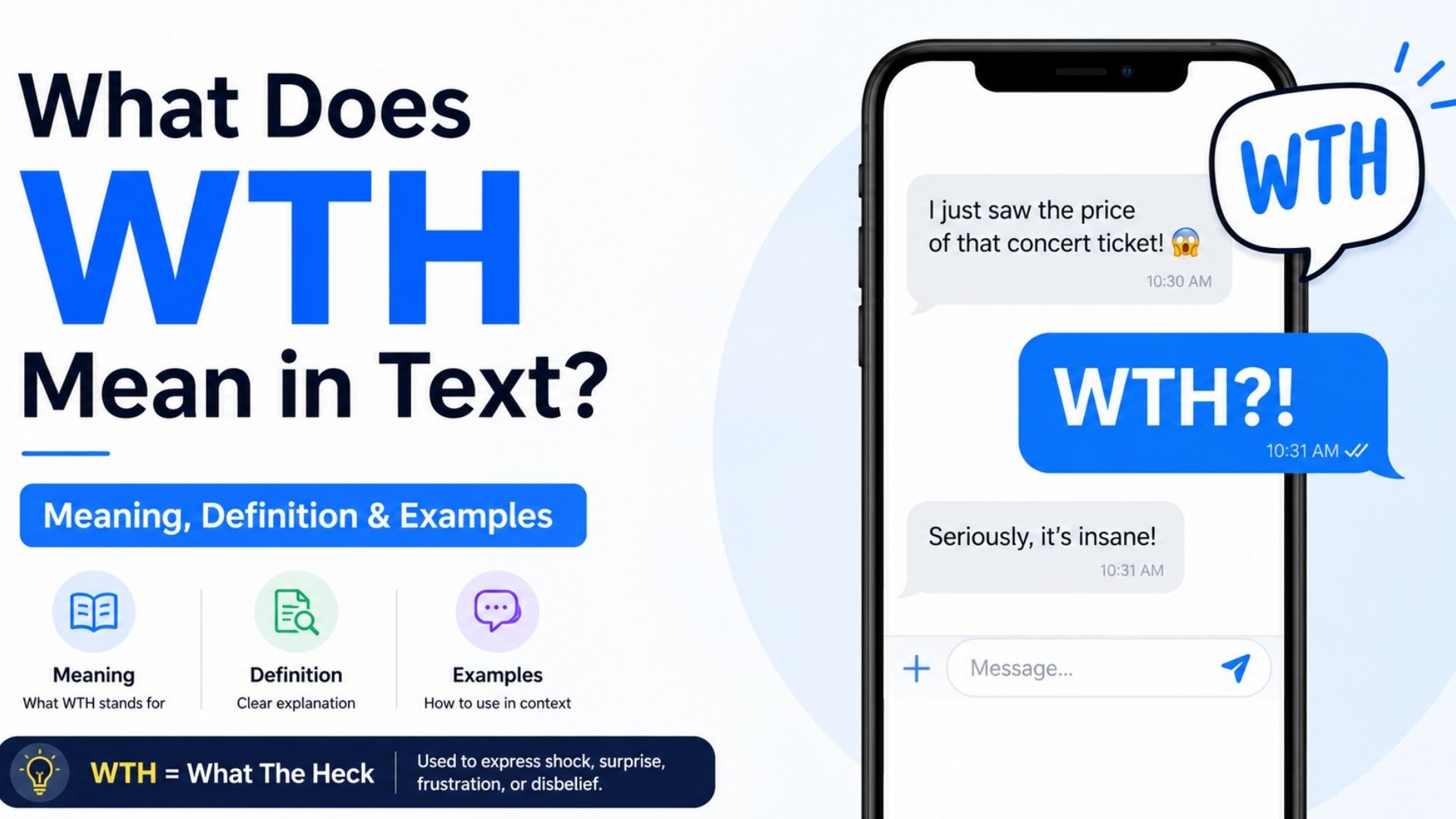
Have you ever opened a message, comment, or social media post and seen “WTH” with no idea how to interpret it? Maybe someone wrote, “WTH just happened?” or “WTH 😂”, and you weren’t sure whether they were angry, confused, or simply joking.
So, what does WTH mean in text? In most cases, WTH is an abbreviation for “what the hell.” However, many people also use it as a softer version of “what the heck.” The exact meaning depends on the person, the conversation, and the tone. It can express surprise, confusion, disbelief, frustration, or playful shock.
For example, if your friend suddenly sends you a photo of something completely unexpected and you reply, “WTH is that?”, you’re probably expressing surprise or confusion rather than genuine anger. On the other hand, “WTH were you thinking?” can sound more frustrated or critical.
In this guide, we’ll explain what does WTH mean in text, where the expression comes from, how people use it in everyday conversations, what emotions it can communicate, and how it compares with similar expressions. By the end, you’ll know exactly how to understand WTH based on context.
What Does WTH Meaning in Text?
The most common answer to what does WTH mean in text is “what the hell.”
However, WTH is also sometimes interpreted as “what the heck,” especially by people who want to use a milder expression.
Both versions are used to communicate a similar feeling:
- Surprise
- Confusion
- Shock
- Disbelief
- Frustration
- Mild annoyance
For example:
“WTH is going on?”
This could mean:
“What the hell is going on?”
Or, in a softer interpretation:
“What the heck is going on?”
The abbreviation allows people to express a strong reaction quickly without typing the full phrase.
Is WTH a Bad Word?
The answer depends on how you interpret the H.
If WTH means “what the hell,” it contains a mild swear word. It’s not generally considered extremely offensive, but it can still be inappropriate in some formal or professional situations.
If someone interprets it as “what the heck,” it’s much softer.
Because the abbreviation can be ambiguous, the tone often depends on the context.
For example:
“WTH 😂”
might be playful.
But:
“WTH is wrong with you?”
could sound genuinely angry or insulting.
The surrounding words make a big difference.
Origin and Background of the Term
The expression behind WTH comes from the longer phrase “what the hell.” People have used variations of this expression for decades to express surprise, confusion, disbelief, or frustration.
As digital communication became more popular, people began shortening common phrases to make texting faster. This led to abbreviations such as:
- WTH
- WTF
- OMG
- IDK
- TBH
- IMO
WTH became a relatively mild way to express disbelief or confusion without using the stronger profanity found in WTF.
That’s one reason you’ll often see WTH in casual online conversations. It gives people a way to communicate a strong reaction while remaining somewhat less explicit.
Over time, the abbreviation spread across:
- Text messaging
- Social media
- Online forums
- Gaming chats
- Group conversations
- Comment sections
- Messaging apps
Today, WTH is widely recognizable among internet users, although its exact emotional intensity can vary from person to person.
Read more: RLS Meaning: What Does RLS Mean in Text, Chat & Social Media?
How WTH Is Used in Daily Life
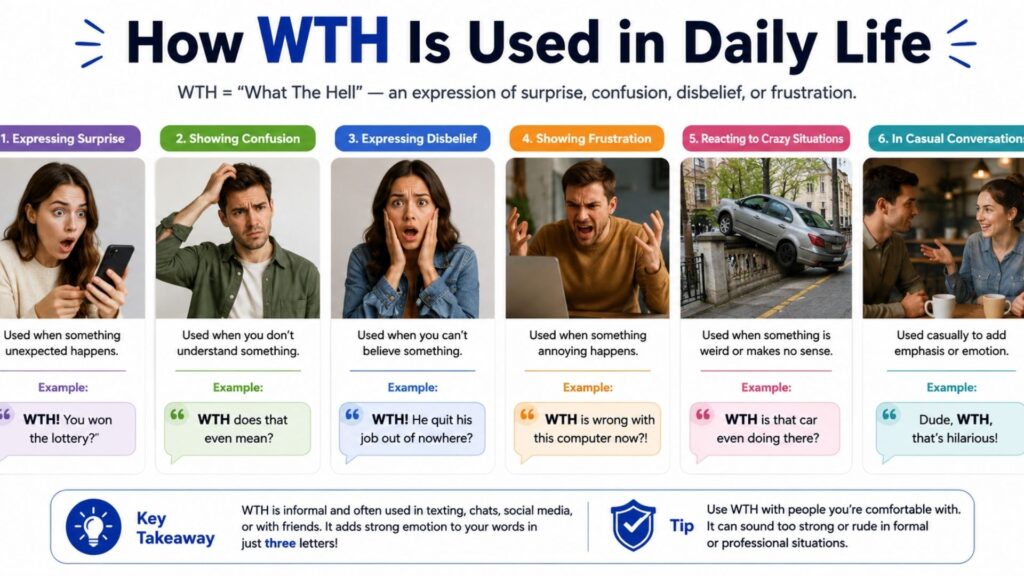
The what does WTH mean in text question doesn’t have just one emotional answer. People use WTH in several different ways, and context determines the intended tone.
1. Reacting to Something Unexpected
One of the most common uses of WTH is reacting to something surprising.
Imagine your friend sends you a picture of a giant cake they just ordered.
You might reply:
“WTH! That’s huge 😂”
Here, you’re expressing surprise. You’re probably not angry at all.
Another example:
“WTH, you actually did it?”
This communicates disbelief or amazement.
In this situation, WTH is similar to saying:
“Wow, I can’t believe this!”
2. Expressing Confusion
People also use WTH when they don’t understand what’s happening.
For example:
“WTH is happening here?”
This means:
“What is going on?”
Or:
“WTH does that even mean?”
Here, the speaker is confused and wants an explanation.
The expression adds emotional intensity to an otherwise simple question.
3. Showing Playful Shock
WTH can be humorous when used among friends.
For example:
“WTH 😂 You wore that to the party?”
If the friends have a playful relationship, this might be teasing rather than genuine criticism.
Another example:
“WTH, you ate the whole pizza?”
The speaker may be jokingly surprised.
Emojis often make this kind of usage easier to recognize. A laughing emoji, crying-laughing emoji, or playful reaction can signal that the message isn’t meant to sound serious.
4. Mild Frustration
WTH can also express annoyance.
For example:
“WTH is taking so long?”
The person is frustrated about a delay.
Or:
“WTH happened to my order?”
Here, the speaker is annoyed and wants to know what went wrong.
This usage is stronger than simple confusion but doesn’t necessarily indicate intense anger.
5. Friendly Teasing
Friends sometimes use WTH to tease each other.
For example:
“WTH, you finally showed up!”
If the relationship is friendly, the speaker may simply be joking about someone arriving late.
Another example:
“WTH are you wearing? 😂”
Depending on the relationship and tone, this could be playful teasing rather than an insult.
Still, be careful. The same words can feel very different depending on who says them and how well you know each other.
6. Social Media Comments
WTH is common in social media comments, especially when reacting to unexpected photos, videos, or news.
For example:
“WTH did I just watch? 😂”
or:
“WTH is happening in this video?”
or:
“WTH, this is actually amazing!”
In these situations, the abbreviation often adds personality and emotional energy to the comment.
Emotional or Practical Meaning of WTH
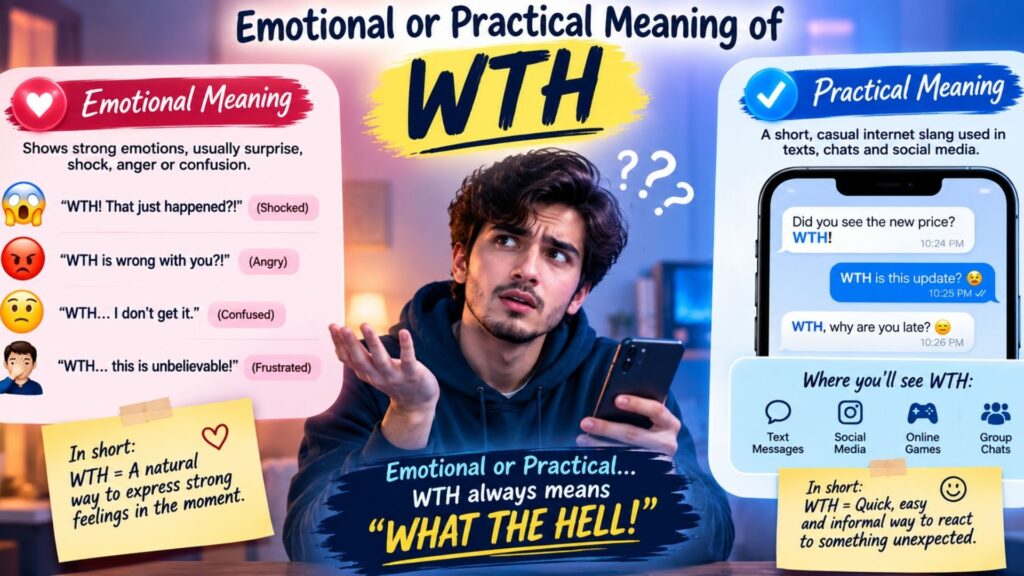
Understanding what does WTH mean in text requires more than knowing the words behind the abbreviation. You also need to consider the emotion behind it.
WTH often works like an emotional amplifier. The basic question might be:
“What happened?”
But adding WTH creates a stronger reaction:
“WTH happened?”
The second version suggests that something unexpected, confusing, or frustrating occurred.
WTH Can Show Surprise
“WTH! You won?”
This communicates genuine surprise.
WTH Can Show Confusion
“WTH is this supposed to mean?”
The person doesn’t understand something.
WTH Can Show Frustration
“WTH is taking so long?”
The speaker is annoyed by a delay.
WTH Can Show Disbelief
“WTH, you bought that?”
The speaker can’t believe what happened.
WTH Can Be Playful
“WTH 😂 You actually did it!”
The speaker is surprised but amused.
This is why you shouldn’t automatically assume WTH means anger. The same abbreviation can communicate completely different emotions depending on the situation.
Similar or Related Terms
If you’re trying to understand what does WTH mean in text, it’s helpful to compare it with similar expressions.
What the Heck
“What the heck” is a softer alternative to “what the hell.”
Some people use WTH to represent either phrase.
WTF
WTF usually stands for “what the fuck.”
It’s generally considered stronger and more vulgar than WTH.
For example:
“WTH is going on?”
sounds milder than:
“WTF is going on?”
Both express confusion or disbelief, but the second is more explicit.
OMG
OMG means “oh my God” or, depending on the speaker, “oh my gosh.”
It’s commonly used to express surprise, excitement, shock, or amazement.
“OMG, that’s incredible!”
WTH is usually more associated with confusion or disbelief.
What?!
Simply writing:
“What?!”
can communicate surprise or confusion without using slang.
Seriously?
“Seriously?” can also express disbelief.
“Seriously? You did that?”
Depending on the context, it may sound surprised, annoyed, or skeptical.
IDK
IDK means “I don’t know.”
It’s different from WTH but often appears in similar conversations.
“WTH is happening?”
“IDK!”
The first person is asking what’s going on, while the second person says they don’t know.
Here’s a quick comparison:
| Expression | Meaning | Typical Tone |
|---|---|---|
| WTH | What the hell / What the heck | Surprise, confusion, frustration |
| WTF | What the fuck | Strong shock, anger, disbelief |
| OMG | Oh my God / Oh my gosh | Surprise, excitement, amazement |
| IDK | I don’t know | Uncertainty |
| What?! | What? | Surprise or confusion |
| Seriously? | Are you serious? | Disbelief or annoyance |
Common Misunderstandings About WTH
Because WTH can communicate different emotions, it’s easy to misunderstand it.
1. It’s Always Rude
Not necessarily.
WTH can sound rude in some situations, especially when directed at someone personally.
For example:
“WTH is wrong with you?”
This can definitely sound insulting.
However:
“WTH 😂 That was hilarious!”
is much more playful.
The context and relationship between the people matter.
2. It Always Means “What The Hell”
Not always.
Some people use WTH as shorthand for “what the heck.” This softer interpretation is common when someone wants to express surprise without sounding too harsh.
Because the abbreviation doesn’t reveal the exact word behind the H, you often need to rely on context.
3. It’s Only for Teenagers
No. People of different ages use internet abbreviations, especially in casual digital communication.
However, individual preferences vary. Some people use WTH regularly, while others prefer to write the full phrase.
The popularity of slang also depends on the platform and online community.
4. It’s Professional
Generally, no.
WTH is informal and is best suited for:
- Text messages
- Casual chats
- Social media
- Friends
- Informal online communities
It’s usually better to avoid it in:
- Formal emails
- Job applications
- Business letters
- Official reports
- Professional presentations
If you need to express confusion at work, you could say:
“I’m not sure I understand what happened.”
That’s clearer and more professional.
5. It Shows Anger
Not necessarily.
WTH can express anger, but it can also express:
- Surprise
- Confusion
- Amusement
- Disbelief
- Curiosity
- Mild frustration
For example:
“WTH 😂 You actually won!”
is probably positive and playful.
Meanwhile:
“WTH were you thinking?”
sounds much more critical.
The context changes everything.
Read more: What Does OTP Mean? Text, Chat, Anime & One-Time Password Explained
Examples of WTH in Sentences
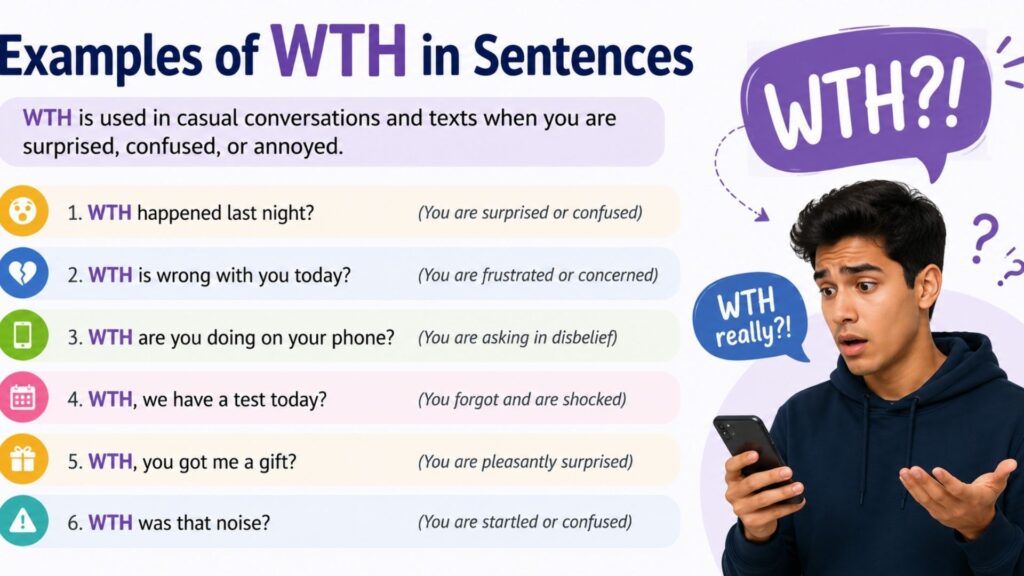
Let’s look at some realistic examples to make the what does WTH mean in text definition even clearer.
Example 1: Surprise
“WTH! You got tickets?”
Meaning: The speaker is surprised and excited.
Example 2: Confusion
“WTH is going on?”
Meaning: The speaker doesn’t understand what’s happening.
Example 3: Disbelief
“WTH, you actually bought it?”
Meaning: The speaker can’t believe the other person made the purchase.
Example 4: Frustration
“WTH is taking so long?”
Meaning: The speaker is annoyed about a delay.
Example 5: Playful Reaction
“WTH 😂 You ate all of that?”
Meaning: The speaker is jokingly surprised.
Example 6: Social Media
“WTH did I just watch? 😂”
Meaning: The video was strange, surprising, or funny.
Example 7: Friendly Teasing
“WTH, you’re wearing that? 😂”
Meaning: The speaker is probably teasing the other person.
Example 8: Asking for an Explanation
“WTH does this mean?”
Meaning: The speaker is confused and wants clarification.
Example 9: Shock
“WTH! That’s the biggest dog I’ve ever seen.”
Meaning: The speaker is amazed by the dog’s size.
Example 10: Mild Annoyance
“WTH, why didn’t you tell me?”
Meaning: The speaker is frustrated because they weren’t informed.
Example 11: Positive Surprise
“WTH, this place is beautiful!”
Meaning: The speaker is pleasantly surprised.
Example 12: Stronger Frustration
“WTH were you thinking?”
Meaning: The speaker is questioning someone’s decision and may be genuinely upset.
These examples demonstrate why the abbreviation shouldn’t be interpreted in isolation. The words around WTH—and sometimes the emojis—help reveal the intended emotion.
Why Understanding WTH Meaning in Text Matters Today
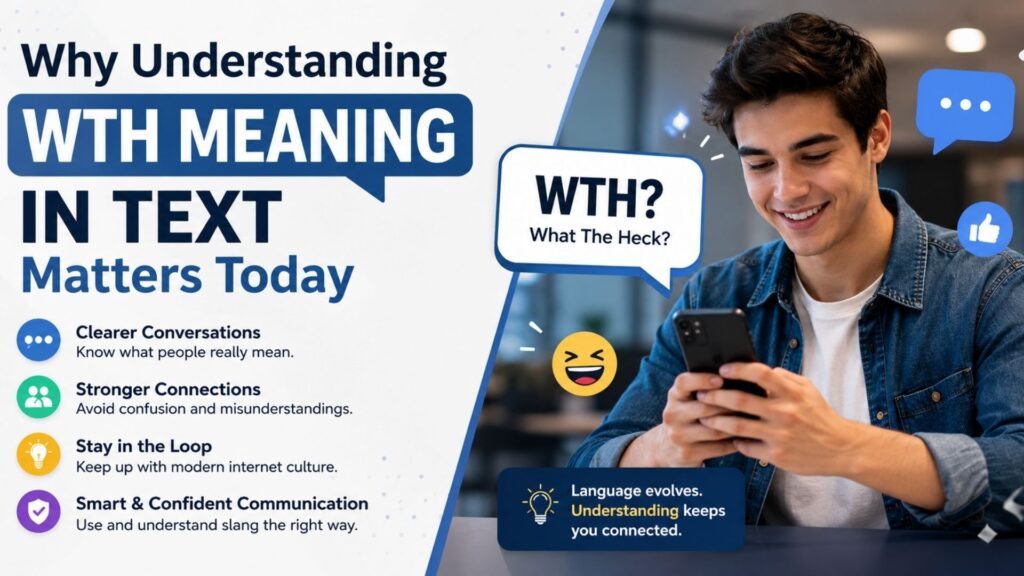
Understanding what does WTH mean in text can help you communicate more confidently online.
Digital conversations don’t provide the same clues as face-to-face communication. When you’re talking in person, you can hear someone’s voice and see their facial expression. In a text message, those signals disappear.
That’s why a short phrase like WTH can sometimes be difficult to interpret.
It Helps You Understand Tone
If someone writes:
“WTH 😂”
the laughing emoji suggests a playful reaction.
But:
“WTH is wrong with you?”
has a completely different tone.
Understanding the abbreviation is only the first step. You also need to read the surrounding message.
It Helps You Avoid Miscommunication
If you’re unfamiliar with WTH, you might assume someone is angry when they’re actually joking.
Knowing the common meanings helps you interpret messages more accurately.
It Helps You Navigate Social Media
WTH appears frequently in comments, replies, memes, and reaction posts.
Understanding it allows you to follow conversations without having to stop and search every abbreviation.
It Helps You Choose the Right Language
Knowing that WTH is informal also helps you decide when to use it.
It’s generally fine in a casual conversation with friends, but you may want to avoid it in professional settings.
It Shows How Digital Language Changes
Internet language evolves quickly. Abbreviations such as WTH demonstrate how people adapt language to communicate emotions quickly in short messages.
The meaning isn’t always fixed to one emotion. Instead, the context gives the abbreviation its personality.
FAQs:
What does WTH mean in simple words?
WTH usually means “what the hell” or “what the heck.” People use it to express surprise, confusion, disbelief, frustration, or playful shock.
Is WTH positive or negative?
WTH can be positive, negative, or neutral, depending on the context. It may express excitement or amusement, but it can also communicate frustration or anger.
Where is WTH commonly used?
WTH is commonly used in text messages, social media comments, online chats, gaming communities, forums, and casual conversations. It’s generally associated with informal digital communication.
Is WTH formal or informal?
WTH is informal. It’s appropriate for casual texting and online conversations but usually isn’t suitable for formal emails, professional documents, or official communication.
Why do people search for WTH meaning in text?
People search for what does WTH mean in text because they may see the abbreviation in a message, comment, or social media post and want to understand its meaning or emotional tone.
Does WTH mean “what the heck”?
Yes. Some people use WTH to mean “what the heck,” which is a softer version of “what the hell.” The intended meaning depends on the person and context.
Is WTH the same as WTF?
No, although the expressions are similar. WTH is generally milder and can mean “what the hell” or “what the heck.” WTF contains stronger profanity and usually sounds more intense.
Can WTH be used jokingly?
Yes. Friends often use WTH playfully to express surprise or tease each other.
For example:
“WTH 😂 You actually did that?”
The laughing emoji and context make the playful tone clear.
Does WTH always mean someone is angry?
No. WTH can communicate surprise, confusion, disbelief, amusement, or frustration. You need to consider the full message to understand the emotion.
Can I use WTH at work?
It’s best to use WTH only in informal workplace chats where casual language is accepted. For formal professional communication, it’s safer to use clearer phrases such as “What happened?” or “Could you clarify what happened?”
Conclusion:
So, what does WTH mean in text? Most commonly, WTH means “what the hell” and is sometimes used as a softer way of saying “what the heck.” People use it to express surprise, confusion, disbelief, frustration, or playful shock.
The key thing to remember is that WTH doesn’t have one fixed emotional tone. A message like “WTH 😂” could be funny and playful, while “WTH were you thinking?” may sound genuinely frustrated. The context, relationship, punctuation, and emojis all help determine what the sender really means.
WTH is also an informal abbreviation, so it’s most appropriate in casual texts, social media comments, gaming chats, and conversations with friends. In professional or formal situations, it’s usually better to choose a more neutral expression.
Once you understand the context, WTH is easy to recognize. Whether someone is shocked by unexpected news, confused by a strange situation, or simply joking with a friend, the abbreviation is usually their quick way of saying, “What the heck is going on?”
