
If you’ve seen SMS while using Snapchat or chatting with friends, you may have wondered what it actually means. Unlike many internet slang terms, SMS isn’t exclusive to Snapchat, but it often appears when people talk about messaging, phone verification, or switching conversations from the app to regular text messages.
If you’re searching for what does SMS mean Snapchat, the simple answer is that SMS stands for Short Message Service. It’s the standard technology used to send text messages between mobile phones over a cellular network.
In this guide, you’ll learn what SMS means on Snapchat, how it’s used, where it came from, common misunderstandings, and why it still matters in today’s world of messaging apps.
What Does SMS Meaning in Text?
The answer to what does SMS mean Snapchat is straightforward: SMS stands for Short Message Service.
SMS is the traditional way mobile phones send and receive text-only messages. Unlike messaging apps like Snapchat, WhatsApp, or Messenger, SMS works through your mobile carrier rather than an internet connection.
On Snapchat, you may encounter SMS when:
- Verifying your phone number.
- Receiving a login or security code.
- Choosing to invite friends via text message.
- Switching from Snapchat chat to regular texting.
In simple terms, SMS refers to standard text messaging, not a special Snapchat feature or slang term.
Real-Life Examples
Here are a few examples of how SMS appears in everyday situations.
Example 1
“Snapchat sent me an SMS verification code.”
Meaning: Snapchat texted a security code to your phone.
Example 2
“I’ll send you the address through SMS.”
Meaning: The person will text you using their phone’s messaging app instead of Snapchat.
Example 3
“I didn’t receive the SMS from Snapchat.”
Meaning: The verification text message hasn’t arrived yet.
Origin and Background of the Term
SMS has existed long before social media.
The abbreviation stands for Short Message Service, a technology introduced in the early 1990s that allowed mobile phones to exchange short text messages.
Originally, SMS messages were limited to 160 characters, encouraging people to write concise messages. Although smartphones now support much richer communication, SMS remains one of the most widely used messaging technologies worldwide.
As apps like Snapchat became more popular, they began using SMS for important functions such as:
- Account verification
- Password recovery
- Security alerts
- Two-factor authentication
- Inviting contacts
Today, SMS continues to work alongside internet-based messaging apps rather than replacing them.
How SMS Is Used in Daily Life
Even though messaging apps dominate modern communication, SMS still plays an important role.
1. Verification Codes
Many apps, including Snapchat, send one-time verification codes through SMS when you create an account, log in from a new device, or enable two-factor authentication.
Example:
“Enter the SMS code we sent to your phone.”
2. Emergency Alerts
Government agencies and emergency services often use SMS to send weather warnings, evacuation notices, or public safety alerts because text messages can reach almost any mobile phone.
3. Appointment Reminders
Doctors, dentists, salons, and other businesses frequently send appointment reminders through SMS.
Example:
“Reminder: Your appointment is tomorrow at 2:00 PM.”
4. Personal Texting
Many people still use SMS to communicate with friends and family, especially when internet access isn’t available.
Example:
“I’ll send you an SMS when I arrive.”
5. Business Promotions
Retail stores, restaurants, and online businesses often use SMS to send:
- Discounts
- Coupons
- Flash sales
- Loyalty rewards
For example:
“Show this SMS for 20% off your purchase.”
6. Delivery Updates
Shipping companies regularly send SMS notifications about package deliveries.
Example:
“Your order will arrive today between 2 PM and 5 PM.”
Read Also: What Does FYM Mean in Slang? Definition, Texting Uses & Examples
Emotional or Practical Meaning of SMS
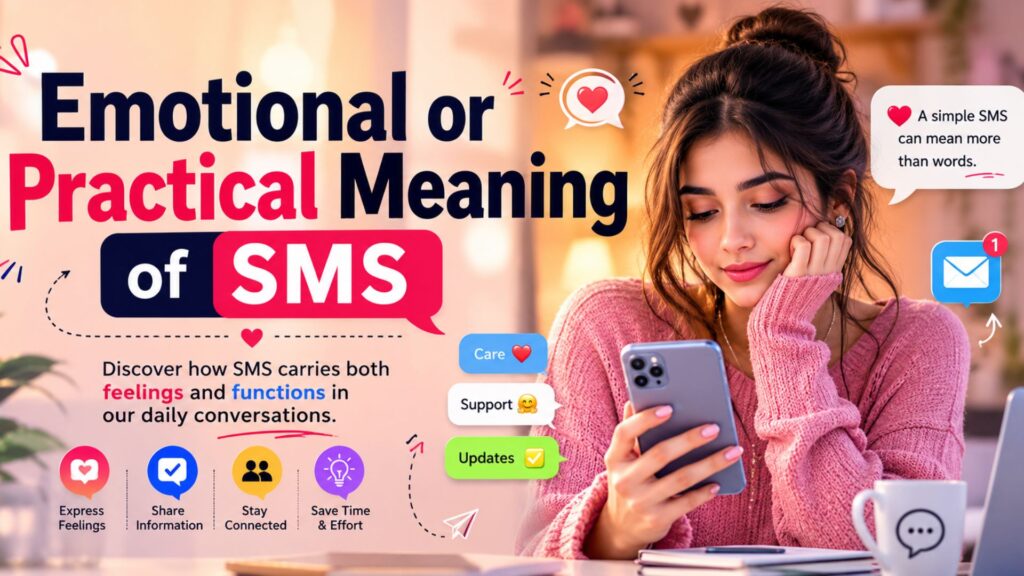
Unlike slang abbreviations, SMS doesn’t carry an emotional meaning.
Instead, it has a practical purpose.
SMS helps people:
- Communicate without internet access.
- Receive important security notifications.
- Verify online accounts.
- Stay informed through alerts.
- Receive reminders and updates.
Think of SMS as the digital equivalent of traditional mail—simple, reliable, and designed to deliver important information.
Similar or Related Terms
Here are several messaging terms commonly confused with SMS.
| Term | Meaning |
|---|---|
| SMS | Short Message Service |
| MMS | Multimedia Messaging Service |
| DM | Direct Message |
| PM | Private Message |
| OTP | One-Time Password |
| IM | Instant Messaging |
| RCS | Rich Communication Services |
SMS vs. MMS
Although they’re similar, SMS and MMS are different technologies.
| SMS | MMS |
| Text only | Text, photos, videos, audio |
| Usually limited to 160 characters | Supports multimedia content |
| Works on nearly every phone | Requires multimedia support |
Common Misunderstandings About SMS
Because messaging technology has evolved, many people misunderstand what SMS actually does.
❌ SMS and WhatsApp Are the Same
They’re different.
WhatsApp uses an internet connection, while SMS uses your mobile carrier’s cellular network.
❌ SMS Is Outdated
Although newer messaging apps are popular, SMS remains essential for:
- Security verification
- Banking alerts
- Emergency notifications
- Business communication
Millions of SMS messages are still sent every day.
❌ SMS Is Always Free
Not necessarily.
Some mobile plans include unlimited texting, while others charge per message, especially for international SMS.
❌ SMS Can Send High-Quality Photos
Standard SMS supports text only.
Photos and videos are typically sent through MMS or internet-based messaging apps.
❌ SMS Is Only for Personal Use
Businesses, healthcare providers, schools, banks, delivery companies, and government agencies all rely on SMS for important communication.
Examples of SMS in Sentences
Here are some everyday examples.
- “Snapchat sent me an SMS code.”
- “Please verify your account using the SMS you received.”
- “I’ll text you through SMS later.”
- “Did you receive the SMS confirmation?”
- “The bank sent an SMS about my transaction.”
- “I got an SMS reminding me about tomorrow’s appointment.”
- “The delivery company sent an SMS update.”
- “My phone never received the Snapchat SMS.”
Why Understanding SMS Meaning in Text Matters Today
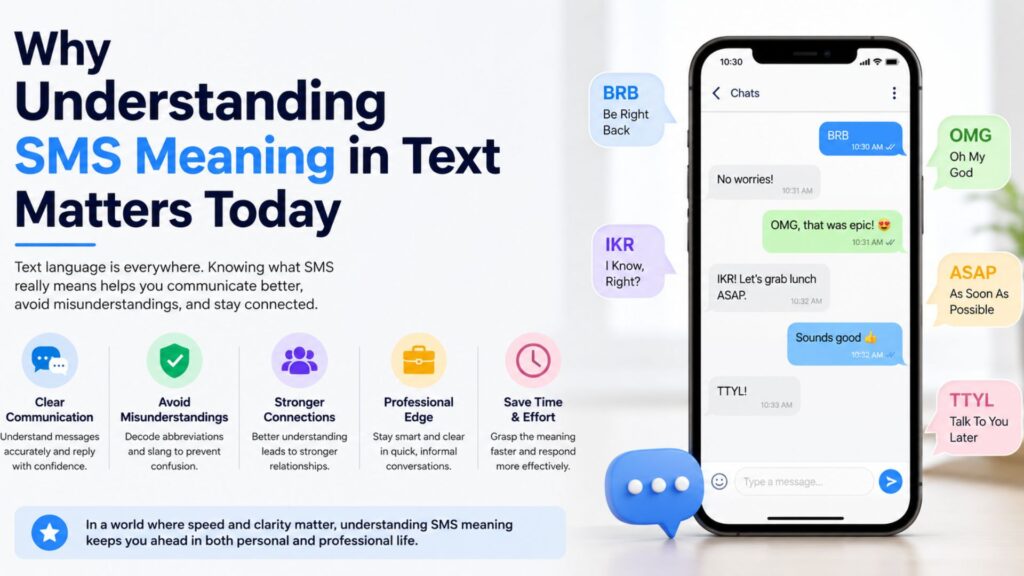
Knowing what does SMS mean Snapchat helps you better understand how modern apps work.
Although Snapchat primarily uses internet messaging, SMS remains important for:
- Creating new accounts.
- Verifying your identity.
- Recovering passwords.
- Protecting your account with security codes.
- Receiving important notifications.
Understanding the difference between SMS and app-based messaging also helps you troubleshoot issues if you don’t receive verification texts or account alerts.
FAQs
What does SMS meaning in text mean in simple words?
SMS means Short Message Service, the standard technology used to send text messages between mobile phones through a cellular network.
Is SMS meaning in text positive or negative?
Neither. SMS is simply a messaging technology and doesn’t have a positive or negative meaning.
Where is SMS meaning in text commonly used?
SMS is commonly used in mobile phones, banking alerts, account verification, appointment reminders, delivery updates, emergency notifications, and apps like Snapchat.
Is SMS meaning in text formal or informal?
SMS itself isn’t formal or informal. It’s simply a communication method. The tone depends on the message being sent.
Why do people search for SMS meaning in text?
People often search what does SMS mean Snapchat after seeing SMS mentioned during phone verification, login security, or account setup and want to understand what it refers to.
Conclusion
If you’ve ever wondered what does SMS mean Snapchat, the answer is simple: SMS stands for Short Message Service, the technology behind traditional text messaging. While Snapchat mainly relies on internet-based messaging, it still uses SMS for important features like phone verification, login security, and account recovery.
Understanding what SMS is—and how it’s different from messaging apps like Snapchat—can help you navigate account setup, security checks, and everyday communication with confidence.
