
Have you ever received a text that included way more personal information than you expected? Maybe someone started describing an awkward date, a health problem, or an embarrassing moment in complete detail. You might have replied with three simple letters: TMI.
If you’re searching for the tmi full form in chat, it means “Too Much Information.” People use TMI in texting, social media, group chats, and everyday conversations when someone shares more personal, private, or unnecessary information than others really needed to know. Depending on the situation, TMI can sound funny, playful, surprised, or mildly annoyed.
The expression has become a familiar part of casual online communication. It’s short, easy to understand, and often lets you react to an awkward overshare without writing a long response. Let’s break down what TMI means, where it came from, how people use it, and what it actually communicates in different situations.
What Does TMI Meaning in Text?
TMI means “Too Much Information.” In text messages, it usually tells someone that they have shared more information than you wanted, expected, or needed to hear.
For example, imagine your friend texts:
“I’m staying home tonight because my stomach has been upset all day, and let me tell you exactly what happened…”
You might respond:
“TMI 😂”
Here, you’re not necessarily angry. You’re simply joking that the conversation has become more detailed than necessary.
The meaning can change slightly depending on the context. Sometimes TMI is genuinely a request to stop sharing personal details. Other times, it’s simply a humorous reaction to an awkward or unexpected statement.
Real-Life Examples:
Here are a few common examples of how TMI can appear in conversations:
- Friend: “I haven’t slept because my neighbor’s snoring kept me awake all night.”
You: “Okay, TMI 😂” - Friend: “I have a crush on my coworker and dreamed about them last night.”
You: “TMI! 😭” - Sibling: “I’m going to the bathroom, but first let me explain exactly why…”
You: “TMI, please! 😂” - Friend: “I told everyone about our private conversation.”
You: “That’s definitely TMI.”
The important point is that TMI doesn’t always mean the information is bad. It usually means the amount or level of detail was unnecessary for the situation.
Origin and Background of the Term
TMI became popular as an informal expression in English-speaking culture, particularly during the late 20th century. The abbreviation gained even more attention as internet communication, instant messaging, forums, and texting became common.
Before abbreviations became a major part of digital communication, people would simply say, “That’s too much information.” TMI shortened that reaction into three memorable letters.
The expression became especially useful online because internet conversations often move quickly. Instead of typing a complete sentence, someone could write “TMI!” and immediately communicate their reaction.
As texting and social media developed, TMI became part of everyday digital vocabulary. It now appears in private messages, comments, memes, group conversations, and even casual spoken English.
Although the term is strongly associated with the internet today, people also say “TMI” aloud in face-to-face conversations. For example, a friend might tell an embarrassing story and someone might laugh and respond, “Whoa, TMI!”
How TMI Is Used in Daily Life
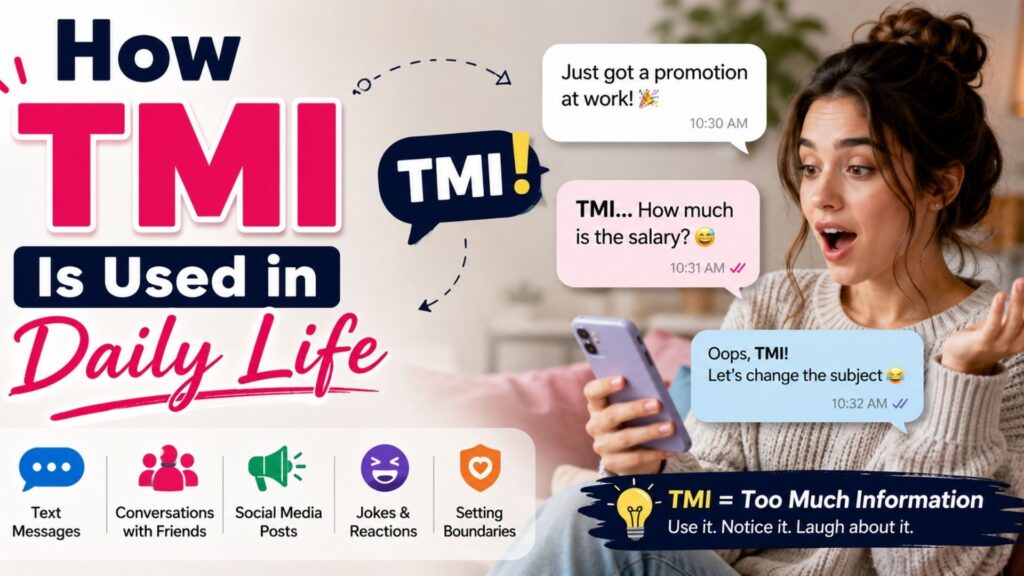
The meaning of TMI stays fairly consistent, but the way people use it depends on where the conversation happens.
1. In Text Messages
Texting is one of the most common places you’ll see TMI.
When a friend shares something extremely personal, embarrassing, awkward, or overly detailed, you can simply reply with “TMI.”
For example:
“I’m running late because I spent 20 minutes trying to find my lost sock.”
A playful response could be:
“TMI 😂”
In texting, TMI often has a humorous tone. Emojis can make the intention clearer. A laughing emoji suggests you’re joking, while a more serious response might indicate that the information genuinely made you uncomfortable.
2. On Social Media
TMI is also common on platforms where people share personal updates publicly.
Someone might post an extremely detailed story about their relationship, health, dating experience, embarrassing mistake, or daily routine. A commenter may respond with “TMI” to point out that the post contains more personal information than necessary.
For example:
“Just posted every detail about my terrible first date.”
Someone might comment:
“TMI 😂”
On social media, the term can be playful, sarcastic, or critical. Context matters because text alone doesn’t always reveal someone’s tone.
3. In Group Chats
Group chats are another perfect environment for TMI.
Imagine a group of friends discussing weekend plans. One person suddenly starts sharing an extremely personal story. Someone else may type:
“Bro… TMI 😭”
The message usually means, “We didn’t need to know all those details!”
Because group chats are informal, TMI is often used as a joke rather than a serious complaint.
However, if someone repeatedly shares private information about themselves or another person, TMI can also serve as a gentle way of signaling that they should stop.
Read More: What Does SMTH Mean in Text? Meaning, Uses & Examples
4. In Real-Life Conversations
TMI isn’t limited to texting.
People commonly say “TMI” during face-to-face conversations when someone overshares.
For example:
Person A: “I was sick yesterday, and here’s everything that happened…”
Person B: “Okay, TMI!”
The spoken version often comes with laughter or a facial expression that makes the meaning obvious.
In person, your tone of voice matters. A friendly tone can make TMI sound playful, while a serious tone can make it clear that you genuinely want the conversation to move on.
5. In Workplace Settings (Casual Ones)
TMI can sometimes appear in casual workplace conversations, especially among coworkers who know each other well.
For example, someone might tell a colleague an overly personal dating story during lunch. The colleague could jokingly say:
“TMI, but good luck!”
However, you should be more careful with TMI in professional environments. Personal boundaries vary from person to person, and information that one coworker finds funny may make another uncomfortable.
It’s usually better to keep workplace communication appropriate and respectful, especially when discussing sensitive personal matters.
Emotional or Practical Meaning of TMI
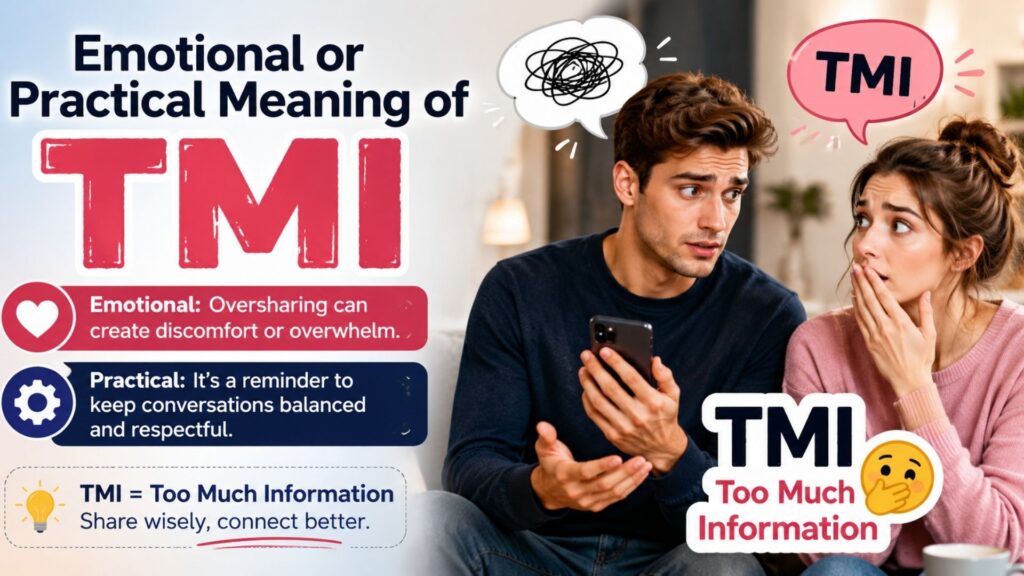
At its core, TMI communicates a boundary about information.
The person saying TMI is often signaling one of these ideas:
- “That’s more detail than I needed.”
- “I didn’t need to know that.”
- “That’s a little too personal.”
- “You’re oversharing.”
- “That information is awkward.”
- “Please stop before this gets even more uncomfortable.”
However, TMI isn’t automatically hostile.
The emotional meaning depends heavily on the relationship between the people involved. Close friends may use TMI as a joke. Someone you barely know might use it more seriously.
For example:
“TMI 😂” usually sounds playful.
“TMI. Please don’t share personal information like that with me.” is much more serious.
That’s why understanding context is important when interpreting short text abbreviations.
Similar or Related Terms
TMI belongs to a larger group of informal expressions used when someone shares too much, becomes overly detailed, or discusses something unnecessarily personal.
| Term | Meaning | Typical Use |
|---|---|---|
| TMI | Too Much Information | Reacting to oversharing |
| Oversharing | Giving excessive personal information | Describing someone’s behavior |
| FYI | For Your Information | Giving useful information |
| BTW | By The Way | Adding another point |
| IDC | I Don’t Care | Showing lack of interest |
| NSFW | Not Safe For Work | Warning about sensitive content |
| TL;DR | Too Long; Didn’t Read | Summarizing lengthy content |
Key Difference:
The biggest difference between TMI and related abbreviations is its focus on excessive or unnecessary information.
For example, FYI usually introduces information that could be useful. TMI suggests the opposite: the information may be unnecessary, overly personal, embarrassing, or simply more detailed than the listener wanted.
Someone can say:
“FYI, the meeting starts at 10.”
That provides useful information.
But:
“TMI, I woke up at 4 a.m. because I had a weird dream about the meeting.”
That second statement may be considered unnecessary personal detail.
Common Misunderstandings About TMI
Although TMI is easy to understand once you know the abbreviation, people sometimes misunderstand its tone or purpose.
1. TMI Is Always Rude
Not necessarily.
Friends frequently use TMI jokingly. A laughing emoji, crying emoji, or playful tone can turn it into a humorous reaction.
For example:
“I just told my entire family about my embarrassing date.”
“TMI 😂”
That doesn’t necessarily mean the person is offended.
Still, TMI can be rude if it’s delivered harshly or used to embarrass someone publicly. Context and tone matter.
2. It’s Only Used Online
This is another common misconception.
TMI became particularly popular through internet culture and texting, but people also use it in spoken conversations.
You can hear someone say:
“Okay, TMI!”
during a normal face-to-face conversation.
The abbreviation has effectively become a spoken expression as well as a texting term.
3. It Means “Stop Talking”
TMI can imply that you should stop, but that isn’t its exact meaning.
Literally, TMI means “Too Much Information.” The listener may use it to signal that the conversation has become too personal or detailed.
Sometimes it means:
“You can stop there.”
But sometimes it simply means:
“Wow, I didn’t expect to hear that!”
The surrounding conversation determines which interpretation makes more sense.
4. It’s Always Negative
TMI can be negative, but it isn’t always serious or critical.
Among friends, saying “TMI 😂” can actually be part of the humor. The speaker may find the situation funny rather than genuinely upsetting.
For example:
“My dog just watched me fall down the stairs and now he won’t look at me.”
“TMI 😭😂”
Here, TMI is being used playfully.
5. It’s Only About Gross Topics
Many people associate TMI with embarrassing or unpleasant subjects, but the term is broader than that.
Someone can provide TMI about:
- Dating
- Family problems
- Money
- Relationships
- Work
- Personal routines
- Health
- Embarrassing experiences
- Private conversations
- Personal opinions
The key issue isn’t necessarily the subject. It’s how much information is being shared and whether the audience actually wanted to hear it.
Examples of TMI in Sentences
Here are several natural examples showing how TMI can work in different situations:
- “Okay, TMI! I really didn’t need those details.”
- “That story was funny, but definitely TMI.”
- “You didn’t have to tell me all of that. TMI 😂”
- “TMI, dude. Save some details for yourself.”
- “I love your honesty, but that was a little TMI.”
- “Why would you post that? TMI!”
- “She gave us TMI about her first date.”
- “I asked how his weekend was, and he gave me TMI.”
- “That conversation went from normal to TMI really fast.”
- “TMI, but I’m glad everything worked out.”
- “Sorry for the TMI, but I needed to explain what happened.”
- “My brother always gives everyone TMI.”
- “That might be TMI for the group chat.”
- “I wasn’t expecting that level of detail. TMI!”
- “You can skip the details—that’s TMI.”
Notice that the phrase can appear at the beginning, middle, or end of a sentence. It can also stand alone as a complete reaction:
“TMI!”
That simplicity is one reason the abbreviation works so well in casual conversations.
Why Understanding TMI Meaning in Text Matters Today
Understanding abbreviations like TMI can make online communication much easier.
Texting removes many of the signals we normally use in face-to-face conversations, such as facial expressions, gestures, and tone of voice. Because of that, a short phrase like “TMI” can sometimes be interpreted in several ways.
If someone texts:
“TMI.”
they could be joking, uncomfortable, surprised, or genuinely asking you to stop sharing details.
Knowing the basic meaning gives you a starting point, but you should also consider the relationship, conversation, punctuation, and emojis around it.
TMI is also a good example of how digital language evolves. People want to communicate quickly, so long expressions often become short abbreviations. “Too Much Information” becomes TMI, just as many other common phrases have developed their own texting shortcuts.
If you understand these expressions, you can respond more naturally and avoid unnecessary confusion.
For example, if a friend says:
“I just told you way too much 😂”
you might reply:
“Haha, definitely TMI 😂”
You understand not only the literal meaning but also the playful tone behind it.
FAQs:
What does TMI meaning in text mean in simple words?
TMI means “Too Much Information.” People use it when someone shares more personal, embarrassing, unnecessary, or detailed information than they expected or wanted to hear.
Is TMI positive or negative?
It can be either. TMI is often used humorously among friends, but it can also express genuine discomfort when someone overshares. The tone and context determine the meaning.
Where is TMI commonly used?
TMI is commonly used in text messages, social media comments, group chats, online conversations, and casual face-to-face conversations.
Is TMI formal or informal?
TMI is informal. It’s suitable for casual texting, social media, and conversations with friends. You generally wouldn’t use it in formal business writing or professional documents.
Why do people search for TMI meaning in text?
People often search for the meaning because abbreviations can be confusing when they appear without context. Knowing that TMI stands for “Too Much Information” makes it easier to understand whether someone is joking, surprised, or uncomfortable.
Conclusion:
So, what is the tmi full form in chat? It stands for “Too Much Information.” It’s a casual expression people use when someone shares more information than necessary, especially when the details are personal, embarrassing, awkward, or unexpected.
TMI can be playful between friends or more serious when someone crosses a personal boundary. It isn’t automatically rude or negative, and it isn’t limited to online conversations. You’ll find it in texts, social media, group chats, and everyday speech.
The next time someone sends you an unexpectedly detailed story, you’ll know exactly what they mean when they say, “TMI!”
