
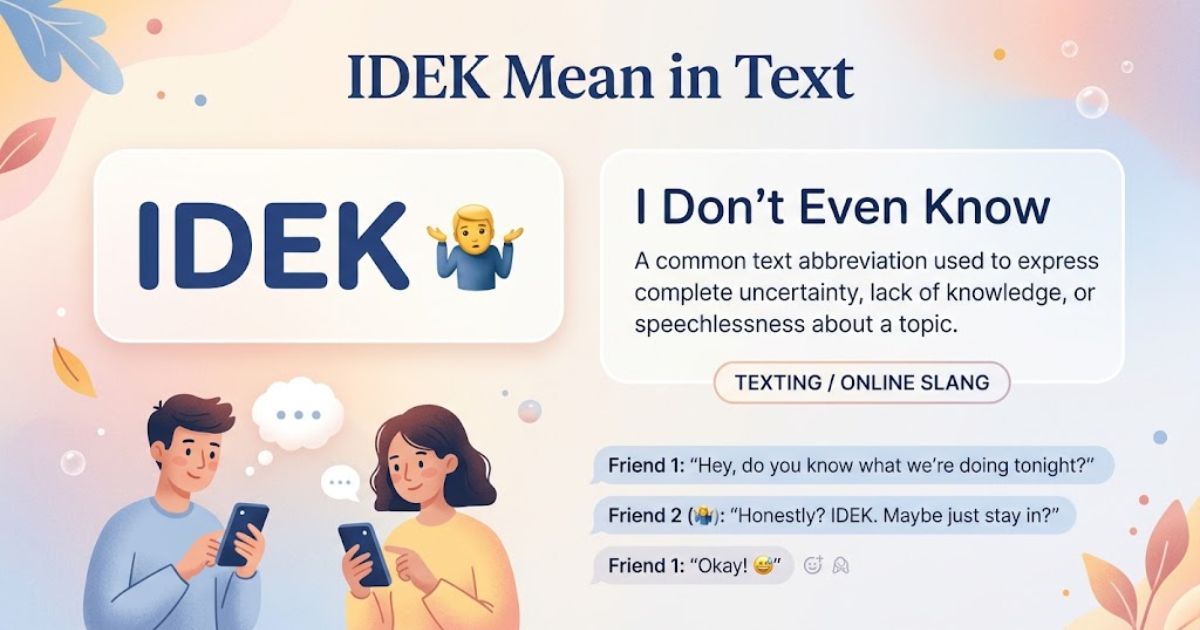
Have you ever received a message that simply says “IDEK” and wondered whether the person is confused, annoyed, joking, or just doesn’t know what to say? This short abbreviation can express several shades of emotion, but its basic meaning is easy to understand.
IDEK means “I don’t even know.” People use it in texts, Snapchat conversations, Instagram DMs, TikTok comments, group chats, and other casual online conversations. It can show confusion, uncertainty, frustration, disbelief, or emotional overwhelm.
The important part is the word “even.” Compared with IDK (“I don’t know”), IDEK often suggests that the situation is especially confusing, ridiculous, unexpected, or difficult to explain.
What Does IDEK Mean in Text? (Quick Answer)
IDEK means “I don’t even know.”
It’s an informal texting abbreviation used when someone doesn’t know an answer, doesn’t understand what’s happening, or feels unsure about a situation.
For example:
“IDEK what happened.”
This means:
“I don’t even know what happened.”
The phrase can sound neutral, frustrated, surprised, or humorous depending on the conversation.
Introduction
Texting has made communication much faster, and abbreviations like IDEK let people express a full thought with just four letters. Instead of typing “I don’t even know what to say,” someone can simply write “IDEK.”
You’ll often see IDEK when a straightforward “IDK” doesn’t quite capture the person’s reaction. Maybe something makes no sense. Maybe a friend has done something completely unexpected. Or perhaps the person is overwhelmed and genuinely can’t explain how they feel.
That’s why understanding the context matters. IDEK doesn’t always mean the person literally has no information. Sometimes it communicates a reaction to a situation.
What Does IDEK Mean in Text Messages?
In text messages, IDEK stands for “I don’t even know.” It’s commonly used when someone is uncertain, confused, surprised, frustrated, or unable to explain something.
For example, imagine your friend suddenly cancels plans and then gives you a completely different explanation an hour later. You might respond:
“IDEK what’s going on anymore.”
Here, IDEK communicates more than simple uncertainty. It suggests that the situation has become confusing or difficult to understand.
Example:
A: “Why did Jake leave the party?”
B: “IDEK. He just disappeared.”
Here, IDEK means the person genuinely doesn’t know what happened.
Another Example:
A: “Did you understand that homework?”
B: “IDEK what the teacher was talking about 😂”
In this example, IDEK expresses confusion with a humorous tone.
Why Is IDEK So Popular in 2025–26?
IDEK remains useful because modern online conversations are quick, informal, and highly expressive. People often want to communicate an emotion without typing a full sentence.
There’s also a subtle difference between saying “I don’t know” and “I don’t even know.” The second phrase can communicate stronger uncertainty.
For example:
“IDK where he went.”
sounds like a straightforward answer.
“IDEK where he went 😭.”
can suggest that the situation has become confusing or frustrating.
IDEK also works well in social media culture because it fits naturally into short comments, captions, replies, and DMs. Emojis can further change the tone. For instance, “IDEK 😂” can sound amused, while “IDEK 😭” may suggest emotional overwhelm or disbelief.
Read More: SMTH Meaning: What Does SMTH Mean in Text, Snapchat & Social Media?
When Should You Use IDEK?
IDEK works best when you’re having an informal conversation with someone who understands texting slang.
When You’re Confused
Use IDEK when you genuinely don’t understand what’s happening.
“IDEK what they’re talking about.”
This is especially common when a conversation or situation has become complicated.
When Something Feels Ridiculous
IDEK can also express disbelief when something seems completely unreasonable.
“He bought another phone even though his old one works perfectly. IDEK 😂.”
Here, the abbreviation isn’t necessarily asking for an answer. It’s more like saying, “I honestly don’t understand this.”
When You’re Frustrated
Sometimes IDEK shows that you’re tired of trying to figure something out.
“IDEK why she keeps changing the plan.”
The context makes the frustration clear.
When You’re Emotionally Overwhelmed
People also use IDEK when they can’t easily describe their feelings.
“IDEK how I’m supposed to feel about all this.”
In this situation, IDEK communicates uncertainty about emotions rather than a lack of factual knowledge.
When You’re Joking
IDEK can be playful too.
“IDEK why I ate the whole pizza 😂.”
The person obviously knows they ate it. They’re using IDEK humorously to suggest they don’t understand their own decision.
Real-Life Text Examples of IDEK
The meaning of IDEK becomes much clearer when you see how people use it in different conversations.
School Chat
Friend: “Did you finish the assignment?”
Student: “IDEK what question 4 is asking 😭.”
Here, IDEK expresses confusion about the assignment.
Relationship Chat
Person A: “Do you think she’s still mad?”
Person B: “IDEK. She hasn’t replied.”
The sender doesn’t know what the other person is thinking or feeling.
Family Chat
Parent: “Why is your brother still asleep?”
You: “IDEK. He went to bed early.”
This is a normal, casual use of the abbreviation.
Work Chat
Coworker: “Do you know why the meeting was moved?”
You: “IDEK. I just saw the new calendar invite.”
This demonstrates that adults can use IDEK in casual workplace conversations, although it isn’t appropriate for every professional situation.
Social Media Comment
Comment: “IDEK how this video has 10 million views 😂.”
Here, IDEK can express surprise, disbelief, or humorous confusion.
IDEK vs IDK: What’s the Difference?
IDK means “I don’t know,” while IDEK means “I don’t even know.”
The difference is small, but IDEK often adds emphasis.
| Slang | Full meaning | Typical feeling |
|---|---|---|
| IDK | I don’t know | Simple uncertainty |
| IDEK | I don’t even know | Stronger confusion, disbelief, frustration, or uncertainty |
Think of it this way: IDK gives an answer; IDEK often gives a reaction.
For example:
IDK where he is.
You simply don’t know his location.
IDEK where he is anymore.
This can suggest that you’ve tried to understand the situation but still have no idea what’s going on.
Example:
A: “Why did Sarah leave?”
B: “IDK.”
This is a simple response.
A: “Why did Sarah leave, block everyone, and then come back?”
B: “IDEK 😭.”
Here, IDEK conveys stronger confusion because the situation itself is unusual.
Is IDEK Formal or Informal?
IDEK is informal texting slang. It’s appropriate for casual conversations with friends, family, classmates, and people who regularly use abbreviations.
You generally shouldn’t use it in formal writing, official documents, academic assignments, or professional emails unless you’re intentionally discussing the slang itself.
Instead of writing:
“IDEK what the issue is.”
in a formal email, you could write:
“I’m not sure what caused the issue.”
The meaning is similar, but the second version fits professional communication much better.
How to Reply When Someone Says IDEK
How you respond depends on why the person used IDEK.
If they’re confused, you can offer an explanation:
“I think it happened because the system updated.”
If they’re frustrated, acknowledge what they’re saying:
“Yeah, that situation is pretty confusing.”
If they’re joking, you can play along:
“LOL, same 😂.”
If they seem emotionally overwhelmed, you can keep your response supportive:
“It’s okay. Take your time and figure it out.”
You don’t always need to answer with another abbreviation. A natural response that matches the person’s tone usually works best.
Common Mistakes People Make With IDEK
Although IDEK is simple, people can misunderstand its tone when they use it without considering the situation.
Using It in Professional Settings
The biggest mistake is treating IDEK like formal English. While coworkers may use it casually in private chats, it can look unprofessional in formal emails, reports, presentations, or client communication.
Choose standard wording when the situation calls for it.
Overusing It
Using IDEK in every uncertain situation can make your messages repetitive or vague.
For example, replying “IDEK” to every question may make it seem like you aren’t interested in the conversation. Use it when it genuinely fits your reaction.
Ignoring Context
IDEK can express confusion, frustration, disbelief, humor, or emotional uncertainty. Don’t assume that every IDEK has exactly the same tone.
An “IDEK 😂” may be playful, while “IDEK anymore” could indicate frustration or emotional exhaustion.
Look at the surrounding messages before interpreting the tone.
Similar Slang Terms You Should Know
If you’re learning modern texting slang, you’ll probably come across several abbreviations related to IDEK.
IDK — “I don’t know”
IDC — “I don’t care”
IKR — “I know, right?”
TBH — “To be honest”
NGL — “Not gonna lie”
IMO — “In my opinion”
FR — “For real”
WTF — “What the fuck,” usually expressing strong surprise, confusion, or frustration
These abbreviations can appear together in the same conversation. For example:
“NGL, IDEK what happened. IKR?”
Understanding each abbreviation makes the overall message much easier to interpret.
Is IDEK Still Popular in 2026?
Yes, IDEK remains recognizable and useful in casual digital communication in 2026. It continues to appear in text conversations and social media because the phrase “I don’t even know” is common in everyday speech.
However, slang popularity isn’t uniform. Different age groups, online communities, platforms, and friend groups use different abbreviations. Someone who rarely uses internet slang might understand IDK immediately but be less familiar with IDEK.
So, while IDEK is still used, the most important factor is always the context and audience.
Frequently Asked Questions
What does IDEK mean in text?
IDEK means “I don’t even know.” It’s an informal abbreviation commonly used to express uncertainty, confusion, frustration, disbelief, or humor.
What does IDEK mean in text message conversations?
In text message conversations, IDEK means “I don’t even know.” People use it when they don’t know an answer or when a situation is difficult to understand or explain.
Is IDEK rude?
IDEK isn’t inherently rude. Its tone depends on the conversation. A short “IDEK” could sound dismissive in some situations, while “IDEK 😂” may be completely playful.
Can adults use IDEK?
Yes. Adults can use IDEK in casual texts, DMs, and informal conversations. It’s still slang, though, so standard language is usually better for formal communication.
Is IDEK the same as IDK?
Not exactly. IDK means “I don’t know,” while IDEK means “I don’t even know.” IDEK often adds emphasis and can communicate stronger confusion, disbelief, or frustration.
Final Thoughts
Understanding what IDEK means in text is simple: it stands for “I don’t even know.” The abbreviation is commonly used when someone feels uncertain, confused, frustrated, surprised, overwhelmed, or simply wants to make a humorous comment.
The main difference between IDEK and IDK is emphasis. IDK is a basic statement of uncertainty, while IDEK often suggests that the situation is particularly confusing or difficult to explain.
You’ll mainly see IDEK in casual texting, Snapchat, social media, DMs, and group chats. Use it naturally, pay attention to context, and remember that formal situations usually call for complete sentences.
