
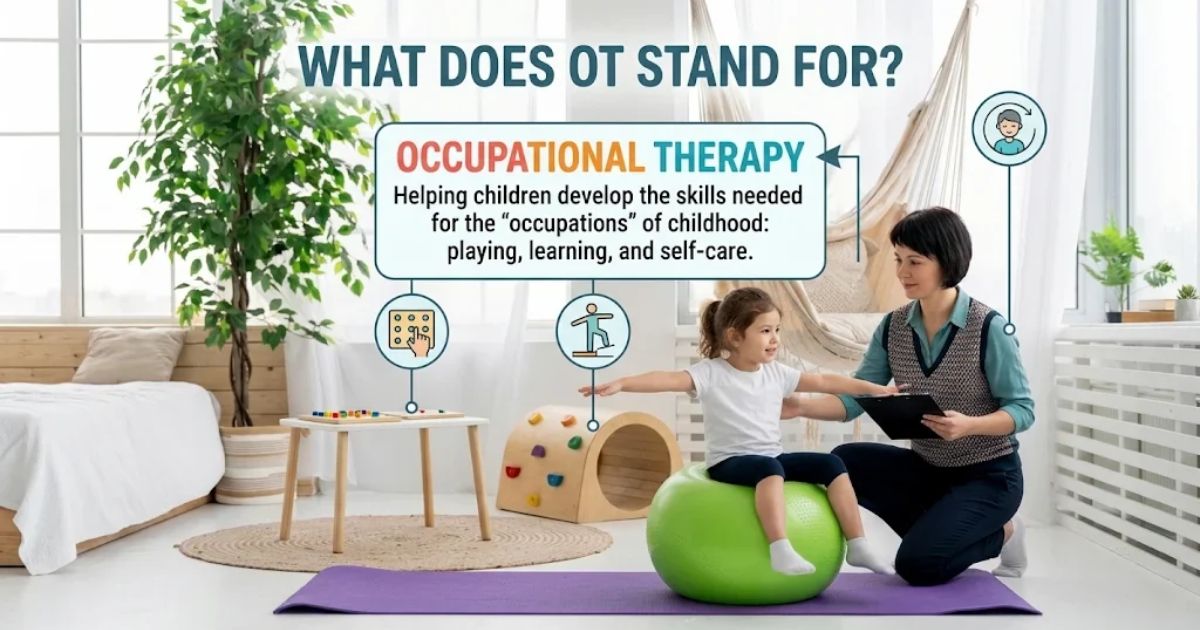
Have you ever come across the abbreviation OT and wondered what it actually means? You’re not alone. OT can stand for several things depending on where you see it. In healthcare, it commonly refers to Occupational Therapy, a type of treatment that helps children and adults develop the skills they need to manage everyday activities independently.
When parents hear the term OT from a doctor, teacher, or healthcare professional, they may have questions about what it involves and how it can help their child. Occupational therapy plays an important role in supporting physical, sensory, cognitive, and emotional development.
In this guide, you’ll discover what OT stands for, its meaning in healthcare, the benefits of occupational therapy for children, common treatment techniques, and signs that your child might benefit from professional support.
What Does OT Stand For?
OT most commonly stands for Occupational Therapy in healthcare. It’s a therapeutic service that helps people develop, improve, or maintain the abilities needed to participate in everyday activities.
The word “occupation” doesn’t only refer to having a job. In occupational therapy, it describes meaningful daily activities that people need or want to do. For children, these activities include playing, eating, dressing, writing, learning, communicating, and interacting with others.
An occupational therapist works with individuals to identify challenges that affect their daily routines. They then create personalized treatment plans to improve functional abilities and encourage greater independence.
For example, a child who struggles to hold a pencil, use a spoon, button a shirt, or participate in classroom activities may benefit from occupational therapy.
However, OT can have different meanings in other situations. Its meaning depends on the conversation and subject.
| Context | OT Meaning |
|---|---|
| Healthcare | Occupational Therapy |
| Medical profession | Occupational Therapist |
| Workplace | Overtime |
| Sports | Overtime |
| Texting and social media | Off Topic |
| Education | Occupational Therapy |
What does OT stand for in medical terms?
In medical terminology, OT generally stands for Occupational Therapy or Occupational Therapist. The exact meaning depends on how it’s used in a medical document or conversation.
For example:
- “My child needs OT” means the child may need occupational therapy.
- “She is an OT” means she works as an occupational therapist.
- “The doctor recommended OT services” means the doctor suggested occupational therapy support.
Understanding the context helps you identify the correct OT abbreviation and avoid confusion.
Read More: 335+ NTMY Meaning: What Does NTMY Mean in Texting? (2026)
Occupational Therapy Meaning
Occupational therapy is a healthcare service designed to help people perform everyday tasks more comfortably, safely, and independently.
An occupational therapist evaluates how a person’s physical abilities, sensory processing, thinking skills, and emotional development affect daily life. Based on this evaluation, they recommend activities and techniques that address specific difficulties.
For children, occupational therapy often focuses on developing essential skills through enjoyable, age-appropriate activities.
For instance, a toddler who struggles with feeding independently might practice holding a spoon, picking up small pieces of food, and coordinating hand movements. These activities may look like ordinary play, but they can support important developmental skills.
What does an occupational therapist do?
An occupational therapist helps children and adults overcome challenges that interfere with everyday activities.
Their responsibilities may include:
- Evaluating fine motor skills, coordination, balance, and sensory responses.
- Supporting children who struggle with dressing, feeding, or personal hygiene.
- Developing hand-eye coordination and functional movement.
- Improving sensory processing and emotional regulation.
- Helping children participate in classroom activities.
- Teaching practical daily living skills.
- Recommending adaptive equipment when necessary.
- Supporting communication and social participation through meaningful activities.
Occupational therapy isn’t limited to children with developmental delays. Adults recovering from injuries, living with disabilities, or experiencing difficulties with daily tasks can also benefit from OT services.
What is pediatric occupational therapy?
Pediatric occupational therapy is a specialized area of OT that focuses on infants, toddlers, children, and teenagers.
Its main purpose is to help young people develop the skills needed to participate in everyday childhood activities.
A pediatric occupational therapist may work on:
- Fine motor skills, such as holding crayons and using scissors.
- Gross motor skills, such as balancing and coordinating body movements.
- Sensory integration and sensory processing.
- Self-care skills, including dressing and brushing teeth.
- Feeding abilities and mealtime participation.
- Play-based learning and social interaction.
- School participation and classroom independence.
- Problem-solving and age-appropriate functional skills.
Every child develops at a different pace. Therefore, pediatric occupational therapy should be based on an individual assessment rather than comparing one child’s abilities with another’s.
Benefits of Occupational Therapy for Children
Childhood is an important period for developing physical, emotional, cognitive, and social abilities. When children experience difficulties with everyday tasks, occupational therapy can provide practical support.
The benefits depend on each child’s needs, developmental stage, and treatment goals. Here are some important ways occupational therapy can support child development.
1. Improves Fine Motor Skills
Fine motor skills involve the small muscles in the hands and fingers. Children use these muscles when writing, drawing, holding objects, turning pages, and handling small toys.
Some children find these activities challenging because they have difficulty controlling their finger movements or coordinating both hands.
Occupational therapists use activities such as:
- Playing with modeling clay.
- Picking up small objects with tweezers.
- Drawing shapes and coloring pictures.
- Threading beads onto strings.
- Building towers with small blocks.
- Practicing safe, age-appropriate scissor skills.
These therapeutic activities help children practice hand strength, finger control, and coordination.
2. Develops Gross Motor Skills
Gross motor skills involve larger muscle groups used for walking, jumping, climbing, balancing, and maintaining body posture.
Some children struggle with activities that require body coordination or balance. An occupational therapist may introduce movement-based activities that encourage controlled and purposeful movement.
Examples include stepping over soft obstacles, playing balance games, crawling through tunnels, and participating in supervised movement activities.
These exercises can support physical participation in playground activities, school routines, and everyday play.
3. Supports Sensory Processing
Children receive information from their surroundings through different senses, including touch, sound, sight, movement, and body awareness.
Some children respond differently to sensory information. For example, a child might become uncomfortable with loud noises, dislike certain clothing textures, or avoid messy activities.
Others may constantly seek movement, pressure, or touch.
Occupational therapy can help children understand and manage sensory experiences through individualized strategies.
A therapist may use activities involving different textures, movement, and controlled sensory experiences. These approaches are selected according to the child’s assessment and individual needs.
4. Encourages Independence in Daily Activities
Everyday tasks such as eating, bathing, dressing, and brushing teeth are important parts of childhood development.
Children who struggle with these activities may become frustrated or depend heavily on adults.
Occupational therapy breaks challenging tasks into smaller, manageable steps.
For example, a child learning to put on a shirt might practice identifying the front and back, finding the sleeves, and pulling the shirt over their head.
With regular practice and appropriate support, children can become more confident in managing daily routines.
5. Improves Hand-Eye Coordination
Hand-eye coordination allows children to use their hands accurately while following visual information.
It’s important for activities such as catching a ball, drawing, stacking blocks, pouring water, and writing.
Occupational therapists may introduce puzzles, building games, ball activities, and drawing exercises to encourage coordination.
6. Supports Emotional and Social Development
Difficulties with everyday activities can sometimes affect a child’s confidence and willingness to participate with others.
For example, a child who struggles with playground games might avoid playing with classmates.
Occupational therapy can provide opportunities to practice social participation, emotional regulation, turn-taking, and problem-solving through structured play.
These experiences may help children feel more comfortable participating in family, school, and social activities.
7. Encourages School Participation
Children need several different abilities to participate successfully in school.
These include sitting comfortably, holding writing tools, organizing materials, following classroom routines, and managing transitions between activities.
An occupational therapist may work with teachers and parents to identify practical classroom adjustments.
The goal isn’t simply to improve handwriting or pencil control. It’s to help children participate more comfortably and independently in their learning environment.
Building Confidence and Independence Through OT
Confidence develops when children discover that they can complete tasks, solve problems, and manage challenges independently.
Occupational therapy supports this process by giving children opportunities to practice skills in a safe and encouraging environment.
Rather than completing every difficult task for a child, therapists often break activities into smaller steps and provide the right amount of assistance.
For example, consider a four-year-old who struggles to put on shoes.
Instead of expecting the child to complete the entire task immediately, an occupational therapist might begin by teaching them how to identify the correct shoe, open the fastening, position their foot, and pull the shoe into place.
Each successful step creates an opportunity for learning.
How does occupational therapy build independence?
There are several ways OT can encourage greater independence:
- Task practice: Children repeat meaningful activities until they become more familiar with the steps.
- Positive reinforcement: Therapists recognize effort and progress to encourage continued participation.
- Adaptive equipment: Special tools may make difficult activities easier to complete.
- Routine development: Consistent daily schedules help children understand what to expect.
- Problem-solving: Children learn different ways to approach challenging activities.
- Family involvement: Parents practice recommended techniques at home to support consistency.
The importance of family participation
Parents play an important role in occupational therapy because children spend much of their time outside therapy sessions.
A therapist may suggest simple home activities, such as helping prepare meals, sorting toys, practicing dressing, or playing with age-appropriate building materials.
These activities create natural learning opportunities without making everyday life feel like a constant therapy session.
It’s also important to celebrate small improvements. A child who holds a spoon independently for the first time or puts on one shoe without assistance has made meaningful progress.
Common Occupational Therapy Interventions
Occupational therapy interventions are activities, techniques, and strategies designed to improve a person’s ability to participate in everyday life.
For children, treatment is often play-based because play provides a natural way to practice movement, coordination, problem-solving, and social interaction.
The therapist selects interventions according to the child’s occupational therapy assessment and individual goals.
Here are some commonly used approaches.
1. Fine Motor Skill Activities
Fine motor interventions focus on improving hand strength, finger control, and coordination.
Common activities include:
- Squeezing soft balls.
- Playing with playdough.
- Picking up objects with child-safe tweezers.
- Stacking blocks.
- Drawing and coloring.
- Practicing simple puzzles.
- Using age-appropriate construction toys.
These activities can support skills needed for writing, feeding, dressing, and other daily tasks.
2. Sensory Integration Activities
Sensory-based occupational therapy interventions help children participate in activities involving sensory information.
Depending on the child’s needs, a therapist may introduce:
- Textured toys and materials.
- Supervised movement activities.
- Play with water or sand.
- Activities involving pushing or pulling.
- Structured obstacle courses.
- Quiet spaces for managing overwhelming sensory experiences.
Sensory integration approaches should be individualized. Not every child benefits from the same sensory activities, and some approaches require professional supervision.
3. Self-Care and Daily Living Skills
Self-care activities teach children how to manage everyday personal needs.
Occupational therapists may work on:
- Dressing and undressing.
- Brushing teeth.
- Washing hands.
- Using utensils.
- Managing simple bathroom routines.
- Putting on shoes.
- Organizing personal belongings.
For example, a child who struggles with buttons may practice using large buttons before moving to smaller ones.
4. Visual Motor and Hand-Eye Coordination Training
Visual motor activities help children coordinate what they see with how they move their hands.
Examples include:
- Completing simple mazes.
- Copying basic shapes.
- Connecting dots.
- Building structures from pictures.
- Catching and throwing soft balls.
- Completing age-appropriate puzzles.
These activities may support classroom participation, drawing, handwriting, and other functional tasks.
5. Adaptive Equipment and Assistive Tools
Sometimes, children need additional tools to complete activities more comfortably.
An occupational therapist may recommend equipment such as:
- Specially designed eating utensils.
- Pencil grips.
- Adaptive scissors.
- Supportive seating.
- Visual schedules.
- Dressing aids.
- Modified writing tools.
These tools are selected based on the child’s functional needs. They aren’t intended to replace skill development but to make meaningful activities more accessible.
6. Play-Based Learning
Play-based learning is a common part of pediatric occupational therapy.
Children may practice important skills through pretend cooking, building blocks, board games, drawing, and imaginative activities.
For example, pretend grocery shopping can encourage grasping, sorting, following instructions, communication, and problem-solving.
Because children are naturally motivated by play, these activities can make therapy sessions more enjoyable and engaging.
7. Cognitive and Executive Function Activities
Some children need additional support with planning, attention, organization, and completing multistep tasks.
An occupational therapist may use visual instructions, sorting activities, simple games, and structured routines to practice these abilities.
The activities are adapted to the child’s developmental level and everyday goals.
How to Know if Your Child Needs OT
Every child develops at their own pace. However, ongoing difficulties with everyday activities may indicate that additional support could be helpful.
Occupational therapy isn’t only for children with diagnosed developmental conditions. A child may benefit from an assessment if physical coordination, sensory responses, self-care, or participation difficulties affect everyday life.
Here are some signs parents may want to discuss with a healthcare professional.
1. Difficulty With Fine Motor Activities
Your child may struggle to:
- Hold crayons, pencils, or small toys.
- Use a spoon or fork.
- Turn pages in a book.
- Stack blocks.
- Manipulate buttons or zippers.
- Complete age-appropriate puzzles.
These difficulties may suggest that a closer look at fine motor development would be useful.
2. Challenges With Daily Living Skills
Some children need more assistance than expected with everyday activities.
For example, your child might consistently struggle with dressing, feeding, brushing teeth, washing hands, or managing basic personal hygiene.
If these challenges interfere with daily routines, an occupational therapy evaluation may help identify the underlying difficulties.
3. Sensory Challenges
You might notice that your child:
- Becomes distressed by ordinary household noises.
- Avoids certain clothing materials.
- Strongly dislikes messy play.
- Has difficulty tolerating busy environments.
- Constantly seeks movement or physical stimulation.
- Finds certain food textures difficult to manage.
Sensory differences can affect participation at home, school, and in social settings.
An occupational therapist can assess how these experiences influence everyday functioning and recommend appropriate support.
4. Difficulty With Coordination and Balance
Some children have trouble coordinating their movements during everyday activities.
You may notice frequent difficulties with climbing, catching a ball, using playground equipment, or completing tasks that require both hands.
These concerns may be worth discussing with a pediatrician or occupational therapist.
5. Problems With School Participation
Your child’s teacher may report challenges with handwriting, using classroom materials, organizing belongings, or participating in practical classroom activities.
Sometimes, these difficulties relate to fine motor coordination, visual motor skills, attention, or sensory processing.
An occupational therapist can help identify which skills need support and suggest appropriate classroom strategies.
6. Difficulty Managing Emotions During Everyday Tasks
A child may become frustrated when an activity feels physically or mentally difficult.
For example, getting dressed, completing homework, or transitioning between activities might regularly lead to distress.
An OT assessment can explore whether sensory, motor, environmental, or functional challenges contribute to these experiences.
When should you seek an occupational therapy assessment?
Consider speaking with your child’s pediatrician if difficulties are persistent, affect daily participation, or cause significant frustration.
An occupational therapy evaluation can help determine whether your child would benefit from treatment.
You don’t need to wait until a child falls far behind developmental expectations before asking questions. Early assessment can help identify support needs and provide practical strategies.
However, occupational therapy isn’t a substitute for medical evaluation. If your child suddenly loses previously acquired abilities or experiences a sudden change in movement or behavior, seek medical advice promptly.
What happens during an OT assessment?
An occupational therapy assessment usually involves several steps:
- Parent discussion: The therapist asks about your child’s development, health, routines, and everyday challenges.
- Skill evaluation: They observe relevant motor, sensory, coordination, and self-care abilities.
- Functional activities: Your child may complete age-appropriate activities involving play, movement, or daily tasks.
- Goal setting: The therapist identifies areas where additional support may help.
- Treatment recommendations: A personalized plan may include therapy sessions, home activities, or classroom adjustments.
Not every assessment follows exactly the same process. The therapist chooses evaluation methods based on the child’s age and specific concerns.
Frequently Asked Questions (FAQ)
1. What does OT stand for in healthcare?
OT stands for Occupational Therapy in healthcare. It helps people develop or improve the skills needed for everyday activities, including dressing, eating, writing, playing, and independent living.
2. What does OT mean in medical terms?
In medical terms, OT usually means Occupational Therapy or Occupational Therapist. It refers to a healthcare service or the professional who provides that service.
3. What is the full form of OT?
The most common healthcare full form of OT is Occupational Therapy. In other contexts, it can mean overtime or off topic.
4. What does an occupational therapist do?
An occupational therapist evaluates and treats difficulties that affect daily activities. They help people improve functional movement, coordination, sensory processing, self-care, and participation in everyday routines.
5. What is pediatric occupational therapy?
Pediatric occupational therapy focuses on helping children develop skills needed for childhood activities. These include playing, writing, eating, dressing, learning, and interacting with others.
6. What are the benefits of occupational therapy for children?
Occupational therapy can support fine motor development, coordination, sensory processing, self-care, emotional regulation, and school participation. Treatment goals depend on each child’s individual needs.
7. How does occupational therapy help children with sensory issues?
It helps identify how sensory experiences affect everyday activities. Therapists may introduce individualized sensory strategies and environmental adjustments to support participation and comfort.
8. What happens during an OT session?
An OT session may include play-based activities, movement exercises, fine motor practice, sensory activities, and everyday skill training. The therapist chooses activities based on the child’s treatment goals.
9. What’s the difference between occupational therapy and physical therapy?
Occupational therapy focuses on helping people participate in everyday activities, while physical therapy primarily addresses movement, strength, mobility, and physical function.
For example, physical therapy may help a child improve walking balance, while occupational therapy may help them develop the coordination needed to dress independently. Their roles can overlap, and some children benefit from both services.
10. Can toddlers receive occupational therapy?
Yes. Toddlers can receive occupational therapy when developmental or functional difficulties affect activities such as feeding, playing, movement, sensory processing, or early self-care.
11. Is occupational therapy only for children with disabilities?
No. Occupational therapy supports people with different needs, including children experiencing temporary difficulties, developmental delays, injuries, or challenges with everyday activities.
12. How long does occupational therapy take to show results?
Progress varies depending on the child’s needs, treatment goals, frequency of sessions, and opportunities to practice skills outside therapy. Some children improve relatively quickly, while others need longer-term support.
Helping Children Thrive Through OT
Occupational therapy can make a meaningful difference in how children participate in everyday life. From learning to hold a pencil to developing independent dressing and feeding skills, OT focuses on abilities that help children become more confident and capable.
The most important thing to remember is that every child has different strengths and challenges. A treatment approach that works for one child may not be suitable for another.
If your child struggles with fine motor skills, sensory processing, coordination, or daily living activities, consider discussing your concerns with a pediatrician or qualified occupational therapist.
With individualized treatment, consistent practice, and family support, children can develop practical skills that help them participate more comfortably at home, at school, and in their communities.
Ultimately, occupational therapy isn’t about making every child develop in exactly the same way. It’s about helping each child build the abilities they need to enjoy everyday activities and reach their individual potential.
Recent Posts
If you’re interested in learning more about occupational therapy, professional development, and child development, these related topics can help you explore the subject further.
How to Improve Occupational Therapy Professional Development
Occupational therapy professionals need to keep developing their knowledge and practical skills. Continuing education, clinical training, professional workshops, and learning from experienced therapists can help improve treatment quality.
Professional development also involves understanding new assessment methods, evidence-based interventions, assistive technology, and changing patient needs.
What Is Occupational Therapy? Benefits and Activities
Occupational therapy helps people participate in meaningful daily activities. Common interventions include fine motor exercises, sensory-based activities, self-care training, coordination exercises, and adaptive equipment.
For children, these activities often involve games and play-based learning that make skill development enjoyable.
Occupational Therapy What Do They Do? A Parent Guide
Parents often wonder what happens when their child starts occupational therapy. An occupational therapist evaluates the child’s functional abilities, identifies challenges, and creates an individualized treatment plan.
Parents can support progress by practicing recommended activities at home, maintaining consistent routines, and communicating regularly with the therapist.
