Have you received a message containing the word “Rabe” and wondered what the sender was trying to say? You’re not alone. Unfamiliar words, unusual spellings, and internet slang can make everyday conversations confusing, especially when someone uses an expression you’ve never seen before.
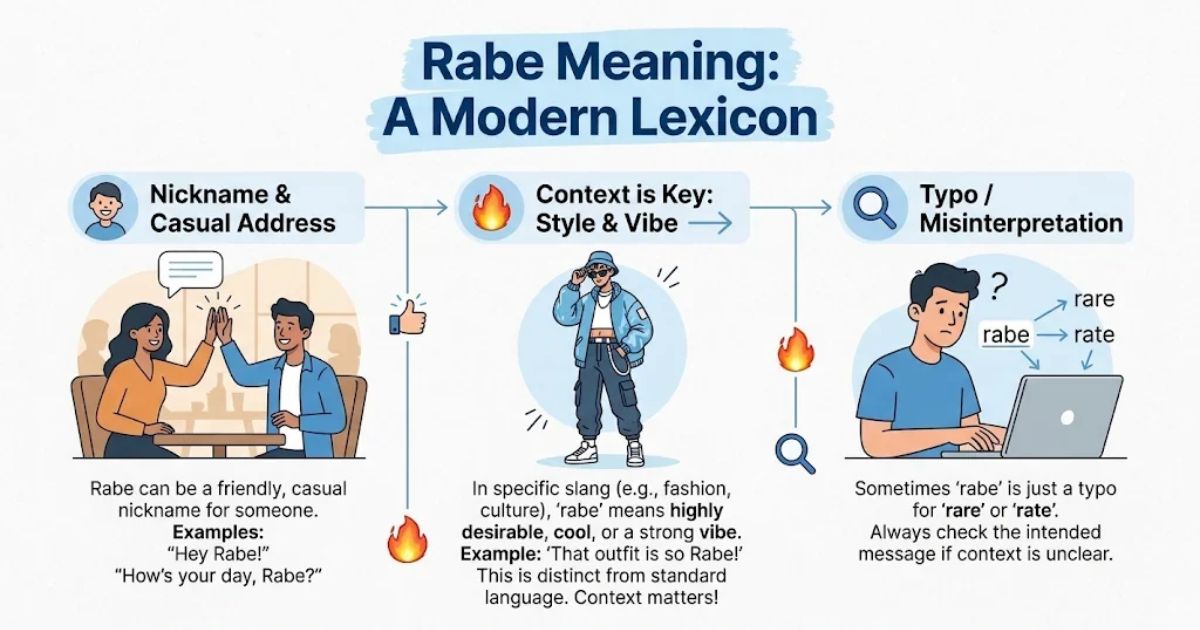
The Rabe meaning isn’t always straightforward. Depending on the conversation, it could be a personal nickname, a playful spelling, a typo, or an inside joke. Some people may even use it as a variation of an affectionate word like “babe,” although that isn’t an established universal definition.
In this guide, you’ll discover what Rabe might mean in texting, how people use it on TikTok, Instagram, Snapchat, and WhatsApp, and how to understand its meaning from a guy or a girl. We’ll also explore real-life examples so you can interpret the word without jumping to the wrong conclusion.
What Does Rabe Mean in Slang?
The word Rabe doesn’t have one widely recognized meaning in mainstream English texting slang. Unlike familiar expressions such as “LOL,” “BRB,” or “Bae,” it isn’t a standard abbreviation with a commonly accepted definition.
In casual online conversations, someone might use Rabe as a nickname, a personalized spelling, a private expression, or simply a typing mistake. Its meaning depends heavily on the person using it and the situation in which it appears.
For example, imagine receiving this message:
“Hey rabe, are you coming tonight?”
The sender might be using Rabe as a personal nickname. If the conversation is romantic, you might wonder whether they intended to write “babe.” However, without more context, there’s no reason to assume that’s definitely what they meant.
Here are some possible interpretations:
- Personal nickname: A name someone uses for a friend, partner, or family member.
- Possible typo: An accidental spelling of another familiar word.
- Stylized expression: A creative spelling chosen to make a message look different.
- Inside joke: A word with a special meaning between two people.
- Context-specific slang: An expression understood within a particular online community.
The important thing is not to assign a fixed definition to Rabe without understanding the conversation.
Read More: 335+ NTMY Meaning: What Does NTMY Mean in Texting? (2026)
Does Rabe Have a Fixed Definition?
No. Rabe doesn’t have a single established definition in widely recognized English slang dictionaries or standard texting vocabulary.
This is why two people might use or interpret the same word differently. One person could use it as a nickname, while another might have typed it accidentally.
Internet language changes quickly. People frequently create their own spellings, shorten words, and develop expressions that make sense only within their social circles.
For instance, someone might call a close friend “Rabe” because it became a nickname over time. Another person might use the same spelling when experimenting with an unusual online username.
Therefore, if you’re trying to understand what does Rabe mean, look at the surrounding words, the relationship between the sender and receiver, and the conversation’s overall tone.
Why Is Rabe So Confusing?
Rabe is confusing because it doesn’t have the same established meaning across different messaging platforms and communities.
When you see a familiar abbreviation such as “IDK,” you can usually understand it immediately. Rabe is different. It doesn’t provide enough information on its own to reveal the sender’s intention.
There are several reasons behind this confusion.
1. Unusual spelling: Rabe looks similar to familiar words, particularly “Babe,” which makes people wonder whether it’s an alternative spelling or a mistake.
2. Personal communication styles: Friends and couples often invent their own nicknames. These expressions may not have any meaning outside their relationship.
3. Social media trends: A word can appear in a comment, video caption, or username without being part of a recognized slang trend.
4. Different language backgrounds: People who communicate in multiple languages may use words that look unfamiliar to English speakers.
5. Lack of context: A single word doesn’t always reveal whether someone is joking, flirting, or simply addressing another person.
Consider these two messages:
- “Good morning, rabe ❤️”
- “That outfit is so rabe!”
The first could be a personal nickname. The second might describe something using an individual or community-specific expression. Neither example establishes a universal slang definition.
The best approach is to avoid guessing and consider the conversation as a whole.
Origin and Background of Rabe
There isn’t a clearly established origin for Rabe as a modern English texting slang term. It doesn’t have a widely documented history comparable to popular internet expressions such as “LOL,” “BRB,” or “Bae.”
One possible reason for its appearance is the way digital communication encourages creative spelling. People regularly change letters, combine words, and develop personal expressions to make their messages feel more individual.
For example, someone might create a nickname by changing the spelling of a friend’s name. Another person might use a variation of an affectionate expression because it feels more personal.
It’s also important to recognize that Rabe may appear outside internet slang. It can occur as a surname, personal name, username, or word in another language. These uses shouldn’t automatically be treated as texting slang.
Without a reliable source connecting the word to a particular online community or historical trend, it’s better not to claim that Rabe originated on TikTok, Instagram, or another platform.
In simple terms, its background as internet slang remains uncertain, and individual usage may explain more than any supposed universal origin.
Rabe Meaning in Text Messages
When someone sends you Rabe in a private message, its meaning depends on what they’re discussing.
Text messages are often short, informal, and full of personal expressions. People don’t always follow standard spelling rules, especially when communicating with friends or romantic partners.
For example, if someone writes:
“Hey rabe, what are you doing?”
They might be using a nickname or an expression that has personal significance.
If you receive:
“Sorry rabe, I couldn’t reply earlier.”
The word could simply be the sender’s preferred way of addressing you.
However, if Rabe appears in a sentence where another word would make more sense, a typo becomes another possibility.
Here are some clues that can help you interpret it:
- Look at the greeting: If Rabe appears at the beginning of a friendly message, it may be a nickname.
- Check the relationship: A close friend or partner may use a personal expression that strangers wouldn’t understand.
- Read the complete sentence: The surrounding words often provide more information than the unfamiliar term itself.
- Consider the sender’s habits: If they regularly use unusual spellings, Rabe might be part of their communication style.
- Ask when necessary: A simple question can prevent unnecessary misunderstandings.
Remember that texting slang doesn’t always have a dictionary definition. Sometimes, the meaning comes from the people using it.
Rabe Meaning on Social Media
Social media creates new opportunities for unusual words and expressions to spread. A term might appear in a video caption, comment section, direct message, or username without having a consistent meaning across the platform.
The Rabe meaning on social media should therefore be understood through the content surrounding it.
For example, a creator might use Rabe as part of a username, while someone else might include it in a comment as a personal nickname.
Let’s look at how it could appear on different platforms.
Rabe on TikTok
On TikTok, unfamiliar words often attract attention because users encounter them in short videos, comments, hashtags, and captions.
If you see Rabe in a TikTok comment, don’t immediately assume it’s a trending slang expression. It might be a nickname, a reference to a creator, an inside joke, or a spelling mistake.
For example:
- “Rabe knows the assignment.”
- “Looking good, rabe!”
- “Only my friends understand rabe.”
These examples illustrate possible personal uses rather than verified meanings of a TikTok trend.
If someone uses Rabe in a video caption, check the video’s subject and the creator’s other posts. That context may reveal whether it’s a name, a joke, or a community-specific expression.
Rabe on Instagram
Instagram users frequently experiment with unusual words in bios, captions, comments, and direct messages.
You might encounter Rabe in a friend’s Instagram story or under a photograph. In that situation, it could be a personalized nickname or an expression understood by a small group of followers.
For example:
“Weekend vibes with my favorite rabe.”
The writer may be referring to a friend using a private nickname.
In another situation, Rabe could be part of an Instagram username or brand identity. That doesn’t necessarily mean the person intends it as slang.
When interpreting Rabe on Instagram, pay attention to the relationship between the people involved and the type of content being shared.
Rabe on Snapchat
Snapchat conversations are usually casual and personal. Friends often use nicknames, shortened words, emojis, and expressions that wouldn’t make sense outside their conversations.
If someone sends you:
“What’s up, rabe?”
They might be addressing you with a personal nickname.
Likewise, if Rabe appears alongside a heart emoji, it may suggest affection, but the emoji alone doesn’t prove that the word means “babe.”
Snapchat messages can disappear, making context especially important. If you’re unsure, asking the sender what they mean is usually the easiest solution.
Rabe on WhatsApp
WhatsApp is commonly used for conversations with friends, relatives, partners, and colleagues. This means an unfamiliar expression can have several possible interpretations.
For instance:
“Good night rabe, talk tomorrow.”
The sender might be using an affectionate nickname or a private expression.
In a family group, Rabe could be a name or an inside joke. In a professional group, it might be a typo or an unrelated term.
Unlike standardized texting abbreviations, Rabe doesn’t have one recognized WhatsApp-specific meaning.
Rabe Meaning From a Guy
If a guy calls you Rabe in a text message, you might wonder whether he’s flirting, showing affection, or simply being friendly.
The answer depends on your relationship and how he normally communicates.
If he’s already comfortable using playful nicknames, Rabe could be his personal way of addressing you. It might be intended affectionately, but you shouldn’t automatically interpret it as a romantic expression.
Consider these situations:
When he’s flirting: If he regularly compliments you, starts conversations, and uses affectionate language, Rabe might be part of his playful communication style.
When he’s a close friend: He may simply use unusual nicknames to make conversations feel more relaxed.
When he’s joking: The word might be connected to a funny experience or an inside joke between you.
When you’re unfamiliar with each other: It could be a typo, an unusual greeting, or a nickname he’s experimenting with.
For example:
“Hey rabe, missed talking to you.”
The overall message sounds affectionate, but the feeling comes from the complete sentence rather than the word Rabe alone.
If you want to know his actual intention, consider his behavior across the conversation instead of focusing on one unfamiliar word.
Rabe Meaning From a Girl
When a girl uses Rabe in a message, the same principle applies: the word doesn’t automatically communicate a specific emotion.
She might use it as a friendly nickname, a playful expression, or a term that has personal meaning between you.
For example:
“You’re funny, rabe 😂”
This could be friendly teasing or an affectionate way of speaking.
If she sends:
“Good morning, rabe ❤️”
The message may feel warm and caring. However, that doesn’t necessarily mean she’s expressing romantic interest.
Here are a few possible situations:
- Close friendship: She may use Rabe as a personal nickname for someone she knows well.
- Romantic conversation: It could be a playful or affectionate expression.
- Casual interaction: She might simply be experimenting with an unusual spelling.
- Private joke: The word may have a meaning that only you and she understand.
Don’t assume that Rabe has a gender-specific meaning. Men and women can use the same expressions differently depending on their personalities and relationships.
Tone and Emotional Meaning of Rabe
Words in digital communication don’t always carry emotions by themselves. The same expression can sound playful in one message and confusing in another.
When interpreting Rabe, consider the sentence, emojis, punctuation, and relationship between the people communicating.
Playful Tone
Rabe might be used playfully when someone wants to make a conversation feel casual or entertaining.
For example:
“You’re late again, rabe 😂”
The laughing emoji and teasing sentence suggest a lighthearted interaction.
In this situation, the sender may be using a nickname rather than trying to communicate a specific slang definition.
Affectionate Tone
Sometimes, Rabe may appear in conversations where people use personal or affectionate nicknames.
For example:
“Take care, rabe. See you soon ❤️”
The caring message and heart emoji create an affectionate tone.
However, affection doesn’t always mean romance. Friends and family members can communicate warmly without having romantic feelings.
Neutral Tone
Rabe can also appear without any obvious emotional meaning.
For example:
“Rabe, send me the picture when you get home.”
Here, it might simply function as a way to address someone.
There’s no strong evidence of flirting, teasing, or affection in the sentence itself.
Confusing Tone
Sometimes, the word appears without enough information to understand its purpose.
For example:
“That’s so rabe.”
If you’ve never heard the expression before, it’s reasonable to feel confused.
Rather than assigning a meaning, consider asking:
“What do you mean by rabe?”
A direct question is often more useful than making assumptions about an unfamiliar slang word.
Real Life Examples of Rabe
Examples can help you understand how an unfamiliar word might function in everyday communication.
The following are illustrative conversations. They show possible personal or context-specific uses of Rabe, not confirmed universal definitions.
Example One: Nickname
Person A: Hey rabe, are you free this weekend?
Person B: Yeah! What’s the plan?
Explanation: Rabe appears as a way of addressing someone. It could be a personal nickname between friends.
Example Two: Affectionate Message
Person A: Good night, rabe. Sweet dreams ❤️
Person B: You too! Sleep well.
Explanation: The message has an affectionate tone. Rabe may be a personal pet name, although its exact meaning depends on the sender.
Example Three: Online Style Description
Person A: I saw your new profile picture!
Person B: What do you think?
Person A: That’s such a rabe look!
Explanation: In this fictional conversation, the word is being used as a personal or community-specific description. It shouldn’t be interpreted as an established synonym for stylish.
Example Four: Friendly Teasing
Person A: You forgot your keys again!
Person B: I know, don’t start 😂
Person A: You’re impossible, rabe!
Explanation: Rabe works like a nickname in this playful exchange. The teasing tone comes from the conversation.
Example Five: Possible Typo
Person A: Hey, rabe, can you call me?
Person B: Did you mean babe?
Person A: Sorry, autocorrect!
Explanation: Here, Rabe was an accidental spelling. This is one possible explanation, especially when the surrounding conversation suggests another intended word.
Example Six: Inside Joke
Person A: Remember our old rabe joke?
Person B: Of course! I still laugh about it.
Explanation: In this example, Rabe refers to a private expression shared between two people. Someone outside their friendship might not understand it.
How to Use Rabe Correctly
Because Rabe doesn’t have a widely accepted slang definition, there’s no universal rule for using it correctly in everyday conversation.
If you want to use it, make sure the person you’re communicating with understands what you mean.
For example, if Rabe is a nickname you’ve developed with a friend, you can use it naturally in casual messages.
You might write:
- “Hey rabe, how was your day?”
- “See you tomorrow, rabe!”
- “Thanks for helping me, rabe.”
- “You’re the best, rabe ❤️”
However, if you’re communicating with someone who has never heard the expression, explain it rather than expecting them to understand.
Here are some practical tips:
- Understand your intended meaning: Know whether you’re using it as a nickname, joke, or personal expression.
- Consider your audience: Don’t assume everyone understands unusual internet slang.
- Pay attention to context: Make sure the expression fits the conversation.
- Avoid forcing it: Natural communication is better than using unfamiliar words just to sound trendy.
- Clarify when needed: If someone misunderstands, explain what you intended.
The main idea is simple: use Rabe only when its meaning is clear to the people involved.
Formal or Informal Usage
Rabe is best treated as an informal, context-dependent expression when it appears in personal digital communication.
It isn’t a standard business abbreviation or a recognized professional term. Therefore, using it in formal documents, workplace emails, or academic writing may confuse readers.
Here’s how its use can differ depending on the situation:
| Communication type | Recommended use |
|---|---|
| Private messages | Acceptable if understood |
| Friendly conversations | Can work as a personal nickname |
| Romantic messages | Depends on the relationship |
| Social media captions | Possible as a personal expression |
| Workplace emails | Generally avoid |
| Academic writing | Avoid unless discussing the word itself |
| Official documents | Avoid |
For example, writing “Thanks, rabe!” to a close friend might be perfectly understandable if that’s your usual nickname.
However, writing “Dear Rabe” in a professional email without knowing whether it’s the recipient’s name would be inappropriate.
Always choose words based on your audience and communication setting.
Common Mistakes People Make With Rabe Meaning Slang
Unfamiliar slang often leads to misunderstandings. Rabe is particularly easy to misinterpret because it resembles familiar expressions without having one established meaning.
Here are some common mistakes to avoid.
Assuming Rabe Has One Universal Meaning
One of the biggest mistakes is believing that every person uses Rabe in exactly the same way.
Internet slang doesn’t always work like traditional vocabulary. Some expressions are created within individual friendships, online communities, or personal conversations.
A nickname used by one person might mean nothing to someone else.
Always consider the context before deciding what the word means.
Assuming Rabe Always Means Babe
Because Rabe looks similar to Babe, some people assume they’re interchangeable.
However, there’s no widely established rule confirming that Rabe is a standard alternative spelling of Babe.
It might be a typo, a creative spelling, or a nickname, but that doesn’t make the two words universally equivalent.
If someone calls you Rabe, don’t automatically assume they’re expressing romantic interest.
Assuming It Always Means Stylish
Another possible misunderstanding is treating Rabe as a synonym for stylish, fashionable, or attractive.
There isn’t a broadly recognized English slang definition supporting that interpretation.
If someone uses it to describe an outfit or personality, they may be using a private expression or community-specific meaning.
Ask what they mean instead of relying on an unsupported definition.
Ignoring the Language of the Conversation
Not every unfamiliar word comes from English internet culture.
Rabe may appear as a name, surname, or expression in another language. Its meaning can change depending on the language and cultural setting.
For example, a person communicating in more than one language might use a word that looks like English slang but has a completely different meaning in their native language.
Always consider the language of the conversation before interpreting an unfamiliar expression.
Using It in Professional Writing
Using unexplained slang in professional communication can make your message difficult to understand.
For example:
“Hello rabe, please review the attached report.”
If Rabe isn’t the recipient’s actual name or an established form of address, the message may appear careless or confusing.
For workplace communication, use clear and professional language. Save unfamiliar personal expressions for conversations where everyone understands them.
Related Words and Expressions
Understanding similar words can help you recognize how Rabe might function in a conversation.
Although these expressions have their own meanings, they’re useful comparisons when exploring modern texting vocabulary.
Babe
Babe is a familiar affectionate term used for a romantic partner, close friend, or sometimes a person someone is flirting with.
For example:
“Good morning, babe!”
Unlike Rabe, Babe has a widely recognized meaning in everyday English.
Bae
Bae is an informal affectionate expression commonly used for a romantic partner or someone special.
For example:
“Spending the weekend with bae.”
It’s often used in social media captions and casual conversations.
Nickname
A nickname is an alternative name given to someone, often because of their personality, appearance, relationship, or a memorable experience.
For example:
“Everyone calls him Rocket because he runs so fast.”
Rabe could function as a nickname if someone uses it consistently for another person.
Vibe
Vibe describes the general feeling, mood, or atmosphere of a person, place, or situation.
For example:
“This café has such a relaxing vibe.”
It’s commonly used in social media captions and everyday conversations.
Slang
Slang refers to informal words and expressions used by particular groups or communities.
For example, “lit,” “low-key,” and “no cap” are familiar examples of modern slang.
Rabe may appear as an informal expression in individual conversations, but that doesn’t establish it as widely recognized internet slang.
Rabe Compared With Babe
Rabe and Babe look similar, which is one reason people confuse them.
However, there is an important difference: Babe has an established meaning, while Rabe doesn’t have one widely accepted English slang definition.
Let’s compare them.
| Feature | Rabe | Babe |
|---|---|---|
| Recognized slang meaning | No fixed meaning | Affectionate term |
| Common usage | Context-dependent | Friends and romantic partners |
| Possible nickname | Yes | Yes |
| Romantic meaning | Not established | Often affectionate or romantic |
| Texting usage | Individual or uncertain | Widely recognized |
| Standard English usage | Not established as slang | Recognized English word |
For example:
Babe: “Hey babe, I miss you.”
This is a recognizable affectionate message.
Rabe: “Hey rabe, I miss you.”
This could be a nickname or a personalized spelling. You would need more context to understand the sender’s intention.
So, does Rabe mean Babe? It might in a particular conversation if the sender intends it that way, but you shouldn’t treat the two words as automatically interchangeable.
Rabe and Other Possible Meanings
It’s important to remember that a word can have meanings outside texting and internet slang.
Rabe may appear in different contexts, including:
- Personal names: It can be used as a first name or surname.
- Online usernames: Someone may choose it as a unique social media identity.
- Nicknames: Friends or family members might use it as a personal name.
- Other languages: It may have a meaning in a language other than English.
- Typos: Someone might accidentally type Rabe when intending to write another word.
- Private expressions: It may refer to a shared memory, joke, or experience.
If you encounter Rabe in a sentence, identify whether the person is using it as a name, a description, or an informal expression.
For example, seeing Rabe in a username doesn’t mean the person is using texting slang. Similarly, finding it in a message doesn’t prove it has a dictionary definition.
This distinction is essential when researching the Rabe word meaning in different contexts.
Social Media Usage of Rabe
Social media platforms have their own communication styles. Users often create new expressions, reuse familiar words, and develop personal ways of communicating.
However, an unfamiliar term appearing on a platform doesn’t automatically make it trending slang.
Let’s examine a few places where you might encounter Rabe.
TikTok
TikTok encourages creative language through short videos, captions, comments, and hashtags.
Rabe might appear in a creator’s username, a comment between friends, or a video discussing a personal experience.
If you see it repeatedly, examine whether the accounts are using it in the same way. Repeated use within one community doesn’t necessarily establish a platform-wide definition.
Instagram users often include personal expressions in their captions, bios, and comments.
Rabe could appear as a nickname or part of someone’s online identity.
For example:
“Another unforgettable day with my favorite people.”
If someone comments “Rabe!” under the photograph, it may be a personal reference rather than a general slang expression.
Snapchat
Snapchat is popular for quick, informal communication.
Friends might use Rabe as a nickname in private messages or stories. The sender’s relationship with the recipient can provide useful clues.
However, don’t assume it has a romantic meaning just because it appears with an emoji.
Reddit contains thousands of communities, each with its own vocabulary and communication habits.
If you encounter Rabe in a Reddit discussion, check the subreddit and the surrounding comments.
It might refer to a username, a specific person, an inside joke, or a topic discussed within that community.
The meaning of an unfamiliar word on Reddit can be highly dependent on the thread.
WhatsApp conversations are usually built around personal relationships and everyday communication.
Rabe might be a nickname used in a private chat or a spelling variation understood by a particular group.
If you don’t understand it, ask the sender directly. There’s no need to guess when a quick clarification can solve the confusion.
Professional Usage
Rabe isn’t a widely recognized professional abbreviation or standard business expression.
If you encounter it in an office message, report, or work-related conversation, don’t automatically interpret it as internet slang.
It could be someone’s name, a project-specific term, a typing mistake, or an abbreviation used within the organization.
For example:
“Please send the updated Rabe document.”
In this sentence, Rabe might refer to a person’s name, document title, or internal project label.
The best approach is to check the surrounding discussion or ask the sender for clarification.
When writing professionally, use established vocabulary and avoid unexplained expressions.
This makes your communication clearer, especially when working with people from different backgrounds or language groups.
Regional and Generational Usage
Slang can vary significantly across countries, age groups, and online communities.
A word that’s common among a small group of friends may be completely unfamiliar to people living in another region.
Rabe may also appear in conversations involving different languages or cultural backgrounds. Someone might use it as a name or personal expression rather than as English internet slang.
Generational differences can create further confusion. Younger social media users often experiment with unusual spellings, while older users may prefer more familiar vocabulary.
However, there’s no reliable basis for claiming that Rabe belongs to a particular generation, country, or regional slang community.
If you see someone using it, consider these questions:
- What language are they speaking?
- Are they communicating with friends or strangers?
- Does the word appear in a personal nickname?
- Is it part of a joke or shared experience?
- Does the surrounding conversation explain its meaning?
These details can help you understand the expression without making assumptions about where it originated.
Practice Questions
Want to check whether you’ve understood the possible uses of Rabe? Try these five questions.
Question One
Someone texts you: “Good morning, rabe ❤️.” What could Rabe mean?
A. A confirmed texting abbreviation
B. A personal or affectionate nickname
C. A professional greeting
D. A mathematical term
Correct answer: B
Explanation: The word could be a personal nickname. The heart emoji suggests warmth, but the exact meaning depends on the relationship.
Question Two
Does Rabe always mean Babe?
A. Yes, in every conversation
B. No, it has no single established slang meaning
C. Only on Instagram
D. Only when used by girls
Correct answer: B
Explanation: Rabe isn’t a universally recognized alternative spelling of Babe.
Question Three
Where should you look to understand the meaning of Rabe in a message?
A. Only at the spelling
B. Only at the sender’s age
C. At the surrounding conversation and relationship
D. At the number of emojis
Correct answer: C
Explanation: Context provides the most useful clues about an unfamiliar expression.
Question Four
Is Rabe a standard professional abbreviation?
A. Yes
B. No, not as a widely recognized business abbreviation
C. Only in emails
D. Only in academic writing
Correct answer: B
Explanation: Rabe doesn’t have an established professional meaning in standard English communication.
Question Five
What should you do if someone uses Rabe and you don’t understand it?
A. Assume they’re flirting
B. Ignore the entire message
C. Make up a definition
D. Politely ask what they mean
Correct answer: D
Explanation: Asking for clarification is the simplest way to avoid misunderstandings.
FAQs
What does rabe mean in slang?
Rabe doesn’t have one widely accepted English slang definition. It may be used as a personal nickname, playful spelling, typo, or inside joke, depending on the conversation.
What does rabe mean in text messages?
In text messages, Rabe may function as a nickname or personalized expression. It could also be a typing mistake. The surrounding message and relationship help determine its intended meaning.
Does rabe mean babe?
Not necessarily. Rabe isn’t a universally recognized alternative spelling of Babe. Someone might use it that way personally, but you need context to understand their intention.
What does rabe mean on TikTok?
Rabe doesn’t have a clearly established TikTok-specific slang meaning. It might appear in usernames, comments, captions, or private jokes. Check the video and surrounding discussion for clues.
Is rabe a real English word?
Rabe isn’t an established English texting abbreviation with a widely accepted slang definition. However, it can appear as a name, surname, or word in other language contexts.
Conclusion
Understanding the Rabe meaning requires more than looking at the spelling. Unlike popular texting expressions such as LOL and Bae, Rabe doesn’t have one widely recognized definition in modern English slang.
It may be a personal nickname, a playful spelling, a possible typo, or an inside joke shared between friends. Its meaning can change depending on the sender, relationship, language, and conversation.
If someone calls you Rabe, don’t immediately assume they’re flirting or using another spelling of Babe. Read the complete message and consider the situation. When you’re still unsure, simply ask what they mean.
The best way to understand unfamiliar internet slang is to focus on context rather than guessing. That’s how you avoid misunderstandings and become more confident with modern texting vocabulary.
