
Have you ever received a message saying “Hyy” and wondered why someone added an extra letter to a simple “Hi”? You’re not alone. Small changes in texting can sometimes carry different meanings, especially when people want to sound friendly, excited, or approachable.
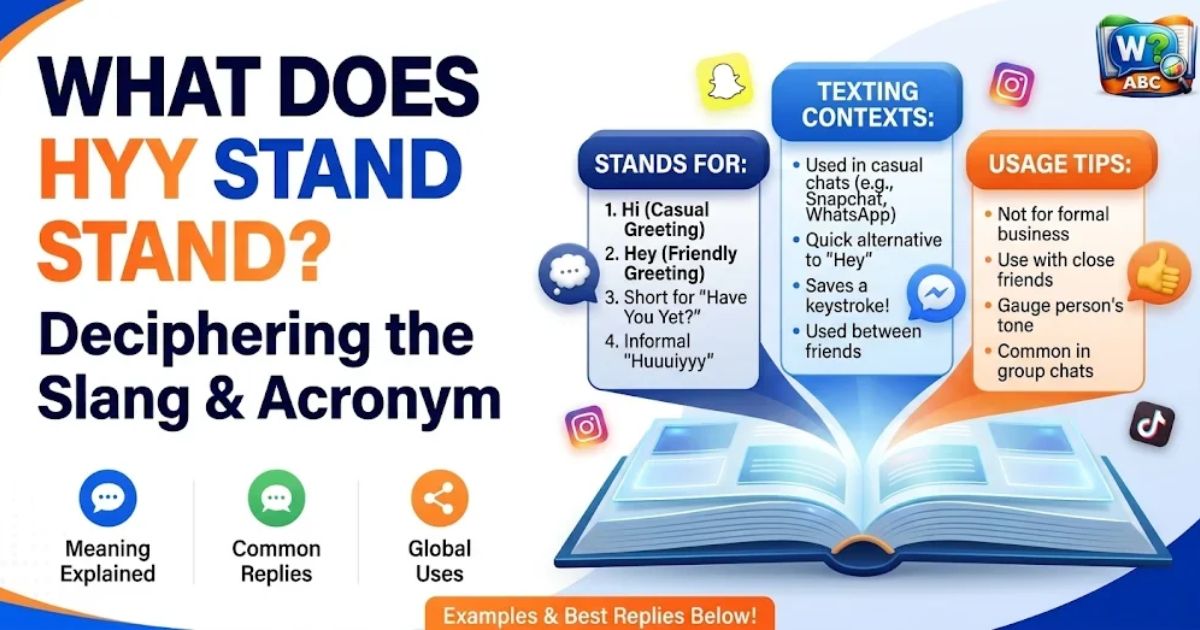
So, what does HYY stand for in texting? In most casual conversations, HYY is an extended or stylized version of “Hey” or “Hi.” People use it as a friendly greeting to start a conversation, get someone’s attention, or make their message feel warmer.
Unlike many internet abbreviations, HYY usually isn’t an acronym with a separate full form. It’s simply an informal spelling variation. However, the meaning and emotional tone can change depending on who sends it, the relationship between the people, and the situation.
Let’s explore what HYY means, whether it can be flirty, how people use it in different countries, and the best ways to respond.
What Does HYY Stand For in Texting?
HYY generally stands for an informal greeting similar to “Hey” or “Hi.” It’s a casual way of saying hello in text messages, social media chats, and online conversations.
The extra “Y” makes the greeting look more expressive than the standard spelling. It can suggest friendliness, excitement, or a desire to sound less formal.
For example:
- “Hyy, how are you?” – A friendly way to start a conversation.
- “Hyy 😊” – A warm and welcoming greeting.
- “Hyy, what’s up?” – A casual attempt to start chatting.
- “Hyy there!” – An informal way to get someone’s attention.
You might notice this spelling in messages from friends, classmates, online acquaintances, or someone trying to start a conversation.
The important thing to understand is that HYY doesn’t usually have a fixed expanded form. It’s a texting variation rather than a traditional abbreviation.
What Does HYY Mean in Text?
In everyday messaging, HYY usually communicates a simple greeting, but its tone can carry additional meaning.
When someone sends “Hyy” instead of “Hi,” they may be trying to sound more relaxed, cheerful, or approachable. The extra letter gives the message a slightly playful appearance.
Consider these examples:
Simple greeting:
“Hyy, are you free today?”
The sender is simply starting a conversation.
Friendly greeting:
“Hyyy! Long time no talk.”
The extended spelling makes the message feel more enthusiastic.
Possible romantic interest:
“Hyy 😊 What are you doing?”
This could be a friendly or flirty attempt to get your attention, depending on your relationship.
In simple terms, HYY means hello, but the way it’s written can make the greeting feel more personal.
Why Do People Use “HYY” Instead of “Hi”?
Typing “Hi” is perfectly fine, so why do people add another letter?
The answer is usually emotional expression. Digital conversations don’t include facial expressions, gestures, or vocal tone. People often change their spelling to make messages feel more natural and expressive.
Here are some common reasons:
1. To sound friendlier: An extra letter can make a greeting feel less formal. “Hyy” may appear warmer than a plain “Hi.”
2. To show excitement: People sometimes stretch words when they’re happy to talk to someone. “Hyyy!” can communicate more enthusiasm than a standard greeting.
3. To start a conversation naturally: A short greeting gives the other person an easy opportunity to reply without needing a specific topic.
4. To create a playful tone: Informal spelling is common in friendships and social media conversations. Extra letters can make ordinary words look more expressive.
5. To develop a personal texting style: Some people regularly write “hyy,” “heyy,” or “hiii” because these spellings match how they naturally communicate.
For example, imagine two friends messaging each other after school. One writes “Hi,” while the other writes “Hyyy!” Both are saying hello, but the second message feels more energetic.
Read More: 356+ SMD Meaning in Text: Slang Definition, Examples & Usage (2026)
Where Is “HYY” Commonly Used?
HYY is commonly found in informal digital communication. Because it’s short and easy to type, people may use it across different messaging platforms.
However, it’s not a platform-specific abbreviation. Its meaning generally stays the same wherever you encounter it.
WhatsApp: Friends and acquaintances may use HYY to begin private conversations or restart an inactive chat.
Instagram: Someone might send “Hyy” in a direct message after following you or seeing your story.
Snapchat: The greeting can appear when someone wants to start a conversation, reply to a snap, or get your attention.
TikTok: Users may use HYY in direct messages or comments when initiating casual interactions.
Facebook Messenger: The spelling can appear in everyday conversations between friends and online acquaintances.
Discord: Some users use HYY when joining informal conversations or greeting people in community chats.
For example, someone might see your Instagram story and send:
“Hyy, where was this picture taken?”
The greeting is simply an introduction to the question.
Emotional Meaning Behind “HYY”
Although HYY is usually just a greeting, its spelling can create a particular emotional impression.
Think about the difference between receiving “Hi” and “Hyyy!!” The basic message is the same, but the second version may feel more enthusiastic.
That’s because people use written language to express emotions that would normally come through their voices.
Here are some feelings HYY might communicate:
- Friendliness: The sender wants to make the interaction comfortable.
- Excitement: The person may be happy to talk to you.
- Warmth: The extended spelling can make the greeting feel less distant.
- Playfulness: The message may reflect a relaxed personality.
- Interest: Someone might be looking for an opportunity to continue chatting.
However, don’t read too much into a single greeting. A person using HYY doesn’t automatically have romantic feelings or a special interest in you.
The rest of the conversation provides much better clues.
Is “HYY” Flirty?
HYY can be flirty, but it isn’t automatically a romantic expression.
Someone might use it to get the attention of a crush, make a first conversation feel comfortable, or show enthusiasm when messaging someone they like.
However, friends also use the same spelling without any romantic intention.
The difference usually comes from the surrounding conversation, the relationship, and how the person communicates afterward.
When “HYY” May Be Flirty
HYY might have a flirty tone when it’s accompanied by affectionate emojis, personal questions, compliments, or an effort to keep the conversation going.
For example:
- “Hyyy 😊 How was your day?”
- “Hyy, I’ve been waiting to talk to you.”
- “Hyyy! What are you doing tonight?”
- “Hyy cutie ❤️”
These messages suggest more personal interest than a simple greeting, although the sender’s actual intention still matters.
Another clue is consistency. If someone regularly starts conversations, asks about your day, remembers small details, and shows genuine interest in you, their greeting may be part of a broader pattern of flirting.
When It’s Just Friendly
HYY is probably just friendly when someone uses it as a casual greeting without adding romantic language or showing special personal interest.
For example:
- “Hyy, did you finish the homework?”
- “Hyy bro, are you coming today?”
- “Hyy everyone!”
- “Hyy, what’s happening?”
These examples sound like ordinary social interactions.
Remember, extended spelling is a texting habit, not proof of attraction. Look at the overall communication instead of assuming that one extra letter has a hidden romantic meaning.
HYY Meaning in Text Across Different Countries
Texting habits vary between countries, communities, and age groups. While HYY generally works as an informal greeting, its popularity and spelling preferences may differ.
Let’s look at how people might use it in different regions.
Pakistan and India What Does HYY Stand For in Texting?
In Pakistan and India, HYY is recognizable in informal online conversations, particularly among people who mix English with their local languages.
It’s commonly used as a casual variation of “Hi” or “Hey” in WhatsApp chats, Instagram DMs, and everyday messaging.
For example:
- “Hyy, kya haal hai?”
- “Hyy, how are you?”
- “Hyy bro, kahan ho?”
- “Hyy, kya kar rahe ho?”
These messages combine an English greeting with familiar conversational expressions.
In Pakistan, you might also encounter HYY in conversations where people use Roman Urdu instead of Urdu script.
For example:
“Hyy, ap kese ho?”
The sender is simply greeting someone and asking how they’re doing.
In India, similar mixed-language texting is common, with expressions such as “Kya kar rahe ho?” or “Kaise ho?” following the greeting.
HYY doesn’t have a special universal Pakistani or Indian full form. Its basic function remains an informal hello.
United States and UK
In the United States and United Kingdom, people more commonly use variations such as “Hey,” “Heyy,” “Hiii,” and “Heyyy.”
HYY may also appear in casual messages, particularly in conversations influenced by informal social media spelling.
For example:
“Hyy! How’s your weekend going?”
The message is simply a relaxed greeting.
In these countries, the spelling “Heyy” may be more familiar to some English-speaking users, but the intended meaning of HYY is generally easy to understand from context.
Middle East
In Middle Eastern online communities, people often combine English greetings with Arabic expressions when messaging friends and acquaintances.
HYY may appear in casual conversations alongside phrases such as “How are you?” or Arabic greetings written in English letters.
For example:
- “Hyy, keef halak?”
- “Hyy, how was your day?”
- “Hyy, shlonak?”
The exact expressions vary by country and dialect.
As with other regions, HYY is generally understood as a casual greeting rather than a formal abbreviation with a separate meaning.
What Does HYY Mean From a Girl?
When a girl sends you HYY, she’s usually saying hello in a friendly and informal way.
She might be starting a conversation, responding to your online activity, or simply trying to get your attention.
The extra “Y” can make the greeting look warmer or more enthusiastic, but it doesn’t automatically mean she’s interested in you romantically.
Consider these examples:
Friendly message:
Girl: “Hyy, did you reach home?”
She’s checking on you or continuing an ordinary conversation.
Casual message:
Girl: “Hyy, what’s up?”
She’s opening the door for a conversation.
Potentially flirty message:
Girl: “Hyyy 😊 I’ve been thinking about you.”
The additional affectionate language makes this message more personal.
If you’re trying to understand her intention, pay attention to whether she asks personal questions, initiates conversations regularly, or makes an effort to keep talking.
A single HYY isn’t enough to determine someone’s feelings.
What Does HYY Mean From a Guy?
When a guy sends HYY, it generally means “Hey” or “Hi.” He may be greeting you, starting a conversation, or trying to get your attention.
Some guys use extended greetings because they sound more relaxed than formal messages.
For example:
- “Hyy, how’s everything?”
- “Hyyy bro, where are you?”
- “Hyy, what are you doing?”
- “Hyy 😊 long time no see.”
The meaning depends on the situation.
If a guy sends HYY with personal questions and affectionate messages, he might be interested in getting closer to you. If he sends it in a group chat or follows it with a casual question, it’s probably just a friendly greeting.
Don’t assume that the sender’s gender changes the actual definition.
Examples of HYY in Text Conversations
The easiest way to understand HYY is to see how it works in real-life messaging situations.
Here are several sample conversations showing different tones and uses.
Friendly Conversation
Person A: Hyy!
Person B: Hey! How are you?
Person A: I’m good. What about you?
Person B: Doing great, thanks!
In this example, HYY is simply a friendly way to start chatting.
Flirty Conversation
Person A: Hyyy 😊
Person B: Heyyy! What’s up?
Person A: Nothing much. Just wanted to talk to you.
Person B: That’s sweet haha ❤️
Here, the greeting is followed by a personal message that suggests romantic interest.
Serious Conversation
Person A: Hyy, can we talk?
Person B: Sure, what’s going on?
Person A: I wanted to clear up something from yesterday.
Person B: Okay, I’m listening.
Although HYY is informal, the conversation becomes serious because of what follows.
Casual Check-In
Person A: Hyy, how’s your day going?
Person B: Pretty good! Just finished work.
Person A: Nice, hope everything went well.
Person B: Thanks! How about yours?
This is a simple example of using HYY to check on someone.
Reconnecting After Silence
Person A: Hyyy! Long time no talk.
Person B: Hey! It’s been ages.
Person A: Yeah, how have you been?
Person B: I’ve been good. What about you?
In this situation, the extended greeting makes reconnecting feel friendly and relaxed.
Difference Between HYY and Similar Greetings
HYY belongs to a wider group of informal greetings that people use in digital conversations.
Although these spellings have similar meanings, they can create slightly different impressions.
| Greeting | Meaning | Common tone |
|---|---|---|
| Hi | Hello | Neutral |
| Hey | Hello or attention-getter | Casual |
| Hii | Extended Hi | Friendly |
| Hyy | Extended or stylized Hi/Hey | Informal |
| Heyy | Extended Hey | Warm or playful |
| Hyyy | Highly extended greeting | Enthusiastic |
| Hello | Standard greeting | Neutral or formal |
| Yo | Informal attention-getter | Relaxed |
For example, “Hi” can feel straightforward, while “Hyyy!” might sound more excited.
However, these differences aren’t strict rules. People develop their own texting habits, so the same greeting can carry different tones depending on the sender.
Is HYY Proper English? What Does HYY Stand For in Texting?
No, HYY isn’t considered standard English spelling. It’s an informal texting variation of “Hi” or “Hey.”
In proper written English, you should use the standard spelling when communicating in formal situations.
For example:
- Standard: “Hi, how are you?”
- Informal: “Hyy, how are you?”
- Standard: “Hey, can we talk?”
- Informal: “Heyy, can we talk?”
Both informal examples are understandable, but they’re better suited to casual conversations.
HYY isn’t usually classified as a formal acronym or recognized dictionary word. It’s part of the flexible spelling style people use online.
If you’re writing an email to a manager, preparing an assignment, or sending a professional message, choose “Hello,” “Hi,” or “Good morning” instead.
When Should You Use “HYY”?
HYY works best in relaxed conversations where informal language is already accepted.
You can use it when:
- Greeting a close friend.
- Starting a casual WhatsApp conversation.
- Messaging someone you know on Instagram.
- Reconnecting with an old friend.
- Replying to someone who uses similar texting language.
- Starting a relaxed conversation with an online acquaintance.
For example, if your friend regularly sends messages like “Hyyy, what’s up?”, replying with “Hyy! Nothing much” feels natural.
The key is to match the communication style of the person you’re messaging.
You don’t need to use HYY in every conversation. A simple “Hi” is equally effective and works with a wider range of people.
When You Should Avoid “HYY”
Although HYY is harmless in most casual conversations, it isn’t suitable for every situation.
There are times when standard greetings are a better choice.
1. Professional emails: Avoid HYY when writing to managers, clients, or business partners. Use “Hello” or “Good morning.”
2. Academic communication: When messaging teachers, professors, or school administrators, choose a more appropriate greeting.
3. Formal introductions: If you’re contacting someone for the first time in a professional setting, avoid overly casual spelling.
4. Serious conversations: When discussing an important issue, a straightforward greeting can help establish the right tone.
5. Unfamiliar people: Some people might find extended spellings confusing or overly familiar.
For example, instead of writing:
“Hyyy sir, I need your help.”
You could write:
“Hello, sir. I need your help with something.”
The second version sounds more respectful and professional.
Why Slang Like “HYY” Became Popular
Online slang has changed the way people communicate. Instead of always following traditional spelling rules, users often adapt words to express their personality and emotions.
HYY is a simple example of this trend.
Several factors explain why informal greetings have become popular.
Quick messaging: People prefer short, easy expressions when chatting throughout the day.
Emotional expression: Extra letters can make a greeting feel warmer or more enthusiastic.
Social media influence: Repeated exposure to informal spelling on Instagram, Snapchat, and TikTok makes these styles familiar.
Personal identity: Some people develop unique texting habits that reflect their personality.
Peer influence: Friends often adopt similar expressions after seeing them repeatedly in group chats.
Another important factor is the difference between spoken and written communication. When you say “Hey!” your voice can express excitement. In text messages, adding extra letters helps recreate some of that feeling.
That’s why “Hyy” can feel more expressive than a plain “Hi.”
Common Misunderstandings About HYY
Even though HYY is a simple greeting, people sometimes misunderstand its purpose.
Let’s clear up three common misconceptions.
It Is Not an Acronym
One common mistake is assuming HYY has a separate full form.
In everyday texting, it generally functions as an extended version of “Hi” or “Hey.” It isn’t normally an abbreviation where each letter represents a different word.
For example, someone sending “Hyy, how are you?” is simply greeting you.
It Is Not Always Romantic
Another misunderstanding is believing that HYY automatically indicates flirting.
While someone might use it to start a romantic conversation, friends, classmates, and family members also use it casually.
The extra letter doesn’t prove attraction.
Look at the rest of the conversation before interpreting someone’s feelings.
It Is Not a Typo
HYY may look like a typing mistake to someone unfamiliar with internet slang.
However, many people intentionally add letters to greetings to make them appear more expressive.
For example:
- “Hii”
- “Hyyy”
- “Heyyy”
- “Hyy”
These are informal spelling choices rather than necessarily accidental mistakes.
Of course, someone could type HYY unintentionally, but you shouldn’t automatically assume that’s what happened.
How to Reply to “HYY”
If someone sends you HYY, the best response is usually simple. You don’t need to overthink it or write a long message.
A natural greeting followed by a question is enough to keep the conversation going.
Here are some replies you can use depending on the situation.
Friendly Replies
If a friend sends HYY, respond with something relaxed and welcoming.
- “Heyyy! How are you?”
- “Hyy! What’s up?”
- “Hey, how’s everything?”
- “Hyyy, long time no see!”
- “Hey! What are you doing?”
These replies make it easy to continue a casual conversation.
Flirty Replies
If someone you like sends HYY, you can respond with a little warmth or playful energy.
- “Hyyy 😊 How have you been?”
- “Hey you! ❤️”
- “Well, hello there 😉”
- “Hyy! Was waiting for your message.”
- “Heyyy, nice to hear from you!”
These responses show interest without making the conversation feel forced.
Short Replies
Sometimes you just want to acknowledge the greeting.
- “Hey!”
- “Hii”
- “Hyy”
- “Hello!”
- “Yo!”
Short replies work well when you’re busy or don’t have much to say.
Warm Replies
If someone you haven’t spoken to in a while sends HYY, a welcoming response can help rebuild the connection.
- “Hyyy! So good to hear from you.”
- “Hey! How have you been?”
- “It’s been a while!”
- “Hii, hope you’re doing well.”
- “Heyyy! What’s new?”
A warm response can turn a simple greeting into a meaningful conversation.
Psychological Impact of Casual Greetings
A greeting might seem unimportant, but small communication choices can influence how people experience a conversation.
When someone sends HYY, the extended spelling may create a warmer first impression than a very short or formal greeting.
For example, compare these messages:
“Hi.”
“Hyyy! 😊”
Both communicate hello, but the second may feel more enthusiastic or welcoming.
This happens because readers interpret more than the literal words. They also notice punctuation, emojis, spelling, and the sender’s usual communication style.
Casual greetings can help:
- Reduce the feeling of formality.
- Make starting a conversation easier.
- Show enthusiasm about talking.
- Create a relaxed atmosphere.
- Encourage a friendly response.
However, the emotional impact isn’t universal. Some people prefer simple messages, while others enjoy expressive spelling.
The best approach is to communicate naturally and respect the other person’s preferences.
Does Auto-Correct Change “HYY”?
Yes, autocorrect or predictive text can sometimes change how you type HYY, depending on your keyboard settings and personal dictionary.
Most smartphone keyboards are designed around standard English spelling. Since HYY is an informal variation, your keyboard might suggest “Hi” or “Hey” instead.
For example, you might type “Hyy” and notice your keyboard suggesting a standard greeting.
There are several reasons this happens:
- HYY isn’t a standard English dictionary entry.
- Your keyboard may recognize it as a spelling mistake.
- Predictive text may prioritize commonly used words.
- Your personal typing history can influence suggestions.
If you regularly use informal spellings, some keyboards may gradually recognize your habits.
However, autocorrect behavior varies between devices, keyboards, and language settings.
If you want to keep the spelling, check the suggested word before sending your message.
Real-World Example From Social Media Culture
Imagine you’re scrolling through Instagram and someone follows your account. A little later, you receive a direct message:
“Hyy 😊”
You might wonder whether the person wants to become friends, start flirting, or simply introduce themselves.
At this point, the message doesn’t reveal much beyond a friendly attempt to begin a conversation.
You could reply:
“Hey! How are you?”
The person might then ask about your interests, mention something from your profile, or continue with a casual question.
Another example happens on Snapchat.
Someone replies to your story with:
“Hyyy, where is this?”
Here, the greeting is just a friendly introduction before asking about your picture.
These situations demonstrate an important point: HYY usually acts as a conversation starter. The real meaning of the interaction becomes clearer through the messages that follow.
Practical Tips for Using Text Slang Correctly
Using informal greetings isn’t difficult, but a little awareness can help you avoid awkward situations.
Here are three practical tips for using HYY naturally.
Match the Other Person’s Tone
Pay attention to how the other person communicates.
If they regularly use informal greetings, replying with HYY or HYYY can feel natural.
However, if someone prefers short, straightforward messages, a simple “Hi” might be more appropriate.
Matching their tone helps conversations feel comfortable without forcing a particular texting style.
Don’t Overuse Extra Letters
Adding extra letters can make a greeting more expressive, but using too many can look exaggerated.
For example:
- “Hi” – Simple and neutral.
- “Hyy” – Casual and friendly.
- “Hyyy!” – More enthusiastic.
- “Hyyyyyyyy!” – Extremely playful or exaggerated.
You don’t need to stretch every greeting. Use extra letters when they naturally fit your mood.
Use Emojis Carefully
Emojis can change how a greeting feels.
For example:
- “Hyy 😊” – Friendly and warm.
- “Hyy 😂” – Playful.
- “Hyy ❤️” – Affectionate.
- “Hyy 😉” – Potentially flirty.
- “Hyy 👋” – A simple hello.
However, emojis don’t have fixed meanings in every conversation. Consider your relationship with the other person before using affectionate or suggestive symbols.
HYY Meaning Text vs Other Modern Slang
HYY belongs to the broader category of informal texting expressions. Unlike many popular internet abbreviations, it doesn’t usually represent a complete phrase.
Understanding how it differs from other slang can make digital conversations easier to follow.
| Slang | Meaning | Typical use |
|---|---|---|
| HYY | Hi/Hey | Greeting someone |
| WYD | What You Doing? | Asking what someone is doing |
| WYA | Where You At? | Asking someone’s location |
| HMU | Hit Me Up | Asking someone to contact you |
| HRU | How Are You? | Checking on someone |
| WSG | What’s Good? | Casual greeting or check-in |
| SUP | What’s Up? | Starting a conversation |
| TBH | To Be Honest | Introducing an honest opinion |
| LOL | Laughing Out Loud | Showing amusement |
| BRB | Be Right Back | Temporarily leaving a conversation |
The main difference is that HYY is a stylized greeting, while most of these expressions are actual abbreviations of longer phrases.
For example, if someone messages you:
“Hyy, WYD?”
They’re essentially saying:
“Hey, what are you doing?”
Once you understand common texting expressions, conversations become much easier to interpret.
Frequently Asked Questions
Here are quick answers to the most common questions about HYY and its use in everyday texting.
What does HYY stand for in texting?
HYY is generally an informal variation of “Hi” or “Hey.” It isn’t usually an acronym with a separate full form. People use it to make greetings sound friendlier, warmer, or more expressive.
What does hyy mean in text from a girl?
When a girl sends HYY, she’s usually saying hello in a casual and friendly way. Depending on the conversation, it might also be a playful or flirty greeting, but it doesn’t automatically indicate romantic interest.
Is hyy flirting?
Not necessarily. HYY can be used when flirting, but it’s also common in ordinary conversations between friends and acquaintances. Look at the rest of the messages to understand the sender’s intention.
Is hyy a typo?
Usually, no. Many people intentionally add an extra letter to “Hi” or “Hey” to make their greetings look more expressive. However, an accidental typing mistake is also possible.
Can I use hyy professionally?
It’s better to avoid HYY in professional communication. Use “Hello,” “Hi,” or “Good morning” when contacting managers, clients, teachers, or business partners.
Why do people spell hi as hyy?
People often spell Hi as HYY to create a friendlier, more relaxed, or more enthusiastic tone. The extra letter adds personality to an otherwise simple greeting.
Is hyy common in Pakistan?
HYY is recognizable in informal texting in Pakistan, particularly in WhatsApp conversations and social media messages. People often combine it with Roman Urdu expressions such as “kya haal hai?” or “ap kese ho?”
Conclusion: What Does HYY Stand For in Texting?
So, what does HYY stand for in texting? In most everyday conversations, it’s simply an informal and expressive way of saying “Hi” or “Hey.”
People use it to greet friends, start conversations, show enthusiasm, or make messages feel warmer. It can sometimes have a flirty tone, especially when accompanied by affectionate language or emojis, but it isn’t automatically romantic.
You may encounter HYY on WhatsApp, Snapchat, Instagram, TikTok, and other messaging platforms. Its basic meaning generally stays the same across different countries and online communities.
The best way to understand it is to consider the sender, the conversation, and the surrounding messages. And if you want to use it yourself, keep it casual and choose the greeting that fits your relationship with the other person.
