Have you ever received a message saying “ION wanna go out” or “ION care anymore” and wondered what ION means? You’re not alone. This short abbreviation appears in text messages, Snapchat conversations, TikTok comments, and Instagram posts, especially among younger internet users.
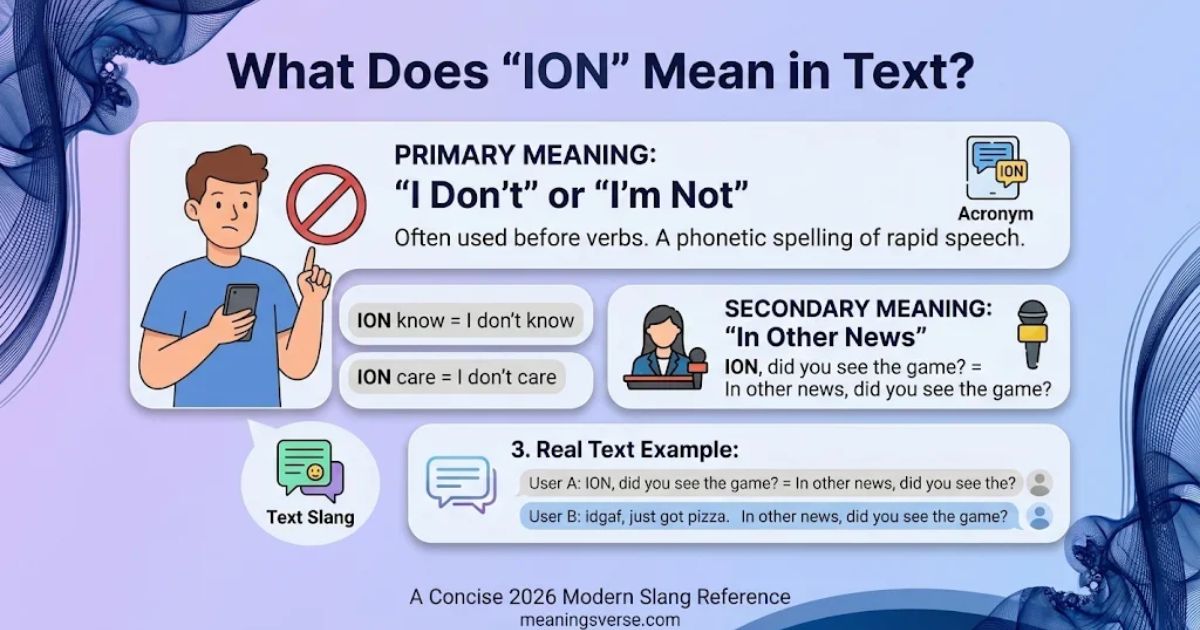
ION usually means “I Don’t” in informal texting and internet slang. People use it as a shortened version of the phrase to save time, express their feelings, or make conversations sound more casual.
For example, someone might text, “ION feel like going anywhere today,” which means “I don’t feel like going anywhere today.”
However, ION doesn’t always have the same meaning. Depending on the conversation, it can also refer to a scientific term or other expressions. Understanding the context will help you figure out what someone actually means.
Let’s explore its meaning, social media usage, examples, and common mistakes so you can use ION correctly in 2026.
Examples
Here are some quick examples to help you understand how people use ION in everyday conversations.
| Text Message | Actual Meaning |
|---|---|
| ION care anymore | I don’t care anymore |
| ION wanna go out | I don’t want to go out |
| ION know what happened | I don’t know what happened |
| ION feel like talking | I don’t feel like talking |
| ION have time today | I don’t have time today |
| ION think so | I don’t think so |
As you can see, ION replaces the words “I don’t” at the beginning of a sentence.
For example, if your friend asks whether you want to attend a party and you reply, “ION feel like it,” you’re simply saying that you don’t feel like going.
The abbreviation is informal, so it’s best suited to casual conversations rather than professional writing.
Why Is ION So Popular Online?
ION has become popular because internet users enjoy finding shorter ways to communicate. Instead of typing a complete sentence, people use abbreviations that express the same idea with fewer characters.
Social media platforms have also helped popularize this style of communication. Short comments, quick replies, captions, and private messages encourage users to write naturally and quickly.
There are several reasons why people use ION:
- Faster communication: Typing ION takes less time than writing “I don’t.”
- Casual expression: It makes messages sound relaxed and conversational.
- Internet culture: Shortened words are common in memes, comments, and online discussions.
- Personal style: Some users prefer slang because it reflects how they naturally speak.
- Convenience: It’s easy to include in short messages without changing the overall meaning.
Another reason is that ION fits naturally into sentences.
For example, “ION wanna argue” is shorter and more casual than “I don’t want to argue.”
However, popularity doesn’t mean everyone understands it. Some people might interpret ION as the scientific word for a charged particle, so context is important.
Read More: IDGAF Mean in Text: Meaning, Examples & How to Use It in 2026
What Does ION Mean in Text on Snapchat?
On Snapchat, ION usually means “I Don’t” when used as internet slang. People use it in snaps, direct messages, story replies, and casual conversations.
Snapchat conversations often move quickly, so shortened expressions make communication easier.
For example, someone might send:
“ION wanna talk about yesterday.”
This means “I don’t want to talk about yesterday.”
The person could be avoiding an uncomfortable topic, expressing frustration, or simply explaining that they aren’t interested in discussing something.
The emotional meaning depends on the surrounding messages. ION itself doesn’t automatically mean someone is angry or upset.
Snapchat Examples
Here are some realistic examples of how ION might appear in Snapchat conversations.
Example 1:
Friend: “Are you coming to the mall?”
You: “ION think so today.”
Meaning: You don’t think you’ll visit the mall today.
Example 2:
Friend: “Why aren’t you replying?”
You: “ION have my phone with me all the time 😂”
Meaning: You’re joking that you don’t always have your phone.
Example 3:
Friend: “Do you still like him?”
You: “ION even know anymore.”
Meaning: You’re unsure about your feelings.
Example 4:
Friend: “Let’s start another Snapchat streak.”
You: “ION wanna lose this one again 😭”
Meaning: You don’t want to lose another streak.
What Does ION Mean in Text on Instagram?
On Instagram, ION commonly means “I Don’t” in informal messages and comments.
People use it when replying to stories, chatting through DMs, commenting on reels, or sharing their opinions.
For example:
“ION care about the drama anymore.”
This means the person doesn’t care about the drama anymore.
You might also see ION in captions expressing frustration, humor, confidence, or a lack of interest.
However, it’s important to understand that ION isn’t an official Instagram abbreviation. It’s general internet slang that people bring into their Instagram conversations.
Instagram Examples
Example 1:
Friend: “Did you see her new post?”
You: “ION follow her anymore.”
Meaning: You don’t follow that person anymore.
Example 2:
Friend: “Everyone is talking about your picture.”
You: “ION care what they think.”
Meaning: Other people’s opinions don’t bother you.
Example 3:
Friend: “Are you posting another reel today?”
You: “ION have anything ready 😂”
Meaning: You don’t have another reel prepared.
Example 4:
Friend: “Why didn’t you like my story?”
You: “ION even see it yet.”
Meaning: You haven’t seen the story.
What Does ION Mean in Text on TikTok?
On TikTok, ION usually means “I Don’t” in comments, captions, and direct messages.
TikTok’s short-form content culture encourages quick reactions and informal expressions. As a result, users often use shortened phrases to communicate their thoughts without writing complete sentences.
For example:
“ION know why this video is so funny.”
This means “I don’t know why this video is so funny.”
You might also encounter ION in reaction videos, relatable posts, and comments about everyday situations.
One thing to remember is that TikTok users sometimes use ION in a playful or exaggerated way. The expression can communicate humor, confusion, annoyance, or simple disinterest.
TikTok Examples
Example 1:
Comment: “Why are you watching this video again?”
Reply: “ION know, it’s addictive 😂”
Meaning: You don’t know why you keep watching it.
Example 2:
Comment: “You should try this challenge.”
Reply: “ION think I’m ready for that.”
Meaning: You don’t think you’re ready to participate.
Example 3:
Comment: “This trend is getting old.”
Reply: “ION wanna see another version 😭”
Meaning: You don’t want to see another version of the trend.
Example 4:
Comment: “Why are you laughing so hard?”
Reply: “ION even know anymore 😂”
Meaning: You’re laughing so much that you can’t explain why.
What Does ION Mean in Text From a Girl?
When a girl uses ION in a text message, it usually means “I Don’t.” The abbreviation doesn’t have a special meaning simply because a girl uses it.
However, the sentence and conversation can help you understand what she’s trying to communicate.
For example, if she texts “ION wanna go out tonight,” she’s saying she doesn’t want to go out.
If she says “ION care what people think,” she may be expressing confidence or independence.
Don’t assume that using ION means she’s flirting, angry, or losing interest. Look at the complete message before deciding what she means.
Common Interpretations
Here are some common ways a girl might use ION.
| Message | Possible Meaning |
|---|---|
| ION wanna talk rn | She doesn’t want to talk right now |
| ION know what to say | She’s unsure how to respond |
| ION care about them | Their opinions don’t matter to her |
| ION feel like going out | She doesn’t want to go out |
| ION wanna argue with you | She wants to avoid an argument |
Example:
You: “Are you upset with me?”
Her: “ION wanna fight about this.”
Meaning: She doesn’t want to argue about the situation.
The message might suggest frustration, but it could also mean she simply wants to avoid unnecessary conflict. If you’re unsure, ask politely rather than assuming her feelings.
What Does ION Mean in Text From a Guy?
When a guy sends ION, it generally means “I Don’t,” just as it does when a girl uses it.
He might use it to express his opinion, explain his plans, show disinterest, or respond casually to a question.
For example:
“ION wanna go anywhere today.”
This simply means he doesn’t want to go anywhere today.
The abbreviation doesn’t automatically reveal his feelings toward you or indicate whether he’s interested romantically.
Examples
Example 1:
You: “Are you coming to the game?”
Him: “ION think I can make it.”
Meaning: He doesn’t think he’ll be able to attend.
Example 2:
You: “Do you miss your old school?”
Him: “ION really miss it tbh.”
Meaning: He doesn’t really miss his old school.
Example 3:
You: “Why are you ignoring that group chat?”
Him: “ION like all that drama.”
Meaning: He doesn’t like the drama happening in the group.
Example 4:
You: “Do you want to watch a movie?”
Him: “ION mind.”
Meaning: In this particular response, he might be using the phrase to say he doesn’t mind watching a movie. The complete wording matters.
Is ION Always Slang for “I Don’t”?
No. Although ION commonly means “I Don’t” in informal texting, it can have other meanings depending on the subject and context.
For example, in chemistry, an ion is an atom or molecule with an electrical charge.
You might also see ION used as an abbreviation or name in specific online communities, organizations, and technical discussions.
This is why you shouldn’t automatically interpret every appearance of ION as texting slang.
Other Possible Meanings of ION
Here are some different ways you might encounter ION:
| Context | Meaning |
|---|---|
| Texting slang | I Don’t |
| Chemistry | An electrically charged atom or molecule |
| Informal speech | A shortened pronunciation or spelling of “I don’t” |
| Technology | May appear as an abbreviation or technical label |
| Names and brands | May be part of a company, product, or organization name |
The most reliable way to understand ION is to examine the sentence in which it appears.
If someone writes “ION wanna go,” it’s probably texting slang. If a chemistry textbook discusses positive and negative ions, it’s referring to science.
What Does Ion Mean in Science?
In science, an ion is an atom or molecule that has gained or lost one or more electrons, giving it an electrical charge.
Unlike the slang expression used in texting, the scientific meaning has nothing to do with the phrase “I Don’t.”
There are two main types of ions:
- Cations: Positively charged ions formed when atoms or molecules lose electrons.
- Anions: Negatively charged ions formed when atoms or molecules gain electrons.
For example, sodium can lose one electron and become a positively charged sodium ion (Na⁺). Chlorine can gain one electron and become a negatively charged chloride ion (Cl⁻).
These oppositely charged ions can attract each other and form ionic compounds, such as sodium chloride (ordinary table salt).
5.3: The Reaction of Sodium with Chlorine – Chemistry LibreTexts
You’ll encounter this meaning in chemistry classes, scientific articles, and discussions about batteries, electricity, and chemical reactions.
So, if someone is talking about chemistry rather than texting, ION probably refers to an electrically charged particle.
How to Use ION Correctly in Text Messages
If you want to use ION in your own conversations, remember that it usually replaces “I Don’t” in informal sentences.
The abbreviation works best when the sentence sounds natural after you replace the letters with the original words.
Here are four common situations where you might use it.
Casual Refusal
You can use ION when you want to casually say that you don’t want to do something.
Examples:
- “ION wanna go shopping today.”
- “ION feel like eating pizza.”
- “ION think I’ll join you guys.”
These messages sound relaxed and are suitable for casual conversations with friends.
Showing Disinterest
ION can help you communicate that you’re not interested in something.
Examples:
- “ION care about that argument.”
- “ION follow those trends anymore.”
- “ION wanna get involved in their drama.”
In these situations, the abbreviation makes your lack of interest clear.
However, be careful when using it in sensitive conversations because it might sound dismissive.
Humor or Sarcasm
You can also use ION to make jokes or exaggerate your reaction to something.
Examples:
- “ION know why I’m still awake at 3 AM 😂”
- “ION understand my own sleep schedule.”
- “ION need another Monday in my life 😭”
These examples use ION to make everyday frustrations sound funny and relatable.
Friendly Conversation
ION can also appear in ordinary conversations without expressing anger or strong emotions.
Examples:
- “ION know what movie to watch.”
- “ION have any plans this weekend.”
- “ION think we’ve met before.”
- “ION remember where I put my keys.”
These are simple ways to use the abbreviation while chatting with friends.
When You Should NOT Use ION
Although ION is common in informal texting, it’s not appropriate for every situation.
The abbreviation is casual internet slang, so using it in professional emails, academic assignments, or formal discussions can make your writing appear careless.
For example, if you’re communicating with a manager, teacher, customer, or business client, it’s better to write complete sentences.
Incorrect Professional Example
Imagine your manager asks whether you can attend an important meeting.
An unsuitable reply would be:
“ION think I can come to the meeting.”
Although the meaning is understandable, ION sounds too informal for most professional communication.
It may also create confusion if the recipient isn’t familiar with internet slang.
Better Version
A more appropriate response would be:
“I don’t think I’ll be able to attend the meeting.”
Other professional alternatives include:
- “I’m unable to attend the meeting.”
- “I don’t believe I’ll be available.”
- “Unfortunately, I won’t be able to join.”
- “I don’t have enough information to confirm.”
The key is to choose language that matches your audience and the situation.
Common Mistakes People Make With ION
ION is easy to recognize once you understand its meaning, but there are still a few common mistakes people make when using it.
Assuming Every Person Uses It the Same Way
Not everyone interprets ION as “I Don’t.”
Some people might understand it as the scientific term, while others may not recognize it at all.
For example, someone studying chemistry could interpret ION as a reference to charged particles rather than texting slang.
Always consider the conversation before deciding what it means.
Using It in Formal Situations
One common mistake is using ION in professional emails, school assignments, or formal messages.
Although abbreviations make texting faster, they aren’t always suitable for serious communication.
Instead of writing:
“ION have the report ready.”
Write:
“I don’t have the report ready.”
The second version is clearer and more appropriate.
Overusing Slang
Using ION in every sentence can make your messages difficult to read, especially when you’re communicating with people who aren’t familiar with internet slang.
For example:
“ION know, ION care, and ION wanna talk.”
Although the meaning is understandable, repeating the abbreviation makes the sentence sound awkward.
Use it naturally rather than forcing it into every message.
Ignoring Context
Context is one of the most important parts of understanding internet slang.
For example:
- “ION know” means “I don’t know.”
- “ION care” means “I don’t care.”
- “An ion carries an electrical charge” refers to chemistry.
The same letters can communicate completely different ideas depending on how they’re used.
ION vs Similar Slang Terms
ION is often used alongside other popular texting abbreviations. Some have similar meanings, while others communicate different feelings.
Understanding these differences will help you avoid confusion.
| Slang | Full Form | Meaning |
|---|---|---|
| ION | I Don’t | Shortened form of “I don’t” |
| IDC | I Don’t Care | Expressing indifference |
| IDK | I Don’t Know | Showing uncertainty |
| IMO | In My Opinion | Sharing an opinion |
| IKR | I Know, Right? | Showing agreement |
| IDGAF | I Don’t Give a F*** | Strong indifference |
| NGL | Not Gonna Lie | Introducing an honest statement |
| TBH | To Be Honest | Expressing an honest opinion |
| FR | For Real | Emphasizing something |
| RN | Right Now | Referring to the present moment |
The biggest difference is that ION replaces “I Don’t,” while most of these abbreviations represent complete expressions.
For example:
- “ION know” = “I don’t know.”
- “IDK” = “I don’t know.”
- “ION care” = “I don’t care.”
- “IDC” = “I don’t care.”
Although ION and IDK can sometimes communicate similar ideas when combined with other words, they’re not interchangeable in every sentence.
Why Gen Z Uses Slang Like ION So Often
Gen Z frequently uses shortened expressions, internet slang, and creative spellings in digital conversations.
ION fits this communication style because it makes messages shorter while preserving their intended meaning.
However, this doesn’t mean every Gen Z user communicates the same way or regularly uses this particular abbreviation.
Several factors help explain why shortened slang remains popular.
1. Faster communication: Short expressions are convenient when people send multiple messages throughout the day.
2. Social media influence: TikTok, Instagram, Snapchat, and other platforms expose users to new expressions through videos, comments, and conversations.
3. Online identity: Slang can help people express their personality and communicate in a style that feels natural to their social group.
4. Humor and creativity: Internet users often change ordinary phrases into shorter or more playful versions.
5. Digital culture: People regularly borrow expressions from music, memes, online communities, and everyday speech.
For example, someone might write “ION wanna deal with Monday” instead of typing the complete sentence.
It’s short, relatable, and easy to understand for someone familiar with the expression.
Still, slang changes over time. Some abbreviations become widely recognized, while others disappear as online trends evolve.
Real-World Examples of ION in Conversations
Seeing ION in actual conversation-style examples makes its meaning easier to understand.
Here are four realistic situations showing how people use it in different settings.
Example 1: Friends Chatting
Alex: “Are you coming to the gym today?”
Ryan: “ION think so. I’m too tired.”
Alex: “Again? 😂”
Meaning: Ryan doesn’t think he’ll go to the gym because he’s tired.
Example 2: Snapchat Conversation
Mia: “Why didn’t you reply to my snap?”
Emma: “Sorryyy, ION check Snapchat that often.”
Mia: “It’s okay 😂”
Meaning: Emma is saying that she doesn’t check Snapchat very often.
Example 3: TikTok Comment
User 1: “How many times have you watched this video?”
User 2: “ION even know anymore 😭”
Meaning: The second user is joking that they’ve watched the video so many times they’ve lost count.
Example 4: Relationship Text
Sam: “Are you still upset about yesterday?”
Taylor: “ION wanna argue. Can we just talk normally?”
Sam: “Yeah, that’s fine.”
Meaning: Taylor doesn’t want to argue and would rather have a calm conversation.
These examples demonstrate that ION doesn’t have one fixed emotional tone. It can sound casual, humorous, uncertain, or serious depending on the situation.
What Does ION Mean in Text Messages Overall?
Overall, ION usually means “I Don’t” in text messages and informal online conversations.
It’s a shortened expression that people use to communicate quickly without typing the complete phrase.
You’ll commonly see it in sentences such as:
- “ION know.”
- “ION care.”
- “ION wanna go.”
- “ION feel like talking.”
- “ION have time.”
The abbreviation appears on Snapchat, Instagram, TikTok, and other messaging platforms.
However, ION isn’t always slang. In scientific discussions, it refers to an electrically charged atom or molecule.
The easiest way to understand the intended meaning is to look at the words around it.
Is ION Considered Proper English?
ION isn’t considered standard written English when it’s used to mean “I Don’t.”
It’s an informal internet abbreviation rather than a traditional grammatical word.
However, that doesn’t mean it’s incorrect in every situation. Language naturally changes depending on how people communicate, and informal expressions have their place in everyday conversations.
For example:
- Informal: “ION wanna go outside.”
- Standard English: “I don’t want to go outside.”
Both communicate the same basic idea, but the second version is appropriate for formal writing.
In casual texting, using ION is generally fine when the recipient understands the abbreviation.
For schoolwork, business communication, official documents, and professional emails, stick with standard English.
How Businesses and Brands Use Slang Like ION
Businesses and brands sometimes use internet slang to connect with younger audiences, especially on platforms such as TikTok and Instagram.
Shortened expressions can make social media content feel more conversational and less formal.
For example, a clothing brand might publish a playful caption such as:
“ION care about trends. Wear what makes you happy.”
The goal is to create a relatable message that matches the brand’s personality.
However, brands should understand their audience before using expressions like ION.
There are a few things businesses should consider:
- Audience familiarity: Not every customer understands internet slang.
- Brand personality: Casual expressions work better for some brands than others.
- Platform choice: Informal language may suit social media but not official business documents.
- Message clarity: Slang shouldn’t make an advertisement confusing.
- Cultural differences: Expressions can have different levels of familiarity across countries and communities.
A brand that uses slang naturally may sound relatable. A brand that forces every trending abbreviation into its content can appear unprofessional or out of touch.
The best approach is to use internet slang when it genuinely supports the message.
The Evolution of Text Slang
Text slang has changed significantly as digital communication has developed.
In the early days of SMS messaging, people often shortened words because mobile keyboards were slower and text messages had character limits.
Expressions such as LOL, BRB, and IDK became popular because they made communication quicker.
As social media platforms grew, internet slang expanded beyond simple shortcuts. Users started developing new spellings, abbreviations, and expressions that reflected online culture.
ION is part of this wider trend. It represents a shortened version of an everyday English phrase.
Today, texting abbreviations appear in:
- Private messages
- Social media captions
- Online gaming chats
- TikTok comments
- Internet memes
- Group conversations
- Digital communities
Some slang terms remain popular for years, while others become less common as new expressions emerge.
This constant evolution is one reason why understanding context matters more than simply memorizing abbreviations.
Frequently Asked Questions About ION
What Does ION Mean in Text?
ION usually means “I Don’t” in informal text messages. People use it as a shortened expression to communicate quickly, such as “ION know” for “I don’t know.”
What Does ION Mean in Text on Snapchat?
On Snapchat, ION generally means “I Don’t.” People use it in snaps, direct messages, and story replies to express their thoughts, feelings, or lack of interest.
What Does ION Mean in Text From a Girl?
When a girl uses ION, it usually means “I Don’t.” The abbreviation doesn’t have a special romantic meaning. The complete sentence and conversation determine her intended message.
What Does ION Mean in Text From a Boy?
When a boy sends ION, it generally means “I Don’t.” He might use it to express disinterest, explain his feelings, or respond casually to a question.
Is ION Rude?
No, ION isn’t inherently rude. It’s an informal abbreviation for “I Don’t.” However, a sentence such as “ION care about you” can sound dismissive or hurtful depending on the situation.
Can I Use ION in School or Work?
You can use ION in casual conversations with friends or classmates. However, it’s better to avoid it in assignments, professional emails, and formal workplace communication.
Is ION Used Worldwide?
ION is recognized in various English-speaking online communities, but its popularity and familiarity differ between regions. Not everyone worldwide understands the abbreviation, so context is important.
What Does ION Mean in Text Slang?
In text slang, ION usually stands for “I Don’t.” It’s commonly used on social media and messaging platforms as a shorter, more casual way to begin a sentence.
Conclusion
ION usually means “I Don’t” in texting and internet slang. It’s a simple abbreviation that helps people communicate quickly on Snapchat, Instagram, TikTok, WhatsApp, and other online platforms.
You might see it in messages such as “ION know,” “ION care,” or “ION wanna go.” Although the abbreviation is generally informal, its tone can change depending on the conversation.
Remember that ION also has a scientific meaning: an electrically charged atom or molecule. So, always consider the context before interpreting it.
If you’re chatting with friends, using ION is perfectly fine when everyone understands the expression. For professional or academic writing, however, it’s better to use the complete phrase “I don’t.”
Now that you know the ION meaning in text, you’ll have no trouble understanding it the next time it appears in your messages or social media feed.
