
Have you seen someone mention PDA in a text, Snapchat message, Instagram comment, or relationship conversation and wondered what it means? You’re probably familiar with the abbreviation, but its meaning can depend on whether someone is talking about romance, social media, or everyday behavior.
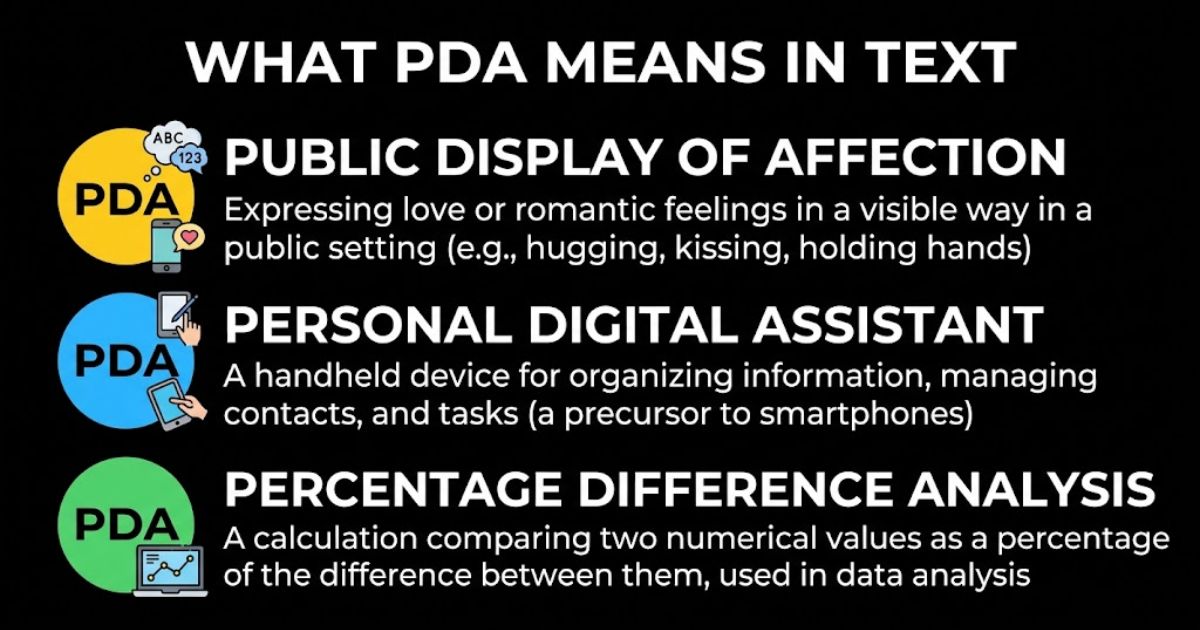
The most common PDA meaning in text is “Public Display of Affection.” It describes romantic or affectionate behavior shown openly around other people. Holding hands, hugging, kissing, or showing obvious romantic affection in public are common examples.
Online, however, PDA can take on a slightly broader meaning. Someone might call affectionate comments, romantic posts, or couple content “online PDA” even though the interaction isn’t happening physically in public.
So, what does PDA mean in text talk? In most relationship-related conversations, it refers to public displays of affection, but the exact tone depends on the context. Let’s look at how people use PDA in texting, Snapchat, social media, relationships, and everyday conversations.
What Does PDA Mean in Text?
PDA means “Public Display of Affection” in most texting and social-media conversations. It usually refers to romantic or affectionate behavior that other people can see.
For example, if someone says, “They were doing so much PDA at the restaurant,” they’re probably talking about a couple showing physical affection in front of other people.
PDA doesn’t necessarily mean something inappropriate. A quick hug, holding hands, or a kiss can all be considered PDA depending on the setting and the people involved.
The abbreviation is especially common when people discuss dating, relationships, celebrities, couples, or social situations.
Featured Snippet Answer
PDA in text usually means “Public Display of Affection.” It refers to romantic or affectionate behavior shown openly in front of other people, such as holding hands, hugging, kissing, or romantic gestures. On social media, PDA can also describe affectionate comments, posts, or couple content shared publicly.
Why PDA Is Common in Modern Texting
Texting has made relationship conversations much shorter and more casual. Instead of typing “public display of affection” every time, people simply use PDA.
The abbreviation is already widely understood, especially in conversations about dating and relationships. It also works well in social-media comments, captions, group chats, and private messages where people often prefer short expressions.
For example:
“They’re always doing PDA 😂”
is much quicker than:
“They’re always showing public displays of affection.”
Modern texting also uses PDA when people discuss what they see online. A couple doesn’t have to be physically standing in front of you for someone to jokingly describe their romantic Instagram posts as PDA.
PDA Full Form in Chat
The PDA full form in chat is usually Public Display of Affection.
The phrase describes visible expressions of affection between people, particularly romantic partners.
Public Display of Affection
A public display of affection can include several types of behavior:
- Holding hands
- Hugging
- Kissing
- Cuddling
- Putting an arm around a partner
- Sitting closely together
- Giving affectionate gestures
What counts as PDA can vary from person to person and from one culture to another.
For some people, holding hands is completely ordinary. For others, even small romantic gestures may feel very private.
What Does PDA Mean in Text Messages?
In text messages, PDA usually keeps its standard meaning: Public Display of Affection.
Someone might use the abbreviation while describing something they saw between a couple, discussing their own relationship, or reacting to a romantic social-media post.
The tone can be serious, teasing, supportive, or critical.
Example Texts
“They were showing PDA at the party.”
Meaning: They were openly showing romantic affection at the party.
“Too much PDA 😂.”
Meaning: The sender thinks a couple is being overly affectionate in public, possibly in a joking way.
“I don’t mind PDA.”
Meaning: The sender is comfortable with public displays of affection.
“We’re not really into PDA.”
Meaning: The couple prefers to keep affection more private.
Different Meanings of PDA in Text
Although Public Display of Affection is the dominant meaning in relationship conversations, the way people use PDA can vary.
Read More: IMK Mean in Text? The Real Meaning, Uses & Examples 2026
1. Romantic PDA
Romantic PDA is the most straightforward use of the abbreviation.
It refers to affectionate behavior between romantic partners that other people can see.
Example:
“They were holding hands and kissing all night. That’s some serious PDA.”
Here, PDA clearly refers to visible romantic affection.
2. Funny or Playful PDA
Friends may use PDA jokingly when they see a couple being affectionate.
For example, someone might see two friends who recently started dating and jokingly say:
Example:
“Okay, enough PDA guys 😂.”
The person may not genuinely be annoyed. They’re simply teasing the couple.
This type of use is especially common in group chats and social-media comments.
3. Awkward or Negative PDA
PDA can also be used when someone feels uncomfortable about seeing romantic behavior in public.
Example:
“That PDA was seriously awkward.”
The speaker is saying that the couple’s affectionate behavior made the situation uncomfortable.
The abbreviation itself isn’t negative. The words around it determine whether PDA is being praised, criticized, or joked about.
4. Online PDA
People sometimes use PDA to describe public romantic behavior on the internet.
A couple constantly posting romantic photos, leaving affectionate comments for each other, or sharing intimate relationship updates might jokingly be described as displaying PDA online.
Online PDA Examples
“Their Instagram is basically nonstop PDA.”
“The comments are full of PDA 😂.”
“They’ve been posting so much couple PDA lately.”
This isn’t the traditional dictionary use of PDA, but it’s an understandable extension of the concept into digital communication.
Also Read: ROFL Mean in Text? Discover Its Meaning on Snapchat, TikTok & More
PDA Meaning in Chat vs Social Media
The basic meaning remains the same, but the setting changes how the abbreviation is used.
In a private chat, someone may say:
“Do you like PDA?”
They’re probably asking about your personal comfort with public affection.
On Instagram, someone may comment:
“The PDA is real 😭.”
They may be joking about a couple’s affectionate photos or comments.
On Snapchat, PDA may refer to what someone saw between two people at school, work, a party, or another social setting.
The context tells you whether PDA refers to physical affection, online affection, or a playful reaction.
Is PDA Good or Bad?
PDA isn’t automatically good or bad. It depends on the people involved, the type of affection, the location, and the social expectations of the situation.
A small gesture may feel sweet and completely normal to one person while making someone else uncomfortable.
The most important factor is usually respect for boundaries.
Mild PDA Usually Includes
Mild PDA can include:
- Holding hands
- A quick hug
- A brief kiss
- Sitting close together
- Putting an arm around someone
- A gentle affectionate gesture
These actions are commonly viewed as relatively low-key forms of affection.
Excessive PDA May Include
What people consider excessive can vary considerably, but some may feel uncomfortable with prolonged kissing, highly intimate touching, or sexual behavior in public.
The setting matters, too. Behavior that might be acceptable at a private party may be inappropriate in a workplace, classroom, religious setting, or family environment.
PDA in Love and Relationships
PDA can be one way couples express affection and closeness. For some people, physical affection feels natural and helps them feel connected to their partner.
Other people prefer keeping romantic behavior private.
Neither preference automatically means a relationship is healthier or less loving.
For example, one couple may happily hold hands while walking through a shopping center, while another couple may rarely show affection in public but have a very close relationship privately.
Healthy relationships generally involve respecting each person’s comfort level rather than assuming everyone should have the same attitude toward PDA.
Psychological Meaning Behind PDA
PDA can communicate several social and emotional signals, depending on the people involved.
Affectionate behavior may communicate closeness, attachment, comfort, or romantic interest. Some couples may also find public affection reassuring because it reinforces their connection.
However, PDA doesn’t automatically prove that a relationship is happy or healthy.
A couple who frequently posts romantic photos may simply enjoy sharing their relationship online. Another couple may rarely post anything and still have a strong relationship.
So, it’s better not to judge an entire relationship based only on how much PDA you see.
PDA Slang Full Form and Internet Culture
In internet culture, PDA has expanded beyond physical public behavior.
Social-media users sometimes use the term humorously when couples constantly post romantic content. A series of affectionate comments, heart emojis, couple selfies, or romantic captions may be described as online PDA.
The idea is essentially the same: affection is being displayed publicly, but the “public” is now an online audience.
Example Meme Caption
“Me opening Instagram and immediately getting hit with couple PDA 😂.”
The person is joking about seeing lots of romantic content while scrolling.
Examples of PDA in Real Conversations
Real conversations show how flexible the term can be.
Example 1: Friends Chatting
Alex: “Did you see Jake and Mia at lunch?”
Sam: “Yeah 😂 They were doing so much PDA.”
Here, PDA refers to visible affection between the couple.
Example 2: Positive Reaction
Alex: “I love seeing couples who aren’t afraid to hold hands.”
Sam: “Same. Cute PDA doesn’t bother me.”
Here, PDA is being discussed positively.
Example 3: Social Media Comment
Comment: “The PDA in this post 😂❤️.”
The commenter is reacting playfully to affectionate couple content.
Common Emojis Used With PDA
Because PDA often appears in romantic or playful conversations, people may pair it with emojis.
Common examples include:
❤️ — Love or affection
💕 — Romantic affection
🥰 — Feeling affectionate or happy
😘 — Kiss
😍 — Admiration or attraction
😂 — Teasing or joking about PDA
😭 — Dramatic or humorous reaction
👀 — Noticing or reacting to something
The emoji can significantly change the tone.
For example:
“Too much PDA 😂” sounds playful.
“Too much PDA 🙄” sounds more annoyed.
“Cute PDA 🥰” sounds positive.
PDA vs Other Popular Text Slang
PDA is different from most everyday texting abbreviations because it describes a behavior rather than simply replacing a phrase.
| Term | Meaning | Common context |
|---|---|---|
| PDA | Public Display of Affection | Dating and relationships |
| BF | Boyfriend | Relationships |
| GF | Girlfriend | Relationships |
| BAE | Someone you love or care about | Casual romance |
| OTP | One True Pairing | Fandom and online culture |
| FR | For real | General texting |
| TBH | To be honest | Opinions and conversations |
| IMO | In my opinion | Sharing opinions |
Knowing the context helps you understand whether someone is discussing a real-life relationship, online behavior, or general internet slang.
When Is PDA Appropriate?
Whether PDA is appropriate depends on the setting and the people around you.
Holding hands or giving a brief hug may be perfectly normal in many public places. More intimate behavior may be better kept private.
The safest rule is to consider location, cultural expectations, personal boundaries, and the comfort of everyone involved.
Situations Where PDA May Feel Inappropriate
Some situations call for greater restraint.
These can include:
- Workplaces
- Classrooms
- Professional events
- Religious settings
- Formal ceremonies
- Family gatherings
- Public places where intimate behavior may disturb others
Cultural expectations also matter. A behavior that seems completely ordinary in one country or community may be viewed differently somewhere else.
How to Respond to PDA Comments
If someone makes a comment about PDA, your response depends on whether they’re joking, complimenting, or criticizing.
Friendly Responses
If someone says:
“That’s some serious PDA 😂.”
You could respond:
“Haha, we can’t help it 😂.”
Or:
“We’re just happy.”
If someone says:
“Cute PDA!”
you could reply:
“Aww, thank you ❤️.”
Responses to Avoid
Try not to become defensive immediately if someone says they’re uncomfortable with PDA.
Instead of:
“Why do you care?”
a calmer response could be:
“Fair enough. We’ll keep it low-key.”
Respectful communication is usually better than turning a small comment into an argument.
Common Mistakes People Make About PDA
There are several misconceptions about PDA meaning in text.
Assuming PDA Is Always Bad
PDA isn’t automatically inappropriate.
A brief hug or holding hands can be a completely normal expression of affection. Whether it’s acceptable depends on the context and people’s comfort levels.
Thinking PDA Only Happens Offline
PDA can also be discussed online.
Couples may publicly post affectionate photos, leave romantic comments, share couple videos, or use loving captions. People may jokingly call this “online PDA.”
Ignoring Cultural Differences
Different cultures have different expectations about public affection.
What’s considered normal in one place may be considered too intimate somewhere else. Personal boundaries also vary from one person to another.
That’s why it’s better to avoid judging someone else’s relationship solely based on how much public affection they show.
FAQs About PDA Meaning in Text
What does PDA mean in text talk?
In text talk, PDA usually means “Public Display of Affection.” It refers to romantic or affectionate behavior that other people can see.
What does PDA mean in a text message?
In a text message, PDA generally means Public Display of Affection, especially when the conversation involves dating, couples, romance, or relationships.
What is PDA full form in love?
In relationship conversations, PDA stands for Public Display of Affection. It can include holding hands, hugging, kissing, cuddling, or other visible romantic gestures.
Is holding hands considered PDA?
Yes. Holding hands is commonly considered a mild form of PDA because it’s an affectionate action between romantic partners that is visible to other people.
Can PDA happen online?
Yes. While traditional PDA refers to physical affection in public, people sometimes use “online PDA” to describe couples publicly displaying affection through social-media posts, comments, photos, and videos.
Is PDA inappropriate?
Not necessarily. PDA isn’t inherently inappropriate. It depends on the behavior, location, cultural expectations, and comfort of the people around you. Mild affection is often viewed differently from highly intimate behavior.
Final Thoughts on PDA Meaning in Text
So, what does PDA mean in text? In most conversations, PDA stands for “Public Display of Affection.” It’s commonly used when talking about romantic behavior such as holding hands, hugging, kissing, cuddling, or showing affection around other people.
On Snapchat, Instagram, and other social platforms, the term can also be used more casually to describe couples publicly displaying affection online.
The important thing to remember is that PDA isn’t automatically good, bad, romantic, or inappropriate. Its meaning and tone depend on the situation. A friend may use it as a joke, a couple may discuss it as a relationship preference, or someone may use it to describe affectionate social-media content.
If you see PDA in a text message, look at the surrounding conversation. When romance or public affection is being discussed, “Public Display of Affection” is almost certainly the intended meaning.
