
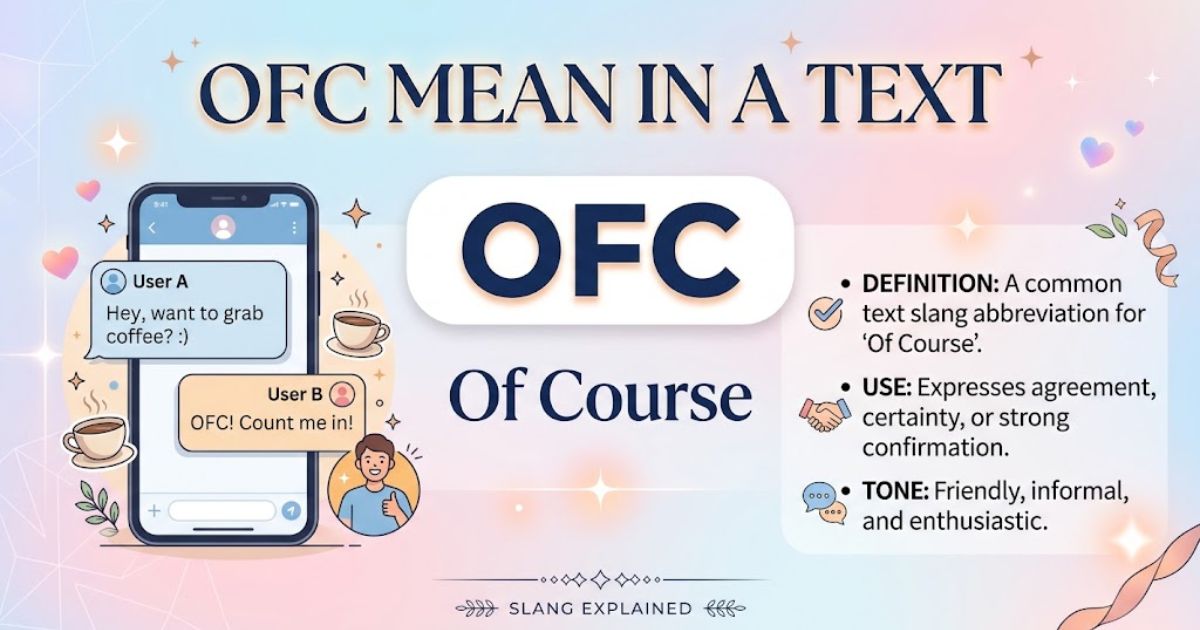
Have you ever received a text that says “OFC” and wondered whether the person is agreeing with you, being sarcastic, or simply replying quickly? You’re not alone. OFC is one of those short texting abbreviations that can mean slightly different things depending on the conversation.
OFC means “Of Course.” It’s a popular internet slang term used in text messages, Snapchat, Instagram, TikTok, and everyday online conversations. People use it to agree, show support, confirm something, or tell someone that something is obvious.
For example, if your friend asks, “Can you help me tomorrow?” and you reply “OFC!”, you’re saying, “Of course!” in a friendly, casual way.
In this guide, you’ll learn what OFC means in text messages, how people use it on social media, what it means when a girl or guy sends it, and how to reply naturally.
What Does OFC Mean in a Text Message? (Quick Answer)
OFC stands for “Of Course.” It’s an informal abbreviation people use when they want to say yes, agree with someone, or confirm something without typing the complete phrase.
Here are a few common examples:
|
Text message
|
Meaning
|
| — | — |
|
“OFC!”
|
Of course!
|
|
“OFC I will.”
|
Of course I will.
|
|
“OFC you can.”
|
Of course you can.
|
|
“OFC 😂”
|
Of course, often with a playful tone.
|
The OFC meaning in texting is usually positive or neutral. However, depending on the conversation, it can also sound sarcastic or slightly annoyed.
Introduction: Why Everyone Keeps Using “OFC” in Texts
Texting has changed the way people communicate. Instead of writing complete sentences, many people prefer short expressions that are easy to type and understand.
That’s where OFC comes in. Rather than writing “Of course, I’d be happy to help,” someone can simply respond with “OFC!”
You’ll often see this abbreviation in conversations between friends, couples, classmates, and people who communicate regularly online. It keeps messages short without losing the basic meaning.
For example, imagine your friend asks, “Are you coming to my birthday party?” A quick reply like “OFC!” sounds natural and friendly.
OFC is especially common in casual American English and online communities, but people use it across many countries and social media platforms.
Read More: What Does WYA Mean in Text? Full Meaning on Snapchat & Social Media
What Does OFC Mean in a Text Message?
In a text message, OFC means “Of Course.” It’s commonly used to express agreement, give permission, confirm plans, or reassure someone.
The abbreviation can replace an entire phrase or fit naturally into a longer sentence.
For instance, if someone asks, “Can I call you later?” replying “OFC” means you’re happy for them to call.
Similarly, if a friend says, “You’re coming with us, right?” and you respond “OFC I am,” you’re confirming that you’ll be there.
The meaning doesn’t change based on whether you’re texting a friend, a boyfriend, a girlfriend, or a family member. What changes is the tone.
Examples:
Example 1:
Friend: “Can you save me a seat?”
You: “OFC!”
Meaning: Of course, I’ll save you a seat.
Example 2:
Friend: “Do you remember our plan?”
You: “OFC I do 😂.”
Meaning: Of course I remember, possibly with a playful or teasing tone.
These examples show why OFC works so well in casual conversations. It’s short, clear, and easy to understand.
Why Do People Use OFC Instead of Writing “Of Course”?
People use OFC because it’s quicker to type and fits naturally into informal digital conversations.
When you’re messaging someone, you don’t always need a complete sentence. A simple abbreviation can communicate the same idea without making the conversation feel formal.
Here are a few reasons people prefer OFC:
Faster communication: Typing three letters is quicker than writing “Of course,” especially during fast conversations.
Casual tone: OFC sounds relaxed and friendly when used with people you know well.
Easy agreement: It lets you say yes or confirm something without explaining further.
Social media familiarity: Many people already recognize OFC from Snapchat, Instagram, TikTok, and messaging apps.
For example, if someone asks, “Do you want to hang out later?” replying “OFC” is a quick way to show you’re interested.
However, if you’re writing an important email or speaking to someone in a formal setting, spelling out “Of course” is usually clearer.
Is OFC Positive or Negative?
OFC is usually positive or neutral, but it can sound different depending on the sender’s tone, punctuation, and relationship with you.
The same three letters can express friendliness, excitement, simple agreement, or sarcasm.
Friendly Tone
When used between friends, OFC often sounds warm and supportive.
Example:
Friend: “Can you help me with this?”
You: “OFC, no problem!”
Here, the sender is happily agreeing to help.
Excited Tone
Adding exclamation marks or emojis can make OFC sound more enthusiastic.
Example:
Friend: “Are you coming to the concert?”
You: “OFC!! 🎉”
This suggests excitement and confirms that you’re planning to attend.
Neutral Tone
Sometimes OFC is simply a straightforward answer without any extra emotion.
Example:
Friend: “Is the store open today?”
You: “OFC, it closes at 10.”
In this case, the abbreviation is part of a normal, informative response.
Sarcastic Tone
OFC can also sound sarcastic when someone thinks the answer should be obvious.
Example:
Friend: “Did you forget your homework again?”
You: “OFC I did 🙄.”
The eye-roll emoji and context suggest frustration or sarcasm rather than genuine excitement.
So, if someone sends you OFC, don’t immediately assume they’re annoyed. Read the rest of the conversation before deciding what they mean.
What Does OFC Mean on Social Media?
The OFC meaning on social media is generally the same as in regular texting: “Of Course.”
However, each platform has its own style of communication, so you may see the abbreviation used in slightly different ways.
OFC on Snapchat

On Snapchat, OFC is commonly used in snaps, private chats, and replies to stories.
For example:
You: “Can I send you another snap?”
Friend: “OFC 😂.”
This means the friend is happy for you to send another snap.
You might also see OFC in conversations about meeting up, sharing pictures, or making plans.
The abbreviation doesn’t have a special Snapchat-only meaning. It still stands for “Of Course.”
OFC on Instagram

On Instagram, OFC appears in direct messages, comments, and replies to stories.
For example:
You: “Can I repost your picture?”
Friend: “OFC!”
The friend is giving permission to repost the picture.
You may also see OFC in comments when someone agrees with a statement or responds to an obvious question.
OFC on TikTok

On TikTok, OFC is often used in comments, direct messages, and conversations about videos.
For example:
Comment: “Would you make a part two?”
Creator: “OFC!”
Here, the creator is saying they would be happy to make another part.
OFC can also appear in humorous comments or sarcastic replies, depending on the video’s context.
OFC in Group Chats
In group chats, OFC is useful when someone asks a question that several people can answer quickly.
For example:
Friend 1: “Are we all meeting at 7?”
Friend 2: “OFC.”
Friend 3: “Yep, see you there!”
It keeps the conversation moving without requiring everyone to type a complete sentence.
When Should You Use OFC?
OFC is appropriate when you’re chatting casually and want to agree, confirm something, or reassure someone.
It’s especially useful when the other person already understands common texting abbreviations.
You can use OFC when someone asks for help, requests permission, checks your plans, or wants to know whether you agree with something.
For example, if your friend asks, “Can I borrow your charger?” replying “OFC” is a natural way to say yes.
You can also use it to reassure someone:
“OFC I remember your birthday!”
Or to confirm plans:
“OFC, I’ll be there at 8.”
The key is to use OFC when a casual response fits the conversation. You don’t need to force it into every message.
When Should You Avoid Using OFC?
Although OFC is widely understood in casual texting, it isn’t suitable for every situation.
If you’re communicating with a client, manager, teacher, or someone you don’t know well, using the complete phrase “Of course” may sound more respectful and professional.
For example, instead of replying to your manager with:
“OFC, I’ll finish it today.”
You could write:
“Of course, I’ll finish it today.”
The second version looks more polished and is less likely to be misunderstood.
You should also avoid using OFC when a question requires a detailed explanation. A short abbreviation might come across as dismissive if someone is asking about something serious.
Real-Life Examples of OFC in Text Conversations
Here are some everyday examples showing how people use OFC in different situations.
Example 1: Making Plans
Friend: “Are you free to hang out tonight?”
You: “OFC! What time?”
Meaning: Of course, I’m available. What time should we meet?
This is a friendly way to confirm your availability and continue planning.
Example 2: Relationship Texting
Girlfriend: “Do you miss me?”
Boyfriend: “OFC, every day ❤️.”
Meaning: Of course I miss you, every day.
In romantic conversations, OFC can sound affectionate or reassuring, especially when paired with a heart emoji or loving words.
However, the abbreviation itself isn’t automatically romantic. The relationship and surrounding messages determine the tone.
Example 3: School Chat
Classmate: “Can you send me today’s notes?”
You: “OFC, I’ll send them after class.”
Meaning: Of course, I’ll send the notes after class.
It’s a quick and casual way to agree to help a classmate.
Example 4: Workplace Chat
Coworker: “Can you check the report before the meeting?”
You: “OFC, I’ll review it this morning.”
Meaning: Of course, I’ll review the report this morning.
This works in an informal workplace chat with colleagues who communicate casually. In a formal email to a client or senior manager, spelling out the phrase is usually more appropriate.
OFC vs Other Popular Text Slang
OFC is one of many abbreviations people use to make online conversations faster. However, it has a different meaning from other common texting terms.
|
Slang
|
Full form
|
Meaning
|
| — | — | — |
|
OFC
|
Of course
|
Agreement or confirmation
|
|
IDK
|
I don’t know
|
Uncertainty
|
|
IDEK
|
I don’t even know
|
Stronger confusion or uncertainty
|
|
IDC
|
I don’t care
|
Lack of concern
|
|
IKR
|
I know, right?
|
Agreement or shared reaction
|
|
FR
|
For real
|
Emphasis or agreement
|
|
TBH
|
To be honest
|
Introducing an honest opinion
|
|
NGL
|
Not gonna lie
|
Introducing a candid statement
|
For example, if someone asks, “Are you coming tonight?” and you reply “OFC,” you’re confirming that you will come.
If you reply “IDK,” you’re saying you’re unsure.
The difference is simple: OFC expresses agreement, while IDK expresses uncertainty.
Why OFC Became Popular in the United States
OFC fits naturally into the informal English used in everyday American texting and online conversations.
In the United States, people frequently shorten common phrases when communicating through messaging apps, social media, and group chats. Expressions like “LOL,” “IDK,” and “BRB” have become familiar parts of digital communication.
OFC follows the same pattern. Because “of course” is already a common phrase in spoken English, shortening it to three letters is easy to understand.
It also works across different situations. Friends can use it to confirm plans, couples can use it to reassure each other, and coworkers can use it in informal workplace messages.
Social media has helped spread the abbreviation beyond the United States, making it recognizable to many English-speaking internet users around the world.
However, its use varies by person and community. Not everyone uses the same texting slang, and some people prefer writing the complete phrase.
Common Mistakes People Make With OFC
Although OFC is easy to understand, a few common mistakes can make your messages sound awkward or confusing.
Using it in formal emails
OFC is informal. Using it in a formal email, business proposal, or professional application may make your writing seem too casual.
Instead of “OFC, I’ll send the document,” write “Of course, I’ll send the document.”
Misreading sarcasm
OFC doesn’t always express genuine agreement or enthusiasm.
For example, “OFC you forgot again 🙄” may be sarcastic or frustrated.
Don’t assume the sender is happy just because they used OFC. Look at the words, emojis, and context.
Overusing abbreviations
Using OFC in every reply can make your conversations feel repetitive.
It’s perfectly fine to use full sentences when you want to sound warmer, clearer, or more thoughtful.
For example, “Of course, I’d love to help you” may feel more personal than a simple “OFC.”
Using it with older audiences
Some older people may understand OFC, while others may not be familiar with texting slang.
If you’re unsure whether someone knows the abbreviation, writing “Of course” is a simple way to avoid confusion.
The goal is to communicate clearly, not to use as many abbreviations as possible.
How to Respond When Someone Says OFC
Your response depends on what the person is agreeing to and the type of conversation you’re having.
If someone says “OFC” after you ask for help, you can reply:
“Thank you! I appreciate it.”
If a friend confirms your plans, you could say:
“Great, see you there!”
If your partner uses OFC in an affectionate message, you might respond:
“Aww, you’re so sweet ❤️.”
And if someone sends “OFC 😂” in a joking conversation, you can simply reply with “LOL” or continue the joke.
You don’t need to respond with another abbreviation just because the other person used one. A natural reply is always fine.
Does OFC Have Other Meanings?
Although OFC most commonly means “Of Course” in texting, the abbreviation can have other meanings in different contexts.
For example, OFC can stand for “Official Fan Club” in entertainment and fan communities. In technical or organizational settings, it may also be used as an abbreviation for a particular term or organization.
However, if you see OFC in a regular text message, Snapchat conversation, Instagram DM, or TikTok comment, the intended meaning is almost always “Of Course.”
The surrounding words will usually tell you whether the person is using the common texting meaning or referring to something else.
Frequently Asked Questions
What does OFC mean in text?
OFC means “Of Course.” It’s a common texting abbreviation used to express agreement, confirmation, permission, or reassurance in casual conversations.
What does OFC mean in texts from a girl or guy?
When a girl or guy sends OFC, it usually means “Of Course.” They may be agreeing with you, confirming something, or reassuring you. The abbreviation itself doesn’t automatically mean romantic interest.
Is OFC rude?
No, OFC isn’t inherently rude. It’s usually friendly or neutral. However, it can sound sarcastic, impatient, or dismissive depending on the conversation and punctuation.
What is OFC in text slang?
OFC is an informal abbreviation for “Of Course.” People use it in messages, social media conversations, and group chats to communicate quickly.
Is OFC commonly used in the United States?
Yes, OFC is recognizable in casual American texting and online communication. It’s also used internationally, particularly among people who communicate in English online.
Final Thoughts
Now you know that OFC means “Of Course” in a text message. It’s a simple, informal abbreviation people use to agree, confirm plans, give permission, or reassure someone.
Whether you see it on Snapchat, Instagram, TikTok, or in a regular text conversation, the meaning is generally the same. The tone can be friendly, excited, neutral, or sarcastic depending on the situation.
If someone texts you “OFC,” read the surrounding conversation to understand exactly how they mean it. And when you’re texting friends or people you know well, feel free to use OFC whenever it sounds natural.
