Have you ever received a message that simply says “IDEK” and wondered whether the person is confused, annoyed, joking, or just doesn’t know what to say? This short abbreviation can express several shades of emotion, but its basic meaning is easy to understand.
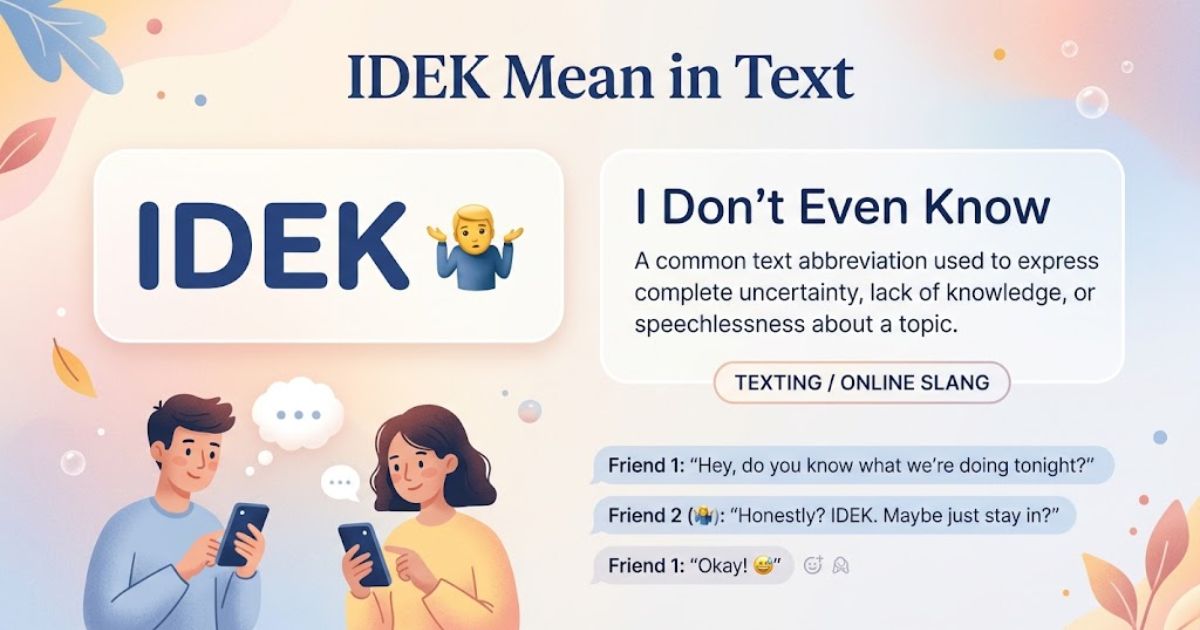
IDEK means “I don’t even know.” People use it in texts, Snapchat conversations, Instagram DMs, TikTok comments, group chats, and other casual online conversations. It can show confusion, uncertainty, frustration, disbelief, or emotional overwhelm.
The important part is the word “even.” Compared with IDK (“I don’t know”), IDEK often suggests that the situation is especially confusing, ridiculous, unexpected, or difficult to explain.
nd dismissive in some situations, while “IDEK 😂” may be completely playful.
Can adults use IDEK?
Yes. Adults can use IDEK in casual texts, DMs, and informal conversations. It’s still slang, though, so standard language is usually better for formal communication.
Is IDEK the same as IDK?
Not exactly. IDK means “I don’t know,” while IDEK means “I don’t even know.” IDEK often adds emphasis and can communicate stronger confusion, disbelief, or frustration.
Why You’re Probably Looking This Up
You might have seen IDEK in a Snapchat message, an Instagram DM, a TikTok comment, or a conversation with a friend and wondered whether it means something different from IDK.
The confusion makes sense. These abbreviations look almost identical, but that extra letter changes the emphasis. IDEK can communicate confusion, disbelief, frustration, or simply not having an answer.
For example, if someone asks, “Why did he suddenly leave the group chat?” and you reply “IDEK 😭,” you’re saying more than just “I don’t know.” You’re also expressing that the situation seems confusing or unexpected.
The important thing is to understand both the literal meaning and the tone. The abbreviation itself doesn’t tell you everything about someone’s feelings.
What It Actually Means in Real Life
IDEK stands for “I Don’t Even Know.” It’s an informal abbreviation used in text messages and online conversations when someone doesn’t have an answer or can’t make sense of a situation.
Wiktionary, the free dictionary+1
The letters break down like this:
- I = I
- D = Don’t
- E = Even
- K = Know
The word “even” adds emphasis. It can make the response sound more confused, surprised, frustrated, or emotionally expressive than a simple “I don’t know.”
Consider these examples:
- “IDEK where I left my keys.” — You genuinely don’t know where they are.
- “IDEK why she said that.” — You’re confused about someone’s behavior.
- “IDEK anymore 😭.” — You’re uncertain or overwhelmed.
- “IDEK how we won that game 😂.” — You’re surprised by an unexpected result.
IDEK doesn’t always signal a serious problem. Sometimes it’s just a playful way to react to something ridiculous.
For instance, if your friend asks why you’ve watched the same funny video ten times, you might reply, “IDEK, it’s too good 😂.” You’re not necessarily looking for an explanation; you’re keeping the conversation light.
How People Use It in Everyday Situations
IDEK works in many everyday conversations because people don’t always have a clear answer. It can be a genuine admission of uncertainty, an emotional reaction, or a casual response when someone asks an unanswerable question.
When you’re confused: “IDEK how this app works.”
When you’re surprised: “IDEK how we finished everything so quickly.”
When you’re frustrated: “IDEK what else I’m supposed to try.”
When you’re joking: “IDEK why I opened the fridge for the fifth time 😭.”
The expression is particularly useful when a longer explanation would feel unnecessary. However, a standalone “IDEK” can sometimes make a conversation stall. If someone needs useful information, it’s better to explain what you do know or offer to find the answer.
For example, instead of replying “IDEK” to a classmate asking about an assignment deadline, you could say, “IDEK, but I’ll check the class group.” That keeps the conversation helpful.
Tone & Context (This Part Really Matters)
The same abbreviation can communicate different emotions depending on the situation. IDEK may sound neutral, funny, frustrated, sarcastic, or even dismissive. The surrounding words, punctuation, emojis, and relationship between the people involved all influence its meaning.
Here are four common ways to interpret it.
- Neutral: “IDEK what time the shop closes.” The person lacks information.
- Confused: “IDEK why that happened.” They’re trying to understand a situation.
- Playful: “IDEK how I survived that exam 😂.” They’re exaggerating for humor.
- Frustrated: “IDEK what you want me to do anymore.” They’re expressing exasperation.
A short “IDEK” isn’t automatically rude or annoyed. Someone may simply be busy or unsure how to respond.
If the conversation feels tense, avoid assuming that the abbreviation tells you exactly what the other person thinks. Asking “What do you mean?” or “Are you okay?” may be more useful than guessing.
When You Should NOT Use This Term
IDEK is perfectly normal in casual texting, but it isn’t the best choice for every conversation. Because it’s informal and can sound vague, think about your audience before using it.
Here are situations where another phrase may work better.
- Formal emails: Replace “IDEK why the report is late” with “I’m not sure why the report is delayed, but I’ll investigate.”
- Workplace discussions: If a colleague needs information, explain what you know and what you still need to check.
- Important decisions: Avoid giving a one-word answer when someone needs a clear recommendation or explanation.
- Sensitive conversations: If a friend is upset, a bare “IDEK” may sound dismissive. Acknowledge their feelings before explaining that you’re unsure what to say.
- Conversations with unfamiliar slang: Use complete words when you aren’t sure whether the other person understands the abbreviation.
For example, if your manager asks why a task hasn’t been completed, replying “IDEK” may sound careless even if you genuinely don’t know. Saying “I’m not sure yet, but I’ll look into it” communicates the same uncertainty while showing that you’re taking responsibility.
Natural Alternatives (Grouped by Tone)
You don’t have to use IDEK every time you’re confused. There are plenty of natural alternatives, and the best one depends on how you want your message to sound.
| Tone | Natural alternatives | Example |
|---|---|---|
| Casual | IDK, no clue, beats me | “No clue where I put it.” |
| Confused | I’m so confused, I have no idea | “I’m so confused about what happened.” |
| Playful | Your guess is as good as mine, who knows? | “Your guess is as good as mine 😂.” |
| Frustrated | I’m honestly lost, I can’t figure it out | “I can’t figure out why it keeps crashing.” |
| Polite | I’m not sure, let me check | “I’m not sure, but I’ll find out.” |
| Professional | I don’t have that information yet | “I don’t have that information yet, but I’ll confirm it.” |
The difference isn’t just formality. Each alternative communicates a slightly different attitude. “Beats me” sounds casual, while “I’m not sure” is more neutral. “I’m honestly lost” makes your confusion more obvious.
Choose the wording that reflects what you actually mean instead of relying on slang to do all the work.
Read More: HMG Mean in Text: Meaning, Uses & Real Examples Explained
Real-Life Examples
The easiest way to understand IDEK is to see how it fits into complete conversations. These examples show how its meaning can shift with context.
1. Making plans
Friend: “Where should we eat tonight?”
You: “IDEK, you choose 😂”
Meaning: You don’t have a preference or can’t decide.
2. Talking about school
Classmate: “Did the teacher change the exam date?”
You: “IDEK. I’ll check the group chat.”
Meaning: You don’t know yet, but you’re willing to find out.
3. Reacting to something surprising
Friend: “How did he finish the entire pizza by himself?”
You: “IDEK 😭”
Meaning: You’re surprised and amused by what happened.
4. Expressing frustration
Friend: “Why isn’t your laptop working?”
You: “IDEK. I’ve restarted it three times.”
Meaning: You’re frustrated because you haven’t found a solution.
5. Talking about relationships
Friend: “Do you think she still likes him?”
You: “IDEK anymore. Their situation is confusing.”
Meaning: You’re uncertain about their relationship.
6. Reacting to a funny mistake
You: “I walked into the kitchen and forgot why I went there.”
Friend: “Again? 😂”
You: “IDEK, my brain needs a restart.”
Meaning: You’re joking about your own forgetfulness.
7. Responding to an unexpected result
Friend: “We actually passed the test!”
You: “IDEK how we pulled that off 😭”
Meaning: You’re surprised and excited about the result.
8. Discussing a confusing message
Friend: “Why did he text you that at 3 a.m.?”
You: “IDEK. It made no sense.”
Meaning: You can’t explain the person’s behavior.
Across these conversations, IDEK consistently communicates uncertainty. The emotional tone comes from the situation and the words around it.
Platform or Culture Notes
IDEK is used across many digital platforms, including Snapchat, Instagram, TikTok, WhatsApp, and ordinary text messaging. Its basic meaning remains “I Don’t Even Know,” regardless of where you see it.
However, different online communities may use it in slightly different ways.
- Snapchat: Often appears in quick, informal exchanges between friends.
- Instagram: Can appear in DMs, comments, and reactions to Stories.
- TikTok: May accompany humorous comments, surprising videos, or confusing situations.
- WhatsApp: Works in private chats and group conversations.
- Gaming communities: Can express confusion about a game mechanic, an unexpected result, or a teammate’s decision.
These are common contexts, not a measured ranking of where IDEK is most popular.
You may also see variations in capitalization. “IDEK,” “idek,” and “Idek” generally mean the same thing. Extra letters or emojis can add emphasis, as in “IDEKKK 😭,” but they don’t change the standard definition.
Online slang also crosses language and age boundaries, so don’t assume everyone understands it. When clarity matters, spelling out “I don’t even know” is always an option.
Common Misunderstandings
IDEK is easy to recognize once you know its full form, but several related abbreviations can cause confusion. Here are some mistakes worth avoiding.
Mistake 1: Thinking IDEK and IDK mean exactly the same thing in every situation.
Both express uncertainty, but IDEK adds emphasis through the word “even.” IDK can sound neutral, while IDEK may sound more confused, surprised, or frustrated. Still, people often use them interchangeably.
Mistake 2: Assuming IDEK always signals frustration.
A person might write “IDEK 😂” because something is funny, not because they’re annoyed. Read the entire message before deciding how they feel.
Mistake 3: Confusing IDEK with IDRK.
IDRK usually means “I Don’t Really Know.” It communicates uncertainty, but it doesn’t include the extra emphasis of “even.”
Wiktionary, the free dictionary+1
Mistake 4: Treating every similar abbreviation as established slang.
Some combinations of letters are widely recognized, while others are uncommon, personal shorthand, or typing mistakes. If you encounter an unfamiliar abbreviation, ask for clarification rather than assuming it has a standard meaning.
FAQs
Is IDEK rude to use?
No. IDEK is generally a casual way to say “I Don’t Even Know.” However, it may sound dismissive if someone is asking an important question and you respond without offering any help. In professional situations, “I’m not sure, but I’ll check” is usually more appropriate.
What’s the difference between IDK and IDEK?
IDK means “I Don’t Know,” while IDEK means “I Don’t Even Know.” IDEK often adds emphasis and can express stronger confusion, disbelief, or frustration. Both are common informal abbreviations, and people sometimes use them interchangeably.
Can you use IDEK sarcastically?
Yes. IDEK can be sarcastic when someone wants to express disbelief or poke fun at a situation. For example, “IDEK why you thought that would work 😂” might be playful teasing. The tone depends on the relationship and the rest of the message.
Does IDEK mean the same thing from guys and girls?
Yes. IDEK generally means “I Don’t Even Know,” regardless of who sends it. It doesn’t have a special meaning based on gender. The sender might be confused, surprised, frustrated, or joking, so consider the conversation rather than assuming a hidden message.
What does IDRK mean?
IDRK usually stands for “I Don’t Really Know.” It’s another texting abbreviation used to express uncertainty. For example, “IDRK when she’ll arrive” means “I don’t really know when she’ll arrive.”
Wiktionary, the free dictionary+1
What about IDFK?
IDFK commonly stands for “I Don’t F***ing Know.” The F-word makes it more vulgar and potentially more aggressive than IDEK or IDK. Some people use it casually among friends, but it may offend others. If you want a polite alternative, use “I have no idea” or “I’m really not sure.”
Wiktionary, the free dictionary+1
Is IFEK a real thing or a typo?
IFEK isn’t a widely established texting abbreviation with one standard meaning comparable to IDEK or IDK. If you see it in a message, it could be a typo, personal shorthand, or an abbreviation specific to a particular group. Check the context or ask the sender what they meant.
What does IDKR mean?
IDKR isn’t as consistently standardized as IDK or IDEK. In some informal conversations, it may be intended as a variation of “I Don’t Know, Really,” but the interpretation can vary. Don’t assume it has one universal meaning; ask the sender if the context doesn’t make it clear.
What does IDE mean in text?
IDE can have several meanings depending on the context. In technology, it commonly stands for Integrated Development Environment, a software application that helps developers write, test, and debug code. In casual texting, its meaning may be different or specific to the conversation. Unlike IDEK, it doesn’t have one universally understood everyday texting meaning.
What does IDER mean?
IDER doesn’t have one widely recognized, standard meaning in everyday English texting comparable to IDEK. It may be a typo, a personal abbreviation, or terminology used within a specific community. If someone sends you IDER, the most reliable approach is to check the surrounding message or ask what they mean.
Conclusion
IDEK means “I Don’t Even Know.” It’s a casual texting abbreviation that expresses uncertainty, confusion, surprise, or frustration, depending on the situation. You may see it in private messages, social media comments, and group chats.
The key difference between IDEK and IDK is the added emphasis of “even.” Although the two expressions are often interchangeable, IDEK can sound more emotional or dramatic.
Use it naturally when chatting with friends, but choose clearer language when you’re communicating professionally or answering an important question. Once you understand the meaning and tone, you’ll find IDEK much easier to interpret in everyday conversations.
