
Have you ever seen someone type “BTA” in a text or social media comment and wondered what those three letters actually mean? Texting abbreviations can be tricky because the same short form may have different meanings depending on the conversation.
When people use BTA meaning in text to describe a person, product, experience, or performance, it commonly stands for “Better Than Average.” In simple terms, it means something is above the normal or expected level. It’s positive, but it doesn’t necessarily mean something is perfect or the absolute best.
For example, if someone says, “That restaurant was BTA,” they’re saying the restaurant was better than average. Likewise, “Your new haircut is BTA” means the haircut looks better than what the person normally considers average.
However, BTA isn’t a completely universal abbreviation. Other slang communities use it differently, including meanings such as “’bout that action.” That’s why the surrounding conversation is important when figuring out exactly what someone means.
What Does BTA Meaning in Text?
The most relevant meaning of BTA in the context of casual texting is “Better Than Average.”
People use it when they want to say that something is good, impressive, or above the usual standard without calling it outstanding or perfect.
Think of a simple rating scale:
Below average → Average → BTA → Excellent → Outstanding
BTA sits comfortably above the middle. It’s a way of giving credit without going overboard.
For example:
“That movie was BTA.”
This means:
“That movie was better than average.”
Someone might also say:
- “Her performance was BTA.”
- “This phone is BTA for the price.”
- “Your new design is BTA.”
- “The food was definitely BTA.”
- “He’s a BTA player.”
The exact tone can range from casual approval to a genuine compliment.
Real-Life Examples
Imagine you ask your friend about a new coffee shop.
You: “How was the coffee?”
Friend: “Honestly, BTA.”
They’re saying the coffee was better than average. They liked it, but they may not consider it the best coffee they’ve ever had.
Another example:
You: “How did my presentation go?”
Friend: “BTA. You explained everything pretty clearly.”
Here, BTA is positive feedback. It suggests the presentation performed better than the normal standard.
In online communities, however, you should always check the surrounding words. BTA has other meanings in slang, so the context can completely change its interpretation.
Origin and Background of the Term
BTA doesn’t have one universally documented origin as a texting abbreviation. Like many internet shortcuts, its meaning has developed through informal online communication.
The phrase “better than average” itself is straightforward English. BTA simply compresses the phrase into three letters, making it quicker to type in casual conversations.
Short abbreviations became increasingly common as texting, instant messaging, social media, gaming communities, and online forums grew. People often shorten familiar phrases because typing a few letters is faster than writing the complete expression.
BTA can therefore function as a quick rating or reaction.
Instead of writing:
“That was better than average.”
Someone may simply write:
“BTA.”
However, BTA is not as universally fixed as abbreviations such as “LOL,” “BRB,” or “OMG.” Different online communities may assign different meanings to the same letters. Some slang references, for example, list BTA as “’bout that action.”
That’s why context should always come first.
Read More: YWA Meaning: What Does YWA Mean in Texting and Chat?
How BTA Is Used in Daily Life
When BTA means “Better Than Average,” it generally expresses approval. People use it to rate experiences, compliment others, describe quality, or react positively to something.
Here are several common situations.
1. Expressing Preference
BTA can help someone express that they prefer something because it performs above the usual standard.
For example:
“I tried both restaurants, but the second one was BTA.”
The speaker is saying the second restaurant was better than average and probably their preferred choice.
It doesn’t necessarily mean the restaurant was exceptional. It simply performed well enough to stand above ordinary options.
2. Showing Appreciation
Someone may use BTA when acknowledging that another person did a particularly good job.
For example:
“Your help with the project was BTA.”
That communicates appreciation while keeping the wording casual.
It can also appear in conversations about gifts, favors, creative work, or personal efforts.
“You really went BTA with that birthday setup.”
Here, the speaker is saying the effort was above what they normally expected.
3. Complimenting Something
BTA can work as a short compliment for almost anything that can be judged or compared.
For example:
“That outfit is BTA.”
“Your photography is BTA.”
“That burger was BTA.”
The phrase gives positive feedback without sounding overly dramatic.
In some conversations, this understated style can actually make the compliment feel more genuine. Instead of saying something is “the greatest thing ever,” the speaker simply says it’s better than average.
4. Talking About Feelings
BTA can sometimes describe how someone feels about an experience.
For example:
“How was the concert?”
“BTA, honestly. I had a good time.”
The speaker is saying the concert was above average and enjoyable.
It can also be used when someone asks about a day, trip, event, or activity:
“How’s your vacation going?”
“BTA so far.”
Here, the person is giving a short, positive assessment.
5. Reacting to Good News
BTA can also appear as a quick reaction when someone shares a positive result.
For example:
Friend: “I got an 85 on my exam.”
You: “BTA! Nice work.”
In this case, BTA recognizes that the result is above average.
The abbreviation works best when both people already understand the shorthand. If there’s any doubt, writing “That’s better than average!” or simply “That’s great!” makes the meaning clearer.
Emotional or Practical Meaning of BTA
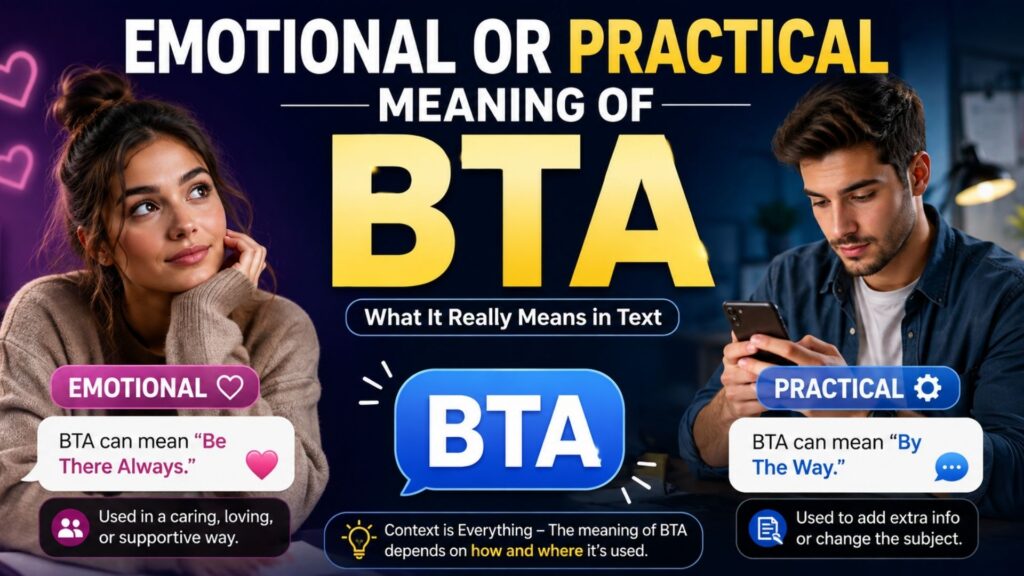
When BTA means “Better Than Average,” its overall emotional meaning is usually positive.
However, the strength of the compliment depends on the context.
Calling something “BTA” usually means:
- It performed above normal expectations.
- It was better than most ordinary examples.
- The speaker approves of it.
- The speaker sees some value or quality in it.
- The speaker isn’t necessarily calling it perfect.
For example, saying:
“Your essay is BTA.”
is positive, but it may not mean:
“Your essay is outstanding.”
That distinction matters. BTA generally gives moderate praise rather than extreme enthusiasm.
A person might use it when they want to be honest and measured. Instead of exaggerating their opinion, they simply say that something is above average.
Similar or Related Terms
Several words and phrases have a similar meaning to BTA when it stands for “Better Than Average.”
| Term | Meaning | Tone |
|---|---|---|
| BTA | Better Than Average | Positive, measured |
| Above average | Better than the normal level | Neutral-positive |
| Pretty good | Good overall | Casual |
| Solid | Dependable or good | Casual |
| Decent | Acceptable or reasonably good | Mildly positive |
| Good | Positive quality | General |
| Great | Strong approval | More enthusiastic |
| Excellent | Very high quality | Strong praise |
| Top-tier | Among the best | Very positive |
The biggest difference is the level of praise.
If someone says “decent,” they may mean something is simply acceptable. If they say “excellent,” they’re giving much stronger praise. BTA sits somewhere in between: it indicates that something has performed better than the ordinary standard.
Common Misunderstandings About BTA
Because BTA can have multiple meanings, it’s easy to misinterpret the abbreviation.
1. It Always Means One Thing
This is probably the biggest misunderstanding.
BTA does not have one universal meaning across every conversation. In one context, it may mean “Better Than Average.” In another slang community, it may mean something completely different.
Always look at the sentence around it.
For example:
“That game was BTA.”
could reasonably support a “Better Than Average” interpretation.
But if BTA appears in a conversation about someone being ready for action, another slang meaning may be intended.
2. It’s Formal
BTA is informal shorthand.
You might see it in:
- Text messages
- Group chats
- Social media
- Gaming communities
- Online comments
- Casual conversations
It generally isn’t appropriate for formal reports, academic writing, business documents, or professional correspondence.
In formal writing, spell out “better than average” instead.
3. Everyone Knows It
Not everyone will recognize BTA immediately.
Unlike extremely common abbreviations such as “LOL” or “IDK,” BTA can be relatively unfamiliar. Its meaning can also change between communities.
So, if you use BTA with someone who doesn’t regularly use internet slang, they may need clarification.
When communicating with a wider audience, spelling out the phrase is usually safer.
4. It’s Negative
When BTA means “Better Than Average,” it is generally positive.
It tells someone that a person, product, experience, or result is above the ordinary level.
However, the praise is somewhat measured. Saying something is BTA isn’t necessarily the same as calling it amazing.
For example:
“The movie was BTA.”
usually means:
“The movie was better than average.”
It doesn’t necessarily mean:
“That movie was one of the greatest movies ever made.”
5. It’s Only for Teenagers
BTA isn’t restricted to one age group.
People of different ages use abbreviations online, particularly when communicating through messaging platforms or online communities.
What matters more is whether the people involved understand the abbreviation and whether it fits the conversation.
Examples of BTA in Sentences
Here are some natural examples of BTA when it means “Better Than Average”:
“That restaurant was BTA for such a small place.”
This means the restaurant was better than expected.
“Your new logo looks BTA.”
This is a casual compliment about the logo.
“The team had a BTA season this year.”
This means the team performed above the usual or expected level.
“How was the new game?”
“BTA. I’d play it again.”
The speaker thought the game was better than average.
“Your presentation was BTA today.”
This means the presentation was above the normal standard.
“That’s a BTA laptop for the price.”
This suggests the laptop offers better-than-average quality or performance for its cost.
“The food was BTA, but the service was slow.”
This shows that BTA can describe one part of an experience without saying everything was excellent.
Why Understanding BTA Meaning in Text Matters Today
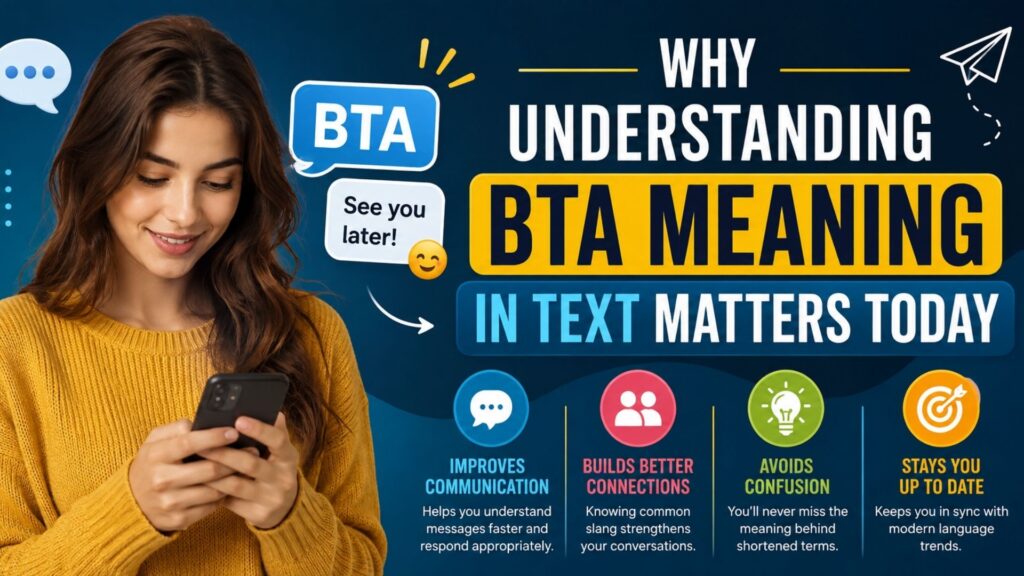
Online communication moves quickly. People often use abbreviations without explaining them, assuming everyone understands the same slang.
That can create confusion when a term has multiple meanings.
Understanding what does BTA mean in text helps you avoid making the wrong assumption. If the conversation is about quality, performance, ratings, or compliments, “Better Than Average” may fit naturally.
For example, if someone says:
“That phone is BTA.”
they’re likely giving it a positive rating.
But if BTA appears in a completely different type of conversation, you shouldn’t automatically apply the same definition.
This is one reason context matters so much with internet slang. The letters themselves are only part of the message. The words around them, the platform, the relationship between the people, and the subject being discussed can all provide clues.
When you’re unsure, a simple question works:
“What do you mean by BTA?”
There’s no need to guess.
FAQs:
What does BTA mean in simple words?
When used to describe quality or performance, BTA commonly means “Better Than Average.” It says that something is above the normal or expected level.
Is BTA positive or negative?
When BTA means “Better Than Average,” it is generally positive. It suggests that something or someone is above the ordinary standard, although it doesn’t necessarily mean perfect or excellent.
Where is BTA commonly used?
BTA may appear in casual text messages, social media posts, group chats, gaming communities, comments, and other informal online conversations. Because BTA has multiple meanings, the context is important.
Is BTA formal or informal?
BTA is generally informal. If you’re writing a professional email, report, or academic paper, it’s clearer to write “better than average” instead.
Why do people search for BTA meaning in text?
People search for the BTA meaning in text because the abbreviation can have different meanings depending on the conversation. They may want to know whether it means “Better Than Average” or another slang expression.
Conclusion:
So, what does BTA mean in text? When it’s being used to describe quality, performance, or an experience, BTA commonly means “Better Than Average.”
It’s a short, positive way to say that something is above the usual standard. You might see it when someone is reviewing a product, complimenting a person, discussing an experience, or reacting to good results.
Still, don’t assume BTA always means the same thing. Internet slang can be highly context-dependent, and BTA has other meanings in different communities.
The easiest way to understand it is to look at the words surrounding the abbreviation. If the conversation is about ratings, quality, or performance, “Better Than Average” is a strong possibility.
