
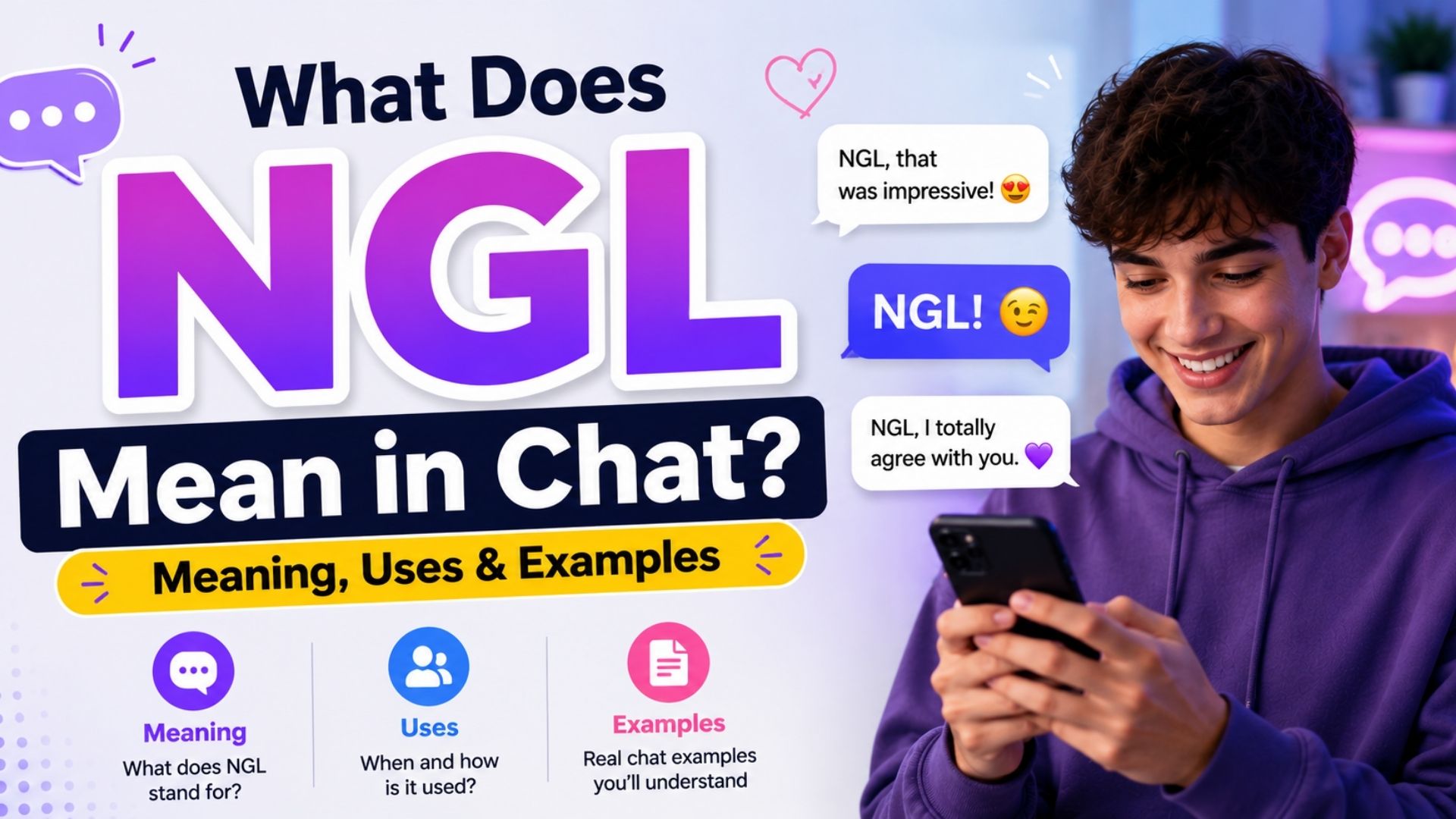
Have you ever been chatting with someone and suddenly seen “NGL” at the beginning of a message? Maybe you understood the rest of the sentence, but those three letters left you wondering what they meant. If so, you’re not alone. Texting abbreviations can sometimes feel like a secret language, especially when you’re seeing one for the first time.
So, what is the meaning of NGL in chat?
In most conversations, NGL means “not gonna lie.” It’s a casual phrase people use when they want to be honest, share a genuine opinion, or introduce something they really feel. For example, someone might say, “NGL, that movie was actually amazing.” In this case, NGL tells you that the person is giving their honest opinion.
However, NGL isn’t limited to positive comments. Someone can use it to introduce praise, criticism, an awkward confession, or even a surprising opinion. The phrase often works like a little signal that says, “Okay, I’m going to be honest with you.”
You’ll commonly see NGL in text messages, Snapchat conversations, Instagram DMs, TikTok comments, group chats, and other informal online spaces. Understanding the phrase can help you read the tone behind a message instead of focusing only on the literal words.
In this guide, we’ll explain the meaning of NGL in chat, where the abbreviation came from, how people use it in everyday conversations, and what emotional tone it can add. You’ll also find realistic examples, similar expressions, common misunderstandings, and answers to frequently asked questions.
What Does NGL Meaning in Text?
The most common meaning of NGL in chat is “not gonna lie.”
It’s an abbreviation of the informal phrase “not gonna lie,” which is itself a casual way of saying “to be honest” or “honestly.”
People often use NGL when they’re about to express a sincere opinion or reveal how they genuinely feel about something.
For example:
“NGL, I really enjoyed that movie.”
This means:
“Honestly, I really enjoyed that movie.”
Another example:
“NGL, I was nervous before the presentation.”
Here, the person is being open about their feelings.
NGL can appear at the beginning of a sentence, in the middle of a message, or occasionally as a standalone response.
For example:
“That was a tough exam, NGL.”
The meaning is essentially:
“That was a tough exam, honestly.”
The abbreviation is popular because it’s short, recognizable, and adds a conversational feeling to digital messages. It can make an opinion sound more personal, as though the speaker is letting you in on what they genuinely think.
Real-Life Examples:
Example 1: Giving an honest opinion
“NGL, this restaurant is better than I expected.”
The person is emphasizing that they’re being sincere about their opinion.
Example 2: Admitting a feeling
“NGL, I was pretty nervous about meeting everyone.”
Here, NGL introduces a personal admission.
Example 3: Giving a compliment
“NGL, you did a really good job on that project.”
The speaker is emphasizing that the compliment is genuine.
Example 4: Sharing criticism
“NGL, I didn’t really like the ending.”
The person is politely introducing a negative opinion.
Example 5: Making a confession
“NGL, I almost forgot about the meeting.”
The abbreviation makes the admission sound casual and honest.
Example 6: Expressing surprise
“NGL, I didn’t think you would actually do it.”
Here, NGL introduces the speaker’s genuine reaction.
These examples show that NGL isn’t automatically positive or negative. Its main purpose is to signal honesty or sincerity.
Read more: What Does STSU Mean in Text? Meaning, Slang & Examples
Origin and Background of the Term

NGL developed as part of the wider world of internet slang and digital communication. It comes from the phrase “not gonna lie,” which has been used in casual spoken English for a long time.
As texting, instant messaging, and social media became more popular, people began shortening familiar phrases to communicate more quickly. Abbreviations like NGL made it possible to express a complete idea using only three letters.
The rise of social media helped spread the term even further. Platforms built around short posts and quick interactions made concise expressions especially useful.
Today, NGL is widely recognized in casual online communication. You might encounter it in:
- Text messages
- Snapchat chats
- Instagram DMs
- TikTok comments
- Group chats
- Gaming conversations
- Online forums
- Social media posts
The phrase also became popular because it fits naturally into everyday conversation. People often say “not gonna lie” when they’re about to share an honest opinion, so shortening it to NGL feels natural in a text.
It’s worth noting that internet slang doesn’t always have a single moment when it suddenly appears. Terms usually become popular gradually as people adopt them across different communities and platforms. NGL is a good example of that evolution.
How NGL Is Used in Daily Life
The meaning of NGL in chat becomes clearer when you see how flexible the expression can be.
People use NGL to introduce opinions, confessions, compliments, complaints, and personal reactions. In many cases, it acts like a verbal pause before someone says what they really think.
For example:
“NGL, I didn’t expect you to finish that so quickly.”
The speaker is emphasizing that this is their genuine reaction.
NGL can also make a compliment feel more sincere:
“NGL, that outfit looks really good on you.”
Or it can introduce criticism in a relatively casual way:
“NGL, I think the old version was better.”
In both cases, NGL signals that the speaker is expressing a real opinion.
People also use it to admit something that might be slightly embarrassing:
“NGL, I still don’t understand how this game works.”
This makes the admission feel more relaxed and conversational.
Another common use is to emphasize a surprising reaction:
“NGL, I actually liked the movie.”
The implication may be that the speaker expected not to like it but ended up enjoying it.
Because of this flexibility, NGL has become a useful phrase in everyday digital communication. It can make a message feel more direct without necessarily making it harsh.
Emotional or Practical Meaning of NGL
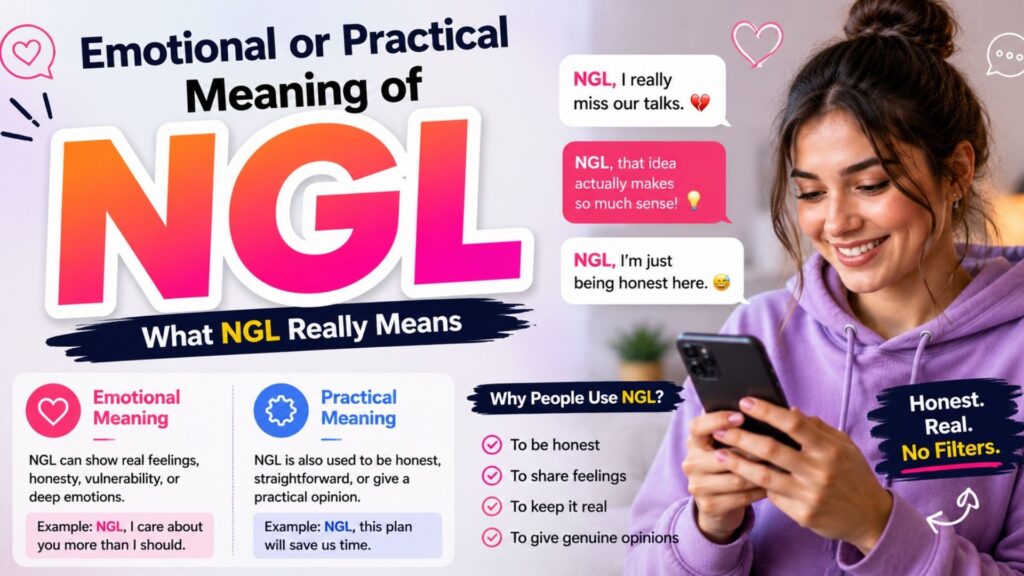
NGL has both a practical and emotional function.
Practically, it helps people introduce an honest statement without writing a longer phrase such as “To be completely honest with you.”
Emotionally, it can create a sense of openness. When someone says “NGL,” it can feel as though they’re lowering their guard and sharing what they genuinely think.
For example:
“NGL, I was really upset about what happened.”
This sounds more personal than simply saying:
“I was upset.”
The abbreviation draws attention to the honesty of the statement.
However, NGL doesn’t guarantee that the following statement is objectively true. It simply signals that the speaker is presenting it as their genuine opinion or feeling.
That’s an important distinction.
If someone says:
“NGL, this is the best pizza ever.”
They’re not stating a fact that can be scientifically proven. They’re expressing a personal opinion and emphasizing that it’s sincere.
Similarly:
“NGL, I think you should reconsider.”
This is an honest suggestion, not necessarily an absolute truth.
In simple terms, NGL is more about perceived sincerity than factual accuracy.
Similar or Related Terms
If you’re learning the meaning of NGL in chat, you’ll probably come across several similar expressions.
| Term | Meaning | Typical Use |
|---|---|---|
| NGL | Not gonna lie | Introducing an honest opinion |
| TBH | To be honest | Expressing sincerity |
| IMO | In my opinion | Sharing a personal view |
| IMHO | In my humble opinion | Giving an opinion, often casually |
| FR | For real | Emphasizing agreement or sincerity |
| Honestly | A direct expression of honesty | Introducing a genuine thought |
| TBF | To be fair | Adding balance to an argument |
| IKR | I know, right? | Agreeing enthusiastically |
| Lowkey | Quietly or somewhat | Expressing a subtle feeling |
| No cap | No lie / I’m being honest | Emphasizing truthfulness |
NGL and TBH are especially similar.
For example:
“NGL, I really like this song.”
and:
“TBH, I really like this song.”
Both communicate honesty.
However, there can be slight differences in style. NGL often feels more casual and conversational, while TBH can sometimes introduce a more direct personal opinion.
Similarly, “no cap” is often used to emphasize that someone is telling the truth, but it belongs to a different style of internet slang.
The exact choice depends on the speaker and the platform they’re using.
Common Misunderstandings About NGL
NGL is a simple abbreviation, but people sometimes misunderstand how it’s used. Let’s clear up a few common misconceptions.
1. It’s Not Always Negative
One of the biggest misunderstandings is that NGL always introduces criticism.
That’s not true.
NGL can introduce positive statements just as easily as negative ones.
For example:
“NGL, you look amazing today.”
That’s clearly a compliment.
Or:
“NGL, this is probably the best meal I’ve had all month.”
Again, the statement is positive.
The abbreviation simply signals that the speaker is being honest. The statement that follows determines whether the message is positive, negative, or neutral.
2. It’s Not Rude by Default
NGL isn’t automatically rude.
However, because it often introduces an honest opinion, what follows can sometimes sound blunt.
For example:
“NGL, I don’t like your idea.”
The NGL itself isn’t rude. The rest of the sentence is simply direct.
You could soften the message by saying:
“NGL, I’m not sure that idea will work, but maybe we could try something else.”
Here, the speaker remains honest while being more considerate.
So, whether NGL feels rude depends largely on the words that come after it and the overall tone of the conversation.
3. It’s Not Formal
NGL is definitely informal.
You might use it in a text to a friend or in a casual social media conversation, but it wouldn’t normally belong in a formal business email or academic essay.
For example, instead of writing:
“NGL, I think this report needs more research.”
in a professional email, you could write:
“Honestly, I think this report would benefit from additional research.”
The second version communicates the same basic idea in a more professional way.
4. It’s Not Just for Teens
Although NGL is common among younger internet users, it isn’t exclusively used by teenagers.
Anyone who regularly communicates through texting and social media may encounter or use the abbreviation.
Internet slang often spreads across age groups, especially when people use the same messaging apps and online platforms.
Of course, individual preferences vary. Some people love abbreviations, while others prefer writing complete words.
5. It Doesn’t Always Start a Sentence
Many people assume NGL must appear at the beginning of a sentence.
That’s not true.
It can also appear at the end:
“That movie was surprisingly good, NGL.”
Or in the middle:
“I was, NGL, a little nervous about it.”
The most common placement is probably at the beginning, but people use it wherever it fits naturally into their writing style.
Examples of NGL in Sentences
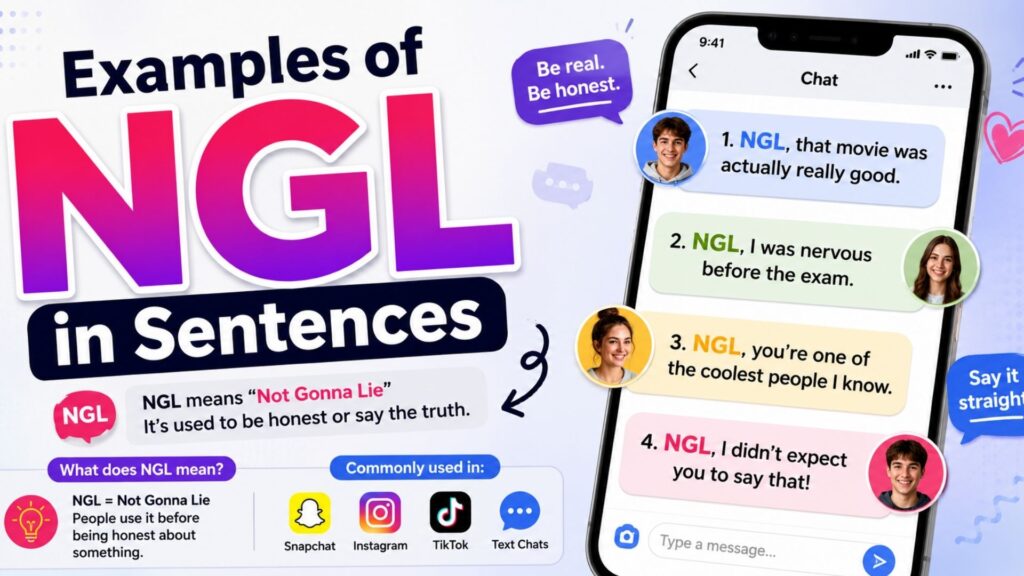
Here are some realistic examples that show the meaning of NGL in chat in different situations.
Example 1: Giving a compliment
“NGL, your presentation was really impressive.”
The speaker is emphasizing that the compliment is genuine.
Example 2: Sharing an opinion
“NGL, I think the first season was better.”
The person is introducing a personal opinion.
Example 3: Admitting nervousness
“NGL, I was nervous before the interview.”
The abbreviation introduces a personal confession.
Example 4: Expressing surprise
“NGL, I didn’t think you’d actually show up.”
The speaker is being honest about their expectations.
Example 5: Talking about food
“NGL, this burger is incredible.”
The speaker is emphasizing how much they genuinely enjoyed the food.
Example 6: Giving constructive criticism
“NGL, I think you could improve the introduction.”
The person is offering an honest opinion without necessarily trying to be rude.
Example 7: Talking about entertainment
“NGL, I didn’t expect to like that show as much as I did.”
The phrase emphasizes the speaker’s genuine surprise.
Example 8: A casual confession
“NGL, I completely forgot about your birthday.”
The speaker is openly admitting a mistake.
Example 9: Expressing agreement
“NGL, you’re right about that.”
Here, NGL reinforces the sincerity of the agreement.
Example 10: At the end of a sentence
“That was one of the funniest things I’ve seen all week, NGL.”
The meaning remains the same even though the abbreviation appears at the end.
These examples demonstrate the flexibility of NGL. Whether it’s used for praise, criticism, surprise, or confession, the central idea remains the same: the speaker is emphasizing honesty or sincerity.
Why Understanding NGL Meaning in Text Matters Today
Digital communication has changed how people express themselves. Conversations that once happened face-to-face now take place through short messages, DMs, comments, and group chats.
As a result, people rely heavily on abbreviations to communicate tone and emotion quickly.
Understanding the meaning of NGL in chat helps you interpret these messages more accurately.
For example, consider this message:
“NGL, I didn’t think you’d actually do it.”
Depending on the context, this could be a compliment, a joke, or a mild criticism. But the NGL tells you that the speaker is emphasizing their genuine reaction.
It also helps you understand the difference between a statement and an opinion.
If someone says:
“NGL, this is the best restaurant in town.”
They’re not necessarily claiming an objective fact. They’re expressing a strong personal opinion.
This distinction becomes especially important online, where short messages can sometimes be misunderstood.
NGL can also help make conversations feel more personal. When someone says “NGL,” they’re often signaling that they’re about to share something they genuinely think or feel.
However, you shouldn’t assume that every use of NGL represents complete or objective truth. People can still be mistaken, exaggerate, joke, or use the phrase sarcastically.
The best way to understand any message is to consider the entire conversation and the relationship between the people involved.
FAQs
What does ngl meaning in text in simple words?
NGL means “not gonna lie.” In simple words, people use it to introduce an honest opinion, genuine feeling, or personal reaction. It’s similar to saying “honestly” or “to be honest.”
Is ngl positive or negative?
NGL can be positive, negative, or neutral. The abbreviation itself doesn’t have a positive or negative meaning. The words that follow it determine the overall tone.
Where is ngl commonly used?
NGL is commonly used in text messages, Snapchat, Instagram DMs, TikTok, social media comments, group chats, gaming conversations, and other informal online communication.
Is ngl formal or informal?
NGL is informal internet slang. It’s suitable for casual conversations but generally isn’t appropriate for formal emails, academic writing, professional reports, or official communication.
Why do people search for ngl meaning in text?
People search for the meaning of NGL in chat because texting abbreviations can be confusing, especially when someone encounters them for the first time. NGL usually means “not gonna lie” and is used to signal honesty or introduce a genuine opinion.
Conclusion
So, what is the meaning of NGL in chat? In most cases, NGL means “not gonna lie.” It’s a casual abbreviation people use when they want to emphasize that they’re being honest, sincere, or genuine about what they’re saying.
You might see NGL before a compliment, criticism, confession, opinion, or surprising reaction. It doesn’t automatically make a message positive or negative. Instead, it acts like a signal that says, “Here’s what I really think.”
The abbreviation is common in texts, social media DMs, group chats, and other informal digital conversations. It’s also flexible enough to appear at the beginning, middle, or end of a sentence.
The next time someone sends you a message starting with “NGL,” you’ll know what they’re doing: they’re probably about to give you their honest take.
Just remember that context still matters. NGL signals sincerity, but the statement that follows—and the relationship between the people talking—determines the real tone of the conversation.
