Have you ever seen someone reply with “SMH” and wondered whether they were annoyed, disappointed, joking, or simply confused? If so, you’re not alone. SMH meaning in text is one of the most common internet slang expressions, and its meaning becomes much clearer when you understand the emotion behind it.
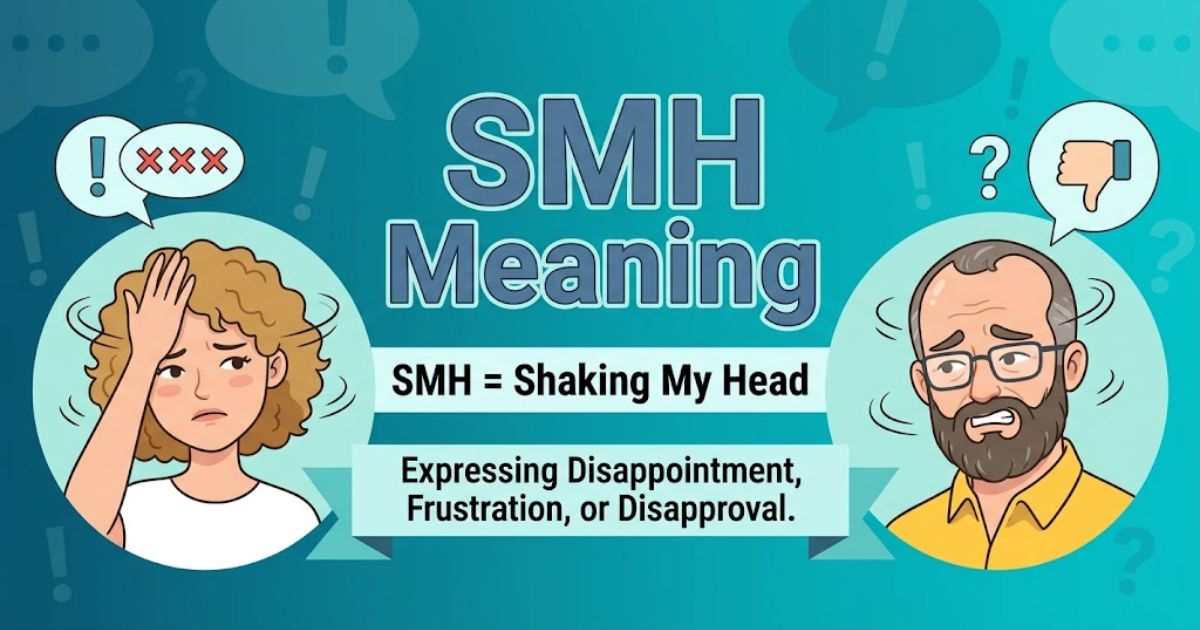
SMH stands for “shaking my head.” People use it in texting, chats, comments, social media posts, and online conversations to express disappointment, disbelief, frustration, embarrassment, or mild annoyance.
Unlike some texting abbreviations that simply shorten a phrase, SMH communicates an attitude. Imagine someone hearing something so silly that they literally shake their head. That’s essentially the feeling behind SMH.
In this guide, you’ll learn what SMH means in text, where it came from, how people use it, what emotions it can express, how its tone changes, and when you should or shouldn’t use it.
What Does SMH Mean in Text?
SMH means “shaking my head” in text messages and online communication.
People typically use it when they react negatively to something without wanting to write a long explanation. It can communicate anything from mild disappointment to disbelief.
For example:
Friend: “I forgot my keys inside again.”
You: “SMH 😂”
Here, SMH doesn’t necessarily mean you’re angry. You’re playfully expressing disbelief or mild frustration.
Another example:
“He showed up two hours late. SMH.”
In this case, SMH communicates disappointment or annoyance.
The meaning depends heavily on context. A message like “SMH 😭” can even sound humorous, while “SMH.” with a period may feel more serious or critical.
Quick Meaning at a Glance
| Term | Meaning | Typical Emotion | Common Use |
|---|---|---|---|
| SMH | Shaking my head | Disbelief, frustration, disappointment | Texting and social media |
| SMH 😂 | Shaking my head | Amusement + disbelief | Funny situations |
| SMH 😭 | Shaking my head | Overwhelmed amusement or frustration | Casual chats |
| SMH 🙄 | Shaking my head | Annoyance | Irritating situations |
| SMH alone | Shaking my head | Reaction without explanation | Quick replies |
In simple terms, SMH is a reaction. It’s similar to saying, “I can’t believe this,” “Seriously?” or “What are you doing?”
The Origin of SMH
SMH stands for “shaking my head,” a phrase that describes the physical gesture people make when they disagree with, disapprove of, or feel disappointed by something.
The abbreviation became popular through internet forums, instant messaging, text messages, and social media. As online communication became faster, users increasingly shortened common expressions into acronyms.
SMH eventually became part of everyday internet slang. Unlike a phrase that belongs to one particular platform, it spread across many forms of digital communication.
Why Did It Become So Popular?
One reason is simplicity.
Typing “shaking my head” takes much longer than typing three letters: SMH.
The abbreviation also captures an emotion that can be difficult to express through plain text. When you’re talking face-to-face, your facial expression or body language can communicate disappointment instantly. In text, abbreviations like SMH help fill that gap.
For example:
“You spent $200 on that?”
“SMH.”
The three letters communicate a reaction without requiring a long explanation.
When Do People Use SMH?
People use SMH in several situations, but the underlying idea is usually a reaction to something they find disappointing, unbelievable, frustrating, embarrassing, or mildly annoying.
1. Disappointment
SMH can express disappointment when someone makes a poor decision or fails to meet expectations.
“You forgot her birthday? SMH.”
The sender is expressing disappointment, although the seriousness depends on the relationship and context.
2. Disbelief
Sometimes something is so surprising that you simply don’t know what to say.
“He bought another gaming keyboard even though he already has five. SMH.”
Here, SMH communicates disbelief rather than serious anger.
3. Frustration
People also use SMH when something repeatedly goes wrong.
“The website crashed right before I finished the order. SMH.”
The abbreviation adds a feeling of frustration to the message.
Read More: FN Meaning: What Does FN Mean in Text, Chat & Social Media?
4. Embarrassment
SMH can describe an embarrassing situation, particularly when someone makes an obvious mistake.
“I walked into the wrong classroom again. SMH.”
The sender is essentially saying, “I can’t believe I just did that.”
5. Mild Annoyance
SMH can communicate annoyance without sounding extremely angry.
“He keeps leaving the lights on. SMH.”
In many casual conversations, the expression is more sarcastic or exasperated than genuinely hostile.
Different Emotions Behind SMH
Although SMH meaning in text literally refers to “shaking my head,” the emotional meaning can vary.
Depending on context, SMH may express:
- Disbelief
- Disappointment
- Frustration
- Annoyance
- Embarrassment
- Exasperation
- Amusement
- Sarcasm
- Disapproval
- Confusion
That’s why you shouldn’t interpret SMH from the letters alone.
Compare these:
“SMH 😂” — probably playful.
“SMH 🙄” — more annoyed.
“SMH…” — may sound disappointed or tired.
“SMH.” — can feel more direct or critical.
The surrounding words and emojis often determine the emotional temperature.
How to Use SMH Correctly in Text Messages
There isn’t one strict grammatical rule for SMH. It can appear at different points in a sentence depending on the effect you want.
SMH at the Beginning
Putting SMH at the beginning emphasizes your reaction.
“SMH, you really forgot your wallet again?”
This sounds like immediate disbelief or frustration.
SMH at the End
Using SMH at the end allows the main statement to come first.
“He missed the easiest shot of the game, SMH.”
This often feels like a reaction added after describing the situation.
SMH Alone
You can also send SMH by itself.
Friend: “I left my phone at home again.”
You: “SMH 😂”
A standalone SMH works best when both people already understand the situation.
SMH with Emojis
Emojis can make the intended tone clearer.
“SMH 😂” can suggest humorous disbelief.
“SMH 🙄” often suggests annoyance.
“SMH 😭” can express exaggerated frustration or amusement.
“SMH 🤦” strongly emphasizes frustration or disbelief.
Using an emoji can prevent a short message from sounding harsher than you intended.
Real-Life Examples of SMH in Conversations
Here are a few everyday examples that show how naturally SMH can fit into a conversation.
Example 1
Alex: “I studied all night and forgot to bring my exam to class.”
Sam: “SMH 😭”
Here, SMH expresses disbelief and sympathetic frustration.
Example 2
Mia: “He said he didn’t know there was a meeting, even though I reminded him three times.”
Chris: “SMH.”
The expression communicates annoyance and disbelief.
Example 3
Jake: “I ordered pizza and accidentally entered my old address.”
Liam: “SMH 😂”
The emoji makes the response playful rather than harsh.
Example 4
Sara: “My brother finished the snacks I was saving.”
Emma: “SMH. That’s criminal 😂”
Here, SMH adds a humorous reaction to an everyday annoyance.
SMH Meaning on Social Media Platforms
The basic SMH meaning generally remains the same across social media platforms: “shaking my head.”
However, the way people use it can vary depending on the community and conversation.
SMH on Snapchat
On Snapchat, SMH may appear in direct messages, captions, or replies.
For example:
“You really posted that? SMH 😂”
The expression can be playful, teasing, or genuinely critical depending on the relationship.
SMH on Instagram
Instagram users commonly use SMH in comments, DMs, captions, and replies.
“SMH, I can’t believe you did that 😂”
In a comment, it may be used as a quick reaction to a funny, surprising, or questionable post.
SMH on TikTok
On TikTok, SMH often appears in comments and captions when viewers react to something surprising, awkward, funny, or frustrating.
For example:
“SMH, why did he do that? 😭”
The expression can be exaggerated for comedic effect.
SMH on Facebook
Facebook users may use SMH in posts, comments, and Messenger conversations.
For example:
“People really believe everything they read online. SMH.”
Here, the tone is more critical than humorous.
SMH in Gaming Chats
Gamers often use SMH when reacting to mistakes, missed opportunities, or surprising plays.
For example:
“You had an open goal and still missed. SMH 😂”
Gaming communities also have many other abbreviations, so the exact tone depends on the situation and group.
Common Situations Where People Use SMH
You might see SMH when someone:
- Makes an obvious mistake
- Does something unexpected
- Makes a questionable decision
- Forgets something important
- Misses an easy opportunity
- Says something unbelievable
- Creates an awkward situation
- Repeats the same mistake
- Behaves irresponsibly
- Experiences frustrating bad luck
The common thread is a reaction of “I can’t believe this.”
Examples of SMH in Everyday Text Conversations
The easiest way to understand SMH is to see it in different everyday situations.
Example 1: School
“I studied for three hours and the test was on a completely different chapter. SMH.”
Here, SMH expresses frustration and disappointment.
Example 2: Work
“The meeting was moved to the exact time we already agreed wasn’t available. SMH.”
This communicates mild annoyance.
Example 3: Sports
“He missed an open goal from five feet away. SMH 😭”
Here, SMH expresses disbelief and possibly humorous frustration.
Example 4: Family
“My brother ate the leftovers I clearly labeled. SMH 😂”
The abbreviation makes the complaint playful.
Example 5: Online Shopping
“I ordered the wrong size for the third time. SMH.”
This expresses frustration with yourself rather than necessarily criticizing someone else.
How the Tone of SMH Changes
The punctuation, wording, emojis, and relationship between the people can dramatically change how SMH sounds.
Consider:
“SMH 😂”
Usually playful or humorous.
“SMH 🙄”
More annoyed or dismissive.
“SMH…”
May sound tired, disappointed, or frustrated.
“SMH!!!”
Stronger emotional reaction.
“Seriously, SMH.”
More openly critical.
This is why texting can sometimes cause misunderstandings. A three-letter reaction doesn’t provide the same facial expressions and voice tone that you’d get during an in-person conversation.
SMH vs Other Popular Text Abbreviations
SMH belongs to a large group of internet abbreviations, but each one communicates something different.
| Abbreviation | Meaning | Typical Purpose |
|---|---|---|
| SMH | Shaking my head | Disbelief or frustration |
| LOL | Laughing out loud | Amusement |
| OMG | Oh my God | Surprise or shock |
| WTF | What the f*** | Strong surprise, anger, or disbelief |
| IDK | I don’t know | Uncertainty |
| TBH | To be honest | Introducing an honest opinion |
| BTW | By the way | Adding information |
| IMO | In my opinion | Giving an opinion |
| FYI | For your information | Sharing information |
| BRB | Be right back | Temporarily leaving a chat |
The difference is especially clear between SMH and LOL. LOL communicates laughter or amusement, while SMH usually communicates disbelief, frustration, disappointment, or disapproval.
Sometimes they can appear together:
“He tried to open the door with his car keys. SMH LOL.”
That means the situation is both ridiculous and funny.
Common Mistakes People Make When Using SMH
SMH is easy to understand once you know it, but there are still situations where using it can create confusion.
Using It in Formal Emails
SMH is informal internet slang. It generally doesn’t belong in formal emails, official correspondence, academic writing, or serious professional documents.
Instead of:
“SMH, this report is late again.”
a workplace message might say:
“I’m concerned that the report has been delayed again.”
The second version communicates the concern clearly without relying on slang.
Using It Without Context
Sending only “SMH” to someone who has no idea what you’re reacting to can be confusing.
If the situation isn’t obvious, explain your reaction.
Instead of:
“SMH.”
you could write:
“SMH, I can’t believe you forgot the appointment again.”
Now the recipient knows exactly what you mean.
Using It During Serious Conversations
SMH can sound dismissive during sensitive conversations.
If someone is discussing a serious personal problem, replying with “SMH” may make them feel judged or ignored.
In those situations, a direct and empathetic response is usually clearer.
Assuming Everyone Knows It
Not everyone uses internet slang. Someone unfamiliar with texting abbreviations may not know what SMH means.
When communicating with a new person, especially in a professional environment, standard language is safer.
Tips for Using SMH Naturally
Use SMH when your reaction is genuinely one of disbelief, frustration, disappointment, embarrassment, or mild annoyance.
Keep the context clear when necessary. If you think the message could sound harsh, add an emoji or explain what you mean.
For example:
“SMH 😂 I can’t believe you actually did that.”
sounds very different from:
“SMH. Unbelievable.”
The first feels playful. The second can sound critical.
A good rule is to match the tone of the conversation rather than using SMH simply because you’ve seen other people use it.
Can SMH Be Funny?
Absolutely. SMH is frequently used humorously.
People often exaggerate their reactions to ordinary situations:
“SMH, my cat ignored me for six hours.”
“SMH 😂 I forgot why I walked into the kitchen.”
“SMH, my phone was in my hand while I was searching for it.”
In these examples, SMH isn’t expressing serious disapproval. It adds a playful “I can’t believe I just did that” feeling.
That flexibility is one reason the abbreviation works so well in casual conversations.
Should You Use SMH in Professional Conversations?
It depends on the setting and relationship.
In a relaxed workplace chat where colleagues regularly use casual language, SMH may be understood. However, in formal professional communication, it’s usually better to avoid it.
Good Places to Use SMH
SMH can fit naturally in:
- Casual texts
- Friends’ group chats
- Informal DMs
- Social media comments
- Gaming chats
- Casual conversations
- Humorous online discussions
Places to Avoid Using SMH
Be more cautious with SMH in:
- Formal emails
- Job applications
- Business proposals
- Official documents
- Academic assignments
- Customer complaints
- Sensitive workplace conversations
- Serious personal discussions
The goal isn’t to avoid slang completely. It’s to choose language that matches the situation.
Similar Slang Words You Should Know
If you’re learning modern texting language, several expressions appear alongside SMH.
Facepalm describes the gesture of putting your hand over your face because something is embarrassing, ridiculous, or frustrating.
OMG expresses surprise or shock.
LOL indicates laughter or amusement.
WTH means “what the heck” and can express surprise or confusion.
IDK means “I don’t know.”
TBH means “to be honest.”
FR means “for real” and is often used to emphasize agreement or sincerity.
Understanding these terms makes online communication much easier to follow, especially when people combine multiple abbreviations in a single conversation.
Why SMH Has Stayed Popular for So Long
SMH has lasted because it solves a simple communication problem: how do you express a strong reaction quickly in text?
In face-to-face conversation, you can shake your head, raise your eyebrows, sigh, or laugh. Text messages don’t automatically carry those physical signals.
SMH gives the reader a compact clue about your reaction.
It’s also flexible. The same three letters can express playful disbelief between friends or genuine frustration in a more serious discussion.
That combination of speed, emotional meaning, and flexibility has helped SMH remain recognizable across different forms of online communication.
Quick Recap: SMH Meaning in Text
SMH means “shaking my head.”
It’s commonly used in texting, chats, social media, gaming conversations, and informal online communication.
The expression can communicate:
- Disbelief
- Disappointment
- Frustration
- Embarrassment
- Mild annoyance
- Amusement
- Disapproval
The exact tone depends on the context, punctuation, emojis, and relationship between the people communicating.
If someone sends you “SMH,” they’re usually reacting to something with a feeling similar to “I can’t believe this” or “Seriously?”
FAQs
1. What does SMH mean in text?
SMH means “shaking my head.” People use it to express disbelief, disappointment, frustration, annoyance, embarrassment, or disapproval.
2. Is SMH considered rude?
Not necessarily. SMH can be playful among friends, but it may sound dismissive or critical in certain situations. Context and tone matter.
3. Can I use SMH in professional emails?
It’s generally better to avoid SMH in formal professional emails. Writing the full thought makes your message clearer and more appropriate.
4. What is the difference between SMH and LOL?
SMH usually expresses disbelief, frustration, or disappointment, while LOL generally indicates laughter or amusement. They can also be used together when something is both ridiculous and funny.
5. Do people still use SMH in 2026?
Yes. SMH remains recognizable internet and texting slang in 2026, particularly in casual digital communication. Its frequency can vary by age group, platform, and online community.
Final Thoughts
Understanding SMH meaning in text is easier when you think of it as a written reaction rather than just three letters. SMH means “shaking my head,” and people use it when something makes them feel disappointed, frustrated, surprised, embarrassed, amused, or mildly annoyed.
The same abbreviation can sound completely different depending on the context. “SMH 😂” may be playful, while “SMH.” can sound more serious or critical.
So, if you see SMH in a text, comment, Snapchat message, Instagram DM, TikTok comment, Facebook post, or gaming chat, look at the surrounding words before deciding exactly how the sender feels. Once you understand that context, SMH becomes one of the easiest and most useful texting abbreviations to recognize.
