
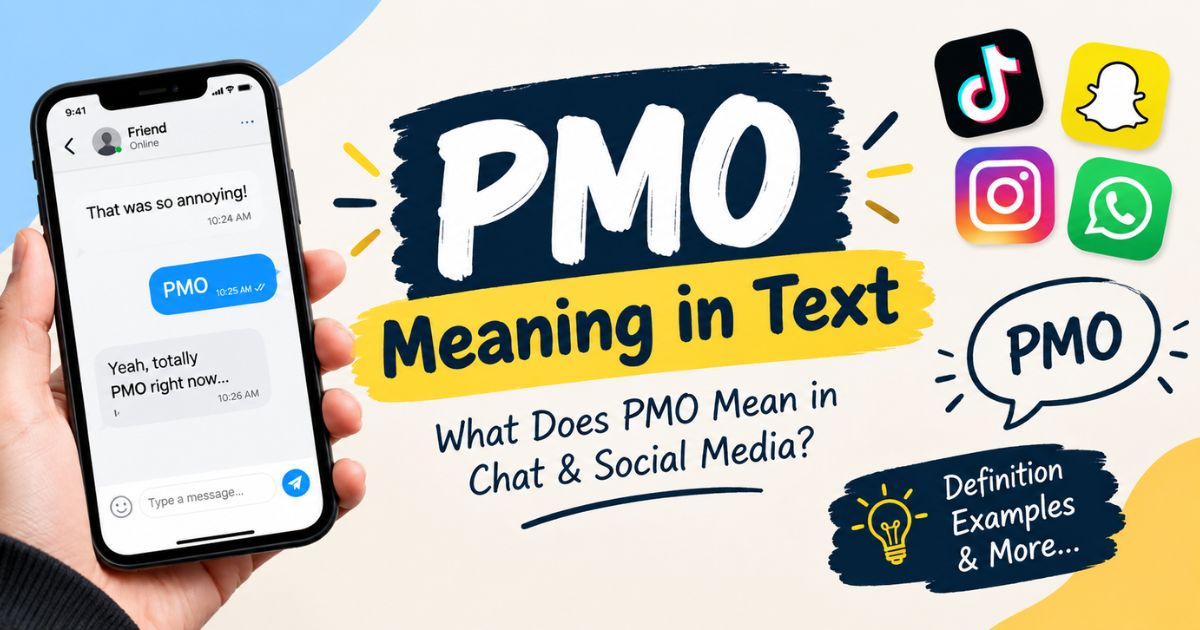
Have you ever received a message that says “PMO” and wondered what the person was trying to say? You’re not alone. PMO meaning in text can change depending on the conversation, which makes this short abbreviation surprisingly confusing.
In casual texting and social media, PMO commonly means “put me on” or “piss me off.” The first is usually a request for a recommendation or introduction, while the second expresses annoyance or frustration. Context and tone are the easiest ways to tell which meaning someone intends.
For example, “PMO to some good songs” means “put me on to some good songs,” while “You PMO” usually means “you piss me off.” In professional settings, however, PMO can mean something completely different, such as Project Management Office.
Let’s break down the PMO slang meaning, its common uses, examples, and the clues that help you understand it correctly.
What Does PMO Mean?
So, what does PMO mean in text? In informal online communication, it usually has two major meanings:
| PMO Meaning | What It Means | Typical Use |
|---|---|---|
| Put Me On | Recommend, introduce, or tell me about something | Music, food, shows, people, products |
| Piss Me Off | Make me angry or annoyed | Frustration, complaints, arguments |
When someone says “PMO” without much context, you need to look at the rest of the message.
For example, “PMO to a good restaurant” means the person wants you to recommend a restaurant. Here, PMO has a positive or neutral meaning.
On the other hand, “That really PMO” means something made the person angry. In this case, PMO is short for “piss me off.”
This is why the PMO text meaning can’t always be understood by looking at the three letters alone. The surrounding words, conversation, and tone provide the real clue.
Origin and Background of the Term
The exact origin of PMO slang isn’t tied to one specific website or moment. Like many texting abbreviations, it developed from the habit of shortening common phrases for faster online communication.
“Put me on” has long been used informally to ask someone to introduce you to something new. A person might say, “Put me on to some good music,” meaning “Recommend some good music to me.” Online users eventually shortened the expression to PMO.
The other meaning comes from “piss me off,” a long-established informal English expression used to describe anger or irritation. In texting, PMO provides a quick way to express that feeling without typing the complete phrase.
Social media, group chats, DMs, and short-form platforms helped abbreviations like these spread quickly. Today, you may see PMO in casual conversations about entertainment, food, relationships, everyday frustrations, and recommendations.
It’s worth remembering that slang changes quickly. The same abbreviation can also have professional meanings outside casual conversations. Project Management Office, for example, is a common business use of PMO.
How PMO Is Used in Daily Life
The meaning of PMO becomes much easier to understand when you look at how people actually use it.
1. Asking for Music Recommendations
One of the clearest uses of PMO is “put me on,” especially when someone wants a music recommendation.
For example:
“PMO to some good R&B songs.”
The person isn’t angry. They’re asking you to introduce them to music they may not know.
You might also see:
“PMO to some underground artists.”
Here, PMO means something like “recommend some artists to me” or “show me what you listen to.”
This use is common because people regularly discover songs, artists, playlists, and genres through friends and social media.
2. Discovering New Shows
PMO can also appear when someone wants recommendations for movies, television shows, anime, documentaries, or other entertainment.
For example:
“PMO to a good Netflix show.”
The intended meaning is essentially, “Recommend a good show to me.”
Another example is:
“You always know the best anime. PMO.”
In this situation, the person wants you to introduce them to something they haven’t watched yet.
The phrase often carries a friendly, casual tone. It can even show that the person trusts your taste.
Read More: DPMO Meaning in Text: What Does It Mean in Chat & Social Media?
3. Food & Restaurant Suggestions
Food is another common topic where PMO means “put me on.”
Someone might text:
“PMO to a good burger spot.”
They’re asking you to recommend a restaurant.
You could also receive:
“PMO to some good food around here.”
That means, “Tell me about some good places to eat.”
In everyday conversation, the phrase doesn’t necessarily mean the person wants a formal recommendation. They may simply want you to share something you personally enjoy.
4. Career or Business Networking
PMO can sometimes be used when someone wants an introduction to a person, business, opportunity, or professional resource.
For example:
“Can you PMO to your manager?”
Depending on the context, this could mean “Can you introduce me to your manager?”
Similarly:
“PMO to someone who works in marketing.”
The person is asking you to connect them with someone who has relevant knowledge or experience.
This use demonstrates why “put me on” isn’t limited to entertainment. It can also mean introduce me, connect me, or point me toward something useful.
However, PMO remains informal slang. In a professional email, “Could you introduce me to someone in marketing?” would usually sound clearer and more appropriate.
5. Social Connections
People can also use PMO when asking friends to introduce them to someone.
For example:
“PMO to your friend who likes basketball.”
Or:
“You know someone who works there? PMO.”
Here, PMO can mean “introduce me,” “connect me with them,” or “help me get acquainted with them.”
The exact interpretation depends on the conversation. If the message involves a person, PMO may refer to an introduction rather than a recommendation.
Emotional or Practical Meaning of PMO
The PMO meaning slang depends heavily on whether the message is asking for something or expressing an emotion.
When PMO means “put me on,” it has a practical purpose. The sender wants information, a recommendation, an introduction, or access to something new.
For example:
“PMO to some good podcasts.”
The person wants you to share recommendations.
When PMO means “piss me off,” it has an emotional purpose. The sender is expressing annoyance, anger, or frustration.
For example:
“That comment really PMO.”
The person is saying that the comment made them angry or irritated.
You can usually distinguish the meanings by looking at what comes before and after PMO.
“PMO to…” often points toward “put me on to…”
“That PMO” or “You PMO” often points toward “piss me off.”
The tone matters, too. A message asking for songs or restaurants is probably a recommendation request. A message containing complaints, arguments, or frustration is more likely to use PMO as an expression of annoyance.
Similar or Related Terms
If you’re learning PMO meaning in texting, you’ll probably encounter many other short internet abbreviations. These expressions serve similar purposes by making casual communication faster.
LMK means “let me know.” Someone might write, “LMK when you’re free.”
IMO means “in my opinion.” It’s commonly used before sharing a personal view.
TBH means “to be honest.” People often use it when introducing a frank statement.
IDK means “I don’t know.” It’s one of the most common texting abbreviations.
WYD means “what are you doing?”
WYA means “where you at?” and usually asks about someone’s current location or whereabouts.
SMH means “shaking my head.” It often communicates disappointment, disbelief, or annoyance.
FR means “for real” and can show agreement, emphasis, or sincerity.
ICL commonly means “I can’t lie,” especially in informal online conversations.
These abbreviations belong to the wider world of social media slang, texting shortcuts, and internet communication. Like PMO, their meanings can depend on context.
Common Misunderstandings About PMO
Because PMO has multiple meanings, it’s easy to misunderstand a message. Here are some of the most common mistakes.
1. PMO Always Means Something Negative
Not necessarily.
If someone says:
“PMO to some good artists.”
They’re not expressing anger. They’re asking you to recommend or introduce them to some artists.
In this situation, PMO means “put me on.”
However, a message such as:
“This traffic PMO.”
uses PMO to mean “piss me off.”
The surrounding sentence is what separates the two meanings.
2. It Only Refers to Music
Music is a popular subject for PMO meaning “put me on,” but it isn’t the only one.
Someone can ask you to PMO to a restaurant, movie, television show, clothing brand, podcast, game, creator, book, or even another person.
The broader idea is introducing someone to something they don’t already know about.
3. It’s Professional Language
PMO can appear in professional environments, but the slang meanings aren’t formal business language.
In a company, PMO often means Project Management Office, a group or function responsible for supporting and coordinating project management practices.
Similarly, in government contexts, PMO can refer to a Prime Minister’s Office.
That’s why you shouldn’t automatically interpret every occurrence of PMO as internet slang. A workplace report saying “the PMO reviewed the project” is very different from a friend texting “PMO to a good movie.”
4. It’s the Same as “Pisses Me Off”
“Piss me off,” “pissed me off,” “pisses me off,” and “pissing me off” are related expressions, but they’re not interchangeable in every sentence.
For example:
“You PMO.”
can mean “You piss me off.”
But:
“That really PMO.”
can mean “That really pisses me off” in casual online writing.
Grammar often gets compressed in texting, so slang users may shorten the phrase in ways that wouldn’t appear in formal English.
5. Older People Don’t Use It
Age can influence slang use, but it’s not accurate to assume that only younger people understand or use PMO.
People encounter internet slang through social media, messaging apps, online communities, gaming, and everyday digital communication. Someone’s familiarity with PMO depends more on their online habits and the communities they participate in than on age alone.
Examples of PMO in Sentences
Seeing the abbreviation in context is one of the easiest ways to understand the PMO text meaning.
PMO meaning “put me on”:
“PMO to some good rap songs.”
“PMO to a good movie tonight.”
“PMO to your favorite coffee shop.”
“I need new podcasts. PMO.”
“PMO to some sneakers that aren’t too expensive.”
“You know a good photographer? PMO.”
“PMO to some new games.”
In each example, the person wants a recommendation, introduction, or suggestion.
PMO meaning “piss me off”:
“That noise really PMO.”
“People cutting in line PMO.”
“You PMO sometimes.”
“That comment PMO so bad.”
“This traffic is PMO.”
Here, PMO communicates irritation or anger.
How to Respond to PMO
Your response can depend on which meaning the sender intended.
If someone says:
“PMO to some good songs.”
You could reply:
“Sure, I’ll send you a few.”
If they say:
“PMO to a good restaurant.”
You might respond:
“Try that new Italian place downtown.”
If PMO means “piss me off,” the response changes:
“What happened?”
or
“Yeah, I can see why you’re annoyed.”
When you’re unsure, simply ask what they mean. That’s better than assuming the wrong interpretation.
Why Understanding PMO Meaning in Text Matters Today
Digital communication is full of abbreviations, shortened phrases, emojis, and slang. A three-letter expression can sometimes carry an entirely different meaning depending on the conversation.
Understanding PMO meaning in text helps you avoid awkward misunderstandings. If someone asks you to “PMO to a good show,” responding as though they’re angry would make little sense. Likewise, treating “You PMO” as a recommendation request could completely miss the sender’s tone.
Context is especially important on platforms such as TikTok, Snapchat, Instagram, group chats, and DMs. Social media slang can spread quickly, and users often adapt abbreviations to fit their own conversations.
It’s also useful to remember that PMO has meanings outside texting. In business, Project Management Office is a common abbreviation. In government contexts, it may refer to a Prime Minister’s Office.
So, when you encounter PMO online, don’t rely on the letters alone. Read the entire sentence and consider the subject, tone, and relationship between the people communicating.
FAQs:
What does pmo meaning in text mean in simple words?
In simple terms, PMO usually means “put me on” or “piss me off” in casual texting. “Put me on” asks for a recommendation or introduction, while “piss me off” expresses annoyance.
Is pmo positive or negative?
It can be either. “Put me on” is usually neutral or positive because someone is asking you to recommend or introduce them to something. “Piss me off” expresses frustration or anger.
Where is pmo commonly used?
PMO can appear in text messages, DMs, group chats, TikTok comments, Snapchat, Instagram, gaming communities, and other informal online conversations. Its slang use is generally casual rather than formal.
Is pmo formal or informal?
The slang meanings of PMO are informal. You might use them with friends or in casual online conversations, but clearer full phrases are usually better for formal emails, academic writing, and professional communication.
Why do people search for pmo meaning in text?
People often search for the PMO meaning in text because the abbreviation has multiple interpretations. A message can use PMO to mean “put me on” or “piss me off,” while professional contexts can use PMO for terms such as “Project Management Office.”
Conclusion:
The most important thing to remember about PMO meaning in text is that context determines the meaning.
In casual conversations, PMO commonly means “put me on” when someone wants a recommendation, introduction, or suggestion. It can also mean “piss me off” when someone is expressing annoyance or frustration.
Look at the words surrounding PMO, the subject of the conversation, and the sender’s tone. “PMO to some good songs” clearly points toward “put me on,” while “That really PMO” usually expresses irritation.
Outside slang, PMO can also mean Project Management Office in business or Prime Minister’s Office in certain government contexts. Understanding these differences makes it much easier to interpret PMO correctly, whether you see it in a text, DM, comment, workplace message, or social media post.
