
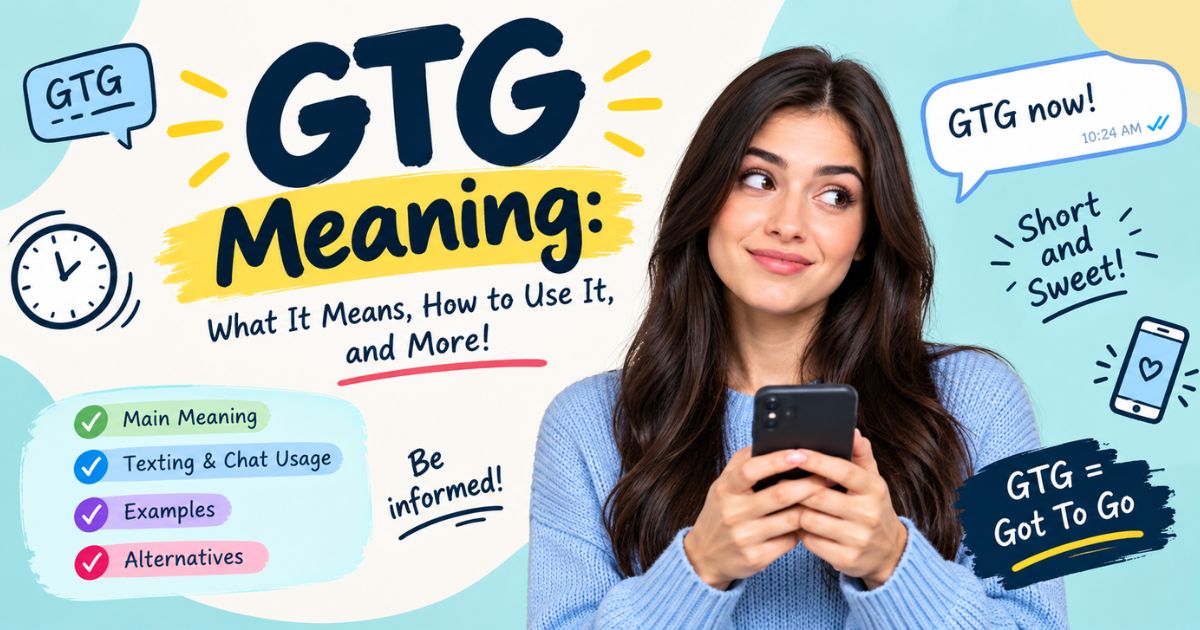
Have you ever been chatting with someone and suddenly received “GTG”? If you’re not familiar with texting abbreviations, you might wonder whether it means something specific or is simply a quick way to end a conversation.
The most common GTG meaning is “got to go” or “gotta go.” People use it in text messages, chats, social media, gaming conversations, and everyday online communication when they need to leave or stop talking.
For example, if a friend texts, “GTG, my mom’s calling,” they mean “I’ve got to go because my mom is calling.”
But there’s more to GTG than just its basic definition. Its tone can change depending on the conversation, and understanding the context can help you know whether someone is simply busy, ending the chat, or trying to move on quickly.
What Does GTG Mean in Text?
GTG means “got to go” in texting. It tells the other person that you need to leave, stop chatting, or attend to something else.
It’s one of the classic internet and SMS abbreviations because it saves time and characters.
For example:
“GTG, I’ll text you later.”
This means:
“Got to go, I’ll text you later.”
You might also see variations such as G2G, which has essentially the same meaning.
The abbreviation is normally casual, so it fits naturally in conversations with friends, family, classmates, gaming teammates, and other people you regularly message.
GTG Meaning in Slang
The GTG meaning in slang is generally “got to go” or “gotta go.”
It isn’t complicated slang. Instead, it’s an abbreviation that became popular through online chat, texting, and instant messaging.
When someone says:
“GTG!”
They usually mean:
“I have to leave now.”
The reason could be anything. They might have work to do, need to eat, have to sleep, be heading somewhere, or simply have another task to handle.
Because GTG is so short, the phrase can sound abrupt if you’re unfamiliar with texting culture. In most cases, though, it isn’t meant to be rude.
GTG Meaning in Chat
In online chat, GTG is often used when someone needs to leave the conversation.
For example:
Friend: “Want to play another round?”
You: “GTG, I have homework.”
Here, GTG clearly means “I have to go.”
Another example:
“GTG, talk tomorrow!”
This sounds friendly because the person is making it clear that they’re leaving but intend to continue the conversation later.
The words that follow GTG can provide useful context. “GTG bye” is a simple goodbye, while “GTG, call you later” suggests the conversation will continue at another time.
Read More: What Does NTY Mean in Text? Meaning, Uses & Examples
GTG Meaning in Texting
In texting, GTG is commonly used when someone wants to end a conversation quickly.
You may see messages such as:
“GTG, dinner’s ready.”
“GTG, I’m running late.”
“GTG, talk to you tomorrow.”
“Sorry, GTG!”
The abbreviation is particularly useful when you’re in a hurry. Instead of typing a complete sentence, you can quickly let the other person know that you have to leave.
GTG vs. G2G
GTG and G2G usually mean the same thing:
GTG = Got to go
G2G = Got to go
Both are informal texting abbreviations. Your choice generally comes down to personal preference and the style of the conversation.
GTG Meaning on Social Media
On social media, GTG usually keeps its standard meaning: “got to go.”
Someone might use it in a direct message, comment, group chat, or casual post.
For example:
“GTG, got work in the morning 😴”
The meaning is simply that the person needs to leave the conversation or stop using the platform.
Because social media communication is often informal, abbreviations like GTG fit naturally into quick interactions.
However, slang can vary between communities. If GTG appears in an unusual context, check the surrounding words before assuming its meaning.
GTG Meaning on Snapchat
On Snapchat, GTG commonly means “got to go.”
For example:
“GTG, snap you later.”
This means:
“I have to go. I’ll message you later.”
If someone sends GTG while you’re having a conversation, it usually doesn’t mean they’re angry or upset. Most of the time, they’re simply telling you that they need to stop chatting.
The tone becomes clearer when you look at the rest of the message.
“GTG ❤️ talk later”
sounds warm and friendly.
Meanwhile:
“GTG.”
is shorter and can feel more abrupt, although it still doesn’t automatically mean anything negative.
GTG Meaning on WhatsApp
On WhatsApp, GTG is also commonly understood as “got to go.”
For example:
“GTG, I need to get ready.”
You could reply:
“Okay, talk later!”
Or:
“No worries, see you later.”
WhatsApp conversations often mix standard English with abbreviations, emojis, and slang, so GTG fits naturally into casual chats.
GTG Meaning in Gaming
Gamers frequently use short abbreviations because messages need to be quick.
In gaming chat, GTG can mean:
“Got to go.”
For example:
“GTG guys, dinner.”
Or:
“GTG, my battery is almost dead.”
In this context, the person is usually announcing that they’re leaving the game or stepping away from the computer or phone.
Sometimes you’ll see:
“GTG after this round.”
That means the player needs to leave after the current match or round finishes.
GTG Meaning From a Guy
If a guy texts you “GTG,” the most likely meaning is simply “got to go.”
Don’t automatically interpret it as a sign that he’s losing interest.
For example:
“GTG, I have an early meeting tomorrow.”
That’s a straightforward reason for ending the conversation.
Even in a romantic conversation, GTG doesn’t automatically carry a hidden message. The surrounding conversation matters much more.
If he says:
“GTG, but I’ll text you tomorrow ❤️”
that’s clearly different in tone from simply:
“GTG.”
Still, one abbreviation isn’t enough to determine someone’s feelings.
GTG Meaning From a Girl
The GTG meaning from a girl is usually exactly the same: “got to go.”
She may be busy, tired, heading somewhere, or simply ready to end the conversation.
For example:
“GTG, my friend is waiting for me.”
That doesn’t necessarily indicate annoyance or disinterest.
As with any text abbreviation, look at the broader conversation instead of trying to assign a hidden meaning to GTG.
Is GTG Rude?
Usually, GTG isn’t rude.
It’s simply a short way to say that you need to leave.
However, the way you use it can affect how it feels.
Compare:
“GTG.”
with:
“Sorry, GTG! I’ll talk to you later.”
The second version feels more considerate because it explains that you’re leaving and gives the conversation a friendly ending.
If you’re talking to someone you don’t know well, adding a short goodbye can make your message sound warmer.
How to Respond to GTG
Your response depends on the situation.
If a friend says:
“GTG, talk later.”
You could say:
“Sure, talk later!”
Or:
“Okay, take care!”
If they’re busy:
“No worries, catch you later.”
If the conversation is playful:
“Alright, go do your thing 😂”
If you want to continue the conversation later:
“Sounds good. Message me when you’re free.”
You don’t need to make your response complicated. A simple acknowledgment is usually enough.
GTG Examples in Sentences
Here are some natural GTG examples you might see in real conversations:
“GTG, my food just arrived.”
“Sorry, GTG. I have class.”
“GTG, talk to you tomorrow.”
“I’d stay, but GTG.”
“GTG guys, see you later.”
“GTG, my phone is dying.”
“Okay, GTG. Have a good night!”
“GTG, I’ll call you after work.”
These examples show that GTG can work in many casual situations where someone needs to leave.
Common Meanings Related to GTG
Although “got to go” is by far the most common meaning in texting, abbreviations can occasionally have different meanings in specialized contexts.
For everyday messages, however, you should normally interpret GTG as “got to go” unless the surrounding conversation clearly indicates otherwise.
| Term | Common Meaning |
|---|---|
| GTG | Got to go |
| G2G | Got to go |
| TTYL | Talk to you later |
| BRB | Be right back |
| BBL | Be back later |
| AFK | Away from keyboard |
| CYA | See you |
| BYE | Goodbye |
| LMK | Let me know |
| IDK | I don’t know |
These abbreviations are especially common in casual digital communication.
GTG vs. BRB vs. TTYL
These terms can look similar because they’re all related to leaving a conversation, but they aren’t identical.
GTG means you need to leave.
BRB means “be right back,” suggesting you’ll return soon.
TTYL means “talk to you later,” which usually signals that the conversation is ending for now.
For example:
“BRB, getting some water.”
You expect to return shortly.
“GTG, I have to leave.”
You’re leaving and may not return immediately.
“TTYL, I need to sleep.”
You’re ending the conversation and expect to talk again later.
Understanding these differences makes texting much easier.
When Should You Use GTG?
GTG works best in informal communication.
You can use it with friends, family, gaming teammates, classmates, and people who already understand texting abbreviations.
For example:
“GTG, see you tomorrow!”
That’s perfectly natural in a casual chat.
However, you should generally avoid GTG in formal communication.
Instead of:
“GTG, I’ll send the document later.”
A professional message would be:
“I need to leave now, but I’ll send the document later.”
The goal isn’t to avoid abbreviations completely. It’s to match your language to the situation.
When Not to Use GTG
Avoid GTG when you’re communicating in a formal or professional setting where clarity and professionalism matter.
That includes formal business emails, official notices, academic writing, and important professional conversations.
You should also be careful when ending a sensitive conversation.
If someone is sharing something emotional or serious, responding with only “GTG” can come across as dismissive.
A kinder option would be:
“I’m sorry, I have to go right now, but I’d like to talk about this later.”
That small amount of extra explanation can make a big difference.
Why Is GTG So Popular?
GTG became popular because texting encourages people to communicate quickly.
Typing “got to go” takes more time than typing three letters. In fast-moving conversations, abbreviations make communication easier and more efficient.
The expression also became widely recognized through early internet chat rooms, instant messaging, SMS, forums, and later social media platforms.
Even though modern messaging allows much longer messages, short abbreviations remain popular because they have become part of digital communication culture.
Conclusion
The most common GTG meaning is “got to go” or “gotta go.”
People use GTG when they need to leave a conversation, stop chatting, step away from a game, or attend to something else. You’ll commonly see it in texts, Snapchat, WhatsApp, social media, gaming chats, and other informal conversations.
GTG usually isn’t rude or negative. Its tone depends on the surrounding message. “GTG, talk later!” sounds friendly, while a one-word “GTG” may feel more abrupt simply because it provides less context.
The easiest way to remember it is:
GTG = Got to go = I need to leave now.
FAQs
What does GTG mean in texting?
GTG usually means “got to go.” It’s used when someone needs to leave or end a conversation.
What does GTG mean in slang?
In slang and casual texting, GTG means “got to go” or “gotta go.”
What does GTG mean on Snapchat?
On Snapchat, GTG generally means “got to go.” It tells the other person that you need to leave the conversation or stop chatting.
What does GTG mean on WhatsApp?
GTG on WhatsApp usually means “got to go.” It’s a casual way to say that you need to leave or become unavailable.
What does GTG mean from a guy?
Usually, it simply means “got to go.” It doesn’t automatically indicate that he’s annoyed or uninterested.
What does GTG mean from a girl?
It generally means “got to go.” The surrounding conversation and tone provide more information about why she is ending the chat.
Is GTG rude?
Not usually. GTG is a normal informal abbreviation. However, using only “GTG” during an emotional or important conversation can sometimes feel abrupt.
What is the difference between GTG and G2G?
There is little practical difference. GTG and G2G are both commonly used to mean “got to go.”
What is the difference between GTG and BRB?
GTG means you need to leave, while BRB means “be right back,” suggesting that you’ll return shortly.
What is the difference between GTG and TTYL?
GTG means “got to go.” TTYL means “talk to you later.” Both can end a conversation, but TTYL specifically suggests you’ll talk again later.
Can GTG mean something other than “got to go”?
Yes, abbreviations can have specialized meanings in particular communities. However, in ordinary texting and chat, “got to go” is the standard interpretation.
How should I respond to GTG?
You can simply say “Okay, talk later!”, “No worries,” or “Take care!” If you want to continue the conversation, you can ask them to message you when they’re free.
📌 Key Takeaways: Understanding GTG
GTG = “got to go.” It’s a common informal texting abbreviation used to tell someone you need to leave.
It works naturally in casual chats, Snapchat, WhatsApp, social media, and gaming. It isn’t normally offensive, but you should avoid it in formal communication and use a warmer response when ending a sensitive conversation.
