Have you received a message containing “DTM” and wondered what the person actually meant? Texting abbreviations can be confusing because the same three letters may have different meanings depending on the conversation. In casual messages, social media, dating chats, and online communities, context usually tells you which definition fits.
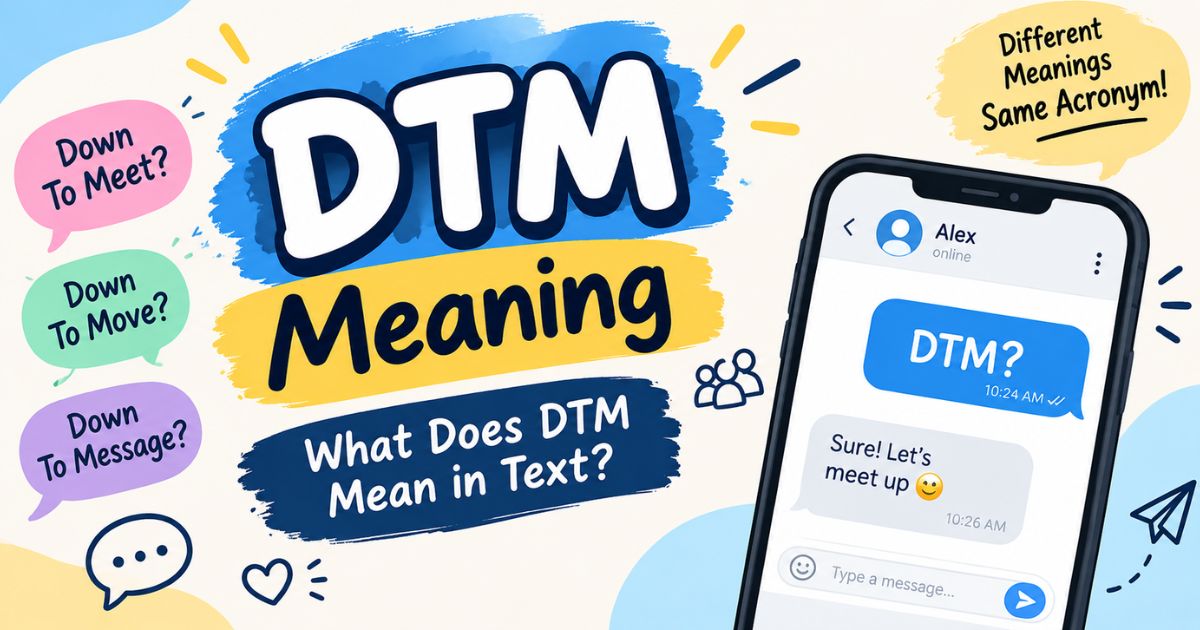
The most common DTM meaning in text is “Down To Meet,” meaning someone is willing or interested in meeting up. However, DTM can also stand for phrases such as “Down To Move” or “Down To Message” in certain conversations. Let’s break down how to recognize the intended meaning without guessing.
What Does DTM Mean In Text?
When someone asks “Are you DTM?”, they may be asking whether you’re down to meet. In simple terms, they want to know if you’re willing to meet in person, hang out, or make plans.
For example, a friend might text, “DTM tonight?” This commonly means, “Are you down to meet tonight?” The exact interpretation still depends on what you were discussing before the message appeared.
Most Common DTM Meaning In Text
The most common meaning in casual texting is Down To Meet.
Here, “down to” means willing, interested, or available to do something, while “meet” refers to getting together in person. So, “DTM?” can function as a short invitation or a quick check of someone’s availability.
Example:
“I’m free after 7. You DTM?”
The person is essentially asking whether you’d like to meet after 7.
Common DTM Meaning
Another possible interpretation is Down To Move. Someone could use it when discussing relocation, changing plans, moving to another place, or physically moving something.
For example:
“If you find a better apartment, I’m DTM.”
In that context, “DTM” could mean “Down To Move,” not “Down To Meet.”
Less Common DTM Meaning
Down To Message can appear in some informal online conversations. It suggests that someone is willing to continue communicating through messages.
This meaning isn’t as universal as “Down To Meet,” so you shouldn’t automatically assume it whenever DTM appears.
Rare DTM Meaning
DTM can also have specialized meanings outside everyday texting. In different industries, communities, games, organizations, or technical settings, the abbreviation may represent something completely unrelated to slang.
That’s why the surrounding words matter. If the conversation isn’t about meeting, moving, or messaging, look at the subject being discussed before interpreting the abbreviation.
Origin And Evolution Of DTM
DTM developed within the broader culture of internet shorthand and mobile texting. As people began communicating through SMS, instant messaging, social platforms, and group chats, abbreviations became a convenient way to express familiar phrases quickly.
The expression “down to” was already common in informal spoken English as a way to say someone was willing or interested in doing something. Digital communication simply made it easier to shorten the phrase further.
Instead of writing:
“Are you down to meet later?”
someone can write:
“DTM later?”
This type of compression is especially common when both people already understand the conversational context.
Psychological And Emotional Meaning Of DTM
The emotional meaning of DTM depends heavily on the situation and the relationship between the people communicating.
When DTM means “Down To Meet,” it can signal openness to spending time together. Between friends, it may simply be a practical question about plans. In dating conversations, however, the same abbreviation can feel more personal because meeting someone may carry romantic or social significance.
Still, don’t read too much emotion into the abbreviation itself. “DTM?” doesn’t automatically mean the person is flirting, interested romantically, or trying to deepen the relationship. The rest of the conversation provides the important clues.
Communication Function Of DTM
DTM works mainly as a communication shortcut. It removes several words while preserving the basic idea.
Compare these two messages:
“Are you down to meet this weekend?”
and
“DTM this weekend?”
The second version is faster and more casual. It also assumes that the recipient understands common texting language.
This makes DTM useful in quick conversations where efficiency matters more than formality.
Cultural And Generational Context Of DTM
Texting slang changes quickly. Younger internet users often encounter abbreviations through social media, gaming communities, group chats, and short-form video platforms.
However, not everyone interprets abbreviations in the same way. Someone unfamiliar with online slang might understand “DTM” as a technical or professional abbreviation rather than a casual phrase.
That difference can create confusion, especially when people from different age groups or communication styles interact.
Why DTM Became Popular
Short abbreviations became popular because digital conversations reward speed and convenience. People often send messages while multitasking, scrolling, gaming, commuting, or participating in busy group chats.
DTM is especially efficient because “down to meet” is a phrase people can use repeatedly when making casual plans.
Its meaning also fits naturally into short questions:
“DTM today?”
“DTM later?”
“You DTM?”
The shorter format makes the conversation feel relaxed rather than formal.
Read More: PMO Meaning in Text: What Does PMO Mean in Chat & Social Media?
Semantic Core Meaning Of DTM
At its core, the common slang meaning of DTM communicates willingness to meet.
Think of it as a compact version of:
“Are you willing to meet?”
or
“Do you want to meet up?”
The abbreviation doesn’t necessarily specify where, when, or why. Those details usually appear elsewhere in the conversation.
Most Common DTM Meaning In Text (Deep Dive)
What It Means
When DTM means Down To Meet, it expresses interest or willingness to meet someone.
Depending on context, it can mean:
- willing to meet
- ready to meet
- interested in meeting
- available to meet
- interested in hanging out
- open to making plans
It doesn’t always mean the person has already made a definite plan. Often, they’re simply checking whether you’re interested.
Typical Use Cases
DTM can appear when friends are arranging a hangout, when someone is making casual social plans, or when two people are discussing whether they should meet.
For instance:
“I’m around downtown. DTM?”
Here, the sender is probably checking whether the other person wants to meet nearby.
Examples In Different Tones
Casual:
“DTM later?”
Friendly:
“We haven’t hung out in forever. DTM this weekend?”
Direct:
“DTM tonight?”
Dating context:
“I’ll be in your area Saturday. DTM?”
The abbreviation stays the same, but the surrounding language changes the tone.
What It Can Sound Like
DTM usually sounds casual and direct. It can feel friendly when used between people who already know each other.
Without additional context, though, a message such as “DTM?” can seem abrupt. That’s particularly true if the recipient isn’t familiar with texting abbreviations.
Meaning Based On Context
Positive Use
A positive use might show enthusiasm about meeting:
“DTM! It’s been ages 😂”
The added language and emoji make the friendly intention clear.
Neutral Use
A neutral version might simply check someone’s availability:
“DTM tomorrow?”
There’s no obvious emotional message beyond making plans.
Negative Or Critical Use
DTM itself isn’t inherently negative. However, the surrounding conversation can make it sound demanding or uncomfortable.
For example:
“So are you DTM or not?”
The issue isn’t the abbreviation; it’s the impatient wording around it.
Dry Or Rushed Use
A very short message such as:
“DTM?”
can feel dry because it contains almost no conversational detail.
That doesn’t necessarily mean the sender is annoyed. They may simply be typing quickly.
How DTM Is Used In Real Conversations
Understanding Or Clarifying
If someone sends DTM and you’re unsure what they mean, it’s perfectly reasonable to ask:
“DTM as in down to meet?”
A quick clarification can prevent an awkward misunderstanding.
Reacting Or Labeling
Someone may also use DTM while describing a situation rather than directly inviting someone.
For example:
“He asked if I was DTM.”
In this sentence, the abbreviation still relates to the idea of meeting, but it isn’t being used as the invitation itself.
Social Or Dating Context
In dating conversations, DTM can be a quick way to test whether someone is interested in meeting offline.
For example:
“We’ve been talking for a while. DTM sometime?”
The phrase can be casual, but the decision to meet should always depend on the comfort and boundaries of both people.
Group Or Online Context
In group chats, DTM may appear when friends coordinate plans:
“Everyone DTM Friday?”
Here, the sender is checking whether the group wants to meet.
Gaming Context
Gaming communities sometimes create their own shorthand. If DTM appears during a gaming discussion, don’t automatically assume it means “Down To Meet.”
Look at the surrounding terms. If players are talking about real-world plans, the meeting interpretation may fit. If they’re discussing a game mechanic, team strategy, or another activity, DTM could have a community-specific meaning.
DTM Meaning On Different Platforms
The abbreviation doesn’t have one separate definition for every platform. Its interpretation usually follows the conversation rather than the app itself.
DTM Meaning On Snapchat
On Snapchat, DTM may mean Down To Meet when someone is discussing plans.
For example:
“DTM after school?”
Because Snapchat conversations are usually casual, abbreviations can appear frequently. Still, context remains the best guide.
DTM Meaning On TikTok
TikTok comments and direct messages often contain rapidly changing slang. DTM can appear in comments or messages, but the meaning depends on the specific conversation.
If a creator uses DTM while discussing meeting someone, “Down To Meet” may fit. In another niche, it could mean something entirely different.
DTM Meaning On Instagram
On Instagram, you might see DTM in DMs, comments, or casual conversations.
A message like:
“You DTM this weekend?”
is naturally interpreted as asking whether someone wants to meet.
DTM Meaning In Texting Or Messaging
Traditional texting is where the abbreviation can be particularly straightforward.
“DTM later?”
usually functions as a quick question about meeting.
The sender may add a time, location, or activity to make the plan clearer.
DTM Meaning On Discord Or Communities
Discord communities often develop specialized vocabulary. DTM may therefore have different meanings depending on the server.
If you’re in a social server, “Down To Meet” might make sense. In a technical, gaming, or hobby-focused server, check the local terminology before assuming the slang definition.
When To Use Vs When To Avoid DTM
When To Use
DTM works best when you’re chatting casually with people who understand texting slang.
It’s suitable for informal conversations about meeting friends, making plans, or checking someone’s availability.
When To Avoid
Avoid DTM when the recipient may not understand slang or when clarity matters more than speed.
A formal email, workplace message, customer communication, academic document, or official request should use the complete phrase instead.
Professional And Safe Alternatives
Instead of DTM, you can write:
“Are you available to meet?”
“Would you like to meet?”
“Are you free to meet later?”
“Would you like to get together?”
These alternatives remove ambiguity and sound more professional.
Hidden Or Risky Meanings Of DTM
Not every DTM abbreviation online has the same meaning. Some abbreviations can also be interpreted differently depending on the community, subject, or conversation.
There’s another important point: DTM can be confused with other slang abbreviations that look similar. For example, DTF is a different expression and can carry a sexual meaning. Don’t substitute one for the other.
If the context involves dating or strangers, it’s especially important to understand exactly what someone means before agreeing to anything.
Variations And Forms Of DTM
DTM can appear in several informal forms:
| Form | Possible meaning |
|---|---|
| DTM? | Down to meet? |
| You DTM? | Are you down to meet? |
| DTM later? | Willing to meet later? |
| DTM tonight? | Interested in meeting tonight? |
| We DTM? | Are we meeting? |
| DTM this weekend? | Interested in meeting this weekend? |
People may also spell out the phrase completely when they want to avoid confusion.
DTM Vs Similar Slang
Several texting abbreviations can appear in the same kinds of conversations.
| Slang | Common meaning | Main purpose |
|---|---|---|
| DTM | Down To Meet | Check interest in meeting |
| LMK | Let Me Know | Request a response or update |
| IDK | I Don’t Know | Express uncertainty |
| BTW | By The Way | Add information |
| TBH | To Be Honest | Introduce an honest opinion |
| IMO | In My Opinion | State an opinion |
| FR | For Real | Emphasize agreement or seriousness |
The important distinction is that DTM usually relates to meeting, while these other abbreviations perform different conversational functions.
How To Decode The Correct Meaning
When you’re unsure what DTM means, examine the words around it.
First, ask what the conversation is about. If you’re discussing weekend plans, locations, or hanging out, “Down To Meet” makes sense.
Next, look at the grammar. A message such as “DTM tonight?” strongly suggests a meeting-related question.
Finally, consider the person and platform. A close friend using DTM in a casual chat is different from someone using the abbreviation in a specialized online community.
When none of these clues provide a clear answer, simply ask. Clarification is better than confidently choosing the wrong definition.
How To Respond To DTM
Your response should match what the sender appears to be asking and how comfortable you are with the conversation.
Casual Replies
If you want to meet, you could say:
“Yeah, I’m down.”
“Sure, what time?”
“Yeah, where?”
Friendly Replies
For a warmer response:
“Definitely! It’s been a while.”
“I’d love to. When are you free?”
Mature Or Respectful Replies
If you want to be clear:
“Yes, I’d be open to meeting. What did you have in mind?”
Or:
“I’m available this weekend. Let me know what works for you.”
Boundary Or Privacy Responses
If you don’t want to meet, you don’t need to provide a detailed explanation.
You can say:
“I’d rather keep chatting here for now.”
or:
“Thanks, but I’m not comfortable meeting.”
A clear boundary is enough.
Common Misunderstandings About DTM
One common mistake is assuming that DTM always means “Down To Meet.” That’s usually the intended slang meaning in casual planning conversations, but abbreviations can have multiple definitions.
Another misunderstanding is treating DTM as automatically romantic. It isn’t. Friends, coworkers in informal chats, acquaintances, and dating partners can all use meeting-related language.
People can also mistake DTM for a similar-looking abbreviation. When the conversation doesn’t clearly point toward meeting, check the context before responding.
Regional And Cultural Usage Of DTM
Internet slang isn’t restricted to one city or country. Social media allows abbreviations to spread across regions quickly.
Even so, slang familiarity varies. A phrase that’s obvious to one online community may be unfamiliar to another. English-speaking users may also interpret abbreviations differently based on age, platform, and local communication habits.
That’s why a full phrase is often better when you’re communicating with someone outside your usual social circle.
Frequently Asked Questions
What does DTM mean in texting?
The most common DTM meaning in texting is “Down To Meet.” It usually asks whether someone is willing or interested in meeting up.
Is DTM positive or negative?
DTM is generally neutral. Its emotional tone comes from the surrounding conversation. “DTM?” can be a simple planning question, while additional wording can make the message sound friendly, excited, impatient, or critical.
Where is DTM commonly used?
DTM can appear in casual text messages, social media DMs, group chats, and online communities. Its exact meaning depends on the conversation.
Is DTM appropriate for professional communication?
Usually, no. In professional communication, it’s clearer to write “Are you available to meet?” or another complete phrase rather than relying on slang.
Can DTM have multiple meanings?
Yes. DTM is an abbreviation, so its meaning can change according to context. “Down To Meet” is a common texting interpretation, while other meanings can occur in specialized conversations.
Conclusion
Understanding DTM meaning in text becomes much easier when you look at the context instead of treating every abbreviation as having one fixed definition. In casual conversations, “Down To Meet” is the most common interpretation, especially when people are discussing plans, hanging out, or meeting in person.
However, DTM can have other meanings, including “Down To Move” or “Down To Message,” depending on the conversation. If the surrounding words don’t make the meaning obvious, asking for clarification is the safest approach.
The key takeaway is simple: DTM usually signals willingness or interest in meeting, but context determines the exact meaning.
