Have you ever seen someone say “I like your PFP” or ask you to “change your PFP” and wondered what they were talking about? If you spend time on Instagram, TikTok, Snapchat, Facebook, Discord, Reddit, or other online platforms, you’ve probably come across this short abbreviation.
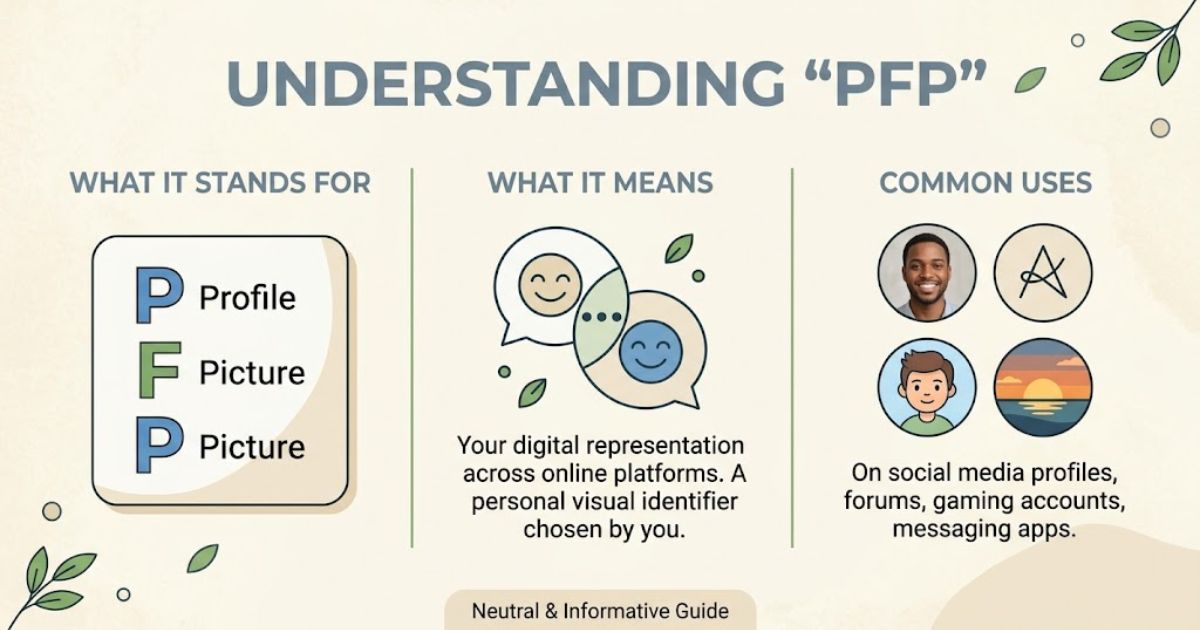
The PFP meaning is simple: PFP usually stands for “profile picture.” It refers to the photo, image, avatar, or graphic that represents you on an online account.
Although PFP is most commonly associated with profile pictures, its meaning can vary slightly depending on the platform and conversation. Let’s break down exactly what PFP means, where it came from, how people use it in texting, and why it has become so common online.
What Does PFP Mean in Text & Chat?
PFP stands for profile picture in most everyday texting and social media conversations. It’s a short, convenient way to refer to the image displayed on someone’s online profile.
Instead of typing “I like your profile picture,” someone can simply write, “I like your PFP.” Both messages communicate the same idea, but the abbreviation makes the conversation quicker and more casual.
You might encounter PFP in private messages, comment sections, gaming chats, group conversations, or discussions about online identities. The image could be a selfie, a picture of a pet, a cartoon character, a celebrity, a logo, or an AI-generated avatar.
Quick Definition
Here’s what PFP means at a glance:
| Term | Meaning |
|---|---|
| PFP | Profile picture |
| Full form | Profile picture |
| Type | Internet abbreviation |
| Common use | Texting, social media, gaming, and online communities |
| Example | “Change your PFP. It’s outdated!” |
| Tone | Usually casual and informal |
In simple terms, your PFP is the image people associate with your account. It helps others recognize you and gives your profile a visual identity.
Although profile pictures are common across many platforms, some services use different labels for similar features. That’s why you might also see terms such as DP, avatar, or profile photo.
Example
Imagine your friend changes their Instagram picture to a new selfie. You notice it and send this message:
You: “Your new PFP looks amazing!”
Friend: “Thank you! I finally liked one of my pictures 😂”
In this conversation, PFP clearly means profile picture. You’re complimenting the image your friend uses on their account.
Here’s another example:
Friend: “Can you send me your PFP?”
You: “Sure, I’ll send you the original photo.”
The friend probably wants the image you’re using as your profile picture, perhaps because they like it or want to see a higher-quality version.
Read More: PM Mean in Text? Discover the Meaning, Uses & Real Chat Examples 2026
Full Form, Stands For & Short Meaning of PFP
The full form of PFP is profile picture. It’s an abbreviation created from the first letters of the words “profile” and “picture.”
People use it because online conversations often favor short, recognizable expressions. Typing three letters is faster than writing the complete phrase, especially when you’re chatting with friends or commenting on social media.
For example, someone might ask, “What’s your PFP?” when they want to know which image you’re using for your account. Another person might say, “Your PFP matches your vibe,” meaning your profile image suits your personality or online style.
PFP isn’t generally an acronym with a different meaning for each letter. It’s a shortened form of a common phrase, and its meaning is usually clear when the conversation involves online profiles.
Short Meaning
The simplest way to remember PFP is:
- PFP = Profile Picture
- New PFP = A new profile image
- Nice PFP = A compliment about someone’s profile image
- Change your PFP = Replace your current profile image
- PFP ideas = Suggestions for profile pictures
For example, if someone messages you, “Need a new PFP ASAP,” they’re saying they want a new profile picture as soon as possible.
The abbreviation is especially useful when discussing social media accounts, online gaming profiles, or messaging apps where profile images help people recognize one another.
Origin, History & First Known Use of PFP
PFP developed as part of the wider culture of internet abbreviations and online communication. As people began spending more time on forums, chat rooms, instant messaging services, and social networks, they needed quick ways to describe familiar online features.
Profile pictures became an important part of digital identity. Instead of displaying only a username, many websites allowed users to add an image to their account. People naturally began shortening “profile picture” in everyday online conversations.
The exact first use of PFP is difficult to establish confidently. It’s better to understand the abbreviation as part of the gradual development of internet shorthand rather than attribute it to one person, website, or specific year without reliable evidence.
As social networking and online gaming grew, PFP became increasingly familiar. People started using it to discuss selfies, anime characters, memes, gaming avatars, celebrity photos, and other images used to represent an account.
Today, PFP is widely understood in online communities. It’s also frequently used in discussions about digital identity, personal branding, and collectible digital artwork.
One important distinction is that PFP usually refers to the image representing your account, not the account itself. That meaning has remained consistent across many online environments.
How People Use PFP in Daily Conversations
People use PFP whenever they want to talk about a profile image without typing the complete phrase. The abbreviation can appear in a compliment, a question, a joke, or a suggestion.
Its meaning is straightforward, but the tone depends on the situation. Someone might use PFP to compliment your new photo, tease you about a funny avatar, or help you choose an image that fits your personality.
Texting Examples
Here are a few examples of how PFP appears in everyday messages.
- “Love your PFP!” — The person likes your profile picture.
- “Where did you get that PFP?” — They’re asking about the source of your image.
- “I’m changing my PFP tonight.” — You’re planning to update your profile picture.
- “Your PFP is so funny 😂” — The image makes the person laugh.
- “Can you rate my PFP?” — The sender wants your opinion about their profile picture.
- “We should use matching PFPs.” — They want both accounts to display related images.
- “That PFP suits you.” — The image matches your style or personality.
These examples show that PFP doesn’t carry a special emotional meaning on its own. The words surrounding it determine whether the message is complimentary, humorous, practical, or simply conversational.
Social Media Usage
On social media, PFP often appears in comments, captions, direct messages, and conversations about account appearance.
For example, a user might post a new selfie and receive comments such as “New PFP goes hard” or “This should be your next PFP.” Both comments refer to using or appreciating a profile image.
The abbreviation also appears in online trends where users change their profile pictures to match a theme. Friends might choose matching images from a television show, use the same cartoon character, or coordinate colors and designs.
In creator communities, a PFP can also contribute to recognition. A recognizable profile image makes it easier for followers to identify an account among comments and posts.
Casual Situations
PFP is especially common in informal conversations because it’s short and easy to understand.
Imagine you’re playing an online game with friends. One friend changes their avatar to a ridiculous cartoon face, and another says, “Bro, that PFP is wild 💀.” They’re reacting to the image, not making a formal statement about the account.
Similarly, a friend might ask you to use matching PFPs for a group chat or suggest a new photo because your current one is several years old.
In these situations, PFP helps people communicate quickly without interrupting the natural flow of conversation.
PFP Meaning Across WhatsApp, Instagram, TikTok & Snapchat
The basic PFP meaning remains the same across most major social media platforms: profile picture. However, the way people use and discuss profile images can vary depending on each platform’s features and community culture.
On WhatsApp, PFP usually refers to the picture displayed on your profile. People may use it when discussing a friend’s photo, asking someone to update their image, or choosing pictures for personal and group accounts.
For example:
You: “Your WhatsApp PFP is different. Is that a new picture?”
Friend: “Yeah, I changed it yesterday.”
Here, PFP means the profile photo associated with the friend’s WhatsApp account.
WhatsApp commonly refers to this feature as a profile photo in its interface and help materials. PFP is simply the informal abbreviation people may use while chatting.
On Instagram, PFP means the profile picture displayed on your account. It’s often the small image people see when they visit your profile, view your comments, or encounter your account elsewhere in the app.
For example:
Friend: “Your new PFP matches your feed perfectly.”
You: “Thanks! I wanted something more aesthetic.”
Instagram users may choose selfies, travel photos, logos, illustrations, or other images that reflect their personality or brand.
Because the profile image appears in several places across the app, people often discuss it when updating their profiles or creating a consistent visual style.
TikTok
On TikTok, PFP refers to the image representing your account. Users might choose a selfie, a favorite character, a meme, a fan-art image, or an avatar that fits their content.
For example:
Comment: “Your PFP is literally me 😂”
This means the commenter relates to or finds the profile picture funny. The comment may be a joke about the image rather than a statement about the account owner’s actual appearance.
TikTok users may also coordinate matching PFPs with friends or fandom communities. In those cases, the profile image becomes a small way to show shared interests.
Snapchat
On Snapchat, PFP generally means the profile image associated with an account. Depending on the account and available features, people may use a Bitmoji, an avatar, or another supported profile image.
For example:
You: “Did you change your PFP on Snapchat?”
Friend: “Yeah, I updated my avatar.”
The sender is asking whether the image representing the account has changed.
Snapchat also has specific avatar and Bitmoji features, so not every image people casually call a PFP is necessarily a traditional photograph. The broader idea remains the same: it’s the visual representation associated with the account.
Different Meanings of PFP in Other Fields
Although profile picture is the most common meaning in social media and everyday texting, PFP can have other meanings in specialized fields.
The intended definition depends on the subject being discussed. If you’re chatting about Instagram, profile picture is the natural interpretation. If you’re reading a technical document, financial discussion, or professional report, you may need to consider a different meaning.
Here are some examples of context-specific uses:
| Context | Possible meaning of PFP | Explanation |
|---|---|---|
| Social media | Profile picture | An image representing an account |
| Digital art and collectibles | Profile-picture artwork or collection | Artwork designed or used as a profile image |
| Business and finance | Pay for performance | A compensation approach linked to performance or results |
| Technical or professional fields | Other specialized expansions | The definition depends on the specific industry |
These alternative meanings aren’t interchangeable. For example, pay for performance has a different meaning from profile picture and is relevant only when the discussion concerns compensation or business practices.
When you encounter PFP outside a social media conversation, read the surrounding sentence and consider the subject. If the meaning remains unclear, checking the document’s terminology or asking the sender is the safest approach.
Common Confusions, Mistakes & Wrong Interpretations
PFP is usually easy to understand, but a few misunderstandings can occur when people encounter the abbreviation for the first time.
One common mistake is assuming PFP refers to a person rather than an image. Another is confusing it with DP, which is a related term used in some messaging communities.
People may also assume PFP is a feature unique to a particular app. In reality, it’s a general expression used across many online platforms.
Understanding these distinctions helps you interpret messages more accurately.
Common Mistakes
Thinking It Means a Person
PFP usually refers to the image on a profile, not the person who owns the account.
For example, if someone says, “Your PFP looks great,” they’re complimenting the image. They may also be complimenting your appearance if the image is a selfie, but the abbreviation itself refers to the picture.
Similarly, “I recognize you from your PFP” means the person recognizes your account or associates you with that image. It doesn’t mean PFP is a nickname for you.
Confusing PFP With DP
DP stands for “display picture” in many online conversations. It is commonly used in parts of South Asia and in informal messaging, especially when discussing profile images.
PFP and DP often refer to the same basic thing: the image displayed on an account.
For example:
- “Change your PFP.” — Update your profile picture.
- “Change your DP.” — Update your display picture.
The difference is mainly in the terminology people prefer. The specific wording shown in an app’s interface may vary.
Assuming It’s a Platform Feature
PFP isn’t usually the official name of a feature exclusive to Instagram, TikTok, Snapchat, or WhatsApp. It’s a general abbreviation people use to describe profile images.
An app may call the feature “profile photo,” “profile picture,” or something related to avatars. Users can still refer to the image as their PFP in conversation.
For instance, someone can say, “I need a new PFP,” regardless of which social media platform they use.
Incorrect Assumptions
Another mistake is assuming a person’s PFP reveals everything about their identity, personality, or intentions.
Someone using a cartoon character as their profile image doesn’t necessarily have that character’s personality. A celebrity photo doesn’t prove that the account belongs to the celebrity, and a blank profile picture doesn’t automatically mean an account is fake.
Profile images provide visual information, but they don’t tell you everything about the person behind the account. Avoid making strong assumptions based on an image alone.
Similar Terms, Alternatives & Related Slang
If you’re learning internet slang, it’s helpful to understand PFP alongside other expressions people use to discuss online profiles and images.
| Term | Meaning | How it’s used |
|---|---|---|
| DP | Display picture | A profile image, often used interchangeably with PFP |
| Avatar | A digital representation of a user | Common in games, virtual spaces, and social apps |
| Profile photo | A picture associated with an account | A straightforward, commonly understood term |
| Profile pic | Informal version of profile picture | Common in everyday messages |
| Icon | A small image representing an account or identity | Common in online communities and gaming |
| Matching PFP | Coordinated profile pictures | Used by friends, couples, or fandom members |
| PFP rate | A request to rate someone’s profile picture | Often seen in casual social conversations |
| PFP trend | A popular style or theme for profile images | Used in online challenges and communities |
These terms overlap, but they aren’t always identical. An avatar might be a cartoon representation rather than a photograph, while an icon can represent a person, group, organization, or project.
For most casual conversations, though, you can think of PFP as the image people associate with an online account.
Examples of PFP in Real Chat Situations
The following conversations show how PFP can appear in different situations. Notice how the abbreviation stays the same while the tone changes.
1. Complimenting a profile picture
Alex: “Hey, your PFP looks amazing!”
Sam: “Thanks! I took that picture on vacation.”
Meaning: Alex likes Sam’s profile image.
2. Asking for a new profile picture
Mia: “I need a new PFP. Any ideas?”
Zoe: “Use one of your beach pictures. Those look great!”
Meaning: Mia wants suggestions for a new profile image.
3. Using matching PFPs
Friend 1: “Let’s get matching PFPs from our favorite anime.”
Friend 2: “I’m in! You pick the characters.”
Meaning: The friends want coordinated profile pictures.
4. Making a joke
Chris: “Bro, your PFP is so cursed 💀”
Jordan: “That’s exactly why I chose it 😂”
Meaning: Chris thinks the image looks strange or funny, and Jordan is playing along with the joke.
5. Discussing a gaming profile
Player 1: “Your PFP looks familiar. Is that from the game?”
Player 2: “Yeah, it’s my favorite character.”
Meaning: The players are talking about the image used to represent an account.
6. Asking someone to change their image
Taylor: “Are you keeping that PFP forever?”
Morgan: “Probably not. I might change it this weekend.”
Meaning: Taylor is asking whether Morgan plans to keep the same profile picture.
These examples demonstrate that PFP is a flexible, everyday abbreviation. You can use it in compliments, questions, jokes, and conversations about personal style without changing its basic meaning.
How to Reply When Someone Says PFP
Your response depends on what the person says about your profile picture. If they’re complimenting it, a simple thank-you works. If they’re asking for suggestions or making a joke, you can respond in a way that matches the conversation.
Casual Replies
Use these when a friend mentions your PFP in an ordinary conversation.
- “Thanks!”
- “Yeah, I just changed it.”
- “I’ve had that one for ages.”
- “Glad you like it!”
- “Thinking of changing it soon.”
These responses keep the conversation relaxed and natural.
Funny Replies
If the person is joking about your profile picture, you can answer with a little humor.
- “My PFP has more personality than me 😂”
- “It’s called art, look it up 💀”
- “Don’t hate the masterpiece.”
- “My PFP deserves its own fan club.”
- “I chose chaos, obviously 😭”
Funny replies work best when you know the other person is joking and you’re both comfortable with that style of conversation.
Friendly Replies
If someone gives you a genuine compliment or wants to connect over a shared interest, try a warm response.
- “Thank you! I really like this picture too.”
- “Glad you noticed!”
- “I got the idea from one of my favorite shows.”
- “We should definitely get matching PFPs.”
- “Thanks! I’ll send you the original if you want.”
These replies help the conversation continue instead of ending with a single word.
Formal Replies
Although PFP is informal, you may encounter it in work-related chats or professional online communities. In those cases, you can respond politely and clearly.
- “Thank you for the feedback.”
- “I’ve updated my profile picture.”
- “I’ll review the image and make the necessary changes.”
- “Thank you for letting me know.”
- “I can share the original image if needed.”
In professional settings, you can also use “profile picture” instead of PFP to make your meaning clear to everyone.
Is PFP Still Popular? Trends & Online Usage
PFP remains a familiar abbreviation in internet culture because profile images are still a basic part of many online accounts. People use them to express personal style, show their interests, represent a brand, or make their accounts easier to recognize.
The term also fits naturally into quick messages and social media comments. Instead of typing the complete phrase every time, users can write PFP and expect many online readers to understand it.
However, its popularity can vary by platform, community, age group, and language. It’s difficult to establish whether usage is increasing or decreasing without reliable, current usage data.
Is Usage Growing?
PFP continues to appear in online discussions, particularly those involving social media profiles, gaming, digital art, and internet trends.
New profile-picture styles also emerge as online communities change. Users may switch between selfies, illustrated avatars, memes, AI-generated artwork, and images connected to a favorite game or show.
That doesn’t necessarily mean the abbreviation itself is growing in popularity. It means the practice of discussing profile images remains relevant in digital communication.
Who Uses It Most?
PFP is especially familiar to people who spend time on social media, online gaming platforms, discussion forums, and digital communities.
You may encounter it in conversations among:
- Social media users who regularly update their profiles.
- Gamers who customize their online identities.
- Fans who use characters or artwork from their favorite shows.
- Friends who coordinate matching profile pictures.
- Creators and businesses discussing their online branding.
However, PFP isn’t limited to a particular age group. Anyone who participates in online communities may encounter or use the abbreviation.
Where Is It Most Common?
PFP appears across social media, messaging apps, gaming platforms, and online forums. Instagram, TikTok, Snapchat, and WhatsApp are familiar places where people may discuss profile images.
It’s also common in conversations about avatars, online communities, and digital artwork. In some settings, such as cryptocurrency and digital collectible communities, PFP may refer specifically to profile-picture artwork or collections.
The meaning is usually clear from the topic. In a casual chat, it typically means profile picture. In a specialized discussion, you may need to consider the broader context.
Quick Facts
Here are the main things to remember about PFP meaning in text.
- Full form: Profile picture.
- Primary meaning: The image representing an online account.
- Common platforms: WhatsApp, Instagram, TikTok, and Snapchat.
- Related term: DP, meaning display picture.
- Common phrase: “Nice PFP,” meaning someone likes your profile picture.
- Typical tone: Casual and informal.
- Common uses: Compliments, profile updates, matching images, gaming, and social media discussions.
- Other possible meanings: Specialized expansions in professional or technical contexts.
- Is it rude? No, not by itself.
- Best way to understand it: Consider the conversation and the platform’s context.
FAQs
What does PFP mean on Snapchat?
PFP usually means profile picture on Snapchat. It refers to the image associated with your account, which may be an avatar or another supported image. The abbreviation is an informal way to discuss your profile image.
What does PFP mean on Instagram?
On Instagram, PFP means profile picture. It’s the image people see when they view your profile or encounter your account in different parts of the app. People commonly use the term when discussing profile updates, selfies, and account appearance.
What does PFP mean on TikTok?
PFP stands for profile picture on TikTok. It refers to the image representing your account, such as a selfie, cartoon character, meme, or avatar. Users may also discuss matching PFPs with friends or fandom communities.
Is PFP rude?
No, PFP isn’t rude. It’s a neutral abbreviation for profile picture. Whether a message sounds rude depends on the words surrounding it and the tone of the conversation.
What does PFP mean from a girl?
If a girl mentions your PFP, she’s usually talking about your profile picture. For example, “I love your PFP” means she likes the image. The abbreviation alone doesn’t establish romantic interest; the rest of the conversation matters.
What does PFP mean from a guy?
When a guy says PFP, he usually means profile picture. He might be complimenting your image, asking you to change it, or discussing an avatar. The exact intention depends on the message.
Is PFP the same as DP?
PFP and DP often refer to the same thing. PFP means “profile picture,” while DP means “display picture.” Both describe an image associated with an online account, although the preferred term varies by community and platform.
What does “nice PFP” mean?
“Nice PFP” is a compliment meaning the person likes your profile picture. They might like your selfie, avatar, artwork, or chosen character. A simple response such as “Thanks!” is usually enough.
Conclusion
The PFP meaning in text is profile picture in most social media and messaging conversations. It’s a convenient abbreviation people use when discussing selfies, avatars, gaming images, profile updates, and online identity.
You’ll commonly see PFP on WhatsApp, Instagram, TikTok, Snapchat, and other online platforms. Expressions such as “nice PFP,” “new PFP,” and “matching PFPs” all refer to the image associated with an account.
Remember that PFP can have specialized meanings in other fields, but profile picture is the usual interpretation in everyday online communication. Once you understand the term, you’ll find it easy to recognize and use in your own conversations.
