
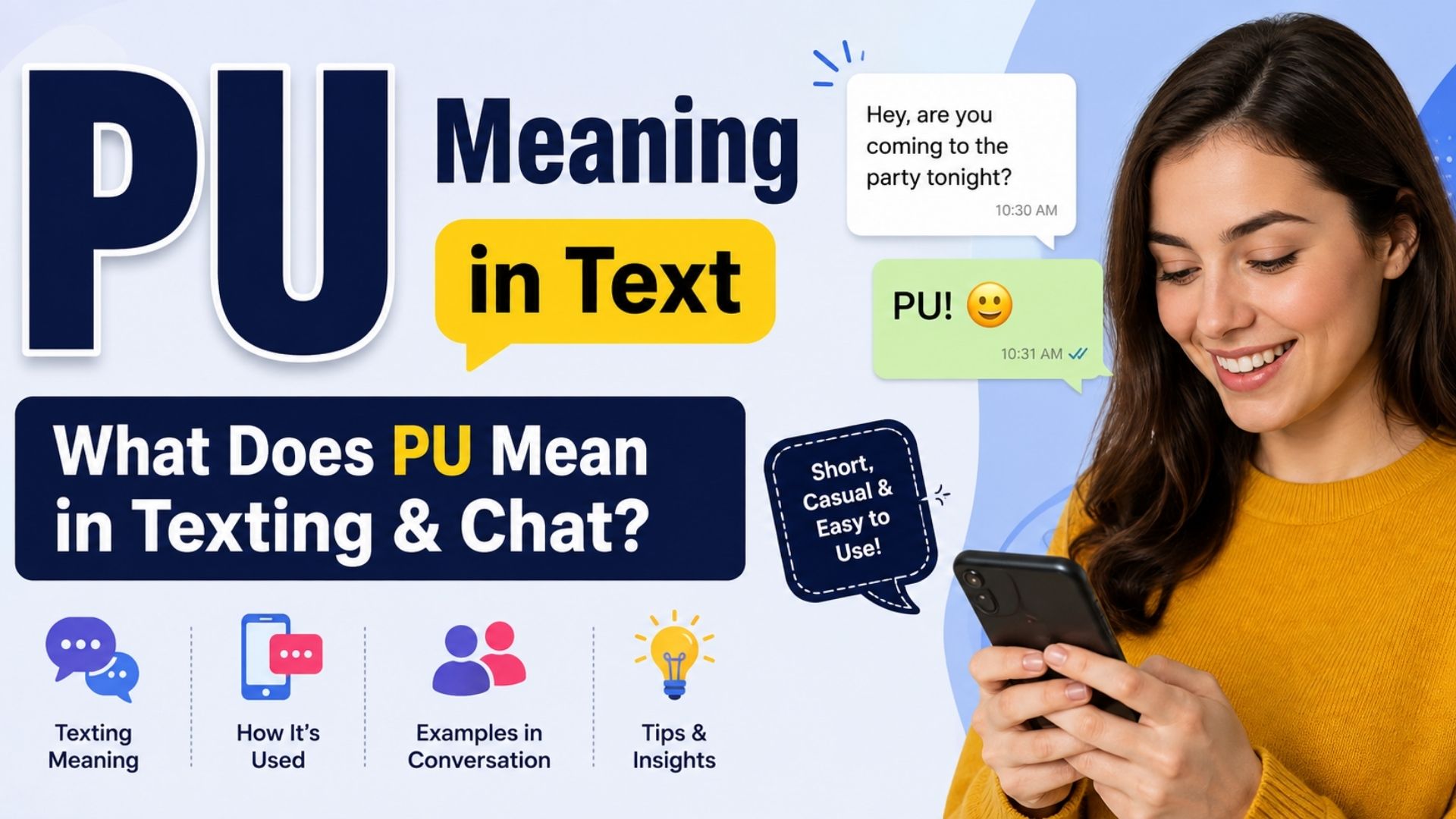
Have you ever received a text like “PU when you’re free” and wondered what the person meant? In texting and casual online conversations, PU meaning in text can be confusing because the abbreviation may have different meanings depending on the context.
In casual chats, PU commonly means “Pop Up.” When someone says “PU later” or “PU when you get home,” they’re usually asking you to message them, contact them, or reach out when you’re available. It’s a quick way to invite someone to start or continue a conversation.
However, PU isn’t universal. In another conversation, it could mean “pick up,” “pull up,” or even “pee-yew,” depending on how it’s written and what the conversation is about. That’s why context matters. Let’s break down the PU meaning in text, how people use it, and how to tell which meaning someone intends.
What Does PU Mean in Text?
In texting, PU usually means “Pop Up.” It’s an informal way of telling someone to message, contact, or reach out to you.
Think of “pop up” as casually appearing in someone’s messages. For example, if a friend says, “PU when you’re free,” they’re essentially saying, “Message me when you’re free.”
The expression is short, casual, and especially useful in quick conversations. It can also appear without much explanation because both people may already understand what they’re talking about.
Simple Examples:
- “PU when you’re home.” → Message me when you get home.
- “PU later.” → Message me later.
- “PU if you need help.” → Reach out if you need help.
- “PU when you’re free.” → Contact me when you have time.
- “PU tonight.” → Message me tonight.
- “Just PU whenever.” → Just reach out whenever you want.
The exact interpretation can change with the conversation. If someone is talking about meeting somewhere, PU might instead mean “pick up” or “pull up.” That’s why you shouldn’t interpret an abbreviation in isolation.
Origin and Background of the Term
“Pop up” is a normal English expression that describes something appearing or happening unexpectedly or suddenly. Over time, casual internet communication shortened many common phrases into abbreviations.
Texting encourages people to communicate quickly. Instead of writing “message me when you’re available,” someone may use a shorter expression such as “PU when free.” The abbreviation saves time while keeping the message casual.
There isn’t one universally established rule saying that PU always means “Pop Up.” Text slang develops naturally through online communities, social media, gaming, messaging apps, and personal conversations. As a result, the same two letters can mean different things in different situations.
This is similar to abbreviations such as “HMU,” “DM,” or “LMK.” Their meanings become clear because people recognize them from the surrounding conversation.
How PU Is Used in Daily Life
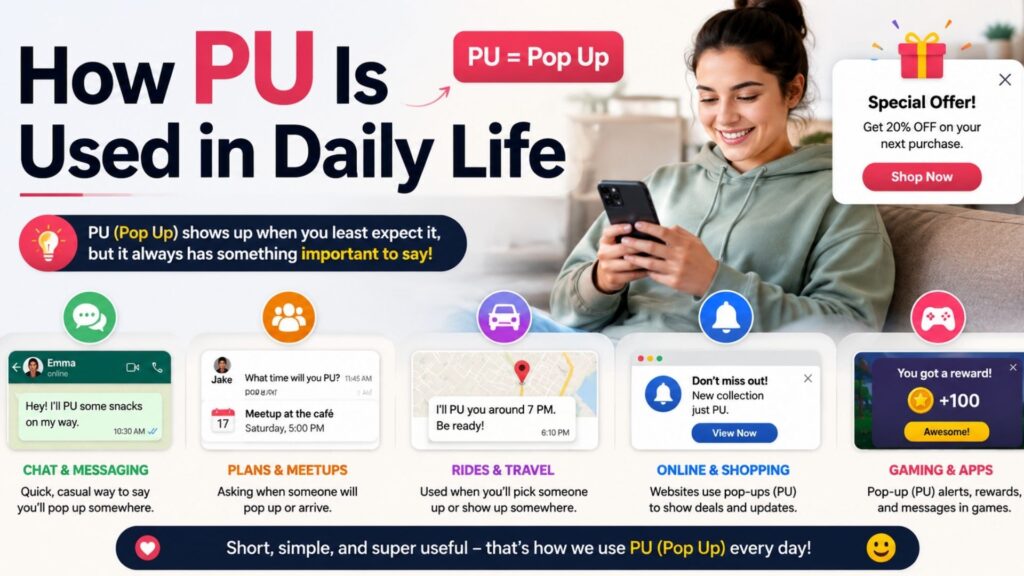
The most important thing to remember about PU meaning in text is that it usually depends on what the sender wants you to do.
1. Asking Someone to Message You
One of the most common casual uses is asking someone to send a message.
For example:
“PU when you get home.”
Here, the sender probably isn’t asking you to physically appear somewhere. They’re asking you to message them once you arrive home.
You might see this between friends, siblings, classmates, or people who already communicate regularly.
2. Requesting Private Conversation
PU can also be used when someone wants to continue a conversation privately.
For example:
“PU later, I need to tell you something.”
The person may be asking you to contact them later because they want to discuss something that doesn’t belong in a public group chat.
In this situation, the meaning is close to “message me privately” or “reach out to me later.”
3. Business Inquiries (Informal)
You may occasionally see PU in informal business or creator conversations, particularly when someone wants another person to contact them directly.
For example:
“PU if you’re interested in the offer.”
Here, the sender is essentially saying, “Contact me if you’re interested.”
However, PU isn’t ideal for formal business communication. In an email to a client, for example, “Please contact me” or “Feel free to reach out” sounds clearer and more professional.
Read More: HMB Meaning in Text: What Does HMB Mean in Chat?
4. Social Media Engagement
Social media users often shorten messages because conversations move quickly. PU can appear in comments, direct messages, stories, or casual posts.
For example:
“PU if you want the details.”
That could mean:
“Message me if you want the details.”
Creators, friends, and online communities may use this kind of shorthand when they already understand the context.
5. Checking Availability
Sometimes PU is connected with someone’s availability.
For example:
“PU when you’re free.”
This tells the other person that they don’t need to respond immediately. Instead, they can message when they have time.
That makes the phrase fairly flexible. It can sound casual and low-pressure, especially between people who already know each other.
6. Following Up
PU may also be used as a quick follow-up after an earlier conversation.
Imagine you told a friend you’d discuss weekend plans later. They might text:
“PU tonight so we can figure it out.”
In that context, PU means something like “message me” or “get in touch with me.”
The surrounding conversation gives you the clue.
Emotional or Practical Meaning of PU
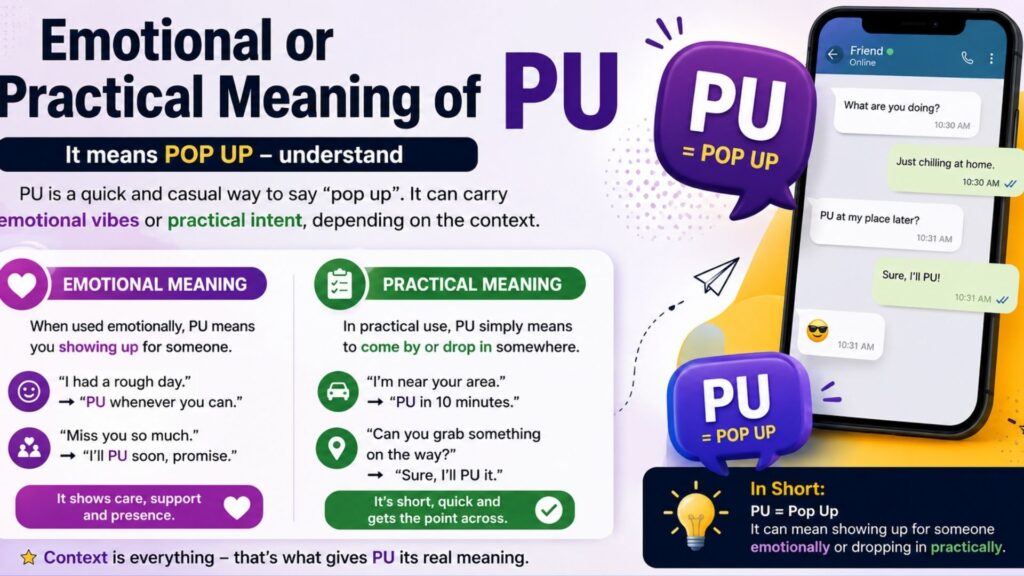
The practical meaning of PU is usually simple: contact me, message me, or reach out to me.
However, the emotional tone can vary.
A friendly “PU when you’re free 😊” sounds relaxed and welcoming. A short “PU later” may sound neutral. Meanwhile, “PU ASAP” suggests urgency.
The abbreviation itself doesn’t automatically tell you whether someone is being friendly, annoyed, romantic, or serious. You need to consider the person’s usual texting style, the conversation, punctuation, and other words around it.
For example:
| Text | Likely meaning | Tone |
|---|---|---|
| “PU when you’re free” | Message me when available | Casual |
| “PU later” | Contact me later | Neutral |
| “PU if you need anything” | Reach out if needed | Helpful |
| “PU ASAP” | Contact me as soon as possible | Urgent |
| “PU tonight 😉” | Message me tonight | Potentially playful |
So, if you’re trying to understand PU meaning in text, don’t focus only on the two letters. Look at the entire message.
Read More: IGL Meaning in Text: What Does IGL Mean in Chat and Social Media?
Similar or Related Terms
Several texting expressions can communicate a similar idea to PU.
HMU means “Hit Me Up.” It commonly means “contact me” or “message me.”
DM me means “Direct Message me.” It’s especially common on social media platforms.
LMK means “Let Me Know.” It asks someone to provide information or respond about something.
Reach out means to contact someone. It’s more standard English and works in both casual and professional situations.
Message me is probably the clearest option because there’s very little room for misunderstanding.
Key Differences:
| Term | Meaning | Typical use |
| PU | Pop Up / message me | Very casual texting |
| HMU | Hit Me Up | Casual conversations |
| DM me | Direct Message me | Social media |
| LMK | Let Me Know | Asking for information |
| Reach out | Contact me | Casual or professional |
| Text me | Send me a text | General messaging |
These expressions overlap, but they aren’t interchangeable in every situation. For example, “LMK” asks someone to give you information, while “PU” generally invites them to contact you.
Common Misunderstandings About PU
Because PU has multiple possible meanings, people sometimes interpret it incorrectly.
1. It Always Means Something Smells
Not necessarily.
You may have seen “P.U.” used as an expression reacting to a bad smell. Someone might write “P.U., that stinks!” In that context, it has nothing to do with texting someone.
However, lowercase “pu” in a message such as “PU later” is more likely to be an abbreviation.
Context is the key.
2. It’s a Typo
PU isn’t automatically a typo.
If someone writes:
“PU when you’re free”
they may intentionally be using an abbreviation for “Pop Up.”
That said, texting contains plenty of typos, so you should consider the surrounding message before deciding what the sender intended.
3. It’s Professional
PU is generally informal texting shorthand.
You might see it between friends, classmates, online acquaintances, or people who already have a casual relationship. It isn’t the best choice for a formal email, job application, official notice, or professional client communication.
Instead of:
“PU when you have time.”
a professional message would be clearer as:
“Please contact me when you have time.”
4. It Has a Romantic Meaning
PU doesn’t automatically mean anything romantic.
A person might use it while talking to a friend, family member, coworker, or romantic interest. The abbreviation itself doesn’t establish attraction.
For example, “PU when you’re home” could be completely ordinary between friends.
If the message contains flirting, emojis, compliments, or other romantic language, the overall context may give it a different tone.
5. It’s Universal
This is one of the biggest misunderstandings.
Not everyone uses PU to mean “Pop Up.” Different people and online communities can use the same abbreviation differently.
Depending on context, PU may refer to:
- Pop up
- Pick up
- Pull up
- An expression about a bad smell
- Another personal or community-specific abbreviation
That’s why context should always come first.
6. It Means “Pick Up”
Sometimes it can.
For example:
“Can you PU the package?”
In that sentence, the writer may mean “pick up.”
Compare that with:
“PU when you get home.”
That sentence is more naturally understood as an invitation to message or contact the person.
When two meanings are possible, look at the words around PU and the topic of the conversation.
Examples of PU in Sentences
Here are some natural examples showing how the abbreviation can work in different situations:
- “PU when you’re free.”
- “Just PU later.”
- “PU when you get home.”
- “PU if you need anything.”
- “You can PU tonight.”
- “PU after work.”
- “PU when you have a minute.”
- “Don’t forget to PU later.”
- “PU whenever you’re ready.”
- “Just PU and we’ll talk.”
- “PU if you want to discuss it.”
- “Can you PU later?”
- “PU when you’re done studying.”
- “PU after dinner.”
- “You can PU tomorrow.”
Now compare those with a different context:
- “Can you PU my order?” → likely “pick up.”
- “PU, that smells terrible!” → likely “pee-yew.”
- “PU to the party!” → could mean “pull up” depending on the community and context.
This shows why there isn’t one meaning that works for every message.
Why Understanding PU Meaning in Text Matters Today
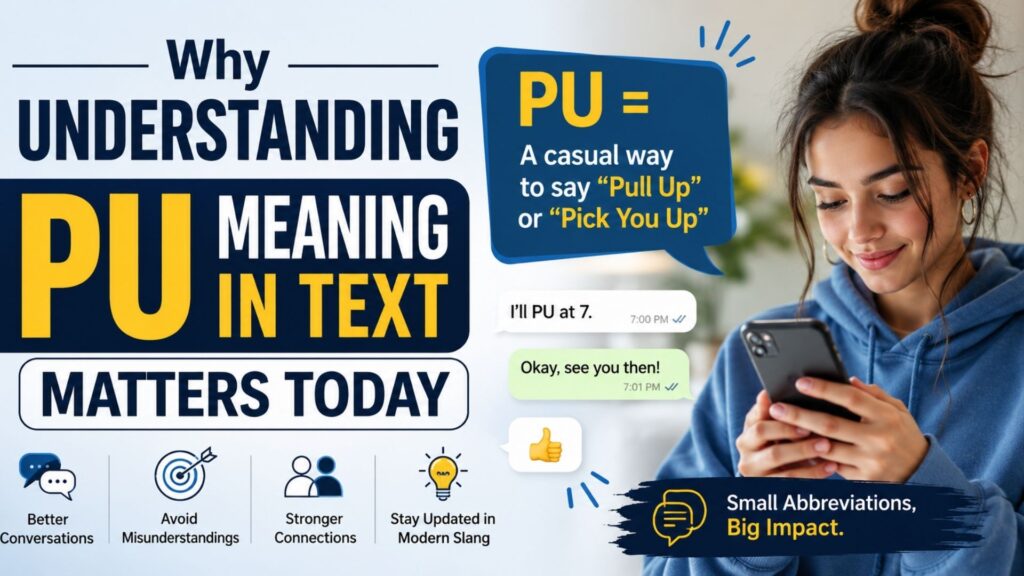
Texting has created a language of its own. People regularly shorten phrases to make conversations faster, more casual, and easier to type.
Understanding abbreviations helps you avoid unnecessary misunderstandings. A two-letter expression can seem confusing when you don’t recognize the slang behind it, but the surrounding words often reveal the intended meaning.
For example, if someone texts “PU when you’re free,” responding as though they asked you to physically come somewhere could create confusion. Once you understand the casual “Pop Up” meaning, the message becomes much clearer.
It also helps to understand tone. Short messages can sometimes appear colder than they actually are. Someone using PU may simply be typing quickly rather than trying to sound distant.
At the same time, you shouldn’t assume every abbreviation has a fixed definition. Online language changes constantly. A phrase that is common in one friend group may be unfamiliar to another.
The safest approach is simple: read PU in context.
If the meaning still isn’t clear, asking “What do you mean by PU?” is perfectly reasonable.
FAQs:
What does pu meaning in text in simple words?
In casual texting, PU commonly means “Pop Up.” It can mean “message me,” “contact me,” or “reach out to me,” especially in phrases such as “PU when you’re free.”
Is PU positive or negative?
PU is usually neutral. Its tone depends on the conversation. It can sound friendly, casual, urgent, or playful depending on the words around it.
Where is PU commonly used?
You may see PU in casual text messages, direct messages, social media conversations, group chats, and other informal online communication.
Is PU formal or informal?
PU is generally informal texting slang. It’s better to write “contact me,” “message me,” or “reach out to me” in formal or professional communication.
Why do people search for PU meaning in text?
People search for it because PU can have several meanings. In one message it may mean “Pop Up,” while in another context it could mean “pick up,” “pull up,” or something else.
Conclusion:
So, what does PU mean in text? In casual messaging, it commonly means “Pop Up,” usually with the sense of “message me,” “contact me,” or “reach out to me.”
For example, “PU when you’re free” generally means “Message me when you’re free.”
However, PU isn’t a universal abbreviation. Depending on the conversation, it can also mean “pick up,” “pull up,” or even “pee-yew” when written as an expression about a bad smell. The surrounding words are what tell you which meaning makes sense.
If you’re unsure, don’t guess based on the abbreviation alone. Look at the context, the topic, and the sender’s usual texting style. That simple approach will help you understand most slang abbreviations without overthinking them.
