
Have you ever received a text that simply says “STSU” and had no idea what the person was trying to say? Internet slang can be confusing, especially when an abbreviation isn’t as common as “LOL,” “BRB,” or “IDK.” One small group of letters can completely change the tone of a conversation.
So, what is the STSU meaning? In texting and online conversations, STSU is commonly used as an abbreviation for “Shut the [expletive] Up.” It is generally a blunt way to tell someone to stop talking, although the tone can range from playful teasing between friends to genuine irritation or anger. Because the phrase can contain profanity, it’s usually considered informal and potentially offensive depending on the situation.
In this guide, we’ll explore the STSU meaning in text, explain how people use it in different situations, and look at real examples so you can understand the tone behind the abbreviation. We’ll also cover common misunderstandings and explain when it’s better to avoid using STSU altogether.
What Does STSU Meaning in Text?
The most common STSU meaning in text is “Shut the [expletive] Up.” It’s essentially a stronger, more abbreviated version of “shut up.”
However, the meaning isn’t always as serious as it sounds.
For example, a close friend might tell you:
“I just won the lottery!”
You might jokingly respond:
“STSU 😂 No way!”
In this case, you’re not actually telling your friend to be quiet. You’re expressing shock and disbelief in a playful way, similar to saying, “No way! Are you serious?”
On the other hand, if someone sends:
“STSU. I’m trying to work.”
The meaning is much more direct. They’re telling the other person to stop talking because they’re annoyed or distracted.
So, when you’re trying to understand the STSU meaning, always look at the context. The relationship between the people, the conversation before the abbreviation, punctuation, and emojis can completely change the tone.
Real-Life Examples:
Example 1: Shock
Friend: “I met your favorite celebrity yesterday.”
You: “STSU 😭 No way!”
Here, STSU expresses surprise rather than genuine anger.
Example 2: Playful teasing
Friend: “I’m definitely the smartest person in this group.”
You: “STSU 😂”
The response is playful and sarcastic.
Example 3: Genuine annoyance
“STSU. I’ve already told you three times.”
This version sounds serious and irritated.
Example 4: Disbelief
“STSU, you’re telling me you actually did that?”
The sender is expressing disbelief and surprise.
These examples show why you shouldn’t interpret STSU as automatically rude or angry. The surrounding conversation provides the real meaning.
Read more: What Does WYGG Mean in Text? Meaning, Uses & Examples
Origin and Background of the Term

The STSU meaning comes from the longer phrase “shut the [expletive] up,” which is itself an intensified version of the familiar phrase “shut up.”
As online communication became faster and more informal, users began shortening longer expressions into abbreviations. This style is common across text messages, social media, gaming chats, and online communities.
STSU isn’t as universally recognized as abbreviations like LOL or OMG, which means its meaning can sometimes vary depending on the group using it. Some people may use it as a direct command, while others use it as a humorous reaction to something surprising or unbelievable.
The abbreviation also reflects a broader trend in digital communication: people often use strong language in a shortened form to express emotion quickly. Instead of writing a full sentence like:
“I can’t believe you just said that!”
Someone might simply respond with:
“STSU 😭”
The intended message becomes clear through context.
How STSU Is Used in Daily Life
People may use STSU in several different ways. Sometimes it’s serious. Other times, it’s basically an exaggerated reaction that means “No way!” or “You have to be kidding!”
Let’s break down some common situations.
1. Expressing Shock
One of the more playful uses of STSU is to express surprise.
For example:
“I got tickets to the concert!”
“STSU 😭 That’s amazing!”
Here, the sender isn’t genuinely asking the other person to stop talking. They’re reacting to surprising news.
In this context, STSU works almost like an emotional exclamation. The emoji often makes the playful intention clearer.
2. Playful Teasing
Friends sometimes use STSU to tease each other.
“I’m the best-looking person here.”
“STSU 😂”
The response is essentially saying, “Oh, please!” or “You can’t seriously believe that.”
This type of use usually depends on the relationship. Close friends may understand that the phrase isn’t meant literally, while strangers could easily interpret it as rude.
3. Friendly Banter
STSU can also appear during friendly banter, especially when two people regularly joke around.
For example:
“You couldn’t beat me in a race.”
“STSU. You literally came last yesterday.”
Here, the abbreviation adds a dramatic, joking tone to the conversation.
Still, it’s worth remembering that what feels funny between close friends may sound offensive to someone who doesn’t know you well.
4. Reacting to Gossip
When someone shares surprising gossip, STSU can be used as a dramatic reaction.
“Guess who just started dating?”
“STSU 😭 Who?”
In this situation, the abbreviation communicates excitement and disbelief. It’s similar to saying:
“No way! Tell me everything!”
This is especially common in casual conversations where people use exaggerated language for humor.
5. Disbelief
STSU can also show that you don’t believe what someone has said.
For example:
“I finished the entire assignment in ten minutes.”
“STSU. There’s no way.”
Here, the abbreviation expresses skepticism. The sender thinks the claim sounds unbelievable.
The tone could be playful or serious depending on the relationship.
6. Light Annoyance
Sometimes STSU is used when someone is mildly irritated.
“STSU, I’m trying to concentrate.”
This is more direct than the playful examples above. The sender genuinely wants the other person to stop talking.
However, the severity still depends on the situation. Between close friends, it might be harmless. In a tense conversation, it can sound disrespectful.
Emotional or Practical Meaning of STSU
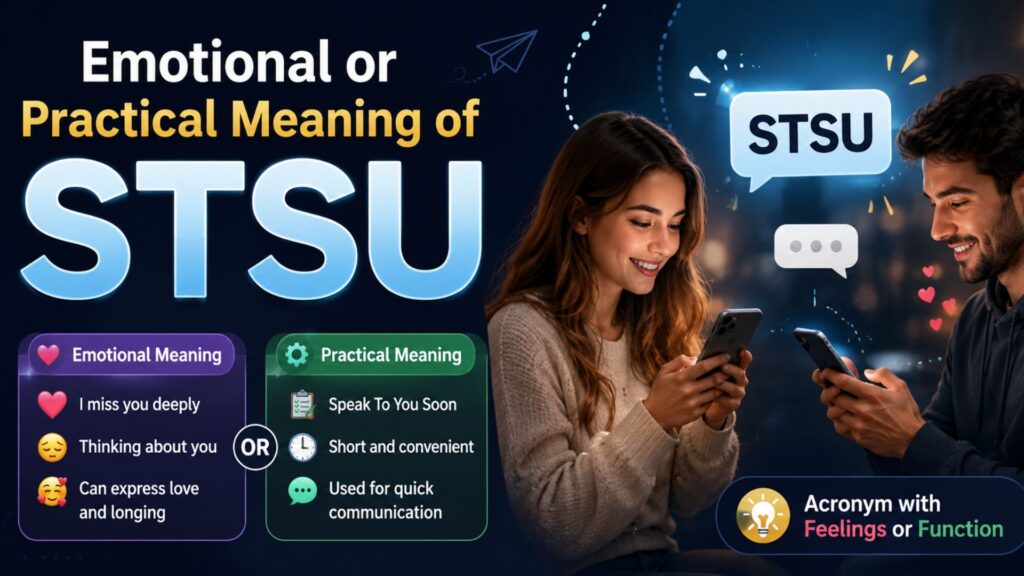
The emotional meaning of STSU can vary significantly.
| Context | Possible Meaning | Tone |
|---|---|---|
| Close friends | “No way!” | Playful |
| Funny story | “You’re kidding!” | Humorous |
| Gossip | “Seriously? Tell me more!” | Excited |
| Disagreement | “Stop talking.” | Harsh |
| Annoyance | “Please be quiet.” | Irritated |
| Argument | “I don’t want to hear this.” | Aggressive |
This is why understanding slang requires more than memorizing definitions.
Imagine two people receiving the exact same message:
“STSU 😂”
One person might laugh because their friend is joking. Another might feel offended because they don’t have that kind of relationship with the sender.
The STSU meaning is therefore strongly influenced by tone and context. Emojis, punctuation, capitalization, and the conversation itself all provide clues.
Similar or Related Terms
Several abbreviations and expressions can have a similar meaning to STSU, but they aren’t always interchangeable.
| Term | Meaning | Typical Tone |
|---|---|---|
| STFU | Shut the [expletive] up | Strong and often aggressive |
| STSU | Shut the [expletive] up | Blunt; may be playful or serious |
| Shut up | Stop talking | Direct |
| Be quiet | Stop making noise or talking | More neutral |
| ZIP IT | Stop talking | Playful or commanding |
| OMG | Oh my God | Shock or surprise |
| No way | I don’t believe you | Surprise or disbelief |
| FR? | For real? | Questioning or surprised |
One important point is that STSU and STFU can be confused because they communicate a similar basic idea. However, STFU is generally more widely recognized and often sounds harsher.
If someone sends STSU in a playful conversation, it might simply mean “No way!” But if someone uses it during an argument, it’s more likely to be interpreted literally.
Common Misunderstandings About STSU
The abbreviation STSU can cause confusion because its tone isn’t always obvious.
1. It Always Means Anger
That’s not necessarily true.
STSU can be used jokingly between friends to express surprise, disbelief, or excitement.
For example:
“STSU 😂 You actually got the job?”
The sender is probably celebrating the news, not expressing anger.
2. It’s Always Offensive
STSU can definitely be offensive in certain situations, especially when directed at someone seriously. However, context matters.
Close friends may use the abbreviation casually without intending harm. Still, if you don’t know the person well, it’s safer to avoid assuming that they’ll find it funny.
3. It’s Formal Slang
STSU is informal internet slang. It’s not suitable for formal writing, professional documents, or most workplace communication.
If you need to ask someone to stop talking in a professional setting, use clearer and more respectful language.
For example, instead of:
“STSU.”
You might say:
“Could we pause the discussion for a moment?”
The second option is much more appropriate at work.
4. It’s Only Used by Teenagers
Not necessarily.
People of different ages use internet slang, especially when communicating through social media and messaging apps. However, the popularity of specific abbreviations can vary between age groups and online communities.
5. It Should Be Used in Professional Chats
Generally, no.
Even if your colleagues understand STSU, the abbreviation can come across as disrespectful or unprofessional. Workplace communication usually requires more care because you can’t always rely on shared humor or personal relationships.
6. It Means Something Positive
Not always.
STSU can express excitement or surprise in a playful way, but the phrase itself is based on telling someone to stop talking. As a result, it can also carry a negative or confrontational tone.
The safest approach is to look at the entire message rather than assuming STSU is positive or negative by itself.
Examples of STSU in Sentences
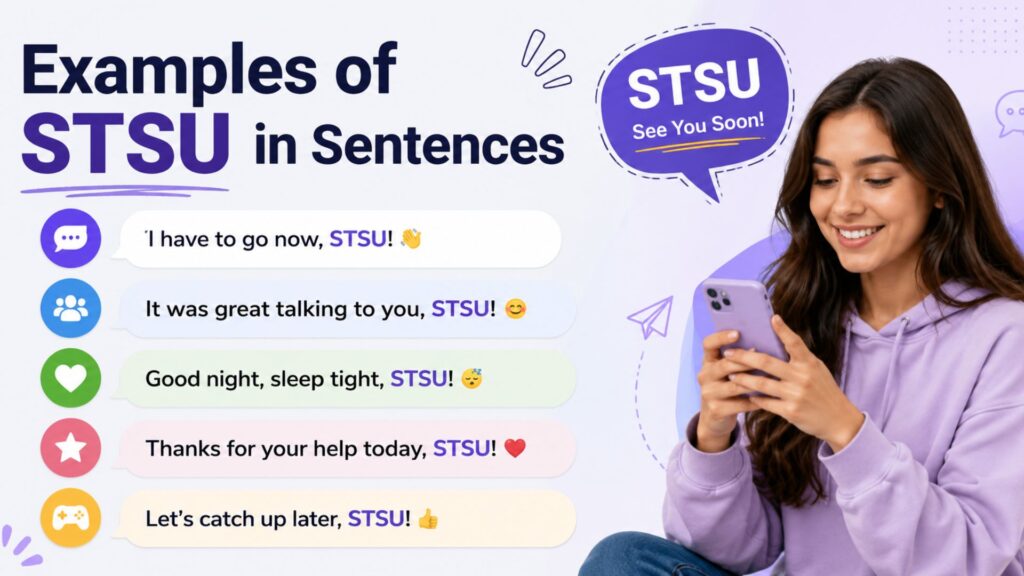
Here are some examples that show how the abbreviation may appear in real conversations:
Expressing surprise:
“STSU 😭 You actually met them?”
Reacting to unexpected news:
“STSU! That’s incredible!”
Playful disbelief:
“You think you’re going to win? STSU 😂”
Reacting to gossip:
“STSU, you’re joking. Tell me everything!”
Calling out an unbelievable claim:
“I finished the whole project in an hour.”
“STSU. Seriously?”
Showing annoyance:
“STSU, I’m trying to focus.”
During friendly banter:
“I’m obviously the best player here.”
“STSU 💀 You lost the last three games.”
Notice how the tone changes in every example. That’s why context is essential when interpreting STSU.
Why Understanding STSU Meaning in Text Matters Today
Digital communication moves quickly. People often rely on abbreviations to express emotions that would otherwise require several sentences.
Understanding the STSU meaning can help you avoid misreading someone’s intention.
For example, if a friend texts:
“STSU 😂”
you might recognize that they’re joking.
But if a coworker sends:
“STSU.”
you may interpret it very differently. The relationship, punctuation, and situation all affect how the message feels.
This is particularly important because text messages don’t include the same nonverbal clues as face-to-face conversations. You can’t hear someone’s voice or see their facial expression. As a result, slang that sounds playful to one person can sound hostile to another.
If you’re unsure about the meaning, consider the context before reacting. Look at what was said immediately before, check for emojis, and think about how the sender normally communicates.
When the meaning is still unclear, simply asking for clarification is often the best option.
FAQs:
What does STSU mean in simple words?
STSU commonly stands for “Shut the [expletive] up.” Depending on the context, it can be a serious command to stop talking or a playful way of expressing shock, disbelief, or surprise.
Is STSU positive or negative?
It can be either. Among friends, STSU may be playful or humorous. In an argument or serious conversation, it can sound rude, aggressive, or disrespectful.
Where is STSU commonly used?
STSU is mainly found in informal digital communication, including text messages, group chats, social media comments, gaming conversations, and online communities.
Is STSU formal or informal?
STSU is informal slang. It’s generally not appropriate for professional emails, formal writing, or workplace conversations where respectful communication is important.
Why do people search for STSU meaning in text?
People often search for the STSU meaning in text because they have seen the abbreviation in a message, comment, or social media post and aren’t sure whether the sender is joking or genuinely angry. Understanding the context helps determine the intended tone.
Conclusion:
The STSU meaning generally refers to “Shut the [expletive] up,” but the way people use it can vary dramatically. Sometimes, it’s a blunt command. In other situations, especially between close friends, it can be a playful reaction meaning “No way!”, “You’re kidding!”, or “Are you serious?”
The biggest lesson is to pay attention to context. An emoji, a joke, or a close friendship can make STSU feel harmless and funny. During an argument, however, the same abbreviation may sound genuinely rude or aggressive.
If you’re ever unsure about what someone means by STSU, don’t immediately assume they’re angry. Look at the conversation around it and consider your relationship with the sender. That’s usually the best way to understand the real meaning behind the slang.
